
SLIDE 1
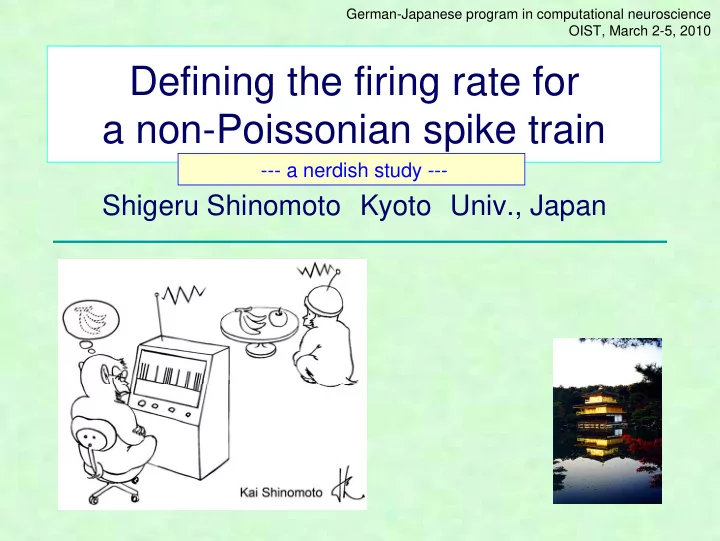
Defining the firing rate for a non-Poissonian spike train
Shigeru Shinomoto Kyoto Univ., Japan
- -- a nerdish study ---
German-Japanese program in computational neuroscience OIST, March 2-5, 2010
Defining the firing rate for a non-Poissonian spike train --- a - - PowerPoint PPT Presentation
German-Japanese program in computational neuroscience OIST, March 2-5, 2010 Defining the firing rate for a non-Poissonian spike train --- a nerdish study --- Shigeru Shinomoto Kyoto Univ., Japan A message from a neuron We have established
German-Japanese program in computational neuroscience OIST, March 2-5, 2010
2
We have established several methods for optimizing rate estimators: 1.PSTH --- 2007 2.Kernel smoother --- 2010 3.Bayesian inference --- 2005, 2009
3
Spike Sequences PSTH Peri-Stimulus Time Histogram
3
number of spikes / binsize
4
T t t 2
Shimazaki and Shinomoto, Neural Comput. (2007) 19: 1503-1527.
Hideaki Shimazaki
5
Shimazaki and Shinomoto, Neural Comput. (2007) 19: 1503-1527.
6
Hideaki Shimazaki
Shimazaki and Shinomoto, J. Comput Neurosci (2010) 29:171-182.
better
7
Shimazaki and Shinomoto, J. Comput Neurosci (2010) 29:171-182.
Most downloaded articles in 90 days (Mar. 3, 2011)
8
Inverse probability = Bayes
Shimokawa & Shinomoto, Neural Computation (2009) 21:1931-1951.
Takeaki Shimokawa
9
poisson
10
Bermann (1982) Ogata (1988) ~ seismology Reich, Victor & Knight (1998) Oram, Wiener, Lestienne & Richmond (1999) Barbieri, Quirk, Frank, Wilson & Brown (2001) Smith & Brown (2003) Koyama & Shinomoto (2005) Shimokawa & Shinomoto (2009) Shimokawa, Koyama & Shinomoto (2010)
How to
11
Non
12
Koyama & Shinomoto, J. Phys. A (2005) 38: L531-L537.
Shinsuke Koyama
~ regularly derived from a fluctuating rate ~ irregularly derived from a constant rate Irregular intervals Regular intervals
13
Shimokawa & Shinomoto, Neural Computation (2009) 21:1931-1951.
Takeaki Shimokawa
rate regularity estimated rate estimated regularity spike train
14
15
16
Shinomoto, Shima & Tanji, Neural Computation (2003) 15: 2823-2842.
unimodal bimodal
preSMA SMA PF CMAr
17
Kim, Shimokawa, Matsuno, Toyama
non-Poissonian characteristics
Shinomoto, Kim, Shimokawa, Matsuno, Funahashi, Shima, Fujita, Tamura, Doi, Kawano, Inaba, Fukushima, Kurkin, Kurata, Taira, Tsutsui, Komatsu, Ogawa, Koida, Tanji, & Toyama, PLoS Comput Biol (2009) 5:e1000433.
regular random bursty
This is in essence due to the time rescaling operation in Lv, or LvR.
18
Korbinian Brodmann (1868 - 1918) Monkey cortex
1909 vintage ! Shinomoto, Kim, Shimokawa,et al., PLoS Comput Biol (2009) 5:e1000433.
I am a German neurologist. I was born in Liggersdorf, and studied medicine in Munich, Würzburg, Berlin and Freiburg.
19
20
Zhao, Omi, Matsuno, and Shinomoto, New J Phys 12 (2010) 063010.
Zhao, Omi, Matsuno
Again, this is in essence due to the time rescaling operation in Lv.
21
22
Shimokawa, Koyama & Shinomoto, J. Comput Neurosci (2010) 29:183-191.
Shimokawa, Koyama