SLIDE 1
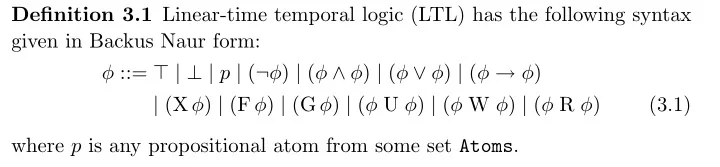
Definition 3.1 Linear-time temporal logic (LTL) has the following syntax given in Backus Naur form: φ ::= ⊤ | ⊥ | p | (¬φ) | (φ ∧ φ) | (φ ∨ φ) | (φ → φ) | (X φ) | (F φ) | (G φ) | (φ U φ) | (φ W φ) | (φ R φ) (3.1) where p is any propositional atom from some set Atoms.
SLIDE 2
→ r ∨ F p G q ¬ U p
Figure 3.1. The parse tree of (F (p → G r) ∨ ((¬q) U p)).
SLIDE 3
3.2.2 Semantics of LTL The kinds of systems we are interested in verifying using LTL may be modelled as transition systems. A transition system models a system by means of states (static structure) and transitions (dynamic structure). More formally: Definition 3.4 A transition system M = (S, →, L) is a set of states S endowed with a transition relation → (a binary relation on S), such that every s ∈ S has some s′ ∈ S with s → s′, and a labelling function L: S → P(Atoms).
SLIDE 4
s0 p, q s1 q, r s2 r
Figure 3.3. A concise representation of a transition system M = (S, → ,L) as a directed graph. We label state s with l iff l ∈ L(s).
SLIDE 5 s1 s3 s0 s2 s4 s1 s3 s0 s2 s4 sd
Figure 3.4. On the left, we have a system with a state s4 that does not have any further transitions. On the right, we expand that system with a ‘deadlock’ state sd such that no state can deadlock; of course, it is then
- ur understanding that reaching the ‘deadlock’ state sd corresponds to
deadlock in the original system.
SLIDE 6
p, q r r r q, r p, q q, r s0 s2 s2 s2 s0 s1 s1 r s2 r s2
Figure 3.5. Unwinding the system of Figure 3.3 as an infinite tree of all computation paths beginning in a particular state.
SLIDE 7
Definition 3.6 Let M = (S, →, L) be a model and π = s1 → . . . be a path in M. Whether π satisfies an LTL formula is defined by the satisfaction relation as follows:
1. π ⊤ 2. π ⊥ 3. π p iff p ∈ L(s1) 4. π ¬φ iff π φ 5. π φ1 ∧ φ2 iff π φ1 and π φ2 6. π φ1 ∨ φ2 iff π φ1 or π φ2 7. π φ1 → φ2 iff π φ2 whenever π φ1 8. π X φ iff π2 φ 9. π G φ iff, for all i ≥ 1, πi φ
SLIDE 8
10. π F φ iff there is some i ≥ 1 such that πi φ 11. π φ U ψ iff there is some i ≥ 1 such that πi ψ and for all j = 1, . . . , i − 1 we have πj φ 12. π φ W ψ iff either there is some i ≥ 1 such that πi ψ and for all j = 1, . . . , i − 1 we have πj φ; or for all k ≥ 1 we have πk φ 13. π φ R ψ iff either there is some i ≥ 1 such that πi φ and for all j = 1, . . . , i we have πj ψ, or for all k ≥ 1 we have πk ψ.