Definition: matrix multiplication For A = M n,k ( R ), B = a i j - - PDF document

definition matrix multiplication for a m n k r b
SMART_READER_LITE
LIVE PREVIEW

Definition: matrix multiplication For A = M n,k ( R ), B = a i j - - PDF document

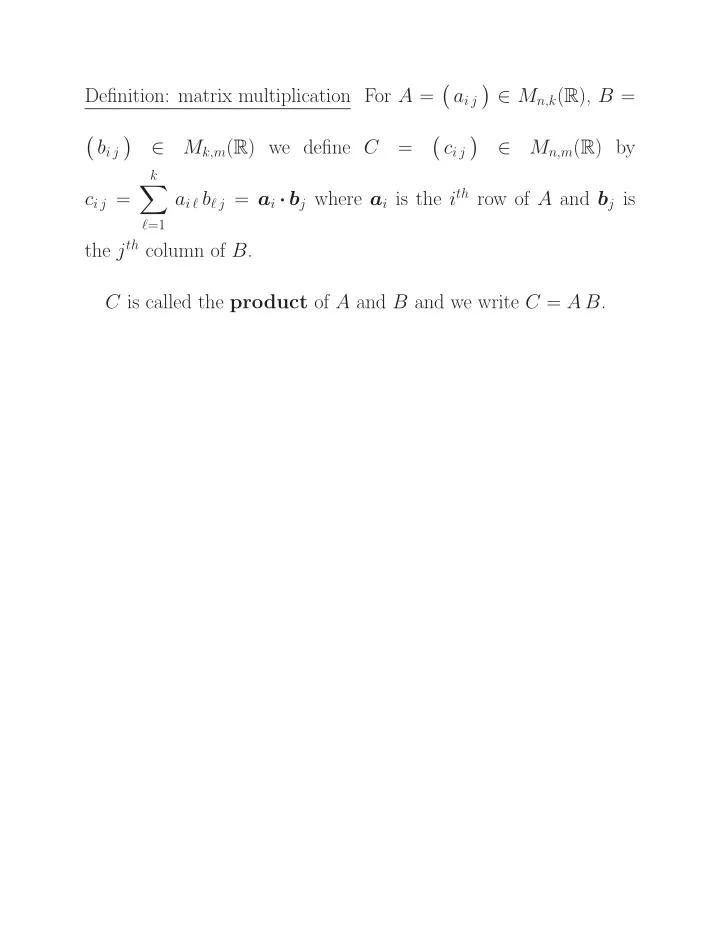
Definition: matrix multiplication For A = M n,k ( R ), B = a i j M k,m ( R ) we define C = M n,m ( R ) by b i j c i j k a i b j = a i b j where a i is the i th row of A and b j is c i j =


slide-1
SLIDE 1

Definition: matrix multiplication For A =

  • ai j
  • ∈ Mn,k(R), B =
  • bi j

Mk,m(R) we define C =

  • ci j

Mn,m(R) by ci j =

k

  • ℓ=1

ai ℓ bℓ j = ai · bj where ai is the ith row of A and bj is the jth column of B. C is called the product of A and B and we write C = A B.

slide-2
SLIDE 2

Definition: determinant (i) The determinant of a 1 by 1 matrix

  • a
  • is a.

(ii) Suppose a definition is provided for a n−1 by n−1 determinant. Define det               a11 a12 · · · a1n a21 a22 · · · a2n · · · an1 an2 · · · ann               =

n

  • j=1

(−1)1+ja1j det ˜ A1j where ˜ Aij is the matrix obtained from A by deleting the ith row and jth column. notes: The matrix ˜ Aij is sometimes called the ijth minor matrix of A. Think of this approach as the definition by expansion along the first row or expansion by minors along the first row.

slide-3
SLIDE 3

Properties of determinants Let A =              v1 v2 . . . vn              ∈ Mn

  • R
  • .
  • 1. det A = det A t
  • 2. Interchanging two rows (or columns) multiplies the determinant

by

  • − 1
  • For the rest of these properties, we will only mention rows — columns

will follow because of property 1.

slide-4
SLIDE 4
  • 3. The determinant is linear in each row

(a) Multipying a row by k multiplies the determinant by k. Note that det

  • k A
  • = kn det A

(b) det                  v1 . . . vi + vi ′ . . . vn                  = det                  v1 . . . vi . . . vn                  + det                  v1 . . . vi ′ . . . vn                  Note that det

  • A + B
  • = det
  • A
  • + det
  • B
  • Note that the determinant is n–linear.
  • 4. If two rows are proportional, the determinant is 0.
  • 5. Adding a multiple of one row to another does not change the

value of the determinant.

  • 6. det
  • A B
  • =
  • det A

det B

  • .
slide-5
SLIDE 5

Let A =

  • aij
  • ∈ Mn(R). We define the cofactor of aij denoted

cij by cij = (−1)i+j det ˜ Aij . The matrix C =

  • cij
  • ∈ Mn(R) is called the cofactor matrix
  • f A.
  • Recall that ˜

Aij is the matrix obtained from A by deleting the ith row and jth column and is sometimes called the ijth minor matrix of

  • A. det ˜

Aij can be called the ijth minor of A or the minor of the element aij of A.

  • In this context, a cofactor is sometimes called a signed minor.

Note: cij is a scalar (real number) but ˜ Aij is an (n − 1) × (n − 1) matrix.

slide-6
SLIDE 6

We can now restate the definition of determinant in terms of cofac- tors. (i) The determinant of a 1 by 1 matrix

  • a
  • is a.

(ii) Suppose a definition is provided for a n−1 by n−1 determinant. Define det               a11 a12 · · · a1n a21 a22 · · · a2n · · · an1 an2 · · · ann               =

n

  • j=1

a1j c1j = a11 c11+a12 c12+· · ·+a1n c1n where cij is the cofactor of aij.

slide-7
SLIDE 7

The transpose of the cofactor matrix C of A is called the classical adjoint of A and denoted by adj A ;i.e., adj A = CT. Theorem: If A is any square matrix, then A ( adj A ) = ( det A ) I = ( adj A ) A . In particular, if det A = 0, the inverse of A is given by A−1 = 1 det A adj A where adj A = CT, C being the cofactor matrix of A.

slide-8
SLIDE 8