SLIDE 1
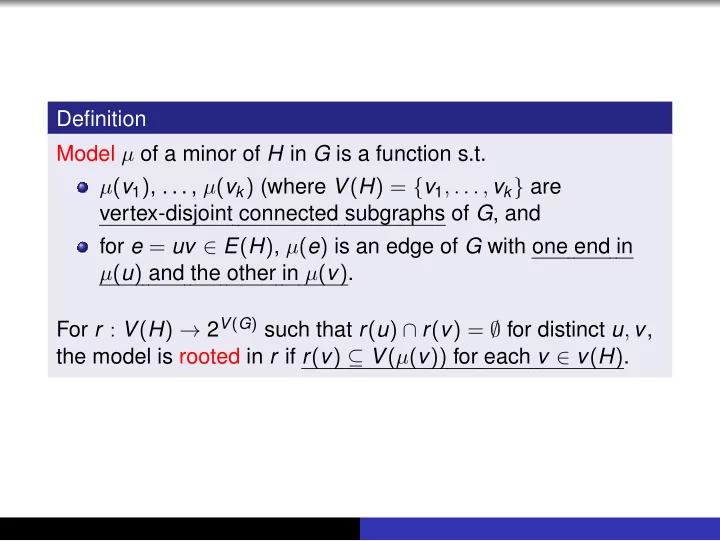
Definition Model µ of a minor of H in G is a function s.t. µ(v1), . . . , µ(vk) (where V(H) = {v1, . . . , vk} are vertex-disjoint connected subgraphs of G, and for e = uv ∈ E(H), µ(e) is an edge of G with one end in µ(u) and the other in µ(v). For r : V(H) → 2V(G) such that r(u) ∩ r(v) = ∅ for distinct u, v, the model is rooted in r if r(v) ⊆ V(µ(v)) for each v ∈ v(H).
SLIDE 2
SLIDE 3
V(H) = {s1, t1, . . . , sn, tn}, E(H) = {s1t1, . . . , sntn}, r(si) = {ui}, r(ti) = {vi}. V(H) = {p1, pn}, E(H) = ∅, r(pi) = {ui, vi}.
SLIDE 4
Goal
Theorem For every H with vertices v1, . . . , vk drawn in a surface Σ, there exists θ such that the following holds. If G is drawn in Σ has a respectful tangle T of order θ, r(vi) = {ui} for i = 1, . . . , k, and dT (ui, uj) = θ for i = j, then G has a minor of H rooted in r.
SLIDE 5 For a surface Σ with holes, the components of the boundary are cuffs. Drawing in Σ is normal if it intersects the boundary only in
- vertices. Root assignment r is normal if r(v) ⊂ boundary for
each v.
SLIDE 6
G drawn normally in the disk, v1, v2, . . . , vm vertices in the cuff. Root assignment r is topologically infeasible if for some i1 < i2 < i3 < i4 and u = v, vi1, vi3 ∈ r(u) and vi2, vi4 ∈ r(v). Topologically feasible otherwise.
SLIDE 7
A G-slice: simple G-normal curve c intersecting the cuff exactly in its ends, splits the disk into ∆1 and ∆2. r/c = {v : r(v) ∩ ∆1 = ∅ = r(v) ∩ ∆2. Connectivity-wise feasible: |G ∩ c| ≥ |r/c| for every G-slice c.
SLIDE 8
Theorem G normally drawn in a disk, r normal root function. Topologically and connectivity-wise feasible ⇒ edgeless minor rooted in r.
SLIDE 9
We can assume G ∩ cuff = roots.
SLIDE 10
G-slice disjoint from G splitting G into two parts:
SLIDE 11
Simple closed curve intersecting G in just one vertex, interior contains a part of G: We can assume: faces intersecting cuffs are bounded by paths.
SLIDE 12
G-slice intersecting G in a root, splitting G into two parts:
SLIDE 13
|r(y)| = 1:
SLIDE 14
Select y spanning minimal arc:
SLIDE 15
Contract path between consecutive vertices of r(y):
SLIDE 16
In a surface Σ, a normal drawing of G is p-generic if curves between distinct cuffs intersect G at least p times simple closed G-normal non-contractible curve c intersects G in < p points ⇒ for a cuff k homotopic to k, G ∩ k ⊆ G ∩ c.
SLIDE 17
A normal root assignment r is topologically feasible if there exists a forest with components Fv : v ∈ dom(r) drawn in Σ such that r(v) ⊆ V(Fv).
SLIDE 18
Theorem (∀Σ, k)(∃p): Let G be a graph with a normal drawing in a surface Σ with at least two holes, at most k vertices in the boundary of Σ, each cuff contains at least one vertex. Normal root assignment r is topologically feasible and the drawing of G is p-generic ⇒ edgeless minor rooted in r. g genus, h number of holes of Σ, k ≪ s ≪ p
SLIDE 19 G-net N drawn in Σ so that N ∩ G = V(N) ∩ V(G), each cuff traces a cycle in N, and N has exactly
homeomor- phic to an
SLIDE 20
N with |G ∩ N| minimum, subject to that with |V(N)| minimum. N connected, minimum degree at least two. One face ⇒ only non-contractible cycles. At least two cuffs: not a cycle.
SLIDE 21
N′: suppress vertices of degree two in N. Minimum degree at least three: |E(N′)| ≥ 3
2|V(N′)|.
One face, h holes: |E(N′)| = |V(N′)| + (h + 1) + g − 2. |V(N′)| ≤ 2(g + h − 1), |E(N′)| ≤ 3(g + h − 1). X = vertices of N of degree at least three or contained in cuffs: |X| ≤ 2(g + h) + k
SLIDE 22
S = the subgraph of N consisting of paths of length at most s starting in X, and paths of length at most 3s between the vertices of X. |V(S)| ≤ 9(g + h)s ≪ p
SLIDE 23
Drawing of G is p-generic, all cycles in N are non-contractible: No path in S internally disjoint from the cuffs has both ends in cuffs. Every cycle in S bounds a cuff. Each component of S is either a tree, or unicyclic with the cycle tracing a cuff.
SLIDE 24 For each v in a cuff, there exist p disjoint paths from v to a vertex z in another cuff. Otherwise, separated by a set Z of less than p vertices. Non-contractible curve through Z contradicting p-genericity
SLIDE 25
At least p−|V(S)|
|V(S)|
≥ s of the paths are internally disjoint from S, and leaving v through the same angle av of N.
SLIDE 26
The forest F certifying topological feasibility of r can be shifted so that F is disjoint from S except for the cuffs, F intersects N in at most γΣ,k ≪ s vertices, and for v in a cuff, all edges of F leave through the angle av.
SLIDE 27
SLIDE 28
Cut Σ along N, obtaining G′ in a disk. r ′: According to components into which F is cut. Apply the disk theorem. Topological feasibility from the choice of r ′. We need to verify connectivity-wise feasibility.
SLIDE 29
For contradiction: G′-slice c, intersecting G′ in t < |r ′/c| vertices. |r ′/c| ≤ 2γΣ,k ≪ s. N ∪ c has two faces, cycle C separating them.
SLIDE 30 Case 1: C ∩ X = ∅ ⇒ C − c is a path of at least |r ′/c| vertices
Replacing C − c by c in N gives a net contradicting the minimality of N.
SLIDE 31 Case 2: C ∩ X = ∅, C ⊆ S ∪ c ⇒ C − c contains a path R of s ≫ |r ′/c| vertices of degree two. Replacing R by c in N gives a net contradicting the minimality
SLIDE 32
Case 3: C ∩ X = ∅, C ⊆ S ∪ c r ′/c = ∅ ⇒ C contains a vertex v in a cuff The angle av in the disk bounded by C. More than s paths internally disjoint from S through av. Contradiction with t < |r ′/c| ≤ s.
SLIDE 33
We have: Theorem (∀Σ, k)(∃p): Let G be a graph with a normal drawing in a surface Σ with at least two holes, at most k vertices in the boundary of Σ, each cuff contains at least one vertex. Normal root assignment r is topologically feasible and the drawing of G is p-generic ⇒ edgeless minor rooted in r. Want: Get rid of “at least two holes”, “each cuff contains a vertex”. Weaken the p-generic assumption: For a curve c surrounding a cuff k, only require |G ∩ c| ≥ |G ∩ k|.