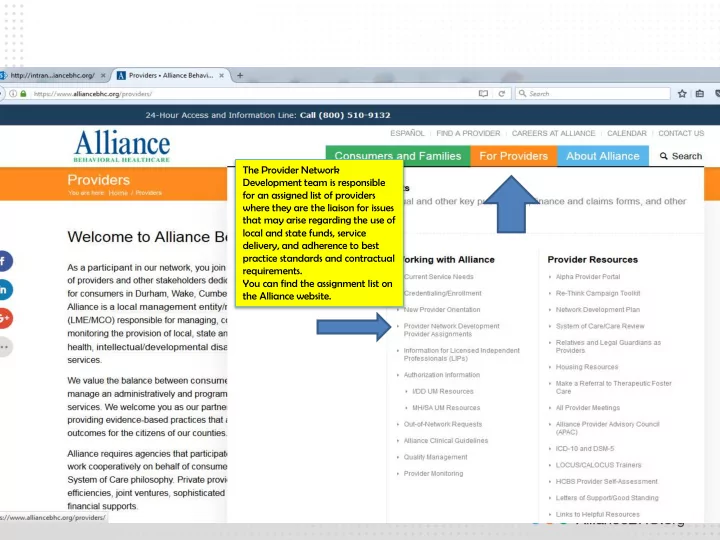
The Provider Network Development team is responsible for an assigned list of providers where they are the liaison for issues that may arise regarding the use of local and state funds, service delivery, and adherence to best practice standards and contractual requirements. You can find the assignment list on the Alliance website.
delivery, and adherence to best practice standards and contractual - - PowerPoint PPT Presentation
The Provider Network Development team is responsible for an assigned list of providers where they are the liaison for issues that may arise regarding the use of local and state funds, service delivery, and adherence to best practice standards
All Provider Meeting March 15, 2017 1:00pm – 3:00pm 4600 Emperor Boulevard, Durham, NC Rooms 104-105
Welcome and Introductions Alliance Provider Advisory Council (APAC) Updates (Wendy Wenzel) Alliance Updates MCO Leadership Updates (Beth Melcher)10 min Legislative Updates(Sara Wilson/Brian Perkins)15 min Therapeutic Foster Care database and referrals- Kate Peterson(10 min) Update on Crisis Facility-Kate Peterson(10 min) Opioid Epidemic Discussion- Dr. Anderson- Brown and Vera Reinstein(20 min) Access to Care overview- Tina Howard(20 min) Health Information Exchange overview(Cathy Estes)(15 min) Questions NEXT MEETING June 21, 2017 1-3 PM
THERAPEUTIC FOSTER CARE INFORMATION Did you know that anyone can make a referral for Therapeutic Foster Care by going to www.ncrapidresource.org? Referrals go to all Alliance Network providers. Instructions are found here: http://ncrapidresource.org/Portals/0/Making%20a%20Referral%20with%20Rapid%2 0Resource%20for%20Families_012915.pdf?ver=2015-02-01-122137-263 All referrals for TFC to Alliance Network Providers must be entered into the RRFF
- Database. By doing this our providers are able to match placements for best
geographic location and treatment program and give choices to referrers. Moves are also tracked. In order to have optimal consideration for an open bed, please enter as much information as you possibly can. Therapeutic Foster Care unlike other residential options requires a “matching process”. This process entails cross referencing a list of youth and family treatment needs with the demographics and strengths of the treatment family. Our goal is to have one treatment placement for a youth as multiple TFC placements can contribute to cumulative trauma. Questions about making a referral? contact@ncrapidresource.org Questions about Alliance TFC: kpeterson@alliancebhc.org Thank you for helping us get the best outcomes for youth and families!
TFC DATABASE REFERRAL FLOW---www.ncrapidresource.org briesser@ncrapidresource.org Ben Riesser, RRFF Data Analyst kpeterson@alliancebhc.org Kate Peterson, Healthcare Network Project Manager Any referral entered by a provider agency: consult your internal policies and procedures regarding ROI’s. You can have a release to Rapid Resource for Families/Alliance Network if your policies and procedures allow. If your agency wants a list of Network providers, please email Kate Peterson and she will be happy to provide one.
Referral into the database
- www.ncrapidre
source.org
Alert goes to Alliance Network TFC Approved Users
- Alliance TFC Provider
Staff
Provider Staff view and determine Yes, No, Maybe-if maybe,
- Dispostion maybe or
yes, provider works the referral, disposition no, the referral disappears from provider's screen.
Provider gets more information from the referrer to determine appropriate match Placement date set with legal custodian and TFC agency
Medical Affairs Department Update
All Provider Meeting 3/15/2017
Tedra Anderson-Brown, M.D. Vera Reinstein, Pharm.D.
Clinical Practice Guidelines Approved at 2/20/17 CAC meeting
- https://www.alliancebhc.org/providers/alliance-clinical-guidelines/
- Bipolar: GUIDELINE WATCH (NOVEMBER 2005): PRACTICE GUIDELINE FOR THE TREATMENT
OF PATIENTS WITH BIPOLAR DISORDER, 2ND EDITION ( update to 2002 Guideline)
- Dementia:) GUIDELINE WATCH (OCTOBER 2014): PRACTICE GUIDELINE FOR THE TREATMENT
OF PATIENTS WITH ALZHEIMER’S DISEASE AND OTHER DEMENTIAS (update to 2007 Guideline)
- OCD Adults : GUIDELINE WATCH (MARCH 2013): PRACTICE GUIDELINE FOR THE TREATMENT
OF PATIENTS WITH OBSESSIVE-COMPULSIVE DISORDER (update to 2007 Guideline)
- PTSD in Adults: GUIDELINE WATCH (MARCH 2009): PRACTICE GUIDELINE FOR THE
TREATMENT OF PATIENTS WITH ACUTE STRESS DISORDER AND POSTTRAUMATIC STRESS DISORDER (update to 2004 Guideline)
- Schizophrenia in Adults: GUIDELINE WATCH (SEPTEMBER 2009): PRACTICE GUIDELINE FOR
THE TREATMENT OF PATIENTS WITH SCHIZOPHRENIA (update to 2004 Guideline)
- SUD in Adults: GUIDELINE WATCH (APRIL 2007): PRACTICE GUIDELINE FOR THE TREATMENT
OF PATIENTS WITH SUBSTANCE USE DISORDERS, 2ND EDITION (update to 2006 Guideline)
Secretary Mandy Cohen’s Letter
Important Steps for Providers
- CDC Guideline for Prescribing Opioids for
Chronic Pain adopted by NCMB
- Register/utilize CSRS
- E-prescribe ALL medications
- Screen for OUD and connect to EB treatment
- Help transform society perception of addiction
by talking about it as a treatable disease
Operation Medicine Drop ( side 2 flyer)
Access to Care QIPs
Presentation to All Provider Meeting March 2017
How is Access to Services Defined?
Funder (DMA/DMH) Contracts:
- Alliance shall ensure network providers meet standards:
provider must provide face to face services within set timeframe (based on urgency level) after request is received from LME/MCO or enrollee (consumer)
- Refer consumers to provider of choice
- Report quarterly a summary of consumers screened by
LME/MCO
- State identified these measures as “Key Performance
Indicators”
What are Urgency Levels/Benchmarks?
Emergent:
- Life threatening condition, immediate need for care
- Measured as: start of call until face to face care is
delivered
- State Benchmark: 97% of callers receive care in 2:15 hours
Urgent:
- Moderate risk or incapacitation in one or more areas of
functioning, includes active substance abuse & individuals releasing from incarceration
- State Benchmark: 82% receive care in 2 days
- Alliance Goal: 62%
What are Urgency Levels/Benchmarks?
Routine:
- Mild risk or incapacitation in one or more areas of
functioning
- State Benchmark: 75% receive care in 14 days
- Alliance Goal: 63%
Does not include callers who are already open to providers
- r discharging from inpatient or crisis services
How is Data Evaluated?
For Routine & Urgent callers, data is based on claims submitted for first service delivered after call or incarceration release date (we also look at provider self- report as comparison); For Emergent, data is based on provider self-report In FY 17, we began to include all claims submitted, including adjudicated, denied, or approved (in line with HEDIS measures); does not include reverted claims For Routine & Urgent callers, provider data is analyzed by the provider receiving the referral from Alliance’s Access & Information Center
Percent Met
- The table below compares overall performance from FY 17, Q4 (Baseline):
Emergent Callers: Overall Results
Time Period Total # of Calls # show in 2:15 % show in 2:15 FY 16, Q4 (Apr-Jun 2016) 205 137 67% FY 17, Q1 (Jul-Sep 2016) 136 114 84% FY 17, Q2 (Oct-Dec 2016)* 162 95 59%
*All claims for Q2 most likely not submitted, yet.
Barrier Analysis, Calls > 2:15 hours
Barrier Analysis 911/Emergency Referrals Internal/External Factors Call to police was not 1st disposition 2 Internal/Escalation of Call
Emergent Callers: Barrier Analysis
Percent Met
- Using ONLY paid claims:
- Percent met is: Q1 - 48% (365/753), Q2 - 37% (260/699)
- If we eliminate those callers for whom we would not expect a claim (individuals with
Medicare/Medicaid or with private insurance or VA benefits, Q1=22, Q2=29):
- Percent met is: Q1 - 50% (365/731), Q2 - 39% (260/670)
- The table below compares performance based solely on claims (not eliminating callers
with Medicare or private insurance):
Routine Callers: Overall Results
Time Period Total # of Calls # show in 14 % show in 14 FY 16, Q1 (Jul-Sep 2015) 1,051 424 40% FY 16, Q2 (Oct-Dec 2015) 959 430 45% FY 16, Q3 (Jan-Mar 2016) 778 370 48% FY 16, Q4 (Apr-Jun 2016) 806 361 45% FY 17, Q1 (Jul-Sep 2016) 753 365 48% FY 17, Q2 (Oct-Dec 2016)* 699 260 37%
*All claims for Q2 most likely not submitted, yet.
For the 806 Routine callers, data on paid claims was analyzed in order to compare to provider self-reported attendance. Results ranged from a low of 26% showing for care in 14 days to a high
- f 64%. Most fell below Alliance goal of 63%.
Performance-by Provider (more than 20 referrals)
26% 64% 0% 10% 20% 30% 40% 50% 60% 70%
Percent Receiving Services (by paid claim) within 14 Days
Routine Callers:
Results for Providers
Percent Met
- The table below compares overall performance based on claims and attendance status:
Time Period Total # of Calls # show in 2 % show in 2 FY 16, Q4 (Apr-Jun 2016)-claims 452 84 19% FY 16, Q4 (Jul-Sep 2016)-attend status 452 122 27% FY 17, Q1 (Jul-Sep 2016)-claims 479 89 19% FY 17, Q1 (Jul-Sep 2016)-attend status 479 122 26% FY 17, Q2 (Oct-Dec 2016)-claims 447 67 15% FY 17, Q2 (Oct-Dec 2016)-attend status 447 123 28%
Urgent Callers: Results
For the last three quarters, Johnston County had the fewest percent with a timely appointment particularly for individuals with Medicaid (18% in Q1, 44% in Q2). In Q1, Wake had the highest percent
- verall, while in Q2 Durham and Cumberland had the highest percent with timely appointments. There
was an increase in individuals with Medicaid receiving timely appointments (Q1-61%, Q2-71%), while the percent of individuals without Medicaid receiving timely appointments remained the same (64%). Main reasons appointments not available: availability of provider (primary reason), caller request, and no appointments available in time frame. Some of the providers receiving the most referrals had average wait times of 7, 6, and 5 days.
*Data does not include two callers residing outside of the catchment area.
Timeliness of Appointments – Non Post-Release Population
Urgent Callers: Results
0% 10% 20% 30% 40% 50% 60% 70% 80% Cumberland Durham Johnston Wake
Percent with Appointments by County (Non-Post Release)
FY 17, Q1 FY 17, Q2
The average amount of time between the expected release date and date of appointment (in Q1) was 2.05 days, above the standard but less than the days for non post-release appointments. Wake County callers in Q1 requesting services following incarceration had the highest percent with appointments in two days, while Cumberland had the highest percent in Q2. The trend shows Johnston with the lowest (even though percent was close to other counties in Q1). 75% of the Q1 callers and 65% Of Q2 callers in this population had an appointment within 2 days (compared to 65% in the 4th quarter). Mirroring findings from the 4th Quarter, the vast majority of individuals in this population (Q1-83%, Q2-85%) do not have Medicaid.
Timeliness of Appointments-Incarceration Post Release
Urgent Callers: Results
0% 10% 20% 30% 40% 50% 60% 70% 80% 90% Cumberland Durham Johnston Wake
Percent with Appointments-CJ Post Release
FY 17, Q1 FY 17, Q2
Consistent with the data from the 4th quarter, individuals who called on Fridays were least likely to attend an appointment within 2 days. In contrast, individuals calling on Sundays - Wednesdays were most likely. Cumberland had the lowest percent of callers who showed within timeframe (18%) in Q!, while Johnston had the lowest (11%) in Q2. Wake continues to have had the highest volume of callers on Fridays and Saturdays who did not show in time (Q1-22, Q2-25). Data for the CJ-Post Release population shows a similar pattern—no one released on a Friday (and Saturday) showed for the appointment in two days.
Showing for Timely Care – Non Post-Release Population
(Data based on claims for Quarters 1 & 2)
Total calls: 29 152 150 169 112 94 25
Urgent Callers: Results
0% 5% 10% 15% 20% 25% 30% 35% 40% Sunday Monday Tuesday Wednesday Thursday Friday Saturday
FY 17, Q1 FY 17, Q2
No callers showed Only 1 caller showed
Urgent Results: Results by Provider
The provider receiving the referral clearly impacts whether a caller receives an appointment within the time standard of 2 days. Provider A had the highest percent of appointments within 2 days (61%) and the highest percent showing for the 2-day appointments (77%). Provider B and Provider C had the lowest percentages (38%) of individuals showing for appointments that were made within 2 days.
Attendance to Appointments – Non Post-Release Population
(Q4, N=281)
10 20 30 40 50 60 70 # referrals # appointments in 2 # attended in 2
Referrals, Timely Appointments, Attendance by Provider* Provider B Provider C
*Data graphed for providers who received more than 10 referrals. Project Lead did not include paid claims due to the very low number that had been submitted.
Provider A
Urgent Results: Results By Provider
The overall attendance rate at 2-day appointments was lower for this population than for the non post-release population. Only 27% of callers were reported as attending appointments within 2 days for all providers (19% had claims for services in 2 days). None of the providers receiving referrals had a show rate above 40%, even when calculating the denominator as the appointments scheduled within 2 days. The provider with the highest engagement percent was Provider A with 38% showed who had appointments scheduled in 2 days (25% for all referrals), although this percent may be misleading due to the low numbers.
Attendance to Appointments-Incarceration Post Release
(Q4, N=96)
* Data graphed for providers who received more than 5 referrals.
Referrals, Timely Appointments, Attendance by Provider*
5 10 15 20 25 30 35 # referrals # appointments in 2 # attended in 2
Provider A
Alliance Action Steps
Overall
- Continue efforts to educate providers on using and updating
appointments, correctly entering attendance status, and accurately submitting claims for services
- Data continues to be analyzed by provider and emailed to
providers for QA use, technical assistance offered to providers, a meeting will be held with providers receiving most referrals
- Created project team to study and implement
recommendations for improving engagement of post-release population
Alliance Action Steps
Emergent Callers
- Improve quality and timeliness of Mobile Crisis services
Urgent Callers
- Expedite creation of assessment services on Friday and
Saturdays, particularly in Wake County Routine Callers
- Continue reminder calls to individuals with appointments that
began in January 2016
NC Health Information Exchange Authority Overview ARE YOU PREPARED? https://hiea.nc.gov/
- The information contained in this overview comes from https://hiea.nc.gov/
- Please contact references in this presentation for any further questions-this was provided by Alliance for informational
purposes only
- Source: NCHICA Update October 2016
General Background
What is a health information exchange and who is the NC HIEA? A health information exchange is a secure and electronic network that gives authorized health care providers the ability to access and share health-related information across a statewide information highway. It exists to improve health care quality, enhance patient safety, improve health outcomes, and reduce
- verall health care costs by enabling health information to be
available securely whenever doctors, nurses and patients need it. The North Carolina Health Information Exchange Authority (NC HIEA) was created by the North Carolina General Assembly to
- versee and administer the state-designated HIE (NCGS 90-414.7).
They will receive input and advice from an Advisory Board consisting of patients, hospital systems, physicians, technology experts, public health officials and other key stakeholders to continuously improve the HIE Network, now called NC HealthConnex, and move towards more efficient and effective care
Who is “required” to use NC HealthConnex?
The new law requires that as of February 1, 2018, all Medicaid providers must be connected and submitting data to NC HealthConnex in order to continue to receive payments for Medicaid services
- provided. By June 1, 2018, all other entities that
receive state funds for the provision of health services, including local management entities/managed care organizations, also must be
- connected. (NCGS 90-414.4)
What does connected mean?
To meet the state’s mandate, a Medicaid provider is “connected” when its clinical and demographic information pertaining to services paid for by Medicaid and other State-funded health care funds are being sent to the NC HealthConnex at least twice daily – either through a direct connection to NC HealthConnex or via a hub (i.e. a larger system with which it participates, another HIE with which it participates, or EHR vendor).
I am a behavioral health or substance abuse treatment provider in North Carolina. Am I required to connect to NC HealthConnex?
If you are a behavioral health provider that bills NC Medicaid for reimbursement for behavioral or mental health services, you are required to connect to the HIE Network, now called NC HealthConnex, by February 1, 2018. How do I connect to NC HealthConnex? 1) The first step in connection is reviewing and signing the Participation
- Agreement. If you have questions regarding this process, please contact
Alice Miller via email alice.miller@nc.gov or by phone 919-754-6912. 2) The second step is to have an ONC-certified EMR product that can send HL7 version 2.0 and higher. 3) The third step is to identify three points of contact within your medical practice that will collaborate with the NC HIEA and the technology partner, SAS, to complete a successful connection.
Do you have a list of EMR systems that support connection to NC HealthConnex?
Any ONC-ATB certified EMR product that can send HL7 version 2.0 and higher will support the connection to NC HealthConnex. Following is a list
- f EMR vendors that are connected to NC HealthConnex currently
(October 2016) or that they have experience with building the connection:
Allscripts Professional Allscripts Touchworks Amazing Charts Aprima AthenaHealth Centricity CureMD eClinicalWorks Epic Greenway Primesuite McKesson Practice Partners Medinformatix MicroMD NextGen Patagonia
EHR Integrations - The NC HIEA continues to work with a list of EHR vendors (Allscripts, AthenaHealth, eClinical Works, Cure MD) to build multi-tenant connections that will enable participants to access patient records in NC HealthConnex via an EHR
- integration. They hope to have these agreements in
place in the near term so that those healthcare providers who have signed Participation Agreements with the NC HIEA can begin utilizing NC HealthConnex for the secure exchange of patient
- information. They recommend that healthcare
providers contact your EHR vendor and request their timeframe for connection so you can begin your planning and preparations.
What happens if my practice doesn’t want to connect to NC HealthConnex? Recently passed legislation requires that as of February 1, 2018, all Medicaid providers must be connected to the HIE in order to continue to receive payments for Medicaid services
- provided. By June 1, 2018, all other entities
that receive state funds for the provision of health services, including local management entities/managed care organizations, must be connected.
General Inquiries Email: hiea@nc.gov OR alice.miller@nc.gov Phone: 919-754-6912 The NC HIEA Business Office regular hours are Monday through Friday 9 a.m. to 5 p.m. Mailing Address: NC Health Information Exchange Authority Mail Service Center 4101 Raleigh, NC 27699-4101
Other News NC Medicaid EHR Incentive Program - If you haven’t already heard, the NC Medicaid EHR Incentive Program gives eligible providers the chance to earn $63,750 over six years if they are using their certified EHR to meet Meaningful Use. If you’re an eligible provider type with a certified EHR and you see 30% Medicaid patients, now is the time to get started. There are resources available to help you attest for a
- payment. The NC Medicaid EHR Incentive Program has