Dennis Shusterman, MD, MPH Professor of Clinical Medicine, Emeritus - - PDF document

dennis shusterman md mph professor of clinical medicine
SMART_READER_LITE
LIVE PREVIEW

Dennis Shusterman, MD, MPH Professor of Clinical Medicine, Emeritus - - PDF document

3/10/16 Scenarios for the De Novo Generation of Toxic Substances Dennis Shusterman, MD, MPH Professor of Clinical Medicine, Emeritus UCSF Division of Occupational & Environmental Medicine Disclosures I have nothing to disclose 1


slide-1
SLIDE 1

◆ 3/10/16 ◆ 1

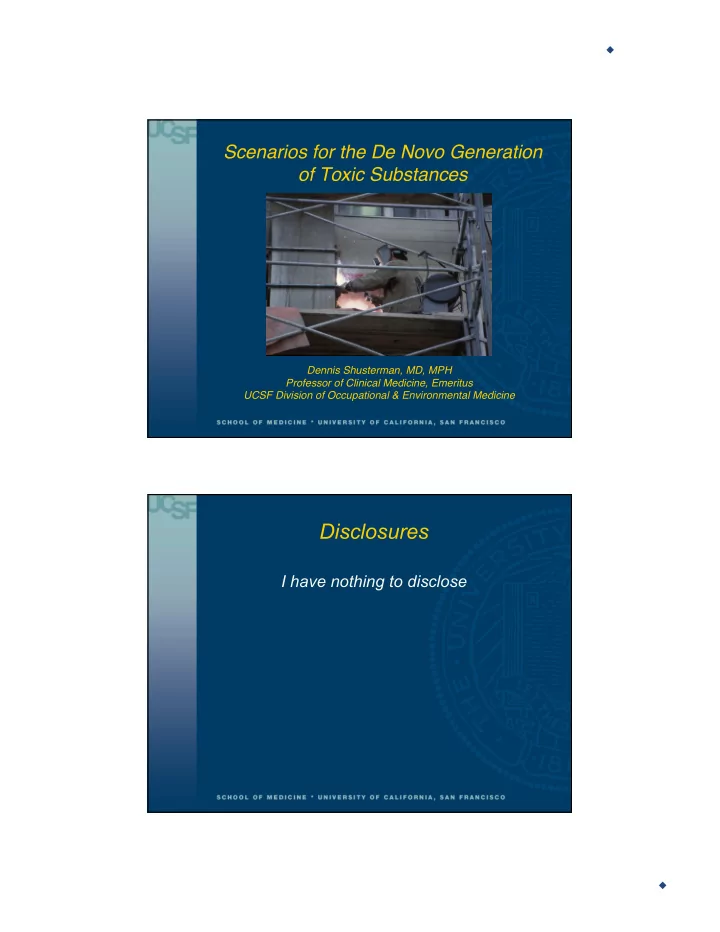
Scenarios for the De Novo Generation 


  • f Toxic Substances

Dennis Shusterman, MD, MPH Professor of Clinical Medicine, Emeritus UCSF Division of Occupational & Environmental Medicine
Disclosures

I have nothing to disclose

slide-2
SLIDE 2

◆ 3/10/16 ◆ 2

Objectives

  • To review the range of de novo toxicants
  • To highlight DDX issues
  • To promote 1
  • and 2
  • prevention

Background

  • Definition of de novo toxicants

Toxic agents that are generated (or transformed) in the workplace or environment.

  • Classes of de novo toxicants

ü Pyrolysis / combustion products ü Mixing incompatibilities ü Environmental activation of toxic agents

slide-3
SLIDE 3

◆ 3/10/16 ◆ 3

Pyrolysis & Combustion Products

Definitions

  • Pyrolysis

ü Non-oxidative thermal decomposition of

  • rganic materials
  • Combustion

ü Oxidative thermal decomposition of organic

materials

Dorland’s Illustrated Medical Dictionary. 2012

slide-4
SLIDE 4

◆ 3/10/16 ◆ 4

Combustion Toxicology: Fire Science

C + ½ O2 à CO Δ

slide-5
SLIDE 5

◆ 3/10/16 ◆ 5

C + ½ O2 à CO Δ C + ½ O2 à CO Δ

slide-6
SLIDE 6

◆ 3/10/16 ◆ 6

Combustion Toxicology: Fire Science

Scenario 1

An electronics assembly factory reports an

  • utbreak of episodic febrile illness among

workers and consults a university clinic to identify the cause. You are on the team that

  • responds. On arrival, you meet with

management and some symptomatic workers. What do you want to know?

slide-7
SLIDE 7

◆ 3/10/16 ◆ 7

Scenario 1

  • A. What is produced in the factory?
  • B. With what materials and processes?
  • C. What were the symptoms and their

timing?

  • D. Who was affected?
  • E. Did anything change pre-outbreak?
  • F. All of the above

Scenario 1

ü What is produced in the factory?

Ø Encapsulated electronic circuit boards

slide-8
SLIDE 8

◆ 3/10/16 ◆ 8

Scenario 1

ü What is produced in the factory?

Ø Encapsulated electronic circuit boards

ü With what materials and processes?

Ø Circuit boards are placed in a mold to be

encapsulated (“potted”) with an epoxy

  • resin. Prior to encapsulation, the interior
  • f the molds are sprayed with a parting

agent

Scenario 1

Ø What were the symptoms and their timing?

Ø Acute (following afternoon break)

  • Chest tightness
  • Sore throat
  • Cough
slide-9
SLIDE 9

◆ 3/10/16 ◆ 9

Scenario 1

Ø What were the symptoms and their timing?

Ø Acute (following afternoon break)

  • Chest tightness
  • Sore throat
  • Cough

Ø Delayed (by another 5-6 hours)

  • Malaise
  • Headache
  • Chills
  • Fever

Scenario 1

ü Who was affected?

Ø All-male workforce Ø 36 of 61 (59%) of workers symptomatic Ø 34 of 61 (56%) smokers

slide-10
SLIDE 10

◆ 3/10/16 ◆ 10

Scenario 1

ü Who was affected?

Ø All-male workforce Ø 36 of 61 (59%) of workers symptomatic Ø 34 of 61 (56%) smokers

OR = 7.7; χ2 = 13.2; p < 0.001

Smoker? Symptomatic? Yes No Yes 27 7 No 9 18

Scenario 1

ü Did anything change pre-outbreak?

Ø Yes…

The mold release spray (parting agent) was changed to one containing a short- chain polytetrafluoroethylene (TeflonR) compound.

slide-11
SLIDE 11

◆ 3/10/16 ◆ 11

Scenario 1

Ø Interpretation -- What happened?

Ø The majority of symptomatic workers

(smokers) contaminated their hands (thence cigarettes) with PTFE dust and subsequently pyrolyzed the PTFE.

Scenario 1

ü Diagnosis?

Ø Polymer fume fever Source: Lewis CE, Kerby GR. An epidemic of polymer-fume fever. JAMA 1965; 191: 103-6.

slide-12
SLIDE 12

◆ 3/10/16 ◆ 12

Fume Fevers

Polymer Fume Fever

  • 1st described by Harris (1951)
  • Agent

ü Polytetrafluoroethylene (PTFE /TeflonR) fume

  • Exposure scenarios

ü Smoking PTFE-contaminated cigarettes

̵

Electronics / textiles / ski wax

ü Welding near PTFE-containing parts

  • Variants / sequelae

ü Veterinary cases (birds) ü ? COPD with repeated episodes (Kales, 1994) ü Chemical pneumonitis (very high temperature)

slide-13
SLIDE 13

◆ 3/10/16 ◆ 13

Polymer Fume Fever

slide-14
SLIDE 14

◆ 3/10/16 ◆ 14

Inhalation Fevers

  • Polymer fume fever
  • Metal fume fever
  • Inhalation fevers from contaminated
  • rganic material (e.g., ODTS)
  • Inhalation fevers from contaminated 


H2O (e.g. humidifier fever)

Inhalation Fevers: Common Features

  • Inhalation of specific types of fine PM
  • Latency period for systemic symptoms

ü ~ 2-8 hours

  • Symptoms

ü Systemic: Chills, fever, myalgias, headache ü Pulmonary & GI: Sx’s variable

  • Spontaneous resolution (~ 24-48 hrs)
  • Negative CXR
slide-15
SLIDE 15

◆ 3/10/16 ◆ 15

Inhalation Fevers: Natural history

  • Key Concepts

ü Does not involve sensitization

à may occur on initial exposure

ü High attack rate among comparably exposed

persons

Inhalation Fevers: Natural history

  • Key Concepts

ü Does not involve sensitization

à may occur on initial exposure

ü High attack rate among comparably exposed

persons

  • Clinical Syndromes

ü May be mistaken for viral URI ü Tachyphylaxis is common (“Monday fever”)

slide-16
SLIDE 16

◆ 3/10/16 ◆ 16

Metal Fume Fever Metal Fume Fever

  • 1st described by Thakrah (1831)
  • Agent = ZnO fume; other metals not proven
  • Synonyms

ü “Brass-founder’s ague” ü “Monday fever” ü “Spelter’s chills”

  • Variants / sequelae

ü “Cadmium fume fever” à pneumonitis

ü Possible bronchospasm (Malo & Cartier, 1987)

slide-17
SLIDE 17

◆ 3/10/16 ◆ 17

Metal Fume Fever

  • Pathophysiology (Blanc et al.; 2003-2007)

ü Nascent ZnO fume reaches alveoli…

à PMN influx into BAL fluid

à Cytokine release (TNF; IL-6; IL-8) in BAL fluid

Nascent ZnO Fume

Electron micrograph courtesy Prof. Lung-Chi Chen, NYU.

100 nm

slide-18
SLIDE 18

◆ 3/10/16 ◆ 18

Inhalation Injury

Spectrum of inhalation injury

ü Rhino-conjunctivitis; Pharyngitis ü Laryngitis ü Tracheo-bronchitis ü Chemical pneumonitis

slide-19
SLIDE 19

◆ 3/10/16 ◆ 19

Spectrum of inhalation injury

ü Rhino-conjunctivitis; Pharyngitis

→ Sinusitis

ü Laryngitis ü Tracheo-bronchitis ü Chemical pneumonitis

Spectrum of inhalation injury

ü Rhino-conjunctivitis; Pharyngitis

→ Sinusitis

ü Laryngitis

→ Vocal cord dysfunction (VCD)

ü Tracheo-bronchitis ü Chemical pneumonitis

slide-20
SLIDE 20

◆ 3/10/16 ◆ 20

Spectrum of inhalation injury

ü Rhino-conjunctivitis; Pharyngitis

→ Sinusitis

ü Laryngitis

→ Vocal cord dysfunction (VCD)

ü Tracheo-bronchitis

→ Irritant-induced asthma

ü Chemical pneumonitis

Spectrum of inhalation injury

ü Rhino-conjunctivitis; Pharyngitis

→ Sinusitis

ü Laryngitis

→ Vocal cord dysfunction (VCD)

ü Tracheo-bronchitis

→ Irritant-induced asthma

ü Chemical pneumonitis

→ Bronchiolitis obliterans

slide-21
SLIDE 21

◆ 3/10/16 ◆ 21

Chemical Pneumonitis Chemical pneumonitis

  • Synonyms

ü Non-cardiogenic pulmonary edema ü Acute respiratory distress syndrome (ARDS) ü Acute lung injury (ALI)

slide-22
SLIDE 22

◆ 3/10/16 ◆ 22

Chemical pneumonitis

  • Synonyms

ü Non-cardiogenic pulmonary edema ü Acute respiratory distress syndrome (ARDS) ü Acute lung injury (ALI)

  • Radiographic features

ü CXR: “Butterfly” infiltrates with normal cardio-


thoracic ratio

ü HRCT: Centrilobular ground-glass attenuation

Source: Fraser & Pare: Diagnosis of Diseases of the Chest. Philadelphia, Saunders, 1970: p. 951

Chemical pneumonitis

slide-23
SLIDE 23

◆ 3/10/16 ◆ 23

Source: Akira M. High-resolution CT in the evaluation of occupational and environmental disease. Radiologic Clin North Am 2002; 40: 43-59.

Chemical pneumonitis Chemical pneumonitis

  • Synonyms

ü Non-cardiogenic pulmonary edema ü Acute respiratory distress syndrome (ARDS) ü Acute lung injury (ALI)

  • Radiographic features

ü CXR: “Butterfly” infiltrates with normal cardio-


thoracic ratio

ü HRCT: Centrilobular ground-glass attenuation

  • Etiologic agents (de novo):

ü Cadmium oxide fume ü Irritant gases & vapors

ü Chlorinated solvent pyrolysis à phosgene ü High-temperature atmospheric chemistry (O3 + NOx)

slide-24
SLIDE 24

◆ 3/10/16 ◆ 24

3 O2 à 2 O3

N2 + O2 à NOx

Δ

slide-25
SLIDE 25

◆ 3/10/16 ◆ 25 Photo: Ansel Adams

Water solubility & initial level of impact

Source: Shusterman Current Allergy Asthma Rep 2003;3:258.

slide-26
SLIDE 26

◆ 3/10/16 ◆ 26

2 NO2 + H2O → HNO3 + HNO2

In vivo fate: NO2 à disproportionation: In vivo fate: Phosgene à hydrolysis:

COCl2 + H2O → CO2 + 2 HCl

slide-27
SLIDE 27

◆ 3/10/16 ◆ 27

Mixing Incompatibilities Scenario 2

A 40 year-old-female presents to her primary care physician with a history of transient eye, nose and throat irritation, as well as cough,

  • ccurring after mixing a window cleaner with

bleach in a poorly ventilated room. Symptoms resolved quickly, but she wants to know what

  • ccurred and how to avoid it in the future.

What do you want to know?

slide-28
SLIDE 28

◆ 3/10/16 ◆ 28

Questions re: exposure

√ What was in the window cleaner? √ Are the product constituents known to be

incompatible? If so, what kind of reaction products were likely formed?

√ Were there any warning labels? √ All of the above

Answers re: exposure

√ What was in the window cleaner?

Ø CAN’T TELL YOU

√ Was there ammonia in the window cleaner?

Ø CAN’T TELL YOU

√ Possibility of chloramine generation if

ammonia is present?

Ø CAN’T TELL YOU IF AMMONIA IS PRESENT BUT

CAN SAY YOU DON’T HAVE TO WORRY ABOUT THAT PARTICULAR REACTION.

slide-29
SLIDE 29

◆ 3/10/16 ◆ 29

Mixing Incompatibilities

Na+ClO- (sodium hypochlorite) plus…

slide-30
SLIDE 30

◆ 3/10/16 ◆ 30

Mixing Incompatibilities

Na+ClO- (sodium hypochlorite) plus… NH3 (ammonia) -> NHxCly (chloramines)

Chloramines

NaClO + NH3 -> NHxCly

slide-31
SLIDE 31

◆ 3/10/16 ◆ 31

Mixing Incompatibilities

Na+ClO- (sodium hypochlorite) plus… H+ (acids) -> Cl2 (chlorine gas)

Chlorine gas

NaClO + 2 HCl -> NaCl + H2O + Cl2

slide-32
SLIDE 32

◆ 3/10/16 ◆ 32

Arsine (AsH3) gas generation

√ Mixing acids with metallic slags √ Immersion of an aluminum ladder in a tank

containing sodium arsenite (NaAsO2)

√ Potential formation in electronics industry

GaAs + 3 HCl à GaCl3 + AsH3

Environmental activation of toxicants

slide-33
SLIDE 33

◆ 3/10/16 ◆ 33

Air Pollutants

Credit: Nick Lammers, Oakland Tribune

H2SO7 + H2O à 2 H2SO4

General Chemical Oleum Release:

July 26, 1993

Cloud enveloped parts of Richmond, San Pablo, El Sobrante, Pinole ~ 24,000 people sought medical attention or claimed health effects

slide-34
SLIDE 34

◆ 3/10/16 ◆ 34

Water Pollutants

Minamata, Japan…

slide-35
SLIDE 35

◆ 3/10/16 ◆ 35

Minamata, Japan… Minamata, Japan…

?

slide-36
SLIDE 36

◆ 3/10/16 ◆ 36

HgCl2 ¡+ ¡bacteria ¡-­‑> ¡CH3Hg+ ¡+ ¡Cl-­‑ ¡

Minamata, Japan…

HgCl2 ¡+ ¡bacteria ¡-­‑> ¡CH3Hg+ ¡+ ¡Cl-­‑ ¡

Minamata, Japan…

slide-37
SLIDE 37

◆ 3/10/16 ◆ 37

HgCl2 ¡+ ¡bacteria ¡-­‑> ¡CH3Hg+ ¡+ ¡Cl-­‑ ¡

Minamata, Japan… Minamata, Japan…

slide-38
SLIDE 38

◆ 3/10/16 ◆ 38

Minamata, Japan… Minamata, Japan…

slide-39
SLIDE 39

◆ 3/10/16 ◆ 39

Pesticides Metam Sodium Spill


Dunsmuir, CA – July 1991

slide-40
SLIDE 40

◆ 3/10/16 ◆ 40

slide-41
SLIDE 41

◆ 3/10/16 ◆ 41

DOT status of Metam Sodium

√ NOT considered a hazardous substance

Ø NO placarding Ø NO double-walled tank cars required

slide-42
SLIDE 42

◆ 3/10/16 ◆ 42

slide-43
SLIDE 43

◆ 3/10/16 ◆ 43

slide-44
SLIDE 44

◆ 3/10/16 ◆ 44

slide-45
SLIDE 45

◆ 3/10/16 ◆ 45

DOT status of Metam Sodium

√ NOT considered a hazardous substance

Ø NO placarding Ø NO double-walled tank cars required

Ø “The liquid fumigant is transported at an elevated

  • pH. When it comes in contact with water/soil

moisture it releases into a gas killing the little

  • critters. For the Railroad at that time placarding

something as hazardous, the substance had to be immediately toxic to humans, it exploded on release, or caught on fire upon release.”

SOURCE: George Day, PE, Region 5 RWQCB, 11/5/15

Metam sodium

H C–N–C–S–, Na+ S = H –

H2S

CH3–N=C=S Methyl isothiocyanate CH3–N=C=S Methyl isothiocyanate

hydrolysis

slide-46
SLIDE 46

◆ 3/10/16 ◆ 46

CH3-N=C=O

Summary

√ Toxic substances can be generated (or activated)

by the action of heat, inappropriate mixing, or biological processes in the environment.

√ The resulting de novo toxicants can be qualitatively

and/or quantitatively more toxic than the starting products.

√ Fume fevers can mimic viral illnesses. √ Foreknowledge of these potential reactions can

hasten the recognition of exposure hazards.

slide-47
SLIDE 47

◆ 3/10/16 ◆ 47

Resource:

  • 1. Inhalation fevers are characterized by

all of the following except:

  • A. Inhalation of fine particles
  • B. A lag-time between exposure and Sxs
  • C. Systemic Sxs (chills and fever)
  • D. Characteristic CXR findings
slide-48
SLIDE 48

◆ 3/10/16 ◆ 48

  • 2. Clinical features of chemical

pneumonitis include all except:

  • A. Hypoxemia
  • B. Symmetrical (“butterfly”) infiltrates
  • C. Specific IgG antibodies (“precipitins”)
  • D. Peripheral leukocytosis
  • 3. Identified mixing incompatibilities

include all except:

  • A. Bleach + ammonia à Chloramines (NHxCly)
  • B. Bleach + acids à Chorine gas (Cl2)
  • C. Bleach + detergent à Phosgene gas (COCl2)
  • D. Gallium arsenide + HCl à Arsine gas (AsH3)