Density Estimation Parametric techniques Maximum Likelihood - - PDF document

density estimation
SMART_READER_LITE
LIVE PREVIEW

Density Estimation Parametric techniques Maximum Likelihood - - PDF document

1 Density Estimation Parametric techniques Maximum Likelihood Maximum A Posteriori Bayesian Inference G aussian M ixture M odels (GMM) EM-Algorithm Non-parametric techniques Histogram Parzen Windows


slide-1
SLIDE 1

1

1

Density Estimation

  • Parametric techniques
  • Maximum Likelihood
  • Maximum A Posteriori
  • Bayesian Inference
  • Gaussian Mixture Models (GMM)

– EM-Algorithm

  • Non-parametric techniques
  • Histogram
  • Parzen Windows
  • k-nearest-neighbor rule

2

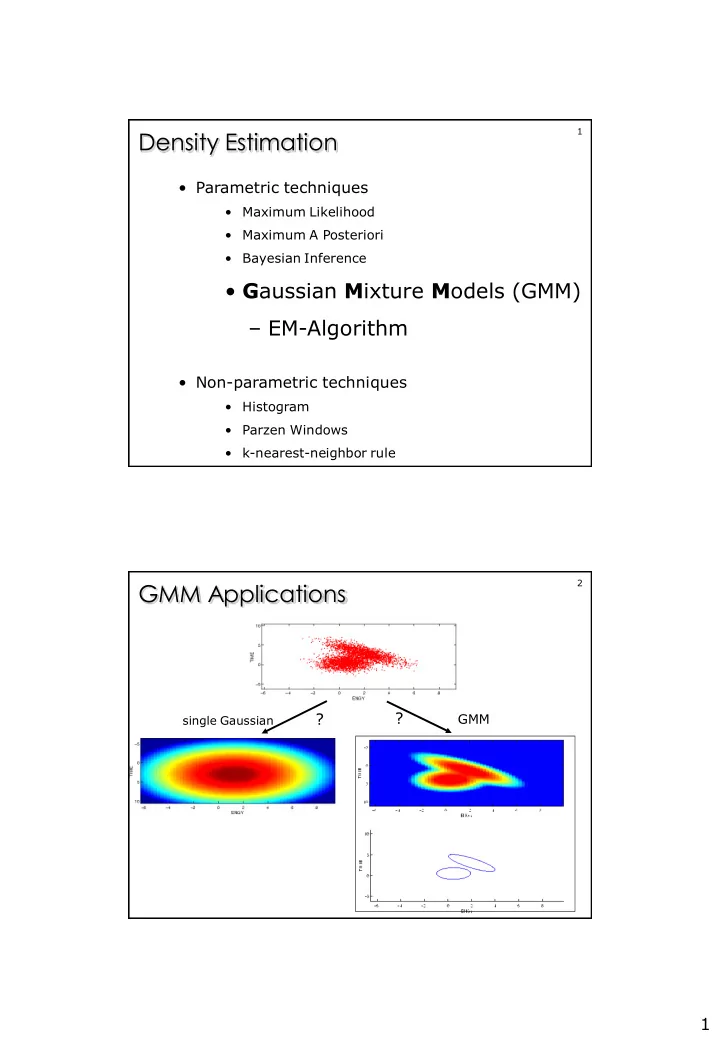
GMM Applications

single Gaussian ?

? GMM

slide-2
SLIDE 2

2

3

GMM Applications

Density estimation

Observed data from a complex but unknown probability distribution. Can we describe this data with a few parameters ? Which (new) samples are unlikely to come from this unknown distribution (Outlier detection )?

4

GMM Applications

Clustering

Observations from K classes. Each class produces samples from a multivariate normal distribution. Which observations belong to which class ? Sometimes easy Sometimes impossible Often possible but not clear-cut

slide-3
SLIDE 3

3

5

GMM: Definition

  • Mixture models are linear combinations of densities:

1

1

with 1 , ( | ) 1

( | ) ( | )

K i i i x

K i i i

c p x dx

p x c p x

  

  

 

– Capable of approximating almost any complex and irregularly shaped distributions ( K might get big )!

{ , }, ( | ) ( , )

i i i i i i

p x N         

  • For Gaussian mixtures:

6

Sampling a GMM

Assume that each data point is generated according to the following recipe:

  • 1. Pick a component (i [ 1 .. K ] ) at random.

Choose component i with probability ci .

  • 2. Sample data point ~ N(i,i).
  • How to generate a random variable according to a

known GMM

( ) ( , )

K i i i i

p x c N   

In the end, we might not know which data points came from which component (unless someone kept track during the sampling process)!

slide-4
SLIDE 4

4

7

Learning a GMM

Recall ML-estimation We have:

A density function p(· ; ) governed by a set of unknown parameters . A data set of size N drawn from this distribution X= {x1, ..., xN}

L( ) ln p(X; ) argmax L( )

 

     

We wish: to obtain the parameters best explaining data X by maximizing the log-likelihood function:

8

Learning a GMM

  • For a single Gaussian distribution this is simple to
  • solve. We have an analytical solution.
  • Unfortunately for many problems (including GMM) it

is not possible to find analytical expressions.

  • Resort to classical optimization techniques ?
  • Possible but there is a better way:

EM – Algorithm (Expectation-Maximization)

slide-5
SLIDE 5

5

9

Expectation Maximization ( EM )

  • Usually used when:
  • the observation is actually incomplete; some values are

missing from the data set.

  • the likelihood function is analytically intractable but can be

simplified by assuming the existence of additional but missing (so-called hidden/latent) parameters.

  • General method for finding ML-estimates in the case
  • f incomplete or missing data (GMM’s are one

application).

The latter technique is used for GMMs. Think of each data point as having a hidden label specifying the component it belongs to. These component labels are the latent parameters. 10

General EM procedure

Observed data set (incomplete): X Assume a complete data set exists: Z = (X, Y) Z has a joint density function: ( | ) ( , | ) p p    z x y Define the complete-data log-likelihood function: L( | ) L( | X,Y) ln (X,Y| ) p     

The EM setting

( | , ) ( | ) p p     y x x Our aim is to find a  that maximizes this function.

slide-6
SLIDE 6

6

11

General EM procedure

  • But: We cannot simply maximize

because Y is not known. L( | X,Y) p(X,Y| ) ln   

  • L (|X, Y) is in fact a random variable:
  • Y can be assumed to come from some distribution
  • That is, L(|X, Y) can be interpreted as a function where

X and  are constant and Y is a random variable. ( | X, ) f  y

  • The EM will compute a new, auxiliary function,

based on L, that can be maximized instead.

  • Let‘s assume we already have a reasonable estimate

for the parameters: (i-1) .

12

General EM procedure

  • EM uses an auxiliary function:

( 1) ( 1)

( , ) ln (X,Y | ) X,

|

i i

Q E p

 

        

How to read this:

– X and (i-1) are constants,

–  is a simple variable (the function argument),

– Y is a random variable governed by distribution f .

  • The task is to rewrite Q and perform some calculations to make

it a fully determined function.

  • Q is the expected value of the complete-data log-likelihood

w.r.t. to missing data (Y), observed data (X) and current parameter estimates ((i-1)).

This is called the E-step (expectation-step)

slide-7
SLIDE 7

7

13

General EM procedure

  • Q can be rewritten by means of the marginal distribution f:

( 1) ( 1) ( 1)

( , ) ln (X,Y | ) X, ln (X, | ) ( | X, )

|

i i i

Q E p p f dy

  

            

y

y y

If y is a continuous random variable: If y is a discrete random variable:

( 1) ( 1) ( 1)

( , ) ln (X,Y | ) X, ln (X, | ) ( | X, )

|

i i i y

Q E p p f

  

           

y y

Think of this as the expected value of a function of Y

E[g(Y)]

Evaluate f( y | X,  (i-1) ), using the current estimate  (i-1). Now Q is fully determined and we can use it!

14

General EM procedure

  • Both E- and M-steps are repeated until convergence.
  • In each E-Step, we find a new auxiliary function Q
  • In each M-Step, we find a new parameter set 
  • In a second step Q is used to obtain a better set of

parameters :

( ) ( 1)

argmax ( , )

i i

Q

 

   

This is called the M-step (maximization-step)

slide-8
SLIDE 8

8

15

General EM algorithm

Summary of the general EM algorithm (see also Bishop, p.440)

  • 1. Choose an initial setting for the parameters  (i-1).
  • 2. E-step: evaluate f ( y | X,  (i-1) ) ,

plug it into to obtain a fully determined auxiliary function

  • 3. M-step: evaluate (i) given by
  • 4. Check for convergence of either the log likelihood or the

parameter values. If the convergence criterion is not satisfied, then let  (i-1)   (i) and return to step 2. dy Y X p X y f Q

y i i

    

 

) | , ( ln ) , | ( ) , (

) 1 ( ) 1 (

( ) ( 1)

argmax ( , )

i i

Q

 

   

16

General EM Illustration

( ) i

( 1) i

( 2) i

( )

( , )

i i

Q    

( 1) 1

( , )

i i

Q 

 

  

Iterative majorisation Aim of EM: Find local maximum

  • f function L() by using

auxiliary function Q(, (i)) . How does this work?

  • Q touches L at point

[(i), L((i))] and lies everywhere below L .

  • Maximize auxiliary function.
  • The position of the maximum (i+1) gives a value of L which is

greater than in the previous iteration.

  • Repeat this scheme with new auxiliary function until

convergence. ( ) L 

slide-9
SLIDE 9

9

17

General EM Summary

  • Iterative algorithm for ML-estimation of systems

with hidden/missing values.

  • Calculates expectance for hidden values based on
  • bserved data and joint distribution.
  • Slow but guaranteed convergence.
  • May get „stuck“ in local maximum.
  • There is no general EM implementation. The details
  • f both steps depend very much on the particular

application.

18

Application: EM for Mixture Models

M i i i i 1

p(x | ) c p (x | )

  

  • Our probabilistic model is now:

M i i 1

c 1

1 M 1 M

(c , ,c , , , )    

with parameters: such that:

  • That is, we have M component densities pi (of the

same family) combined through M mixing coefficients ci .

slide-10
SLIDE 10

10

19

EM for Mixture Models

  • The incomplete-data log-likelihood becomes

(remember we assume X is iid):

N N M i j j i j i 1 j 1 i 1

L( | X) ln p(x | ) ln c p (x | )

  

          

  

  • Difficult to optimize with log of sum

 

N i i 1

Y y

  • Now let‘s try the EM-trick:

– Consider X as incomplete. – Introduce unobserved data whose values indicate which component of the MM generated each data item. – That is, yi1,...,M and yi=k if the i-th sample stems from the k-th component.

20

EM for Mixture Models

  • If we knew the values of Y, the log likelihood would

simplify to:

 

 

i i i

N N i i i y y i y i 1 i 1

L( | X,Y) lnp(X,Y | ) ln p(x | y , )p(y | ) ln c p (x | )

 

       

 

Could apply standard

  • ptimization

techniques

  • But we don‘t know Y, so we follow the EM-procedure:
  • 1. Start with an initial guess of the mixture parameters:
  • 2. Find an expression for the marginal density function of the

unobserved data p( y | X,  ):

g g g g g 1 M 1 M

(c , ,c , , , )    

slide-11
SLIDE 11

11

21

EM for Mixture Models

N g g i i i 1

p( | X, ) p(y | x , )

  

y

  • Using guessed parameters, we obtained the desired marginal

density function.

  • This can now be substituted in Q (i.e. in the E-step).

Using Bayes‘s rule, we get:

g g i i i i i g i

p(x | y , )p(y ) p(y | x , ) p(x | )    

i i i

g y y i y M g k k i k k 1

c p (x | ) c p (x | )

  

i i i

g y y i y g i

c p (x | ) p(x | )   

yi is the (unknown)

component label of data point xi. 22

  • But for Gaussian mixtures, there is no need to deal with Q in the

above form!

   

y g new

X y p y X L ) , | ( ) , | (

argmax

Θ

Here it is not necessary to deal with this directly

  • For our mixture model, the E-step is:

( , ) ln(L( | X, )) ( | X, )

g g

Q p     

y

y y 

   

     

 

 

Substituted marginal hidden data density

  • The M-step is to find a parameter set that maximizes Q.

new

  • Instead, a set of simple formulas for updating

can be used.

EM for Gaussian Mixtures

slide-12
SLIDE 12

12

23

These formulas are derived from .

EM for Gaussian Mixtures

1

1 ( | , )

N new g k i i

c p k x N

 

1 1

( | , ) ( | , )

 

  

 

N g i i new i k N g i i

x p k x p k x 

1 1

( | , )( )( ) ( | , )

 

     

 

N g new new T i i k i k new i k N g i i

p k x x x p k x  

Update formulas

( , )

g

Q  

  • 3. Compute parameters , using update formulas

(perform E- and M-step simultaneously):

new

Plug in the expression found in previous step (k = label of the k-th component)

24

EM for Mixture Models

Derivation of the update formulas

( , ) ln(L( | , )) ( | , )

g g

Q p     

y

y y

Substituted marginal hidden data density

Q in its initial form:

  • After a lot of simplification we arrive at an equation where the ck

and k are expressed independently:

1 1 1 1

( , ) ln( ) ( | , ) ln( ( | )) ( | , )

M N g g k i k i M N g k i k i k i

Q c p k x p x p k x 

   

     

 

Get formulas for k from this part Get formula for ck from this part

with

1

1 ( | , )

N g k i i

c p k x N

 

Formula for ck, after further simplification
slide-13
SLIDE 13

13

25

EM for Gaussian Mixtures

  • Formula for ck (previous slide) is valid for any mixture model,

not just Gaussian.

  • Formulas for k will be specific to the Gaussian mixture.

1 2 2

1 1 2(

) ( )

(2 )

1 ( , ) ( | , )

   

   

d

k

T k k k k k k

x x

p x

e

 

  

Plug this into the expression on the previous slide

  • For a d-dimensional Gaussian component, use
  • Take the derivatives of the resulting expression with respect to

k and k (very technical).

  • Set the derivatives to zero, then solve for k and k.

 The results are the update formulas for knew and knew.

26

EM for Gaussian Mixture Models

Summary of the algorithm for GMM (see Bishop, p.438):

  • 1. Initialize the parameters  old = (c1… cM , μ1…μM, Σ1…ΣM)
  • 2. E-step:

evaluate the responsibilities of each component for all data points: No need to compute explicitly!

) , (

) 1 ( 

 

i

Q

1

( | , ) ( | , ) , ( | , )

  • ld

k k i k k i M j j i j j j

c p x p k x c p x  

   

Responsibility of the k-th component for the i-th data point

slide-14
SLIDE 14

14

27

EM for Gaussian Mixture Models

  • 3. E-step/M-step: Update the parameters
  • 4. Evaluate the log likelihood

and check it for convergence. If the convergence criterion is not satisfied, return to step 2.

 

 

  

N i

  • ld

i N i i

  • ld

i new k

x k p x x k p

1 1

) , | ( ) , | ( 

1 1

( | , )( )( ) ( | , )

N

  • ld

new new T i i k i k new i k N

  • ld

i i

p k x x x p k x  

 

     

 

1

1 ( | , )

N new

  • ld

k i i

c p k x N

 

 

 

  

N i M k k k i k k

x p c X p

1 1

)) , | ( ln( ) | ( ln 

28

Relation to k-means

  • Let ck=1/M and k=2I
  • k-means procedure:
  • 1. Random initialize M cluster centers.
  • 2. Assign each data point to a cluster according to the

minimum distance criterion:

  • 3. Re-calculate cluster centers:
  • 4. Go to step 2 until no change in cluster centers.

i k i j i

1 if j|| x μ || || x μ || p(k | x )

  • therwise

       

N i i new i 1 k N i i 1

p(k | x )x p(k | x )

 

  

slide-15
SLIDE 15

15

29

Relation to k-means

  • GMM is referred to as soft clustering
  • Probability p( k | xi , ) indicates the responsibility of

the k-th component for the i-th observation (i.e. the posterior prob. that the i-th observation comes from the k-th component).

  • For each point xi, GMM produces smooth posterior.

From these, one can find cluster label for each xi: C(xi) = argmax p( k|xi , )

k

  • k-means is a hard clustering method
  • The responsibility of can only be 1 or 0 .

30

GMM: Open questions

  • How many components are required ?
  • Answer is highly problem dependent.
  • One possibility: Try different numbers, then choose model

(number) which gives best performance on a validation data set .

  • Which initial parameters to use ?
  • Same here: in general we don‘t know where to look for

global maximum.

  • Obvious approaches:
  • 1. Perform k-means to obtain initial μ’s.
  • 2. Try different random values and choose the ones which

lead to maximal likelihood.

slide-16
SLIDE 16

16

31

GMM/EM Resources

  • J. A. Bilmes et al : A Gentle Tutorial of the EM Algorithm

and its Application to Parameter Estimation for Gaussian Mixture and Hidden Markov Models (1998)

  • GMMBAYES - Gaussian Mixture Model Methods

Matlab-Toolbox

http://www.it.lut.fi/project/gmmbayes/

  • Gaussian Mixtures Demo Applet

http://lcn.epfl.ch/tutorial/english/gaussian/html/index.html