Department Bilateral co-operation e.g. with the Netherlands, - - PDF document

▶
department bilateral co operation e g with the
SMART_READER_LITE
LIVE PREVIEW

Department Bilateral co-operation e.g. with the Netherlands, - - PDF document

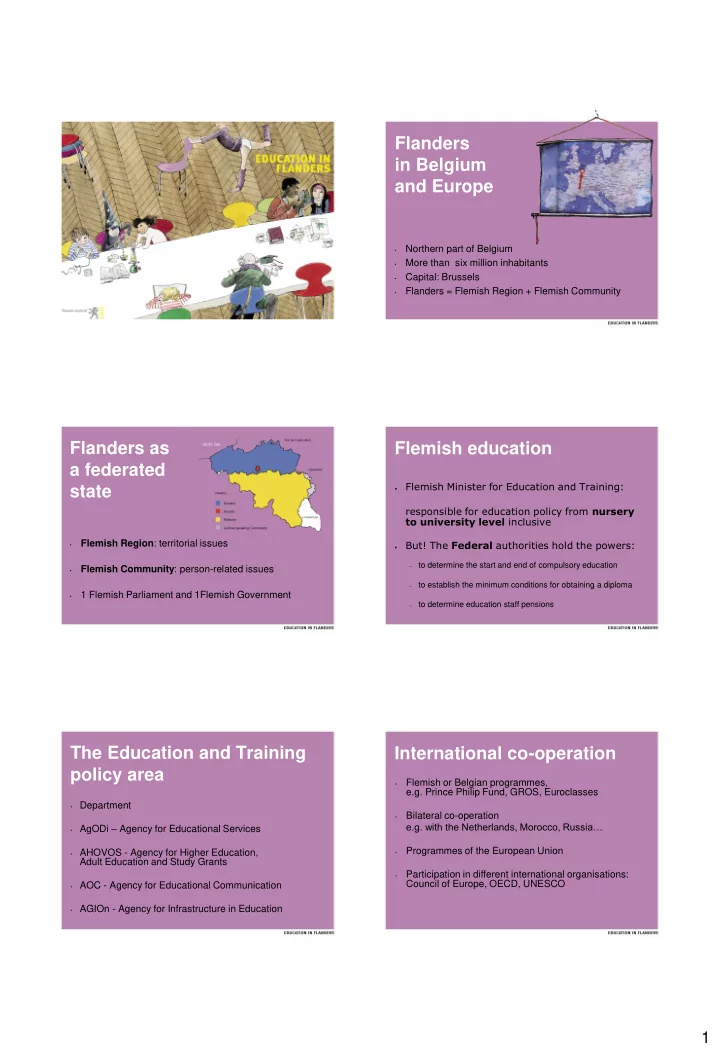
Flanders in Belgium and Europe Northern part of Belgium More than six million inhabitants Capital: Brussels Flanders = Flemish Region + Flemish Community Flanders as Flemish education a federated Flemish Minister for


slide-1
SLIDE 1

1

  • Northern part of Belgium
  • More than six million inhabitants
  • Capital: Brussels
  • Flanders = Flemish Region + Flemish Community

Flanders in Belgium and Europe Flanders as a federated state

  • Flemish Region: territorial issues
  • Flemish Community: person-related issues
  • 1 Flemish Parliament and 1Flemish Government

Flemish education

  • Flemish Minister for Education and Training:

responsible for education policy from nursery to university level inclusive

  • But! The Federal authorities hold the powers:

–

to determine the start and end of compulsory education

–

to establish the minimum conditions for obtaining a diploma

–

to determine education staff pensions

The Education and Training policy area

  • Department
  • AgODi – Agency for Educational Services
  • AHOVOS - Agency for Higher Education,

Adult Education and Study Grants

  • AOC - Agency for Educational Communication
  • AGIOn - Agency for Infrastructure in Education

International co-operation

  • Flemish or Belgian programmes,

e.g. Prince Philip Fund, GROS, Euroclasses

  • Bilateral co-operation

e.g. with the Netherlands, Morocco, Russia…

  • Programmes of the European Union
  • Participation in different international organisations:

Council of Europe, OECD, UNESCO

slide-2
SLIDE 2

2 Programmes of the European Union

  • Lifelong Learning Programme (LLP):

–

4 sub-programmes: Comenius, Erasmus, Leonardo da Vinci, Grundtvig

–

Transversal programme

–

Jean Monnet programme

  • Implementation of LLP by EPOS vzw
  • EPOS: (European Programmes for Education,

Training and Co-operation) School population in full-time education per level

  • f education (2006-2006 school year)

School population in adult education and part-time arts education (2006-2006 school year)

Education in Flanders: general principles

  • Compulsory education
  • Freedom of education
  • Equal opportunities in education
  • Educational networks
  • Financing education
  • Controlling education costs
  • Autonomy
  • Participation
  • Organisation of the school and academic year

Compulsory education

  • Principle: right to education
  • Start: 1 September of the calendar

year in which the child reaches the age of 6

  • End: at the age of 18 or 30 June
  • f the calendar year in which the child

reaches the age of 18

  • Full-time compulsory education until 15 or 16
  • Compulsory education ≠ compulsory school attendance

 home education is possible

Freedom of education

  • Constitution: freedom of education
  • Every natural or legal person has

the right to organise education and establish institutions for this purpose

  • Governing bodies or school boards
  • Parental freedom of choice
slide-3
SLIDE 3

3

Equal opportunities in education (GOK)

  • Act on equal opportunities in education

–

right to enrolment

–

local consultation platforms

–

additional needs provision

  • Go to www.ond.vlaanderen.be/GOK

Educational networks

  • Representative association of governing bodies
  • 3 educational networks :

–

GO!

–

publicly funded, publicly run education

–

publicly funded, privately run schools

  • Publicly run and privately run education

Financing education

  • 8.86 billion euro (2007)

= 40 % of the Flemish budget

  • Costs of schools:

–

staffing costs: paid by the Ministry of Education and Training

–

Operating costs: through financing or funding of schools

Education budget per level of education (2007) Education budget for every category of expenditure (2007)

New financing system

  • 2 pillars of the new financing system:

1.

Treated on equal footing

2.

Financing is partly based on the social profile of the school population = pupil characteristics

slide-4
SLIDE 4

4

Pupil characteristics

  • 4 (research-based) indicators are very accurate in

predicting pupil performance:

–

the level of education of the parents

–

the home language

–

the family income

–

the neighbourhood in which a child lives

  • Schools get more means if they have a lot of pupils

meeting one or more of these indicators

Cost control

  • Access to nursery, primary and secondary education:

free of charge

  • School materials in nursery and primary education:

–

for developmental objectives and attainment targets: free of charge

–

'double maximum invoice' from 1 September 2008

–

informing parents on list of costs (e.g. for meals)

Cost control

  • School materials in secondary education:

–

certain costs for educational activities and teaching aids

–

list of costs in school regulations

–

pupils and parents have a say beforehand

  • Detailed information at www.schoolkosten.be

Autonomy

  • Towards greater local accountability
  • More responsibility for:

–

education providers

–

pupils, students and parents

  • At all levels
  • f education

Central participation structures

  • VLOR (Flemish Education Council):

–

council of all education stakeholders

–

gives advice to the Minister and to the Flemish Parliament

  • VLIR (Flemish Interuniversity Council):

–

advisory body for university education

  • VLHORA (Flemish Council for Non-University Higher

Education):

–

advisory body for the colleges of higher education

  • VOC (Flemish Negotiating Committee):

–

negotiating committee for higher education

Local participation structures

  • Nursery, primary and secondary education:

–

school council:

  • general right to information
  • advisory powers
  • consultative powers
  • communication duties

–

educational council

–

pupil council

–

parent council

–

parents’ association

slide-5
SLIDE 5

5

Local participation structures

  • Higher education:

–

student council

–

negotiating committees

–

academic council

–

works council

The legal position of staff

  • Flemish Parliament Acts on the legal position of staff:

–

for publicly funded education

–

for GO! education

  • Permanent appointment
  • Bigger autonomy with regard to the policy on human

resources cf job descriptions and evaluations

  • Staff members of colleges of higher education and

universities have a separate legal position

Organisation of the school

  • Nursery, primary and secondary schools +

adult education centres : school year

–

Start : 1 September

–

End: 30 June (31 August)

and academic year Organisation of the school and academic year

  • Centres for adult basic education:

respect the school year system in practice

  • Higher education : academic year

–

start: between 1 September and 1 October

–

end: day before the start of the next academic year

Levels of education

  • Nursery and primary education (BaO)
  • Secondary education (SO)
  • Higher education (HO)
  • Part-time arts education (DKO)
  • Adult education (VO)

Structure of education

slide-6
SLIDE 6

6

Organisation of compulsory education (nursery, primary and secondary education)

  • The schools cluster:

a collection of different schools of the same level of education (nursery, primary and secondary education), which work together at various levels (logistics, education provision)

Organisation of compulsory education (nursery, primary and secondary education)

  • Number of teaching periods determines the number
  • f teachers
  • Number of hours to call in child carers

(mainstream nursery education)

  • A funding envelope for the provision of care on the

basis of the total number of pupils

  • A funding envelope for management and support staff

Structure of nursery and primary education

  • Mainstream nursery and primary education

–

nursery education (2.5 to 6 years)

–

primary education (6 to 12 years)

  • Special nursery and primary education

–

nursery education

–

primary education

Structure of nursery and primary education

  • Special nursery and primary education

–

for children who need special help, temporarily or permanently

–

8 types: reform of learning support

  • Integrated nursery and

primary education (GON)

Content of nursery and primary education

  • Developmental objectives:

–

mainstream nursery education

–

special nursery and primary education types 1, 2, 7 and 8

  • Attainment targets: mainstream primary education
  • Cross-curricular attainment targets

Structure of secondary education

  • Full-time secondary education

(12 to 18 years)

–

mainstream secondary education

–

special secondary education providing 4 types of education reform: learning support

–

integrated secondary education (GON)

slide-7
SLIDE 7

7 Structure of secondary education

  • Part-time secondary (from 15 or 16 years)

–

part-time vocational secondary education

–

apprenticeship VIZO-Syntra

–

recognised part-time training programmes

new Flemish Parliament Act on ‘learning and working’

Full-time secondary education

  • Stages: 1st to 4th stage
  • Types of education (from 2nd stage onwards):

–

general secondary education (ASO)

–

technical secondary education (TSO)

–

secondary arts education (KSO)

–

vocational secondary education (BSO)

  • Courses of study

Content of secondary education

  • Attainment targets: mainstream secondary education

–

subject-related attainment targets

–

cross-curricular attainment targets (VOETen)

–

specific attainment targets (2nd & 3rd stage of ASO)

  • Developmental objectives : special secondary education

Content of secondary education

  • From 2nd stage: final choice of subjects with a common

and an optional part

  • Diploma of secondary education gives unlimited access

to higher education

Higher Education

  • Bachelor courses
  • Master courses
  • Further training programmes

Postgraduates and updating and in-service training courses

  • Doctoral programmes

Higher Education

  • Higher professional education

–

  • nly professionally-oriented bachelor courses

–

  • nly provided by colleges of higher education
  • Academic education

–

both bachelor and master courses

–

provided by both universities and colleges of higher education (association)

  • Association: inter-institutional co-operation between a

university and one or more colleges of higher education

slide-8
SLIDE 8

8

Bachelor courses

  • Min. 180 ECTS (= European Credit Transfer System)
  • Professional bachelor
  • Academic bachelor
  • Bachelor after bachelor course: min. 60 ECTS

Master course

  • Min. 60 ECTS
  • After completion of an academic bachelor course
  • r a bridging programme
  • Master after master course: min. 60 ECTS

Part-time arts education

  • Extra learning for children and adults
  • Artistic education
  • Enrolment fee
  • 4 courses of study:

–

visual arts

–

music

–

wordcraft

–

dance

Adult education

  • Entirely separate from the initial educational pathway
  • Enrolment fee
  • Linear (being phased out) & modular courses
  • Contact and combined education

Adult education

  • 3 levels of education
  • Adult basic education

 adult basic education centres

  • Secondary adult education

Higher vocational education

 adult education centres

Support and quality control

  • Pupil Guidance Centres (CLBs)
  • Information and communication technologies
  • Communication
  • Quality control and quality promotion
slide-9
SLIDE 9

9 Pupil Guidance Centres (CLBs)

  • Information, help and guidance
  • For parents, pupils, teachers, school management

teams.

  • Guidance provided by CLBs:

–

learning and studying

–

the school career

–

preventive health care

–

social and emotional development

ICT

  • Cross-curricular attainment

targets and developmental

  • bjectives (1 September 07)
  • REN: Regional Network
  • f Experts
  • 5 pillars of Flemish policy:

–

strengthening the policy-making power

–

improving the expertise of education staff

–

infrastructure

–

an appropriate policy on teaching resources

–

encouraging research and ICT monitoring

Communication

  • Informing and promoting involvement
  • Parents, pupils, school management teams, teachers…

–

www.ond.vlaanderen.be

–

Klasse

–

publications (paper and/or electronic)

–

information events (Tours of Flanders…)

Quality control and quality promotion

  • Nursery, primary, secondary, part-time arts education,

CLBs & adult education centres

  • 3 pillars:

–

attainment targets and developmental objectives

–

the inspectorate: school audits

  • r centre audits

–

educational guidance

Quality control and quality promotion

  • School or centre audits

 inspectorate assessess the implementation of attainment

targets and developmental objectives

 inspection reports available to the public  in case of shortcomings : calling in the educational guidance

service (PBD),

  • Act on ‘Quality Management’ is being prepared

Quality control and quality promotion

  • Higher education

 Internal quality control  External quality control through a visitation (public report)

  • Accreditation = international recognition of a training

programme

slide-10
SLIDE 10

10

Education - labour market

  • Testing grounds
  • Modularisation
  • Competence agenda
  • Higher vocational education
  • Lifelong learning

Education - labour market

  • Modularisation

–

Training courses in modules instead of stages or study years

–

each finished moduleincreasing chances on the labour market

  • Testing grounds

–

projects of schools experimenting in an environment with few regulations

–

themes: ‘technology’, ‘on-the-job learning' and ‘study and career choice’ …

The Competence Agenda 2010

  • Matching education to labour market needs

–

Action 1: study and career choice

–

Action 2: development of workplace learning

–

Action 3: development of a sense of entrepreneurship

–

Action 4: accreditation of experiential learning (APEL)

Higher vocational education

  • Training courses of adult education + 7th specialist

years in TSO and KSO + 4th stages of BSO

  • Organised not only in adult education centres but also

in secondary schools and colleges of higher education

  • Development of higher vocational education in close

co-operation with professional sectors

Lifelong learning

  • Changing needs of the labour market

 lifelong learning is necessary

  • Flexibilisation of learning pathways by means of:

–

distance learning

–

recognition of competencies acquired elsewhere (APEL)

–

dual learning pathways

–

evening courses…

Study financing

  • Adjustment of legislation:

–

also part-time vocational and nursery and primary education

–

the same income limits for higher, secondary & nursery and primary education

–

increase of grant amounts

–

grants linked to regular school attendance

–

changes in the nationality condition

–

changes in educational conditions

slide-11
SLIDE 11

11

Anti-truancy campaign

  • Young people playing truant are often those who need

education very badly.

  • Actions: awareness-raising, information, prevention,…
  • Shared responsibility:

Young people, CLBs, parents, schools, police, doctors…

  • www.ond.vlaanderen.be/leerplicht

Participation of pre-schoolers

  • Children not attending nursery school

–

At risk of falling behind in learning or language skills

–

pre-schooler participation is needed in order to guarantee equal

  • pportunities in education
  • Various policy measures:

–

awareness-raising, increasing the number of pre-school entry classes, care staff member

Health policy

  • Healthy schools:

 learning & doing healthy things  of paramount importance for the

less encouraged-at-home children

Aiming high for languages

  • Mastering the school language

 increases equal opportunities in education

  • Language competences are important

–

both Dutch and foreign languages

  • Language policy supported by all teachers

Learning support

  • Describes learning support in mainstream & special

education

  • Replaces current typology in special education (8 types)
  • The learning support matrix:

–

4 levels of learning support

–

4 clusters/target groups

  • www.ond.vlaanderen.be/leerzorg

Teacher training reform

  • Integrated teacher training 180 ECTS

= professional bachelor in colleges of higher education

  • Specific teacher training course

–

after having gained a diploma of higher or adult education

–

at universities, adult education centres and colleges of higher education

slide-12
SLIDE 12

12

Teacher training reform

  • 1 diploma of teacher

based on a single set of key competences

  • Content of curriculums is reinforced
  • More practical experience

–

pre-service training

–

in-service training

Study credit

  • Each student of a college of higher education or

university

  • Encourages an informed study choice
  • Enrolment when study credit is zero

 enrolment is only possible with the consent of the institution  an increase of enrolment fee is possible

Study credit

Study credit Starting capital 140 credits At enrolment Minus credits enrolled for End of academic year plus credits earned First 60 credits earned are doubled On completion of a master Minus 140 credits

Rational energy use (REG)

  • In this way more resources can be spent on

content of education

  • Pupils learn about sustainable development
  • REG measures:

–

Awareness-raising and grants from the authorities see www.energiesparen.be

–

E70 directive

–

passive schools