Deprescribing: with any corporate organization offering financial A - - PDF document

deprescribing
SMART_READER_LITE
LIVE PREVIEW

Deprescribing: with any corporate organization offering financial A - - PDF document

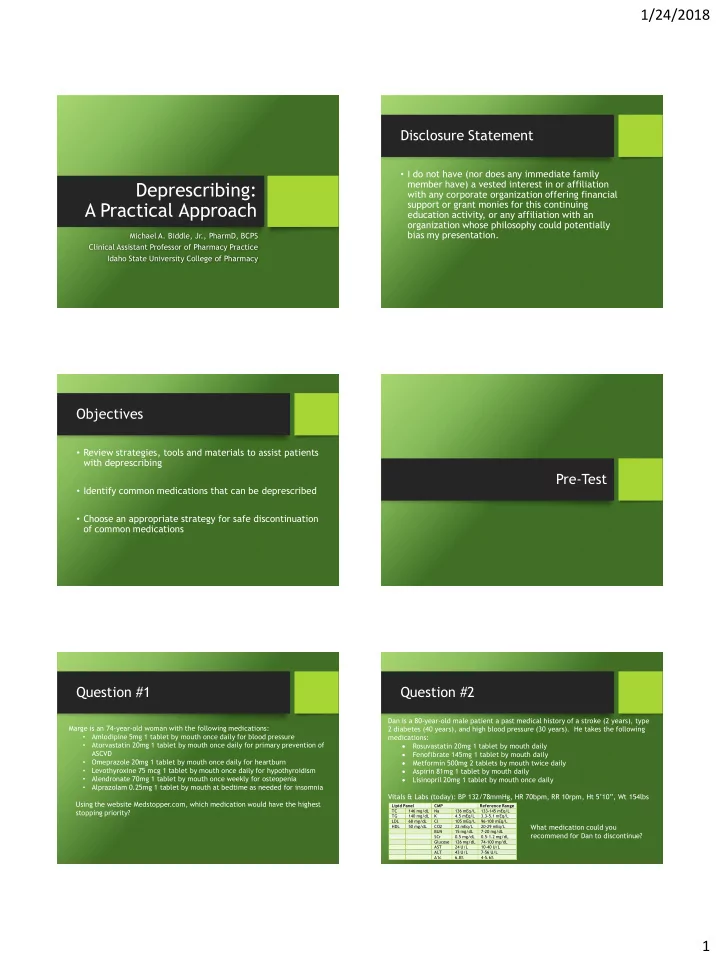
1/24/2018 Disclosure Statement I do not have (nor does any immediate family member have) a vested interest in or affiliation Deprescribing: with any corporate organization offering financial A Practical Approach support or grant monies for


slide-1
SLIDE 1

1/24/2018 1

Deprescribing: A Practical Approach

Michael A. Biddle, Jr., PharmD, BCPS Clinical Assistant Professor of Pharmacy Practice Idaho State University College of Pharmacy

Disclosure Statement

  • I do not have (nor does any immediate family

member have) a vested interest in or affiliation with any corporate organization offering financial support or grant monies for this continuing education activity, or any affiliation with an

  • rganization whose philosophy could potentially

bias my presentation.

Objectives

  • Review strategies, tools and materials to assist patients

with deprescribing

  • Identify common medications that can be deprescribed
  • Choose an appropriate strategy for safe discontinuation
  • f common medications

Pre-Test Question #1

Marge is an 74-year-old woman with the following medications:

  • Amlodipine 5mg 1 tablet by mouth once daily for blood pressure
  • Atorvastatin 20mg 1 tablet by mouth once daily for primary prevention of

ASCVD

  • Omeprazole 20mg 1 tablet by mouth once daily for heartburn
  • Levothyroxine 75 mcg 1 tablet by mouth once daily for hypothyroidism
  • Alendronate 70mg 1 tablet by mouth once weekly for osteopenia
  • Alprazolam 0.25mg 1 tablet by mouth at bedtime as needed for insomnia

Using the website Medstopper.com, which medication would have the highest stopping priority?

Question #2

Dan is a 80-year-old male patient a past medical history of a stroke (2 years), type 2 diabetes (40 years), and high blood pressure (30 years). He takes the following medications:  Rosuvastatin 20mg 1 tablet by mouth daily  Fenofibrate 145mg 1 tablet by mouth daily  Metformin 500mg 2 tablets by mouth twice daily  Aspirin 81mg 1 tablet by mouth daily  Lisinopril 20mg 1 tablet by mouth once daily Vitals & Labs (today): BP 132/78mmHg, HR 70bpm, RR 10rpm, Ht 5’10”, Wt 154lbs

Lipid Panel CMP Reference Range TC 146 mg/dL Na 136 mEq/L 133-145 mEq/L TG 140 mg/dL K 4.5 mEq/L 3.3-5.1 mEq/L LDL 68 mg/dL Cl 105 mEq/L 96-108 mEq/L HDL 50 mg/dL CO2 22 mEq/L 20-29 mEq/L BUN 15 mg/dL 7-20 mg/dL SCr 0.5 mg/dL 0.5-1.2 mg/dL Glucose 126 mg/dL 74-100 mg/dL AST 24 U/L 10-40 U/L ALT 43 U/L 7-56 U/L A1c 6.8% 4-5.6%

What medication could you recommend for Dan to discontinue?

slide-2
SLIDE 2

1/24/2018 2

Question #3

Which of the following medications do NOT need to be tapered to prevent a discontinuation syndrome?

  • A. Omeprazole
  • B. Diazepam
  • C. Atorvastatin
  • D. Metoprolol succinate
  • E. Alendronate

Deprescribing Overview Defining Deprescribing

  • “Systematic process of identifying and discontinuing

drugs in instances in which existing or potential harms

  • utweigh existing or potential benefits within the

context of an individual patient’s care goals, current level of functioning, life expectancy, values and preferences.”

  • Scott IA, et al.
  • “The process of withdrawal of an inappropriate

medication, supervised by a health care professional with the goal of managing polypharmacy and improving

  • utcomes”
  • Reeve E, et al.

Scott IA, Hilmer SN, Reeve E, et al. Reducing inappropriate polypharmacy: the process of deprescribing. JAMA Intern Med. 2015:175:827-34. Reeve E, Gnjidic D, Long J, et al. A systematic review of the emerging definition of ‘deprescribing’ with netowrk analysis: implications for future research and clinical practice. Br J Clin Pharmacol. 2015;80:1254-68

Deprescribing Process

  • 1. Obtain a complete medication list with

indications for each medication

  • 2. Assess each medication for the risk of drug-

induced harm

  • 3. Evaluate the appropriateness of each

medication

  • 4. Prioritize drugs for discontinuation
  • 5. Implement a discontinuation plan and

monitor the patient’s progress

Scott IA, Hilmer SN, Reeve E, et al. Reducing inappropriate polypharmacy: the process of deprescribing. JAMA Intern Med. 2015:175:827-34.

Deprescribing Algorithm

Scott IA, Hilmer SN, Reeve E, et al. Reducing inappropriate polypharmacy: the process of deprescribing. JAMA Intern Med. 2015:175:827-34.

Safety Concerns of Deprescribing

  • Adverse drug withdrawal events
  • Physiological reactions to withdrawal
  • Associated with corticosteroids, CNS agents and PPIs
  • Can be prevented by tapering but could still occur

during the taper

  • Serious harm is rare

Reeve E, Moriarty F, Nahas R, et al. A narrative review of the safety concerns of deprescribing in older adults and strategies to mitigate potential harms. Expert Opin Drug Saf. 2018;17:39-49.

slide-3
SLIDE 3

1/24/2018 3

Safety Concerns of Deprescribing

  • Return of medical condition
  • Prevalence of return varies between conditions
  • Close monitoring can minimize the consequences
  • Restarting the discontinued medication can revert

symptoms to baseline

  • Deprescribing preventative medications can be more

challenging due to difficulty in monitoring

  • Difficult to know if breaks in therapy will have long

term effects

Reeve E, Moriarty F, Nahas R, et al. A narrative review of the safety concerns of deprescribing in older adults and strategies to mitigate potential harms. Expert Opin Drug Saf. 2018;17:39-49.

Safety Concerns of Deprescribing

  • Reversal of drug-drug interactions
  • Limited research in this area
  • Consider pharmacokinetic and pharmacodynamic

implications of drugs being discontinued

  • Enzyme inducers or inhibitors
  • Effects on drugs with narrow therapeutic indexes

Reeve E, Moriarty F, Nahas R, et al. A narrative review of the safety concerns of deprescribing in older adults and strategies to mitigate potential harms. Expert Opin Drug Saf. 2018;17:39-49.

Barriers to Deprescribing

  • Provider Barriers
  • Concern about contradicting a specialist’s recommendation
  • Fear of causing withdrawal symptoms or disease relapse
  • Lack of data to assess risks and benefits with older patients
  • Worry that discussing life expectancy and deprescribing may be

interpreted as a reduction in care

  • Pressure from guideline recommendations
  • Limited time to discuss discontinuation
  • Addressing Barriers
  • Work as as team to develop a collaborative, patient-centered plan
  • Clearly communicate with all providers involved in the patient’s care
  • Include patient-specific factors and evidence-based risk/benefit

assessments to support deprescribing decisions

  • When available, use evidence-based deprescribing guidelines and

algorithms

Scott IA, Hilmer SN, Reeve E, et al. Reducing inappropriate polypharmacy: the process of deprescribing. JAMA Intern Med. 2015:175:827-34.

Barriers to Deprescribing

  • Patient Barriers
  • Fear of the condition worsening or returning
  • Previous negative experience with deprescribing
  • Influence from friends, family, etc.
  • Hope of future effectiveness
  • Addressing Barriers
  • Include the patient and caregivers in the process
  • Shared decision making
  • Provide education about risks and benefits
  • Provide a clear plan that includes managing withdrawal

symptoms

  • Provide ongoing support and monitoring to reassure the

patient and caregivers

Scott IA, Hilmer SN, Reeve E, et al. Reducing inappropriate polypharmacy: the process of deprescribing. JAMA Intern Med. 2015:175:827-34. Bemben NM. Deprescribing: An application to medication management in older adults. Pharmacotherapy. 2016;36:774-780.

Deprescribing Through Shared Decision Making

  • Step 1: Creating awareness that options exist
  • Step 2: Discussing the options and their benefits and

harms

  • Step 3: Exploring patient preferences for the different
  • ptions
  • Step 4: Making the decision

Jansen J, Naganathan V, Carter SM, et al. Too much medicine in older people? Deprescribing through shared decision making.

  • BMJ. 2016;353:i2893.

Deprescribing Tools

slide-4
SLIDE 4

1/24/2018 4

Beers Criteria

  • Lists of potentially inappropriate medications

for older patients

  • Lists of medications that should be avoided or

adjusted based on kidney function and drug- drug interactions

  • Does not include suggestions for how to

discontinue medications

American Geriatric Society 2015 Beers Criteria Update Expert Panel. American Geriatrics Society 2015 updated Beers criteria for potentially inappropriate medication use in older adults. J Am Geriatr Soc. 2105;63:2227-2246.

STOPP/START Criteria

  • Screening Tool for Older People’s Prescriptions

(STOPP) and Screening Tool to Alert to Right Treatment (START)

  • Screening tool for older patients to identify

potentially inappropriate (STOPP) and appropriate (START) medications

  • Does not include suggestions for how to

discontinue medications

O’Mahoney D, O’Sullivan D, Byrne S, et al. STOPP/START criteria for potentially inappropriate medication use in older adults. J Am Geriatric Soc. 2015;44:213-218.

Deprescribing.org

  • Deprescribing algorithms and guidelines for

PPIs, benzodiazepines, antipsychotics and antihyperglycemics

  • Deprescribing information pamphlets and

patient decision aids

  • Links to additional resources

Medstopper.com

  • Tool for identifying medications to reduce or discontinue
  • Provides a stopping priority for each of the patients

medications

  • Cites Beers and STOPP criteria when applicable
  • Includes recommendations for suggested tapers and

symptoms to watch for when discontinuing medications

  • Some medications have links to patient decision tools

for calculating risks and benefits

Primary Health Tasmania

  • Primary Health Tasmania Website
  • http://www.primaryhealthtas.com.au/resources/deprescribing
  • Deprescribing guides and fact sheets for several drug classes
  • Sulfonylureas, statins, PPIs, opioids, NSAIDs, glaucoma eye drops,

cholinesterase inhibitors, bisphosphonates, benzodiazepines, antipsychotics, antiplatelet agents, antihypertensive agents, allopurinol, and vitamin D & calcium.

  • Deprescribing Quick Reference Guide for all drug classes

covered

  • Fact sheets discuss risks and benefits of the medication class

as well as strategies for limiting discontinuation syndromes

A Practical Guide to Stopping Medications in Older People

  • Available at:
  • http://www.bpac.org.nz/BPJ/2010/April/stopguide.aspx
  • Overview of general deprescribing concepts
  • Specific guidance on stopping several common

medications

  • Includes tapers and withdrawal effects (when applicable)
  • Antidepressants, benzodiazepines, antihypertensive,

statins, warfarin, NSAIDs, acid suppressants, oral corticosteroids, antiparkinsonian medications and bisphosphonates

  • Does not discuss risks and benefits
slide-5
SLIDE 5

1/24/2018 5

Deprescribing Common Medications Antipsychotics Antipsychotics: Why Deprescribe?

  • Limited evidence to support use in patients

with dementia

  • Limited evidence for treating insomnia in

patients without psychosis

  • Increased risk of cardiovascular, metabolic and

cognitive adverse effects

McGrath K, Haijar ER, Kumar C, et al. Deprescribing: A simple method for reducing polypharmacy. J Fam Pract. 2017;66:436-445. Bjerre LM, Farrell B, Hogel M, et al. Deprescribing antipsychotics for behavioral and psychological symptoms of dementia (BPSD) and insomnia: an evidence-based clinical practice guideline. Available at: http://www.open-pharmacy-research.ca/evidence-based- deprescribing-algorithm-for-antipsychotics/.

Antipsychotics: How to deprescribe?

  • Decrease dose by 25-50% every 1-2 weeks over 3-6 months in patients

with dementia.

  • If taking for insomnia (usually low doses), can stop without taper
  • Monitor every 1-2 weeks for return of neuro-psychiatric symptoms
  • If symptoms return:
  • Attempt behavioral interventions
  • Restart at lowest dose possible and try deprescribing again in 3 months (2

attempts should be made)

  • Consider change to risperidone, olanzapine, aripiprazole

McGrath K, Haijar ER, Kumar C, et al. Deprescribing: A simple method for reducing polypharmacy. J Fam Pract. 2017;66:436-445. Bjerre LM, Farrell B, Hogel M, et al. Deprescribing antipsychotics for behavioral and psychological symptoms of dementia (BPSD) and insomnia: an evidence-based clinical practice guideline. Available at: http://www.open-pharmacy-research.ca/evidence-based- deprescribing-algorithm-for-antipsychotics/.

Benzodiazepines Benzodiazepines: Why Deprescribe?

  • Can cause confusion and increase risk of falls
  • Not indicated for treatment of insomnia
  • Discontinuation can improve cognition and

psychomotor abilities

McGrath K, Haijar ER, Kumar C, et al. Deprescribing: A simple method for reducing polypharmacy. J Fam Pract. 2017;66:436-445. Farrell B, Thompson W, Davies S et al. Evidenced-based clinical practice guideline for deprescribing benzodiazepine receptor

  • agonists. Unpublished manuscript. Available at: http://www.open-pharmacy-research.ca/evidence-based-deprescribing-algorithm-

for-benzodiazepines/

slide-6
SLIDE 6

1/24/2018 6

Benzodiazepines: How to deprescribe?

  • Decrease by 25% every 2 weeks then 12.5% reductions near the end
  • f the taper if possible or drug planned drug-free days
  • Provide education and recommend supportive strategies
  • Behavior change strategies
  • Talk therapy
  • Monitor every 1-2 weeks for duration of taper
  • If symptoms relapse:
  • Continue current dose for 1-2 weeks then resume taper at a slower rate
  • Recommend alterative medications for insomnia

McGrath K, Haijar ER, Kumar C, et al. Deprescribing: A simple method for reducing polypharmacy. J Fam Pract. 2017;66:436-445. Farrell B, Thompson W, Davies S et al. Evidenced-based clinical practice guideline for deprescribing benzodiazepine receptor

  • agonists. Unpublished manuscript. Available at: http://www.open-pharmacy-research.ca/evidence-based-deprescribing-algorithm-

for-benzodiazepines/

Cholinesterase Inhibitors Cholinesterase Inhibitors: Why Deprescribe?

  • Only indicated for mild to moderate

Alzheimer’s disease

  • Minimal benefit in patients with severe dementia
  • Used to slow progression and provide

symptomatic relief

  • Do not stop or reverse progression
  • Can cause abdominal pain, anorexia, diarrhea,

nausea, vomiting, and weight loss

Bemben NM. Deprescribing: An application to medication management in older adults. Pharmacotherapy. 2016;36:774-780.

Cholinesterase Inhibitors: Candidates for deprescribing

  • Patients who:
  • Do not improve within 3 months of initiating therapy
  • Institutionalized patients with severe dementia who

have been treated for at least 2 years

  • Have adverse effects
  • Have dementia that has progressed to a point where

slowing progression is no longer reasonable

  • Feel the medication is no longer working

Bemben NM. Deprescribing: An application to medication management in older adults. Pharmacotherapy. 2016;36:774-780.

Cholinesterase Inhibitors: How to deprescribe?

  • Taper off over 2-4 weeks
  • Monitor for 1-3 months
  • If symptoms worsen, reinitiate therapy

Bemben NM. Deprescribing: An application to medication management in older adults. Pharmacotherapy. 2016;36:774-780.

Proton Pump Inhibitors

slide-7
SLIDE 7

1/24/2018 7

Proton Pump Inhibitors: Why Deprescribe?

  • Limited indications for long-term use
  • Potential for drug-drug interactions
  • Have been associated with an increase risk for

bone fractures, pneumonia, C. difficile infections.

  • Can decrease absorption of vitamin B12, iron and

magnesium

McGrath K, Haijar ER, Kumar C, et al. Deprescribing: A simple method for reducing polypharmacy. J Fam Pract. 2017;66:436-445.

Proton Pump Inhibitors: How to deprescribe?

  • Decrease to a lower dose and/or decrease dosing

frequency then stop

  • Monitor closely for rebound symptoms
  • If rebound occurs:
  • Try nonpharmacologic therapy (diet changes, weight loss)
  • Intermittent dosing of antacids or H2RAs
  • If symptoms continue for 3-7 days and interfere with daily

activities:

  • Test and treat for H. pylori
  • Consider return to previous dose

McGrath K, Haijar ER, Kumar C, et al. Deprescribing: A simple method for reducing polypharmacy. J Fam Pract. 2017;66:436-445. Farrell B, Pottie K, Thomposon W, et al. Deprescribing proton pump inhibitors. Can Fam Physician. 2017;63:354-364.

NSAIDs/ASA (>325mg/day) NSAIDs/ASA (>325mg/day): Why Deprescribe?

  • Worsen chronic kidney disease (CKD),

congestive heart failure (CHF) and blood pressure

  • Increase risk of acute kidney injury
  • Cause or worsen ulcers

McGrath K, Haijar ER, Kumar C, et al. Deprescribing: A simple method for reducing polypharmacy. J Fam Pract. 2017;66:436-445.

NSAIDs/ASA (>325mg/day): How to deprescribe?

  • For osteoarthritis, switch to acetaminophen or stop medications (no taper

needed)

  • For inflammatory conditions, may need a slow taper to limit pain
  • Monitor pain symptoms
  • If pain returns and is localized:
  • Consider topical NSAIDs or corticosteroid injections
  • If pain returns is severe and/or non-localized
  • Restart at lowest effective dose
  • Consider using a COX-2 inhibitor plus a PPI for patients at risk for GI bleeding

McGrath K, Haijar ER, Kumar C, et al. Deprescribing: A simple method for reducing polypharmacy. J Fam Pract. 2017;66:436-445. Deprescribing Clinical Reference Group. NSAIDs. Available at: http://www.primaryhealthas.com.au/resources/deprescribing.

Statins

slide-8
SLIDE 8

1/24/2018 8

Statins: Why Deprescribe?

  • Limited evidence for patients >80 years of age
  • Older patients are at higher risk for statin-related

side effects such as myopathy

  • Quality of life is improved in patients with limited

life expectancy

  • Benefits may continue for 5+ years after

discontinuation

McGrath K, Haijar ER, Kumar C, et al. Deprescribing: A simple method for reducing polypharmacy. J Fam Pract. 2017;66:436-445. Bemben NM. Deprescribing: An application to medication management in older adults. Pharmacotherapy. 2016;36:774-780.

Statins: Candidates for deprescribing

  • Patients who:
  • Are >80 years of age
  • Using statins for primary prevention and have been

taking them for >5 years

  • Have a life expectancy <5 years
  • Are experiencing significant side effects (myopathy)

McGrath K, Haijar ER, Kumar C, et al. Deprescribing: A simple method for reducing polypharmacy. J Fam Pract. 2017;66:436-445. Bemben NM. Deprescribing: An application to medication management in older adults. Pharmacotherapy. 2016;36:774-780.

Statins: How to deprescribe?

  • Stop the statin
  • No taper necessary

McGrath K, Haijar ER, Kumar C, et al. Deprescribing: A simple method for reducing polypharmacy. J Fam Pract. 2017;66:436-445. Bemben NM. Deprescribing: An application to medication management in older adults. Pharmacotherapy. 2016;36:774-780.

Antihypertensives Antihypertensives: Why Deprescribe?

  • Low blood pressure may be associated with

increased morbidity and mortality

  • Patients with postural hypotension are more

likely to fall when being treated for hypertension

  • Elderly patients are more sensitive to adverse

drug effects

  • Diuretics can cause hypotension and incontinence

Deprescribing Clinical Reference Group. Antihypertensive agents. Available at: http://www.primaryhealthas.com.au/resources/deprescribing. McGrath K, Haijar ER, Kumar C, et al. Deprescribing: A simple method for reducing polypharmacy. J Fam Pract. 2017;66:436-445.

Antihypertensives: Candidates for deprescribing

  • Patients who:
  • Frail elderly and/or immobile
  • At high fall risk
  • Have confirmed postural hypotension
  • >20mmHg fall in systolic and/or >10mmHg fall in

diastolic BP when staining

Deprescribing Clinical Reference Group. Antihypertensive agents. Available at: http://www.primaryhealthas.com.au/resources/deprescribing. McGrath K, Haijar ER, Kumar C, et al. Deprescribing: A simple method for reducing polypharmacy. J Fam Pract. 2017;66:436-445.

slide-9
SLIDE 9

1/24/2018 9

Antihypertensives: How to deprescribe?

  • If blood pressure is below target
  • Reduce dose or number of antihypertension medications
  • Taper by 25% every month for 3-4 months
  • Monitor closely
  • Initiate lifestyle changes to support medication reduction
  • r cessation
  • Reinitiate if needed

Deprescribing Clinical Reference Group. Antihypertensive agents. Available at: http://www.primaryhealthas.com.au/resources/deprescribing. McGrath K, Haijar ER, Kumar C, et al. Deprescribing: A simple method for reducing polypharmacy. J Fam Pract. 2017;66:436-445.

Bisphosphonates Bisphosphonates: Why Deprescribe?

  • Benefits may persist long after discontinuation
  • Longer treatment may not provide additional

benefit

  • Especially in patients with low risk of falls and only

non-vertebral fractures

  • Oral bisphosphonates can cause upper GI adverse

effects

  • Increased risk of cardiac arrhythmias in patients

who zolendronic acid use for 9 years vs. 6 years

Bemben NM. Deprescribing: An application to medication management in older adults. Pharmacotherapy. 2016;36:774-780. Deprescribing Clinical Reference Group. Bisphosphonates. Available at: http://www.primaryhealthas.com.au/resources/deprescribing.

Bisphosphonates: Deprescribing

  • Patients with 3-5 years of therapy may be candidates

for a 1-2 year “drug holiday”

  • Monitor bone mineral density every 2 years
  • Reinitiate therapy if T-score drops below -2.5
  • Patients who should continue therapy:
  • Persistent high risk of fracture after 3-5 years of therapy
  • Very low T-score (-2.5 or below)
  • Suffered a fracture while on therapy

Bemben NM. Deprescribing: An application to medication management in older adults. Pharmacotherapy. 2016;36:774-780. Deprescribing Clinical Reference Group. Bisphosphonates. Available at: http://www.primaryhealthas.com.au/resources/deprescribing.

Antihyperglycemic Agents Antihyperglycemic Agents: Why Deprescribe?

  • Increased risk of hypoglycemia which can lead

to falls, fractures, and impaired cognition

  • Sulfonylureas have limited efficacy after 10

years of therapy due to decreased beta cell function

Deprescribing Clinical Reference Group. Sulphonylureas. Available at: http://www.primaryhealthas.com.au/resources/deprescribing. Farrell B, Black C, Thompson W, et al. Deprescribing antihyperglycemic agents in older patients. Can Fam Physician. 2017;63:832-843

slide-10
SLIDE 10

1/24/2018 10

Antihyperglycemic Agents: Candidates for deprescribing

  • Patients:
  • At risk of hypoglycemia
  • At risk for or experiencing adverse effects from

antihyperglycemic agents

  • With uncertainty about clinical benefits
  • Frail, dementia, limited life-expectancy

Farrell B, Black C, Thompson W, et al. Deprescribing antihyperglycemic agents in older patients. Can Fam Physician. 2017;63:832-843

Antihyperglycemic Agents: How to deprescribe?

  • Reduce dose or discontinue medication
  • Monitor blood sugars daily for 1-2 weeks after each

change

  • Up to 12 weeks for TZDs
  • If hyperglycemia occurs, return to previous dose or

consider starting an agent with lower risk of hypoglycemia

Deprescribing Clinical Reference Group. Sulphonylureas. Available at: http://www.primaryhealthas.com.au/resources/deprescribing. Farrell B, Black C, Thompson W, et al. Deprescribing antihyperglycemic agents in older patients. Can Fam Physician. 2017;63:832-843

Summary Take-Home Points

  • There are many tools and resources available to

assist both providers and patients with deprescribing

  • Successful deprescribing plans must involve the

patient and caregivers in the decision making process

  • When possible, use evidence-based guidelines,

algorithms and titration schedules to develop deprescribing plans

Post-Test Question #1

Marge is an 74-year-old woman with the following medications:

  • Amlodipine 5mg 1 tablet by mouth once daily for blood pressure
  • Atorvastatin 20mg 1 tablet by mouth once daily for primary prevention of

ASCVD.

  • Omeprazole 20mg 1 tablet by mouth once daily for heartburn.
  • Levothyroxine 75 mcg 1 tablet by mouth once daily for hypothyroidism.
  • Alendronate 70mg 1 tablet by mouth once weekly for osteopenia.
  • Alprazolam 0.25mg 1 tablet by mouth at bedtime as needed for insomnia.

Using the website Medstopper.com, which medication would have the highest stopping priority?

Answer: Alprazolam

slide-11
SLIDE 11

1/24/2018 11

Question #2

Dan is a 80-year-old male patient a past medical history of a stroke (2 years), type 2 diabetes (40 years), and high blood pressure (30 years). He takes the following medications:  Rosuvastatin 20mg 1 tablet by mouth daily.  Fenofibrate 145mg 1 tablet by mouth daily.  Metformin 500mg 2 tablets by mouth twice daily.  Aspirin 81mg 1 tablet by mouth daily.  Lisinopril 20mg 1 tablet by mouth once daily. Vitals & Labs (today): BP 132/78mmHg, HR 70bpm, RR 10rpm, Ht 5’10”, Wt 154lbs

Lipid Panel CMP Reference Range TC 146 mg/dL Na 136 mEq/L 133-145 mEq/L TG 140 mg/dL K 4.5 mEq/L 3.3-5.1 mEq/L LDL 68 mg/dL Cl 105 mEq/L 96-108 mEq/L HDL 50 mg/dL CO2 22 mEq/L 20-29 mEq/L BUN 15 mg/dL 7-20 mg/dL SCr 0.5 mg/dL 0.5-1.2 mg/dL Glucose 126 mg/dL 74-100 mg/dL AST 24 U/L 10-40 U/L ALT 43 U/L 7-56 U/L A1c 6.8% 4-5.6%

What medication could you recommend for Dan to discontinue?

Answer: Fenofibrate

Question #3

Which of the following medications do NOT need to be tapered to prevent a discontinuation syndrome?

  • A. Omeprazole
  • B. Diazepam
  • C. Atorvastatin
  • D. Metoprolol succinate
  • E. Alendronate

Answers: Atorvastatin & alendronate

Questions/Discussion