design rules general understanding Standards and guidelines - - PDF document

design rules
SMART_READER_LITE
LIVE PREVIEW

design rules general understanding Standards and guidelines - - PDF document

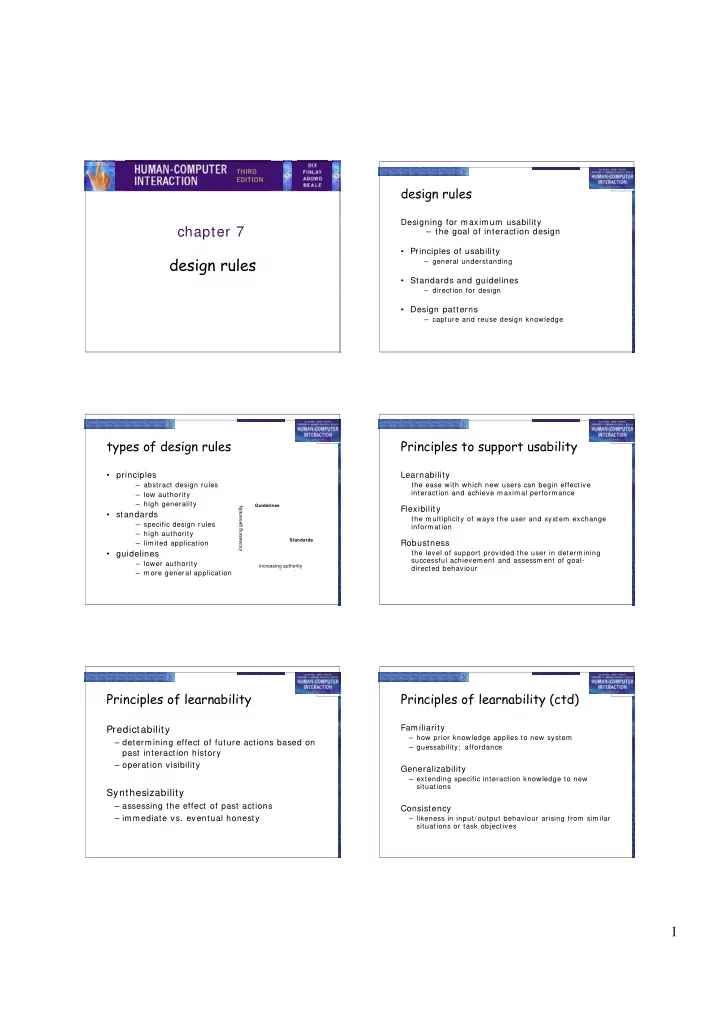
design rules Designing for m axim um usability chapter 7 the goal of interaction design Principles of usability design rules general understanding Standards and guidelines direction for design Design patterns


slide-1
SLIDE 1

1 chapter 7

design rules

design rules

Designing for m axim um usability – the goal of interaction design

  • Principles of usability

– general understanding

  • Standards and guidelines

– direction for design

  • Design patterns

– capture and reuse design knowledge

types of design rules

  • principles

– abstract design rules – low authority – high generality

  • standards

– specific design rules – high authority – lim ited application

  • guidelines

– lower authority – m ore general application

increasing authority increasing generality

Standards Guidelines increasing authority increasing generality

Principles to support usability

Learnability

the ease with which new users can begin effective interaction and achieve m axim al perform ance

Flexibility

the m ultiplicity of ways the user and system exchange inform ation

Robustness

the level of support provided the user in determ ining successful achievem ent and assessm ent of goal- directed behaviour

Principles of learnability

Predictability

– determ ining effect of future actions based on past interaction history – operation visibility

Synthesizability

– assessing the effect of past actions – immediate vs. eventual honesty

Principles of learnability (ctd)

Fam iliarity

– how prior knowledge applies to new system – guessability; affordance

Generalizability

– extending specific interaction knowledge to new situations

Consistency

– likeness in input/ output behaviour arising from sim ilar situations or task objectives

slide-2
SLIDE 2

2

Principles of flexibility

Dialogue initiative

– freedom from system im posed constraints on input dialogue – system vs. user pre-em ptiveness

Multithreading

– ability of system to support user interaction for m ore than one task at a tim e – concurrent vs. interleaving; m ultim odality

Task m igratability

– passing responsibility for task execution between user and system

Principles of flexibility (ctd)

Substitutivity

– allowing equivalent values of input and

  • utput to be substituted for each other

– representation m ultiplicity; equal opportunity

Customizability

– m odifiability of the user interface by user (adaptability) or system (adaptivity)

Principles of robustness

Observability

– ability of user to evaluate the internal state of the system from its perceivable representation – browsability; defaults; reachability; persistence;

  • peration visibility

Recoverability

– ability of user to take corrective action once an error has been recognized – reachability; forward/ backward recovery; com m ensurate effort

Principles of robustness (ctd)

Responsiveness

– how the user perceives the rate of com m unication with the system – Stability

Task conformance

– degree to which system services support all

  • f the user's tasks

– task com pleteness; task adequacy

Using design rules

Design rules

  • suggest how to increase usability
  • differ in generality and authority

increasing authority increasing generality Standards Guidelines

increasing authority increasing generality

Standards

  • set by national or international bodies to

ensure compliance by a large community of designers standards require sound underlying theory and slowly changing technology

  • hardware standards more common than

software high authority and low level of detail

  • ISO 9241 defines usability as effectiveness,

efficiency and satisfaction with which users accom plish tasks

slide-3
SLIDE 3

3

Guidelines

  • m ore suggestive and general
  • m any textbooks and reports full of guidelines
  • abstract guidelines (principles) applicable

during early life cycle activities

  • detailed guidelines (style guides) applicable

during later life cycle activities

  • understanding justification for guidelines aids

in resolving conflicts

Golden rules and heuristics

  • “Broad brush” design rules
  • Useful check list for good design
  • Better design using these than using nothing!
  • Different collections e.g.

– Nielsen’s 10 Heuristics (see Chapter 9) – Shneiderm an’s 8 Golden Rules – Norm an’s 7 Principles

Shneiderman’s 8 Golden Rules

  • 1. Strive for consistency
  • 2. Enable frequent users to use shortcuts
  • 3. Offer inform ative feedback
  • 4. Design dialogs to yield closure
  • 5. Offer error prevention and simple error

handling

  • 6. Permit easy reversal of actions
  • 7. Support internal locus of control
  • 8. Reduce short-term m em ory load

Norman’s 7 Principles

  • 1. Use both knowledge in the world and

knowledge in the head.

  • 2. Sim plify the structure of tasks.
  • 3. Make things visible: bridge the gulfs of

Execution and Evaluation.

  • 4. Get the m appings right.
  • 5. Exploit the power of constraints, both natural

and artificial.

  • 6. Design for error.
  • 7. When all else fails, standardize.

HCI design patterns

  • An approach to reusing knowledge about

successful design solutions

  • Originated in architecture: Alexander
  • A pattern is an invariant solution to a

recurrent problem within a specific context.

  • Exam ples

– Light on Two Sides of Every Room (architecture) – Go back to a safe place (HCI )

  • Patterns do not exist in isolation but are linked

to other patterns in languages which enable complete designs to be generated

HCI design patterns (cont.)

  • Characteristics of patterns

– capture design practice not theory – capture the essential common properties of good examples

  • f design

– represent design knowledge at varying levels: social,

  • rganisational, conceptual, detailed

– embody values and can express what is humane in interface design – are intuitive and readable and can therefore be used for communication between all stakeholders – a pattern language should be generative and assist in the development of complete designs.

slide-4
SLIDE 4

4

Summary

Principles for usability

– repeatable design for usability relies on m axim izing benefit of one good design by abstracting out the general properties which can direct purposeful design – The success of designing for usability requires both creative insight (new paradigm s) and purposeful principled practice

Using design rules

– standards and guidelines to direct design activity