Determining wildlife population and habitat status in the Thunder - - PowerPoint PPT Presentation

determining wildlife population and habitat status in the
SMART_READER_LITE
LIVE PREVIEW

Determining wildlife population and habitat status in the Thunder - - PowerPoint PPT Presentation

Determining wildlife population and habitat status in the Thunder Bay Area of Concern Thunder Bay AOC | Public Advisory Committee Meeting | Thunder Bay, ON | Greg Grabas | Environment Canada | May 6, 2015 Mission Marsh Delisting Criteria -


slide-1
SLIDE 1

Determining wildlife population and habitat status in the Thunder Bay Area of Concern

Thunder Bay AOC | Public Advisory Committee Meeting | Thunder Bay, ON | Greg Grabas | Environment Canada | May 6, 2015
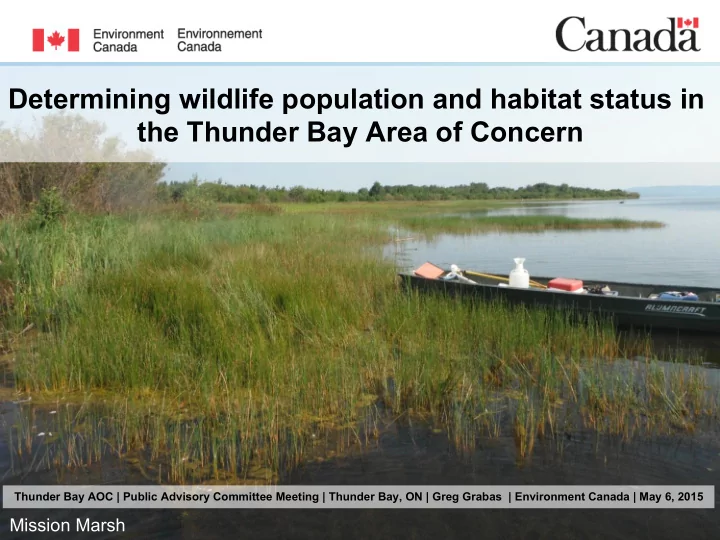
Mission Marsh

slide-2
SLIDE 2

Page 2 – August 12, 2015

Delisting Criteria - Wildlife

Populations

That the wildlife community (at a population level) does not differ significantly from suitable Lake Superior reference sites. Or Monitoring data shows that the wildlife community (at a population level) does not differ significantly from the abundance that would be expected from the amount and quality of physical, chemical, and biological habitat typical of the Area of Concern.

Habitat

This beneficial use will no longer be impaired when riparian, wetland, and coastal habitat within the Thunder Bay AOC is in compliance with the guidelines set out through Environment Canada's How Much Habitat is Enough? (2004) – Habitat Change Detection Analysis (2012). In addition, remaining and created wetlands must be protected from further degradation through existing environmental legislation. Provincial standards should be used to inventory and classify wetlands within the Thunder Bay AOC.

slide-3
SLIDE 3

Site 2 1 American Bittern 2 American White Pelican 3 Bald Eagle 2 Barn Swallow 2 Belted Kingfisher 1 Brown-headed Cowbird 6 Blue-winged Teal 3 Clay-colored Sparrow 4 Common Merganser 5 Common Nighthawk 2 Common Raven 12 Common Yellowthroat 14 Double-crested Cormorant 1 Great Blue Heron 3 Green-winged Teal 2 Herring Gull 5 Mallard 7 Red-winged Blackbird 4 Sora 3 Song Sparrow 2 Wood Duck 1 White-throated Sparrow 1 Yellow-rumped Warbler 1 Yellow Warbler Site 1 3 American Bittern 1 Common Yellowthroat 4 Great Blue Heron 4 Green-winged Teal 1 Herring Gull 2 Mallard 1 Merlin 2 Osprey 4 Red-breasted Merganser 20 Red-winged Blackbird 4 Sora 5 Swamp Sparrow 2 Swainson's Thrush 1 Tree Swallow 1 Veery 3 Wood Duck 1 White-throated Sparrow 1 Yellow-rumped Warbler 1 Yellow Warbler

Which site has a ‘better’ bird community ?

Swamp Sparrow American Bittern Sora

slide-4
SLIDE 4

Page 4 – August 12, 2015

Use several ‘metrics’ to define condition of biotic communities

Metric Metric Metric Metric Metric Metric Index of Biotic Integrity (IBI)

Sturgeon Bay

Use Index of Biotic Integrity to determine the condition of wildlife communities

slide-5
SLIDE 5

Page 5 – August 12, 2015

How are indices developed?

Community Attribute Increasing Physical/Chemical Disturbance

A B B

Suitable metric

slide-6
SLIDE 6

Page 6 – August 12, 2015

slide-7
SLIDE 7

Page 7 – August 12, 2015

Use sites inside● and outside■ of the Area of Concern

slide-8
SLIDE 8

Page 8 – August 12, 2015

There are surrounding land use data for several wetlands

N 200 200 400 Meters

Open Water Wetland Beach and Bluff Woodlot and Forest Pasture and Idle Field Crop and Improved Residential Non-Residential Development Utility and Transportation

Land Use within 1,000 metres

slide-9
SLIDE 9

Key water quality parameters

  • pH – indicate pollution
  • Conductivity – from fertilizer and road salt
  • Turbidity – suspended sediment or biota
  • Temperature – cooler is better
  • Nitrogen – from sewage and fertilizer
  • Phosphorus – fertilizer and industrial
slide-10
SLIDE 10

Page 10 – August 12, 2015

Mixed conditions inside and outside

  • f the Area of Concern (out of 10)

Site (Thunder Bay) Condition Site (St. Mary’s River) Condition

Sturgeon Bay 7.01 Anderson Creek 5.74 Flathead Harbour 7.00 Carpin Beach 6.20 Cloud Bay 6.84 Desbarats Wetland 6.69 Northern Wood Preservers Marsh 6.81 Echo Bay 6.14 Mission Marsh 6.57 Hay Bay Wetland 4.56 Pine Bay 5.92 Joe Dollar Bay Wetland 6.22 Hurkett Cove 5.88 Lake George 4.43 Brule Bay 5.78 Maskinonge Bay 7.19 Blende Rivermouth Wetland 5.43 Pumpkin Point 4.12 Chippewa Marsh 5.43 Stobie Creek 6.57 Neebing Marsh 5.09 West Shore, St. Joseph Island 3.24

slide-11
SLIDE 11

Page 11 – August 12, 2015

How are indices developed?

Community Attribute Increasing Physical/Chemical Disturbance

A B B

Suitable metric

slide-12
SLIDE 12

Page 12 – August 12, 2015

Marsh bird and amphibian surveys

  • Passive point count sampling
  • Secretive species call broadcast (birds)
  • 3-visits per wetland
slide-13
SLIDE 13

Submerged Aquatic Vegetation

  • 20 randomly placed

quadrats

  • All species and

coverage recorded

slide-14
SLIDE 14

Page 14 – August 12, 2015

Aquatic Macroinvertebrates

Cloud Bay

slide-15
SLIDE 15

Page 15 – August 12, 2015

Divide birds into guilds

Marsh User Marsh Nesting Bird Emergent Marsh Nesting Obligate Marsh Nesting Generalist Area-Sensitive Emergent Marsh Nesting Obligate Non-Area-Sensitive Emergent Marsh Nesting Obligate Marsh Foraging Bird Water Forager Aerial Forager Non-Aerial/ water Forager

slide-16
SLIDE 16

Page 16 – August 12, 2015

Breeding marsh bird community attributes that respond to disturbance

Clear relationship

  • Species richness of aerial and water foragers (-)
  • Abundance of aerial and water foragers (-)

Probable – more data required

  • Species richness of marsh nesting generalists (-)
  • Species richness of marsh nesting obligates (-)

Chippewa Marsh

slide-17
SLIDE 17

Page 17 – August 12, 2015

Mixed breeding bird community conditions inside and outside of the Area of Concern (out of 20)

Site Condition

Sturgeon Bay 15 Chippewa Marsh 12 Mission Marsh 12 Cloud Bay 11 Northern Wood Preservers Marsh 11 Pine Bay 11 Neebing Marsh 10 Hurkett Cove 9 Brule Bay 5

slide-18
SLIDE 18

Page 18 – August 12, 2015

Condition Location

Breeding bird community condition inside and

  • utside of the Area of Concern (out of 20)
slide-19
SLIDE 19

Page 19 – August 12, 2015

Macroinvertebrate community attributes that respond to disturbance

Clear relationship

  • Number of Crustacea and Mollusca genera (-)
  • Percent Crustacea and Mollusca genera (-)
  • Percent Amphipoda (-)
  • Percent Crustaceans (-)

Probable – more data required

  • Overall species richness (-)
  • Percent Chironomids (-)
slide-20
SLIDE 20

Page 20 – August 12, 2015

Site Condition

Pine Bay 20 Hurkett Cove 18 Sturgeon Bay 15 Cloud Bay 14 Chippewa Marsh 13 Blende Rivermouth Wetland 12 Brule Bay 11 Mission Marsh 7 Flathead Harbour 6 Neebing Marsh 6 Northern Wood Preservers Marsh 5

Macroinvertebrate community conditions inside Area

  • f Concern generally lower than outside (out of 20)
slide-21
SLIDE 21

Page 21 – August 12, 2015

Aquatic macroinvertebrate community condition inside the AOC is lower than outside

Location Condition

slide-22
SLIDE 22

Page 22 – August 12, 2015

No metrics identified for amphibian community

Probable – more data required

  • Species richness of woodland species (wood frog, spring

peeper, chorus frog, treefrog) (-)

  • Species richness of intolerant species (-) northern

leopard frog, pickerel frog, and wood Frog

  • Likelihood of detecting a rare species (-) northern leopard

frog, and pickerel frog Brule Bay

slide-23
SLIDE 23

Page 23 – August 12, 2015

No metrics identified for submerged aquatic vegetation community

Probable – more data required

  • Richness of turbidity tolerant species (+)
  • Average coefficient of conservatism (-)

Flathead Harbour

slide-24
SLIDE 24

Page 24 – August 12, 2015

Next steps

  • Collect more data
  • Rerun analyses
  • Recalibrate IBIs
  • Make decision on delisting paradigm

Cloud Bay