
SLIDE 1
18TH INTERNATIONAL CONFERENCE ON COMPOSITE MATERIALS
1 Introduction For wind turbines blades, composite materials are widely used because they can reduce the total weight while retaining the structural properties and because they have good tailoring and fatigue life
- characteristics. The tailoring capability of the
composite blade could be used to passively control the wind turbine response and results in a decrease
- f fatigue loads and the risk of flutter. However, the
aeroelastic codes in the wind energy fields such as HAWC2 still use the classical beam models. It cannot be used to investigate the coupling effects of anisotropic materials. It is shown in [1] that a typical wind turbine blade has very small couplings, but that these can be introduced easily by adding angled unidirectional layers. In this paper a new beam element which is able to consider anisotropic characteristics of a beam is developed and implemented into the structural part
- f the HAWC2.
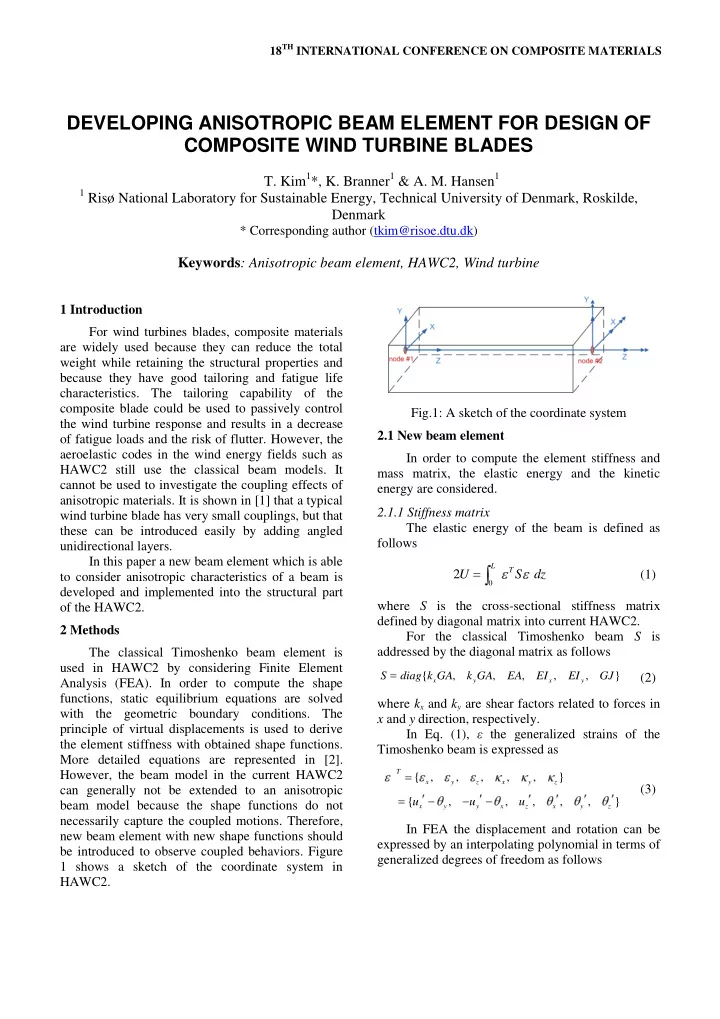
2 Methods The classical Timoshenko beam element is used in HAWC2 by considering Finite Element Analysis (FEA). In order to compute the shape functions, static equilibrium equations are solved with the geometric boundary conditions. The principle of virtual displacements is used to derive the element stiffness with obtained shape functions. More detailed equations are represented in [2]. However, the beam model in the current HAWC2 can generally not be extended to an anisotropic beam model because the shape functions do not necessarily capture the coupled motions. Therefore, new beam element with new shape functions should be introduced to observe coupled behaviors. Figure 1 shows a sketch of the coordinate system in HAWC2. Fig.1: A sketch of the coordinate system 2.1 New beam element In order to compute the element stiffness and mass matrix, the elastic energy and the kinetic energy are considered. 2.1.1 Stiffness matrix The elastic energy of the beam is defined as follows 2
L T
U S dz (1) where S is the cross-sectional stiffness matrix defined by diagonal matrix into current HAWC2. For the classical Timoshenko beam S is addressed by the diagonal matrix as follows
{ , , , , , }
x y x y
S diag k GA k GA EA EI EI GJ
(2) where kx and ky are shear factors related to forces in x and y direction, respectively. In Eq. (1), ε the generalized strains of the Timoshenko beam is expressed as
{ , , , , , } { , , , , , }
T x y z x y z x y y x z x y z
u u u
(3) In FEA the displacement and rotation can be expressed by an interpolating polynomial in terms of generalized degrees of freedom as follows
DEVELOPING ANISOTROPIC BEAM ELEMENT FOR DESIGN OF COMPOSITE WIND TURBINE BLADES
- T. Kim1*, K. Branner1 & A. M. Hansen1