Developing physiologically-based toxicokinetic (PBTK) models to - PowerPoint PPT Presentation
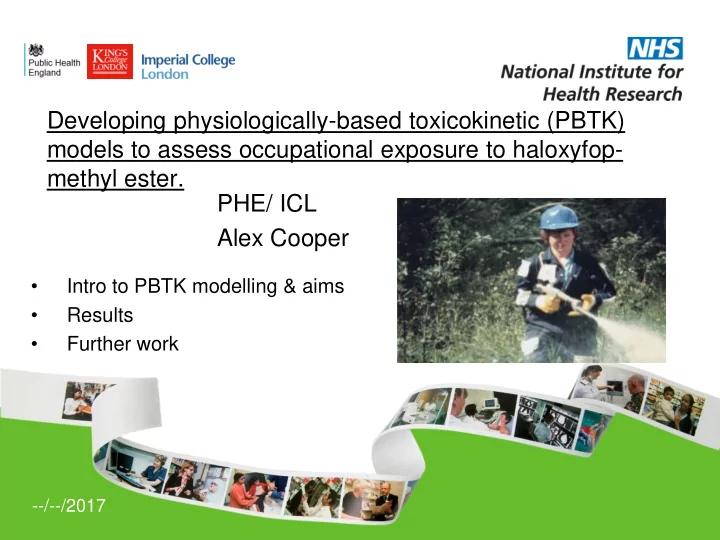
Developing physiologically-based toxicokinetic (PBTK) models to assess occupational exposure to haloxyfop- methyl ester. PHE/ ICL Alex Cooper Intro to PBTK modelling & aims Results Further work --/--/2017 PBTK modelling
Developing physiologically-based toxicokinetic (PBTK) models to assess occupational exposure to haloxyfop- methyl ester. PHE/ ICL Alex Cooper • Intro to PBTK modelling & aims • Results • Further work --/--/2017
PBTK modelling
Project overview Construct rodent PBTK models for herbicides Calibrate parameters common to both species Calibrate models with rodent toxicokinetic data Calibrate Calibrate mouse- Exposure human- specific reconstruction specific Extrapolate models to parameters parameters humans Human Human Mouse biomonitoring data toxicokinetic toxicokinetic data data Exposure reconstruction with human biomonitoring data
Hypothesis & aims Hypothesis: PBTK models can be calibrated and used to accurately calculate tissue exposures for use in risk assessment. Aims: • To investigate if there are different biologically-plausible approaches to fitting toxicokinetic data in the same rodent PBTK model, and once extrapolated to humans, whether these have different implications for internal exposure assessment. • To reconstruct human external exposure, using a calibrated human PBTK model and human biomonitoring data. • To infer exposure in target tissues of interest using a calibrated human PBTK model.
Case study: haloxyfop-methyl ester peroxisome liver toxicity Inhibits proliferation (NOAEL is 0.5 mg/ Kg bw/ ACCase day) ÷ 100 Acceptable Operator Exposure Limit (AOEL) is 0.005 mg/ Kg/ day - AOEL is ‘the maximum internal (absorbed) amount of active substance to which operator may be exposed (from all absorption routes) without adverse health effects’ (European Commission) - expressed as internal levels (mg/ kg bw/ day)
Octanol: water partition coefficient (logP o:w ) for haloxyfop-P • assay performed to provide additional biochemical data for model calibration • performed as described in OECD (1995), and modified to resemble physiological conditions (37 ° C, using PBS pH 7.4 for aqueous layer). • No significant difference between both experimental conditions (p = 0.85,α = 0.05; n = 10). • QSAR value is 3.93!
Fit liver toxicokinetic data PPAR α Model liver receptor transporter activity binding (NO PPAR α receptor binding)
Maximum tissue exposure (individual C) Extrapolate from mouse (with PPAR α receptor binding) Concentration (ng/ g-tissue) Extrapolate from mouse (with liver transporter activity)
Risk assessment: Operator maximum systemic exposure Extrapolate from mouse (with PPAR α receptor binding) Dose (mg/ Kg bw) UK-POEM model AOEL German model A B C Extrapolate from mouse (with liver transporter activity) Dose (mg/ Kg bw) A B C
Take home message PBTK models can be calibrated and used to accurately calculate tissue exposures for use in risk assessment
Further work • Determine concentration ratio between human blood & plasma • Fraction unbound in human plasma • Partition coefficient between veg. oil & water • Assess exposure to brominated flame retardants
Thanks Tim Ebbels Matt Puncher Manoj Aggarwal Gwyn Lord Michael Bartels Tim Gant Claire Terry Tina Mehta www.nihr.ac.uk
Recommend
More recommend
Explore More Topics
Stay informed with curated content and fresh updates.