
SLIDE 1
Developing mathematical pedagogy in the early years: Number sense Session 1: Games
Sue Gifford S.Gifford@roehampton.ac.uk
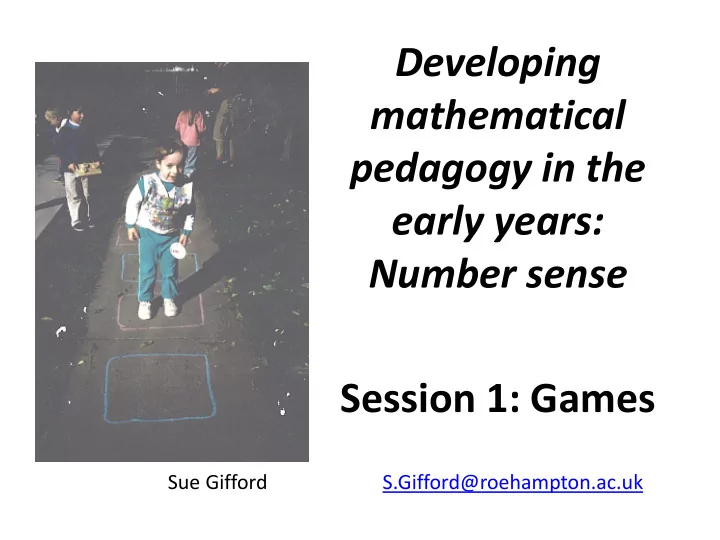
Developing mathematical pedagogy in the early years: Number sense - - PowerPoint PPT Presentation
Developing mathematical pedagogy in the early years: Number sense Session 1: Games Sue Gifford S.Gifford@roehampton.ac.uk What predicts maths success? What research tells us in the early years: p arents education and home learning
Sue Gifford S.Gifford@roehampton.ac.uk
What predicts maths success?
What research tells us in the early years:
at primary school:
Anxiety blocks working memory space
Fixed mindsets
Children’s understanding of number during preschool is consistently associated with their mathematical achievement in primary and secondary school. Mathematical achievement in turn is consistently found to be the strongest predictor of children’s
entering the workforce. (Early Intervention Foundation 2018)
Erikson Early Math Collaborative Ball skills predict maths - Interceptive timing The neural circuitry used to build up a child’s understanding of their external environment, the way they orientate themselves spatially.. is also used to process numbers and more abstract thinking. Mon-Williams (2018) University of Leeds, Psychological Science https://www.tes.com/news/clumsy-children-need- extra-help-three-rs
Children count reliably with numbers from one to 20, place them in order and say which number is one more or one less than a given number. Using quantities and objects, they add and subtract two single-digit numbers and count on or back to find the answer. They solve problems, including doubling, halving and sharing.
(DfE, 2012)
Children at the expected level of development will:
names of numbers, numerals, their value, and their position in the counting order;
up to 5;
0-5 and for 10, including corresponding partitioning facts.
Children at the expected level of development will:
contexts, considering size and difference;
up to 10, including evens and odds
Number sense: a feeling for numbers ‘Five is a number which is medium small’
NCETM: Main areas of early years maths
So children need a lot of counting opportunities!
What helps Anna count?
http://prek-math-te.stanford.edu/patterns- algebra/patterns-counting-words
Key assessment: Counting out a number from a larger group
Young-Loveridge (1991)
The cardinal principle - last number you say is the number of the group
the number of things represented by the number
All at once finger numbers
https://www.learningtrajectories.org/activity/fantastic-five-tricky-two
When do children see number symbols linked to numbers of things in school?
High SES - 96% Low SES -18%
Gersten et al (2005)
Children need to link:
Griffiths, Back & Gifford (2016) Making numbers
4 more people to vote: what might happen?
A rich mental model for a mental number line?
A rich mental model for a mental number line?
(Laski & Siegler 2014)
The Estimation Station
https://nrich.maths.org/content/id/13339/Estimation%20Station.pdf
You can pick 2 out of every 100 I picked 4 because I thought there were about 200!
(Trundley 2008 NRICH)
Janine Davenall
Erikson early math:
making a staircase pattern from a story
(SFON)
See NRICH for examples
your right.
Play with a dot dice, then a numeral dice. What might you observe and assess? Questioning and comments? How might you adapt and develop?
Try out and develop some games: – Collecting, Target, Track, Estimating ? – indoors and outdoors – scoring and recording Bring or send notes and photos! Check your school policy on photos first.
References
Davenall, J. (2015) Developing Number Through Tidying Up http://nrich.maths.org/11528 Early intervention Foundation (2018) Key competencies in early cognitive development: Things, people, numbers and words. Public Health England https://www.eif.org.uk/report/key-competencies-in-early-cognitive-development-things-people- numbers-and-words Gersten, R., Jordan, N. C., & Flojo, J. R. (2005). Early identification and interventions for students with mathematics difficulties. Journal of Learning Disabilities, 38, 293–304. Gifford, S. (2005) Teaching mathematics to 3 – 5s: developing learning in the Foundation Stage Maidenhead: Open University Press Gifford, S. (2014) ‘A good foundation for number learning for five year olds: an evaluation of the English Early Learning ‘Numbers’ Goal in the light of research’. Research in Mathematics Education 16 (3) 219-233 Griffiths, R., Back,J. & Gifford, S. (2016) Making numbers: using manipulatives to teach arithmetic. Oxford: Oxford University Press Laski,E.V. & Siegler, R.S.(2014) Learning from number board games: you learn what you encode Developmental Psychology 50 (3) 853-864 Rittle-Johnson,B., Fyfe,E.R., Hofer, K.G., Farran, D.C. (2016) Early math trajectories: low income children’s trajectory mathematics knowledge from ages 4 to 11, Child Development DOI: 10.1111/cdev.12662 Siraj-Blatchford, I., Sylva, K., Muttock, S., Gilden, R. and Bell, D. (2002) Researching Effective Pedagogy in the Early Years, (REPEY) Research Report 356. London: Department of Education and Skills. www.327matters.org/Docs/RR356.pdf Trundley, R. (2008). The value of two. Mathematics Teaching, 211, 17–21 http://nrich.maths.org/11527 Young-Loveridge, J. (1991). The development of children’s number concepts from ages five to nine. Hamilton: University of Waikato.