Developing SCA Based Wideband Networking Waveforms Mark Turner and - - PowerPoint PPT Presentation

developing sca based wideband networking waveforms
SMART_READER_LITE
LIVE PREVIEW

Developing SCA Based Wideband Networking Waveforms Mark Turner and - - PowerPoint PPT Presentation

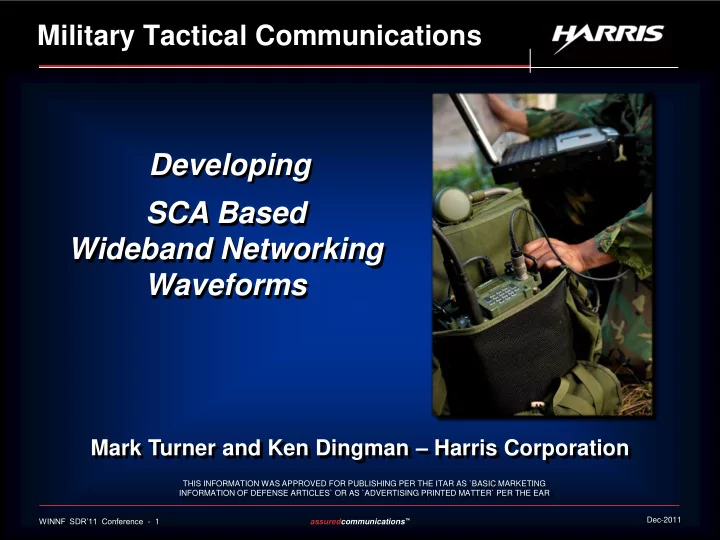
Military Tactical Communications Developing SCA Based Wideband Networking Waveforms Mark Turner and Ken Dingman Harris Corporation THIS INFORMATION WAS APPROVED FOR PUBLISHING PER THE ITAR AS `BASIC MARKETING INFORMATION OF DEFENSE


slide-1
SLIDE 1

WINNF SDR’11 Conference - 1 assuredcommunications™ Dec-2011

Developing

SCA Based Wideband Networking Waveforms

Mark Turner and Ken Dingman – Harris Corporation

Military Tactical Communications

THIS INFORMATION WAS APPROVED FOR PUBLISHING PER THE ITAR AS `BASIC MARKETING INFORMATION OF DEFENSE ARTICLES` OR AS `ADVERTISING PRINTED MATTER` PER THE EAR

slide-2
SLIDE 2

WINNF SDR’11 Conference - 2 assuredcommunications™ Dec-2011

Presentation Overview

  • Military Tactical Networking: objectives, architectural

vision and key characteristics.

  • Software Communications Architecture provides a

standardized foundation.

  • SCA based wideband networking waveforms: where

is the “state-of-the-art”?

  • Harris wideband networking waveform experiences.
  • Key lessons learned.
  • Conclusions.
slide-3
SLIDE 3

WINNF SDR’11 Conference - 3 assuredcommunications™ Dec-2011

SCA Networking Waveforms Military

Tactical Networking

slide-4
SLIDE 4

WINNF SDR’11 Conference - 4 assuredcommunications™

Tactical Networking Key Objectives

  • Realization of information superiority on the battlefield

through network extension deeper into the military enterprise, to forces operating at the “tactical edge”.

  • Provide timely and accurate content delivery (voice,

data and video).

  • Facilitate force self-synchronization, dynamic re-planning /

redirection and speed of command.

  • Facilitate “high reliability” communications in harsh RF

environments (mobility, propagation, interference).

  • Enabling use of collaboration applications such as

ISR, SA and biometrics.

Dec-2011

slide-5
SLIDE 5

WINNF SDR’11 Conference - 5 assuredcommunications™

Architectural Vision

  • Multiple interconnected network environments, i.e.,

air, ground, space, Global Information Grid (GiG) supporting variety of services.

– “Stub networks” focused on end user applications (i.e., ISR, Situation Awareness). – “Transit networks” provide interconnection of stub networks within and between disparate network environments, including interconnection to the GiG.

  • Internet Protocol (IP) serves as the common

language foundation across the overall network architecture (convergence layer).

Dec-2011

slide-6
SLIDE 6

WINNF SDR’11 Conference - 6 assuredcommunications™ Dec-2011

Example Network Architecture

Dismounted Warfighters

Mobile Services

Dismounted Leaders Mounted Leaders

Limited C5 Access Limited C4 Access Voice, SA

Handhelds with Additional Data Capabilities Handhelds, Manpacks With Additional Data and Video Capabilities Vehicular Systems Provide Data Link Between Dismount Forces and Cloud Infrastructure

“Move the Data”

“Thicken the Network” “Increase SA”

C4 Services “GIG Cloud” Services Objective CAS / ISR Platforms

slide-7
SLIDE 7

WINNF SDR’11 Conference - 7 assuredcommunications™

Key Characteristics

  • Mobile Ad Hoc Network (MANET)

– Scalable, dynamic network operating without a static infrastructure (i.e., cell towers, fiber optic cables). – Fast self-forming and self-healing network where nodes dynamically enter and leave.

  • Adaptation to varying RF channel conditions (i.e.,

interference, obstructions, node mobility)

– Wideband channels with “signals-in-space” optimizations – Advanced routing algorithms.

  • Security

– High assurance data security across combination of secure (without intermediate decryption) and non-secure networks. – Encrypted traffic transfer at multiple security levels.

Dec-2011

slide-8
SLIDE 8

WINNF SDR’11 Conference - 8 assuredcommunications™ Dec-2011

SCA Networking Waveforms SCA Provides a Standardized Foundation

slide-9
SLIDE 9

WINNF SDR’11 Conference - 9 assuredcommunications™ Dec-2011

Software Communications Architecture

  • Set of rules and protocols for SDR applications.
  • Component Based Design (CBD) technology.
  • Independence of Platform and Applications software.

Application Programmer Interfaces (APIs))

slide-10
SLIDE 10

WINNF SDR’11 Conference - 10 assuredcommunications™ Dec-2011

The SCA Today

  • Standardization is the key!
  • Developed as part of U.S. DoD JTRS Program.

– Specification (v2.2.2) & suite of APIs published by U.S. DoD. – Evolution continues (SCA “next” rolled out Dec-2010). – Change Management controlled by US DoD today.

  • Growing international acceptance

– EDA “Three Category Approach” for API standardization. – ESSOR program adoption of SCA v2.2.2 baseline. – Commercial tool suite emergence.

  • Wireless Innovation Forum “Coordinating Committee

for International SCA Standards”

– Coordination Model defined for harmonization

  • f standards portfolio.
slide-11
SLIDE 11

WINNF SDR’11 Conference - 11 assuredcommunications™ Dec-2011

Three Category API Approach

Category 1 International Open Standard Recognized ISO(s) Category 2 Multi-National Interests Coalition PMOs Category 3 Specific National Interest National Authorities Unclassified Unlimited distribution Examples: SCA v2.2.2 APIs (profiles in future) Unclassified Controlled and limited distribution Examples: Coalition Waveforms (COALWNW, HDR) Security APIs Classified Controlled and nationally limited distribution Examples: Crypto Algorithms

slide-12
SLIDE 12

WINNF SDR’11 Conference - 12 assuredcommunications™ Dec-2011

SCA Networking Waveforms Where is the

“State of the Art”?

slide-13
SLIDE 13

WINNF SDR’11 Conference - 13 assuredcommunications™

Soldier Radio Waveform (SRW) Characteristics

  • Objective: Battery powered stub network applications.
  • Operating Modes (SiS):

– Combat Communications (CC - wideband) – Electronic Warfare (EW – wideband AJ)

– LPI/LPD (Low Probability of Intercept/Detection - spread).

  • Each SiS supports a discrete set of bandwidths.
  • Frequency Range:

– 225 MHz to 420 MHz; 1.350 to 2.500 GHZ

  • Maximum data rate: 2 Mbps (CC mode)
  • MAC: Hybrid CSMA/TDMA

Dec-2011

slide-14
SLIDE 14

WINNF SDR’11 Conference - 14 assuredcommunications™

Wideband Networking Waveform (WNW) Characteristics

  • Objective: High capacity transit network applications.
  • Operating Modes (SiS):

– Orthogonal Frequency Domain Multiple Access (OFDM-WB) – Anti-jam (WB) – BEAM (NB) – LPI/LPD (Low Probability of Intercept/Detection--spread).

  • Each SiS has a variety of bandwidths, data rates.
  • Frequency Ranges:

– 225 to 420 MHz; 1.350 to 1.390 GHZ 1.755 to 1.850 GHz

  • Maximum data rate: 5 Mbps
  • MAC: USAP / TDMA

Dec-2011

slide-15
SLIDE 15

WINNF SDR’11 Conference - 15 assuredcommunications™

Harris Networking Waveform (ANW2) Characteristics (1 of 2)

  • Objective: Scalable to support either stub or transit

network configurations.

  • Adaptive SiS optimizes channel performance

– Suite of bandwidths from 500 KHz to 5 MHz. – Range of on-air data rates: 22 Kbps to ~ 10 Mbps. – Extremely robust vs. fading and multi-path conditions – Tolerant to interference with partial RX spectrum loss. – Same waveform can be demodulated in different ways to facilitate different platform implementations.

  • Network formation

– Subnet formation and synchronization < 30 secs. – Subnet healing time < 5 secs; Joining time < 5 secs.

Dec-2011

slide-16
SLIDE 16

WINNF SDR’11 Conference - 16 assuredcommunications™

Harris Networking Waveform (ANW2) Characteristics (2 of 2)

  • Self-Synchronizing scheme, no GPS required.
  • MANET Protocols (passive, pro-active and reactive)

with zone routing to optimize performance.

  • Black IP Routing and HAIPE for secure data transport.
  • Dedicated Digital Voice interval for traditional CNR

and multi-talker voice capability (true party line).

Dec-2011

slide-17
SLIDE 17

WINNF SDR’11 Conference - 17 assuredcommunications™

Networking Waveform Development

1999 2001 2005 2007 2011

PRC-117G SRW PRC-117G ANW2 Dev

NSA Cert

PRC-152A

2003 2009

SLICE SUO SAS JTRS HMS

SRW Development

Technology Development Productization

Harris Networking Development

Technology Development Productization

First Release

Dec-2011

slide-18
SLIDE 18

WINNF SDR’11 Conference - 18 assuredcommunications™

Future SCA Networking Waveforms

  • Coalition WB Networking Waveform (COALWNW)

– Multi-national effort to realize an IP-based WB networking waveform for tactical interoperability among coalition partners.

  • Australia, Finland, France, Germany, Italy, Spain, Sweden,

United Kingdom, United States.

– Phase 1: Consolidated and prioritized operational requirements (ORD approved January 2011). – Phase 2: Waveform design and development. – Phase 3: Interoperability testing.

  • ESSOR High Data Rate Waveform (HDR)

– Program effort to define and develop IP based WB networking waveform to support European coalition partners. – User traffic (voice, video, data); AJ features; LPI/LPD.

Dec-2011

slide-19
SLIDE 19

WINNF SDR’11 Conference - 19 assuredcommunications™ Dec-2011

SCA Networking Waveforms

Harris Experience

slide-20
SLIDE 20

WINNF SDR’11 Conference - 20 assuredcommunications™ Dec-2011

Harris SCA Pedigree

  • 1st radio provider with JTEL SCA certification.
  • 1st radio provider to put completed SCA

waveform into JTRS Information Repository.

  • 1st & only radio provider with JTEL SCA

certified radios without waivers – AN/PRC-152 HH and AN/PRC-117G MP radios

  • 1st & only JTRS fielded SCA waveforms.
  • 1st & only fielded SCA 30-2000 MHz radio with

NSA certified wideband networking.

  • Official “JTRS Approved” status from JPEO.
  • Completed SRW NSA Type1 Certification
  • Ported and demonstrated WNW WF from

JTRS IR.

Delivered > 150,000 SCA compliant radios

slide-21
SLIDE 21

WINNF SDR’11 Conference - 21 assuredcommunications™

Harris Falcon III Networking Radios

AN/PRC-117G AN/PRC-152A RF-7800M Size

7.4W x 3.7 H x 8.8 D in 2.0 W x 9.6 H x 2.5 D in (w/batt) 7.4W x 3.4 H x 8.8 D in

Weight

8 lbs 2.6 lbs w/ batt 8 lbs

Crypto Algs

KY-57, KYV-5, KG-84, HAIPE™, AES KY-57, KYV-5, KG-84, HAIPE™, AES AES, Citadel I and II

Power Output

NB: 10W; WB: 20W peak/5 W ave; SAT: 20W NB: 5W; WB:5W peak/2.5W ave SAT: 10W Burst Mode NB: 10W; WB: 20W peak/5 W ave;

SW Environment SCA 2.2

SCA 2.2 SCA 2.2

NB Waveforms

VHF/UHF LOS, SINCGARS, HQ I and II, DAMA, IW, HPW VHF/UHF LOS, SINCGARS, HQ I and II, HPW VHF/UHF LOS, QuickLook I and II

WB Waveforms

ANW2, Rover (opt) ANW2 ANW2, Rover (opt)

WB Channel Spacing

500kHz, 1.2MHz, 2.5MHz, 5MHz 500kHz, 1.2MHz, 2.5MHz, 5MHz 500kHz, 1.2MHz, 2.5MHz, 5MHz

Dec-2011
slide-22
SLIDE 22

WINNF SDR’11 Conference - 22 assuredcommunications™

ANW2 Development Experience

  • Incremental development approach

– Initial focus on key CONOPS; frequent user feedback. – Started with basic functionality (i.e. node counts, ranges, net formation, modem performance). – Significant investment to develop extensible network simulation capabilities. – Evolved domain knowledge along with waveform maturity.

  • Key waveform design concepts

– “Right size” waveform design (scale up vs. scale down).

  • Same waveform demodulated in different ways to facilitate scaling across

platforms with varying capabilities.

  • Exportable security services; Disadvantaged platforms

– Architectural choices to multiple wideband networking waveforms on a single platform. – Ensure voice communications even in the presence of overwhelming data traffic

Dec-2011

slide-23
SLIDE 23

WINNF SDR’11 Conference - 23 assuredcommunications™

ANW2 Networking Experience

  • ANW2 initially released on AN/PRC-117G MP Radio.
  • Deployed in field down to company and platoon

levels supporting multiple missions & applications.

– Missions: En route strategic air communications and communications on-the-move. – Applications: Chat, e-mail, data (sharepoint portal access) and full motion video over the SIPRNet. – “…first time in the history of Airborne Operations where commanders, while in flight, were able to receive and share SIPRNet data prior to exiting the aircraft”. [82nd Airborne]

Dec-2011

slide-24
SLIDE 24

WINNF SDR’11 Conference - 24 assuredcommunications™

Harris SRW Porting Experience

  • Ported version 1.01.1c to AN/PRC-117G MP radio

– Multiple drops taken from JTRS IR as waveform matured. – Significant analysis and prototyping.

  • Key Software Modifications

– PHY implementation used as reference design only. – Used radio supplied platform networking functions

  • Leveraged ANW2 DSP & FPGA components (i.e., sequencer).
  • Utilized OE MHAL

– GPP largely reusable. Worked stubs and code that wouldn’t build, throughput optimizations, update exception handling. – Secure traffic data handling

  • Maintain consistency with existing networking data flows.
  • API updates to optimize data copies, secure memory handling.

Dec-2011

slide-25
SLIDE 25

WINNF SDR’11 Conference - 25 assuredcommunications™

Harris SRW Networking Experience

  • Applications: voice, data, low rate video.
  • Validated implementation/models (or gold standard

radios) not available to verify interoperability in-house

– Required early and frequent joint interoperability testing with

  • ther SRW developers
  • Challenge to gain understanding of “anticipated” SRW

profiles/use case models.

– SRW working group facilitated knowledge exchange, significant focus on configuration parameters.

Dec-2011

slide-26
SLIDE 26

WINNF SDR’11 Conference - 26 assuredcommunications™ Dec-2011

SCA Networking Waveforms

Key Lessons Learned

slide-27
SLIDE 27

WINNF SDR’11 Conference - 27 assuredcommunications™ Dec-2011

SRW Key Lessons Learned

  • Quality, completeness of reference implementations

and design artifacts directly impacts porting efficiency.

  • Waveform application modifications driven by:

– Functional allocation to HW and SW processing frameworks. – SW threading model and real-time analysis. – Memory footprints and security architecture.

  • Philosophical differences in exception handling.

– Exceptions used to handle status conditions and lack of pre- condition testing, conflicting with standard C++ classes.

  • Configurability

– Can provide value, but can also impact interoperability.

  • Configuration management strategy/plan essential

– Isolate changes; Move large components en-masse. – Wrap ported functionality to minimize interface changes.

slide-28
SLIDE 28

WINNF SDR’11 Conference - 28 assuredcommunications™

ANW2 Key Lessons Learned

  • MANET waveforms offer almost limitless use cases.

– Bound use cases through categorization and profiles where possible, especially for disadvantaged platforms. – Test and verification of wideband networking waveforms requires significant scale, including applications validation.

  • Wideband networking waveforms DSP and FPGA

implementations heavily dependent on RF hardware.

– Standardization of transceiver interface is opportunity minimize porting effort and ensure consistent performance.

  • “Right size” waveform definition and design facilitates

application across multiple platform domains.

– Identify least capable platform and define functionality for it. – “Scale up” capabilities to less disadvantaged platforms.

Dec-2011

slide-29
SLIDE 29

WINNF SDR’11 Conference - 29 assuredcommunications™

Conclusions

  • Military tactical communications being shaped through

wideband networking waveform technology.

– Voice, data and video connectivity down to “tactical edge”. – Facilitates speed of command, force self-synchronization, dynamic re-planning & redirection, collaboration applications.

  • AN/PRC-117G (C) only fielded SCA 30 – 2000 MHz

radio with NSA certified wideband networking.

– ANW2 Waveform deployed today; SRW testing & demos. – Significant scale required to test and verify wideband networking waveforms, including associated applications. – Porting complex networking waveform from JTRS IR successful (requires coherent architectural, testing, CM strategies).

Dec-2011

slide-30
SLIDE 30

WINNF SDR’11 Conference - 30 assuredcommunications™ Dec-2011

Contact Information

Mark R. Turner

Harris Corporation

Director of Software and Information Assurance Engineering

mark.turner@harris.com

Ken Dingman

Harris Corporation

  • Sr. Engineering Manager

Waveform Applications

ken.dingman@harris.com