Development MDGs to SDGs: the role of health Source: UN Change in - - PowerPoint PPT Presentation

development mdgs to sdgs the role of health
SMART_READER_LITE
LIVE PREVIEW

Development MDGs to SDGs: the role of health Source: UN Change in - - PowerPoint PPT Presentation

Yoko Akachi Research Fellow Global Health and Development MDGs to SDGs: the role of health Source: UN Change in under-5 mortality rate between 1990 and 2015 Source: WHO Trends in the under-5 mortality rate and number of under-5 deaths


slide-1
SLIDE 1

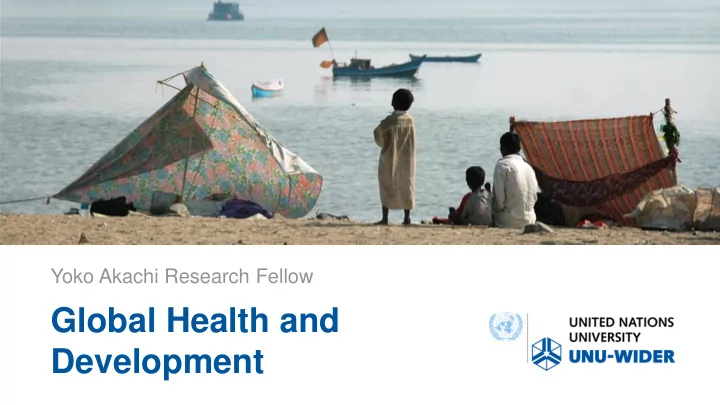
Global Health and Development

Yoko Akachi Research Fellow

slide-2
SLIDE 2

MDGs to SDGs: the role of health

Source: UN

slide-3
SLIDE 3

Change in under-5 mortality rate between 1990 and 2015

Source: WHO

slide-4
SLIDE 4

Trends in the under-5 mortality rate and number of under-5 deaths

Global, regional, and national levels and trends in under-5 mortality between 1990 and 2015, with scenario-based projections to 2030: a systematic analysis by the UN Inter-agency Group for Child Mortality Estimation Lancet 2015, Available online 8 September 2015 http://dx.doi.org/10.1016/S0140-6736(15)00120-8

slide-5
SLIDE 5

Development assistance for health by health focus area, 1990-2014

Source: Sources and Focus of Health Development Assistance, 1990–2014

  • JAMA. 2015;313(23):2359-2368. doi:10.1001/jama.2015.5825
slide-6
SLIDE 6

Gaps in achieving the MDG targets

  • Big picture: Links among

development, inequality, and health?

  • Zooming in:

– What interventions contributed to reductions in mortality? – How can the aid for health be used more efficiently?

Source: WHO

slide-7
SLIDE 7 .05 .06 .07 .08 .09

.5 1 1990 2000 2010

Ashanti

.04 .06 .08 .1

.5 1 1990 2000 2010

Brong Ahafo

.08 .09 .1 .11 .12

.5 1 1990 2000 2010

Central

.062 .064 .066 .068 .07

.5 1 1990 2000 2010

Eastern

.04 .045 .05 .055 .06 .065

.5 1 1990 2000 2010

Greater Accra

.09 .1 .11 .12 .13

.5 1 1990 2000 2010

Northern

.04 .06 .08 .1 .12

.5 1 1990 2000 2010

Upper East

.04 .06 .08 .1 .12

.5 1 1990 2000 2010

Upper West

.02 .04 .06 .08 .1

.5 1 1990 2000 2010

Volta

.04 .05 .06 .07 .08 .09

.5 1 1990 2000 2010

Western

(mean) bednets3 (mean) bontoilet (mean) pipwater (mean) anc (mean) onlymilk (mean) vaccine (mean) death

Y ea r su r v ey w as s t a r t ed

Graphs by region

Key intervention coverage by region

Ghana

What key intervention coverage is associated with child mortality?

  • 75 DHS surveys 1991-2013
  • 241 sub-national regions of 24

sub-Saharan African countries (550,000 children under 5)

  • Bednet coverage, water and

sanitation infrastructure, vaccination coverage, institutional deliveries, modern contraception usage, antenatal care, breastfeeding practices

  • Regional fixed effects and country

time trends

Source: DHS

slide-8
SLIDE 8

Links among health, income, and poverty

  • Wealth to health

– Increases in income per capita – Improvements in health technology, institutions and infrastructure

  • Health to wealth

– Microeconomic studies (e.g. deworming, iron supplements) – Improved health central to poverty reduction

  • Labor productivity, education,

investment, demographic channels

Economic development could lead to better health of the population, but the arrow is bidirectional: better health contributes to economic development

slide-9
SLIDE 9

Demographic transition

David E. Bloom Science 2011;333:562-569

Published by AAAS

  • When looking into development,

you have to consider population growth rate and age structure

  • Countries can experience

“demographic dividend” – Demographically driven, time- limited economic boom – e.g. East Asia in 1965-1990

slide-10
SLIDE 10

David E. Bloom Science 2011;333:562-569

Published by AAAS

Age structure of (A) East/Southeast Asia and (B) Sub-Saharan Africa 1950 to 2050

slide-11
SLIDE 11

Investing in reproductive, maternal, and child health

  • Childhood health and nutrition can have a

substantial impact on both physical and cognitive development, and eventual health status and productivity as an adult

  • Health investments in children and

mothers (fetal growth) most important for human capital

  • Inter-generational effect (e.g. under

nutrition of mothers affecting their children of either sexes)

  • Investing in health of mothers and

children means investing in the country’s economy and future

Childhood health strongly affect the health status and productivity as an adult And ultimately determines the health and well-being of the next generation

slide-12
SLIDE 12

Measuring health in research

  • Indicators of health and well-

being: “biological” and “economic” standard of living

  • Health is multi-dimensioned

– Mortality versus morbidity

  • Physical measures such as birth

weight, stunting, wasting, adult height

  • Sources of health data

– Censuses – Population surveys – Civil registration – Institution based individual and service records – Data collected specifically for medical/epidemiological studies

slide-13
SLIDE 13

Continuing to the next presenters

  • Investment case for health to

heads of state and Ministry of Finance

  • Innovative mechanisms to aid

health (e.g. results-based financing)

  • Externality of health -budgeting

for health when the benefit goes beyond health

  • Major global shift of attention

towards NCDs

  • Measuring health and the

multi-disciplinary nature of research blending epidemiology, medicine, public health and economics

slide-14
SLIDE 14

www.wider.unu.edu

Helsinki, Finland