
SLIDE 1
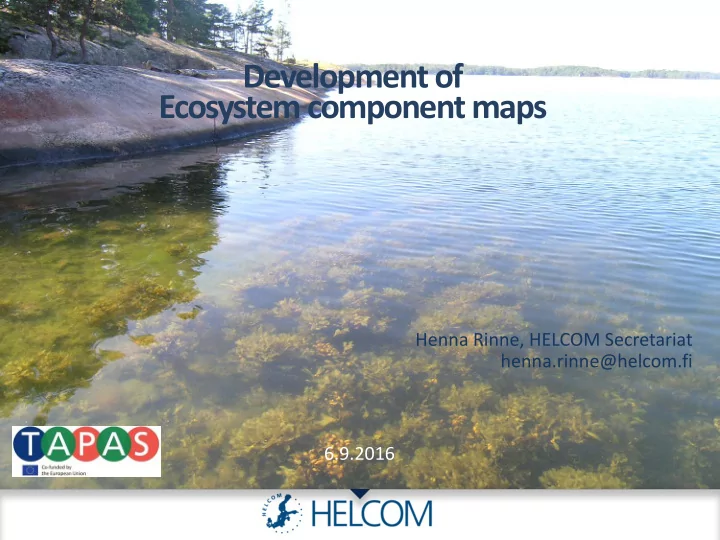
Development of Ecosystem component maps
Henna Rinne, HELCOM Secretariat henna.rinne@helcom.fi 6.9.2016
Development of Ecosystem component maps Henna Rinne, HELCOM - - PowerPoint PPT Presentation
Development of Ecosystem component maps Henna Rinne, HELCOM Secretariat henna.rinne@helcom.fi 6.9.2016 40 Ecosystem component layers Pelagic habitats (2) Broad-scale seabed habitats (6) Habitat forming species (5) Natura 2000
Henna Rinne, HELCOM Secretariat henna.rinne@helcom.fi 6.9.2016
TAPAS workshop 6.9.2016 2
– Springtime (weeks 12-22) Chl-a concentration used as a proxy. Areas with high phytoplankton production are given higher importance – Data: satellite data (MERIS) for 2011 (or potentially mean of years 2009-2011). No MERIS data available for years 2012-1016. Data provided by the Finnish Environment Institute. For Danish area probably complemented with MODIS data.
– Areas not suffering from hypoxia (O2 concentration > 2mg/l). If possible, areas weighed with O2 concentration (higher concentration, higher importance). – Data: requests to SMHI and to IOW made. Final data source, format and timescale still uncertain.
6.9.2016 3 TAPAS workshop
‒ Infralittoral mud ‒ Infralittoral sand ‒ Infralittoral hard bottom ‒ Circalittoral mud ‒ Circalittoral sand ‒ Circalittoral hard bottom
6.9.2016 4 TAPAS workshop
generalizations chosen due to lack of suitable substrate data
presence (1) and absence (0) to the BSII
6.9.2016 5 TAPAS workshop
6.9.2016 6 TAPAS workshop
– Polygon data received, the methods and the coverage of the marine area vary between countries – Converted to 1 km grid cells, Data as presence (1) and absence (0) to the BSII
6.9.2016 7 TAPAS workshop
6.9.2016 8 TAPAS workshop
6.9.2016 9 TAPAS workshop
– Cod spawning: Based on Hüssy, K. 2011. Review of western Baltic cod (Gadus morhua) recruitment dynamics. ICES Journal of Marine Science 68(7), 1459-1471. – Cod abundance: Baltic International Trawl Survey (BITS) data from ICES. – Map values normalized in the BSII
years summed) was >0.5 tonnes and the number of years when cod has been caught within the statistical rectangle was >1, the area was considered as cod distribution area. A value corresponding low CPUE values was given to these areas.
6.9.2016 10 TAPAS workshop
Hüssy 2011
6.9.2016 11
– Baltic International Acoustic Survey (BIAS) data, average of 2011-2015. Reported as millions of fish/ICES statistical rectangle. Outside BIAS coverage, landings data used. – For herring, the landings data indicated distribution across the Baltic Sea, thus a constant value of 10 (millions of herring/ICES rectangle) was given to all areas outside BIAS data, corresponding to low abundance. – For sprat BIAS surveys cover almost the whole distribution area. Few areas with significant sprat landings but outside BIAS area value of 1 (millions of sprat/ICES rectangle) was given corresponding to low abundance. – The map values are normalized in the BSII
6..9.2016 12 TAPAS workshop
6.9.2016 13 TAPAS workshop
– Demersal spawning: The distribution area delineated by selecting area with depth < 50m within ICES subdivisions 25-32 (Florin & Höglund 2008, Florin et
Bothnian Bay and Quark, as well as Russian part of Gulf of Finland were excluded from the map, according to HELCOM sub-basin division. Presence (1) absence (0) data to the BSII. – Pelagic spawning: Baltic International Trawl Survey (BITS) data, reported per ICES subdivision, average of 2011-2016, quarter 1. In the subdivisions 25, 26 and 28 also demersal spawners can be included in the CPUE values (Florin et
6.9.2016 14 TAPAS workshop
6.9.2016 15 TAPAS workshop
– No reliable data for adults across the Baltic Sea (gaps in landings data, coastal fish monitoring data scarce in many areas) – Recruitment areas essential for maintaining fish populations – Modelling studies exist for fish recruitment areas thresholds for environment requirements for fish recruitment
– Depth (Baltic Sea Bathymetry database) – Exposure (Wave Impact Index Isæus 2004) – Salinity (May means for 2011-2014, Copernicus Marine Environment Monitoring Service) – Secchi depth (MERIS data for May 2011, Tartu Observatory) Presence (1) absence (0) maps to the BSII
6.9.2016 16 TAPAS workshop
6.9.2016 17
Generalized to 1km grid
Generalized to 1km grid
TAPAS workshop
– Sweden leading the data collation and map production (Related to HELCOM Rec 34/1). – Data call on SPAs and IBAs sent in June, again in August. Deadline 23 September. – Wish for the separation of breeding and wintering areas, if possible. – Migration routes may be difficult.
6.9.2016 18 TAPAS workshop
– Seals: Count data collated in BALSAM project, reported per HELCOM sub-basin / country (e.g. Swedish Bothnian Bay). Haul-out sites reported as points (coordinates). – Harbour porpoise: Probability for detection maps from SAMBAH project will be available – delivery schedule still uncertain
6.9.2016 19 TAPAS workshop
6.9.2016 20
Method:
Method:
TAPAS workshop
6.9.2016 21
Method:
Method:
TAPAS workshop
6.9.2016 22 TAPAS workshop
6.9.2016 23
TAPAS workshop