Dictionaries and Dynamic Sets Abstract Data Type (ADT) Dictionary : - - PowerPoint PPT Presentation

dictionaries and dynamic sets
SMART_READER_LITE
LIVE PREVIEW

Dictionaries and Dynamic Sets Abstract Data Type (ADT) Dictionary : - - PowerPoint PPT Presentation

CS 5633 -- Spring 2006 Dictionaries and Dynamic Sets Abstract Data Type (ADT) Dictionary : Insert ( x , D ): inserts x into D D is a Delete ( x , D ): deletes x from D dynamic set Find ( x , D ): finds x in D Augmenting Data Structures Popular


slide-1
SLIDE 1

CS 5633 Analysis of Algorithms 1 3/2/06

CS 5633 -- Spring 2006

Augmenting Data Structures

Carola Wenk Slides courtesy of Charles Leiserson with small changes by Carola Wenk

CS 5633 Analysis of Algorithms 2 3/2/06

Dictionaries and Dynamic Sets

Abstract Data Type (ADT) Dictionary : Insert (x, D): inserts x into D Delete (x, D): deletes x fromD Find (x, D): finds x in D Popular implementation uses any balanced search tree (not necessarily binary). Like that each

  • peration takes O(log n) time.

D is a dynamic set

CS 5633 Analysis of Algorithms 3 3/2/06

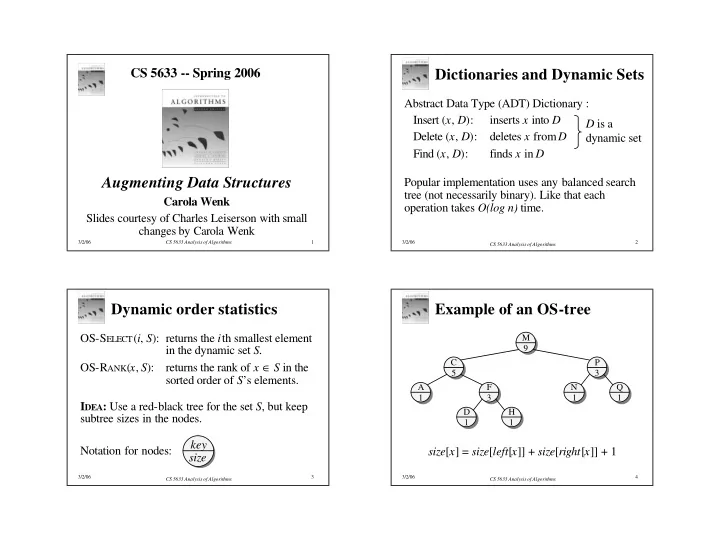
Dynamic order statistics

OS-SELECT(i, S): returns the ith smallest element in the dynamic set S. OS-RANK(x, S): returns the rank of x ∈ S in the sorted order of S’s elements. IDEA: Use a red-black tree for the set S, but keep subtree sizes in the nodes. key size Notation for nodes:

CS 5633 Analysis of Algorithms 4 3/2/06

Example of an OS-tree

M 9 C 5 A 1 F 3 N 1 Q 1 P 3 H 1 D 1

size[x] = size[left[x]] + size[right[x]] + 1

slide-2
SLIDE 2

CS 5633 Analysis of Algorithms 5 3/2/06

Selection

OS-SELECT(x, i) ? ith smallest element in the subtree rooted at x k ← size[left[x]] + 1

? k = rank(x)

if i = k thenreturn x if i < k thenreturn OS-SELECT(left[x], i) else return OS-SELECT(right[x], i – k ) Implementation trick: Use a sentinel (dummy record) for NIL such that size[NIL] = 0. (OS-RANK is in the textbook.)

CS 5633 Analysis of Algorithms 6 3/2/06

Example

M 9 C 5 A 1 F 3 N 1 Q 1 P 3 H 1 D 1

OS-SELECT(root, 5)

i = 5 k = 6 M 9 C 5 i = 5 k = 2 i = 3 k = 2 F 3 i = 1 k = 1 H 1 H 1

Running time = O(h) = O(logn) for red-black trees.

CS 5633 Analysis of Algorithms 7 3/2/06

Data structure maintenance

  • Q. Why not keep the ranks themselves

in the nodes instead of subtree sizes?

  • A. They are hard to maintain when the

red-black tree is modified. Modifying operations: INSERT and DELETE. Strategy: Update subtree sizes when inserting or deleting. k ← size[left[x]] + 1

? k = rank(x)

CS 5633 Analysis of Algorithms 8 3/2/06

Example of insertion

M 9 C 5 A 1 F 3 N 1 Q 1 P 3 H 1 D 1

INSERT(“K”)

M 10 C 6 F 4 H 2 K 1

slide-3
SLIDE 3

CS 5633 Analysis of Algorithms 9 3/2/06

Handling rebalancing

Don’t forget that RB-INSERT and RB-DELETE may also need to modify the red-black tree in order to maintain balance.

  • Recolorings: no effect on subtree sizes.
  • Rotations: fix up subtree sizes in O(1) time.

Example:

C 11 E 16 7 3 4 C 16 E 8 7 3 4

∴RB-INSERT and RB-DELETE still run in O(log n) time.

CS 5633 Analysis of Algorithms 10 3/2/06

Data-structure augmentation

Methodology: (e.g., order-statistics trees)

  • 1. Choose an underlying data structure (red-black

trees).

  • 2. Determine additional information to be stored

in the data structure (subtree sizes).

  • 3. Verify that this information can be maintained

for modifying operations (RB-INSERT, RB- DELETE — don’t forget rotations).

  • 4. Develop new dynamic-set operations that use

the information (OS-SELECT and OS-RANK). These steps are guidelines, not rigid rules.

CS 5633 Analysis of Algorithms 11 3/2/06

Interval trees

Goal: To maintain a dynamic set of intervals, such as time intervals.

low[i] = 7 10 = high[i] i = [7, 10] 5 4 15 22 17 11 8 18 19 23

Query: For a given query interval i, find an interval in the set that overlaps i.

CS 5633 Analysis of Algorithms 12 3/2/06

Following the methodology

  • 1. Choose an underlying data structure.
  • Red-black tree keyed on low (left) endpoint.

int m

  • 2. Determine additional information to be

stored in the data structure.

  • Store in each node x the largest value m[x]

in the subtree rooted at x, as well as the interval int[x] corresponding to the key.

slide-4
SLIDE 4

CS 5633 Analysis of Algorithms 13 3/2/06

17,19 23

Example interval tree

5,11 18 4,8 8 15,18 18 7,10 10 22,23 23

m[x] = max high[int[x]] m[left[x]] m[right[x]]

red

CS 5633 Analysis of Algorithms 14 3/2/06

Modifying operations

  • 3. Verify that this information can be maintained

for modifying operations.

  • INSERT: Fix m’s on the way down.

6,20 30 11,15 19 19 14 30 11,15 30 6,20 30 30 14 19

  • Rotations — Fixup = O(1) time per rotation:

Total INSERT time = O(logn); DELETE similar.

CS 5633 Analysis of Algorithms 15 3/2/06

New operations

  • 4. Develop new dynamic-set operations that use

the information.

INTERVAL-SEARCH(i) x ← root while x ≠ NIL and (low[i] > high[int[x]]

  • r low[int[x]] > high[i])

do ? i and int[x] don’t overlap if left[x] ≠ NIL and low[i] ≤ m[left[x]] then x ← left[x] else x ← right[x] return x

CS 5633 Analysis of Algorithms 16 3/2/06

Example 1: INTERVAL-SEARCH([14,16])

17,19 23 5,11 18 4,8 8 15,18 18 7,10 10 22,23 23

x

x ← root [14,16] and [17,19] don’t overlap 14 ≤ 18⇒ x ← left[x]

14 16

slide-5
SLIDE 5

CS 5633 Analysis of Algorithms 17 3/2/06

Example 1: INTERVAL-SEARCH([14,16])

17,19 23 5,11 18 4,8 8 15,18 18 7,10 10 22,23 23

x

[14,16] and [5,11] don’t overlap 14 > 8 ⇒ x ← right[x]

14 16 CS 5633 Analysis of Algorithms 18 3/2/06

Example 1: INTERVAL-SEARCH([14,16])

17,19 23 5,11 18 4,8 8 15,18 18 7,10 10 22,23 23

x

[14,16] and [15,18] overlap return [15,18]

14 16 CS 5633 Analysis of Algorithms 19 3/2/06

Example 2: INTERVAL-SEARCH([12,14])

17,19 23 5,11 18 4,8 8 15,18 18 7,10 10 22,23 23

x

x ← root [12,14] and [17,19] don’t overlap 12 ≤ 18⇒ x ← left[x]

12 14 CS 5633 Analysis of Algorithms 20 3/2/06

Example 2: INTERVAL-SEARCH([12,14])

17,19 23 5,11 18 4,8 8 15,18 18 7,10 10 22,23 23

x

[12,14] and [5,11] don’t overlap 12 > 8 ⇒ x ← right[x]

12 14

slide-6
SLIDE 6

CS 5633 Analysis of Algorithms 21 3/2/06

Example 2: INTERVAL-SEARCH([12,14])

17,19 23 5,11 18 4,8 8 15,18 18 7,10 10 22,23 23

x

[12,14] and [15,18] don’t overlap 12 > 10⇒ x ← right[x]

12 14 CS 5633 Analysis of Algorithms 22 3/2/06

Example 2: INTERVAL-SEARCH([12,14])

17,19 23 5,11 18 4,8 8 15,18 18 7,10 10 22,23 23

x

x = NIL ⇒ no interval that

  • verlaps [12,14] exists

12 14 CS 5633 Analysis of Algorithms 23 3/2/06

Analysis

Time = O(h) = O(log n), since INTERVAL- SEARCH does constant work at each level as it follows a simple path down the tree. List all overlapping intervals:

  • Search, list, delete, repeat.
  • Insert them all again at the end.

This is an output-sensitive bound. Best algorithm to date: O(k + log n). Time = O(k log n), where k is the total number

  • f overlapping intervals.

CS 5633 Analysis of Algorithms 24 3/2/06

Correctness

  • Theorem. Let L be the set of intervals in the

left subtree of node x, and let R be the set of intervals in x’s right subtree.

  • If the search goes right, then

{ i′ ∈ L : i′ overlaps i } = ∅.

  • If the search goes left, then

{i′ ∈ L : i′ overlaps i } = ∅ ⇒ {i′ ∈ R : i′ overlaps i } = ∅. In other words, it’s always safe to take only 1

  • f the 2 children: we’ll either find something,
  • r nothing was to be found.
slide-7
SLIDE 7

CS 5633 Analysis of Algorithms 25 3/2/06

Correctness proof

  • Proof. Suppose first that the search goes right.
  • If left[x] = NIL, then we’re done, since L = ∅.
  • Otherwise, the code dictates that we must have

low[i] > m[left[x]]. The value m[left[x]] corresponds to the right endpoint of some interval j ∈ L, and no other interval in L can have a larger right endpoint than high( j). L

high( j) = m[left[x]]

i

low(i)

  • Therefore, {i′ ∈ L : i′ overlaps i } = ∅.

CS 5633 Analysis of Algorithms 26 3/2/06

Proof (continued)

Suppose that the search goes left, and assume that {i′ ∈ L : i′ overlaps i } = ∅.

  • Then, the code dictates that low[i] ≤ m[left[x]] =

high[ j] for some j ∈ L.

  • Since j ∈ L, it does not overlap i, and hence

high[i] < low[ j].

  • But, the binary-search-tree property implies that

for all i′ ∈ R, we have low[ j] ≤ low[i′].

  • But then {i′ ∈ R : i′ overlaps i } = ∅.

L

i j i′