Dictionary lookup Suppose youre looking up a word in the dictionary - - PDF document

dictionary lookup
SMART_READER_LITE
LIVE PREVIEW

Dictionary lookup Suppose youre looking up a word in the dictionary - - PDF document

10/6/2016 Dictionary lookup Suppose youre looking up a word in the dictionary (paper one, not online!) You probably wont scan linearly thru the pages inefficient. What would be your strategy? Binary search


slide-1
SLIDE 1

10/6/2016 1 Dictionary lookup

 Suppose you’re looking up a word in the

dictionary (paper one, not online!)

 You probably won’t scan linearly thru the

pages – inefficient.

 What would be your strategy?

Binary search

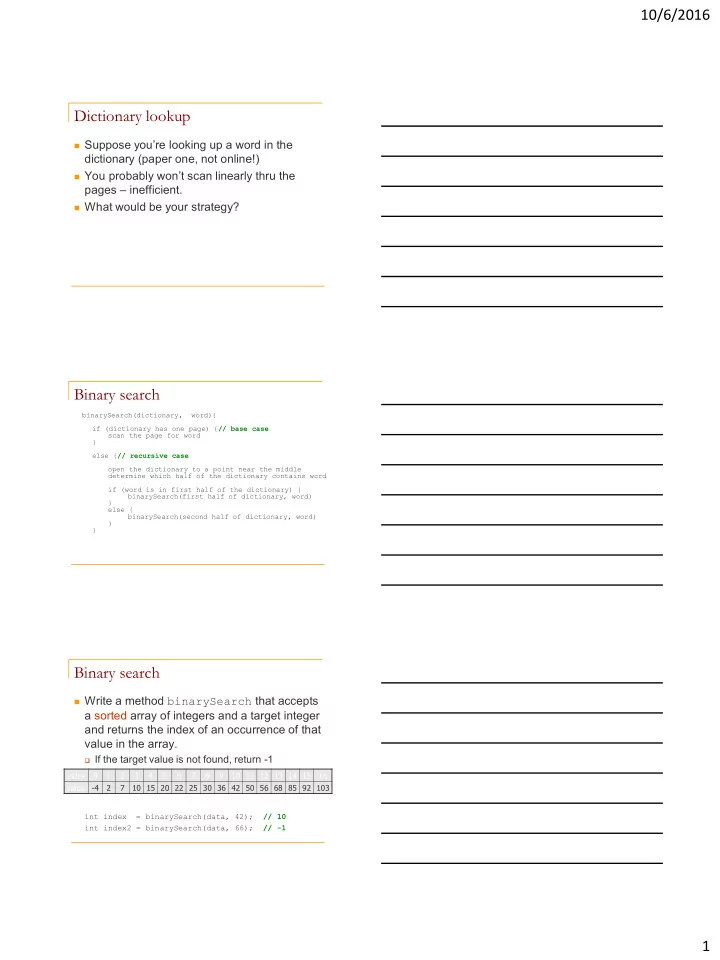
binarySearch(dictionary, word){ if (dictionary has one page) {// base case scan the page for word } else {// recursive case

  • pen the dictionary to a point near the middle

determine which half of the dictionary contains word if (word is in first half of the dictionary) { binarySearch(first half of dictionary, word) } else { binarySearch(second half of dictionary, word) } }

Binary search

 Write a method binarySearch that accepts

a sorted array of integers and a target integer and returns the index of an occurrence of that value in the array.

 If the target value is not found, return -1

int index = binarySearch(data, 42); // 10 int index2 = binarySearch(data, 66); // -1 index 1 2 3 4 5 6 7 8 9 10 11 12 13 14 15 16 value

  • 4

2 7 10 15 20 22 25 30 36 42 50 56 68 85 92 103

slide-2
SLIDE 2

10/6/2016 2 Iclicker Question #1

 A user interface is like a joke. If you have to

explain it:

  • A. It’s just not that good.

Interfaces

Savitch ch. 8.4

Relatedness of types

 Consider the task of writing classes to represent

2D shapes such as Circle, Rectangle, and Triangle.

 There are certain attributes or operations that

are common to all shapes:

perimeter, area

 By being a Shape, you promise that you can

compute those attributes, but each shape computes them differently.

slide-3
SLIDE 3

10/6/2016 3 Interface as a contract

 Analogous to the idea of roles or certifications in real life:  "I'm certified as a CPA accountant. The

certification assures you that I know how to do taxes, perform audits.” Compare to:

 "I'm certified as a Shape. That means you can be

sure that I know how to compute my area and perimeter.”

The area and perimeter of shapes

 Rectangle (as defined by width w and height h):

area = w h perimeter = 2w + 2h

 Circle (as defined by radius r):

area =  r2 perimeter = 2  r

 Triangle (as defined by side lengths a, b, and c)

area = √(s (s - a) (s - b) (s - c)) where s = ½ (a + b + c) perimeter = a + b + c

Interfaces

 interface: A list of methods that a class promises to

implement.

 Inheritance encodes an is-a relationship and provides code-sharing. 

An Executive object can be treated as a StaffMember, and Executive inherits StaffMember’s code.

 An interface specifies what an object is capable of; no code sharing. 

Only method stubs in the interface

Object can-act-as any interface it implements

A Rectangle does what you expect from a Shape as long as it implements the interface.

slide-4
SLIDE 4

10/6/2016 4 Interfaces with abstract classes

public abstract class Shape { public abstract double area(); public abstract double perimeter(); }

Java Interfaces

 An interface for shapes:

public interface Shape { public double area(); public double perimeter(); }

 This interface describes the functionality common to all shapes.

(Every shape knows how to compute its area and perimeter.)

Interface declaration syntax:

public interface <name> {

public <type> <name>(<type> <name>, ..., <type> <name>); public <type> <name>(<type> <name>, ..., <type> <name>);

...

public <type> <name>(<type> <name>, ..., <type> <name>);

}

All methods are public!

Implementing an interface

public class Circle implements Shape { private double radius; // Constructs a new circle with the given radius. public Circle(double radius) { this.radius = radius; } // Returns the area of the circle. public double area() { return Math.PI * radius * radius; } // Returns the perimeter of the circle. public double perimeter() { return 2.0 * Math.PI * radius; } }

slide-5
SLIDE 5

10/6/2016 5 Implementing an interface

 A class can declare that it implements an

interface.

 This means the class needs to contain an

implementation for each of the methods in that interface.

(Otherwise, the class will fail to compile.)

 Syntax for implementing an interface

public class <name> implements <interface name> { ... }

Requirements

 If we write a class that claims act like a Shape but

doesn't implement the area and perimeter methods, it will not compile.

 Example:

public class Banana implements Shape { //without implementing area or perimiter }

 The compiler error message:

Banana.java:1: Banana is not abstract and does not override abstract method area() in Shape public class Banana implements Shape { ^

Diagramming an interface

 We draw arrows from the classes to the interface(s)

they implement.

 Like inheritance, an interface represents an is-a

relationship (a Circle is a Shape).

slide-6
SLIDE 6

10/6/2016 6 Rectangle

public class Rectangle implements Shape { private double width; private double height; // Constructs a new rectangle with the given dimensions. public Rectangle(double width, double height) { this.width = width; this.height = height; } // Returns the area of this rectangle. public double area() { return width * height; } // Returns the perimeter of this rectangle. public double perimeter() { return 2.0 * (width + height); } }

Triangle

public class Triangle implements Shape { private double a; private double b; private double c; // Constructs a new Triangle given side lengths. public Triangle(double a, double b, double c) { this.a = a; this.b = b; this.c = c; } // Returns a triangle's area using Heron's formula. public double area() { double s = (a + b + c) / 2.0; return Math.sqrt(s * (s – a)*(s – b)*(s - c)); } // Returns the perimeter of the triangle. public double perimeter() { return a + b + c; } }

Interfaces and polymorphism

Polymorphism is possible with interfaces.

Example: public static void printInfo(Shape s) { System.out.println("The shape: " + s); System.out.println("area : " + s.area()); System.out.println("perim: " + s.perimeter()); System.out.println(); }

Any object that implements the interface may be passed as the parameter to the above method. Circle circ = new Circle(12.0); Triangle tri = new Triangle(5, 12, 13); printInfo(circ); printInfo(tri); Interface is a type!

slide-7
SLIDE 7

10/6/2016 7 Interfaces and polymorphism

 We can create an array of an interface type, and store

any object implementing that interface as an element.

Circle circ = new Circle(12.0); Rectangle rect = new Rectangle(4, 7); Triangle tri = new Triangle(5, 12, 13); Shape[] shapes = {circ, tri, rect}; for (int i = 0; i < shapes.length; i++) { printInfo(shapes[i]); }

 Each element of the array executes the appropriate behavior for

its object when it is passed to the printInfo method, or when area or perimeter is called on it.

Iclicker Question #2

There is no code sharing when using an interface.

A.

True

B.

False

Iclicker Question #2 Answer

There is no code sharing when using an interface.

A.

True

B.

False

slide-8
SLIDE 8

10/6/2016 8 IClicker question #3

 Writing an interface requires you to specify

the methods a class implementing the interface does not need to address.

  • A. True
  • B. False

IClicker question #3 Answer

 It is possible to write an interface to specify

the methods a class implementing the interface does not need to address.

  • A. True
  • B. False – any signatures not implemented

cause a compile error.

Comments about Interfaces

 The term interface also refers to the set of public

methods through which we can interact with objects of a class.

 Methods of an interface are abstract.  Think of an interface as an abstract base class with all

methods abstract

 Interfaces are used to define a contract for how you

interact with an object, independent of the underlying implementation.

 Separate behavior (interface) from the implementation

slide-9
SLIDE 9

10/6/2016 9

When to use interfaces or abstract classes

 An abstract class: mix of abstract and non-

abstract methods, so some default implementations.

 An abstract class can also have static methods,

private and protected methods, etc.

Interfaces and inheritance

 Interfaces allow us to get around the Java limitation of no

multiple inheritance – a class can implement several interfaces

class ImplementsSeveral implements Interface1, Interface2 { // implementation }

 A class can implement an interface AND extend another

class

 Inheritance can be applied to interfaces – an interface

can be derived from another interface

Commonly used Java interfaces

 The Java class library contains several

interfaces:

 Comparable – allows us to order the elements of an

arbitrary class

 Serializable (in java.io) – for saving objects to

a file.

 List, Set, Map, Iterator (in java.util) –

describe data structures for storing collections of

  • bjects
slide-10
SLIDE 10

10/6/2016 10 The Java Comparable interface

 A class can implement the Comparable interface to

define an ordering for its objects. public interface Comparable<E> { public int compareTo(E other); } public class Employee implements Comparable<Employee> { … }

 A call of a.compareTo(b) should return:

a value < 0 if a comes "before" b in the ordering, a value > 0 if a comes "after" b in the ordering,

  • r

0 if a and b are considered "equal" in the ordering.

Comparable and sorting

 If you implement Comparable, you can sort arbitrary

  • bjects using the method Arrays.sort

StaffMember [] staff = new StaffMember[3]; staff[0] = new Executive(…); staff[1] = new Employee(…) staff[2] = new Hourly(…); staff[3] = new Volunteer(…); Arrays.sort(staff);

Note that you will need to provide an implementation of compareTo

compareTo tricks

 Delegation trick - If your object's attributes are

comparable (such as strings), you can use their compareTo:

// sort by employee name public int compareTo(StaffMember other) { return name.compareTo(other.getName()); }

slide-11
SLIDE 11

10/6/2016 11 Iclicker Question #1

 We can create an array of an interface

type, and store any object implementing that interface as:

  • A. Its type
  • B. Its index
  • C. An element
  • D. A reference

Iclicker Question #1 Answer

 We can create an array of an interface

type, and store any object implementing that interface as:

  • A. Its type
  • B. Its index
  • C. An element
  • D. A reference (this is true as well…)

Another example

public class Contact implements Comparable<Contact>{ private String firstName, lastName, phone; public boolean equals(Object other) { if (!(other instanceof Contact)) return false; return (lastName.equals(((Contact)other).getLastName()) && firstName.equals(((Contact)other).getFirstName())); } // Uses both last and first names to determine ordering. public int compareTo(Contact other) { String otherFirst = other.getFirstName(); String otherLast = other.getLastName(); if (lastName.equals(otherLast)) return firstName.compareTo(otherFirst); else return lastName.compareTo(otherLast); } }

Note the difference in the parameters of compareTo() and equals() In version 1.4 of Java compareTo() needed parameter of type Object

slide-12
SLIDE 12

10/6/2016 12

import java.util.Arrays; Contact[] friends = new Contact[6]; friends[0] = new Contact ("John", "Smith", "610-555-7384"); friends[1] = new Contact ("Sarah", "Barnes", "215-555-3827"); friends[2] = new Contact ("Mark", "Riley", "733-555-2969"); friends[3] = new Contact ("Laura", "Getz", "663-555-3984"); friends[4] = new Contact ("Larry", "Smith", "464-555-3489"); friends[5] = new Contact ("Frank", "Phelps", "322-555-2284"); Arrays.sort(friends); for (int i=0; i<friends.length; i++) System.out.println (friends[i]); }

ArrayList

 The ArrayList declaration:

public class ArrayList<E> extends AbstractList<E> implements List<E>, RandomAccess, Cloneable, Serializable

 The List interface includes:

Method E get(int index) Returns the element at the specified position int indexOf(Object o) Returns the index of the first occurrence

  • f the specified element

E remove(int index) Removes the element at the specified position E set(int index, E element) Replaces the element at the specified position

Lists and collections

 The declaration of the List interface:

public interface List<E> extends Collection<E>

 Has methods that any collection of elements should

have: add, clear(), contains, isEmpty(), remove, size()

slide-13
SLIDE 13

10/6/2016 13 The Predator interface

public interface Predator { void stalk(Prey p); boolean chase(Prey p); void eat(Prey p); }

The Predator interface

public interface VenomousPredator extends Predator, Venomous { //interface body } Note: an interface can extend multiple interfaces. Why is this not a problem?

instanceof operator in this context

 Suppose

 Animal is an interface  Class Pet implements Animal  Class Cat extends Pet

 Code

 Animal p = new Pet();  Animal q = new Cat();  Pet r = new Pet();  Pet s = new Cat();  Cat t = new Cat();

<<Interface>>

Animal Pet Cat

slide-14
SLIDE 14

10/6/2016 14 instanceof operator in this context

 (p instanceof Animal) == true  (p instanceof Pet) == true  (p instanceof Cat) == false  (q instanceof Animal) == true  (q instanceof Pet) == true  (q instanceof Cat) == true  (r instanceof Animal) == true  (r instanceof Pet) == true  (r instanceof Cat) == false

instanceof operator in this context

 (s instanceof Animal) == true  (s instanceof Pet) == true  (s instanceof Cat) == true  (t instanceof Animal) == true  (t instanceof Pet) == true  (t instanceof Cat) == true