Dienstag 30. Nov. 10 [] All Your Baseband Are over-the-air - - PowerPoint PPT Presentation

dienstag 30 nov 10 all your baseband are
SMART_READER_LITE
LIVE PREVIEW

Dienstag 30. Nov. 10 [] All Your Baseband Are over-the-air - - PowerPoint PPT Presentation

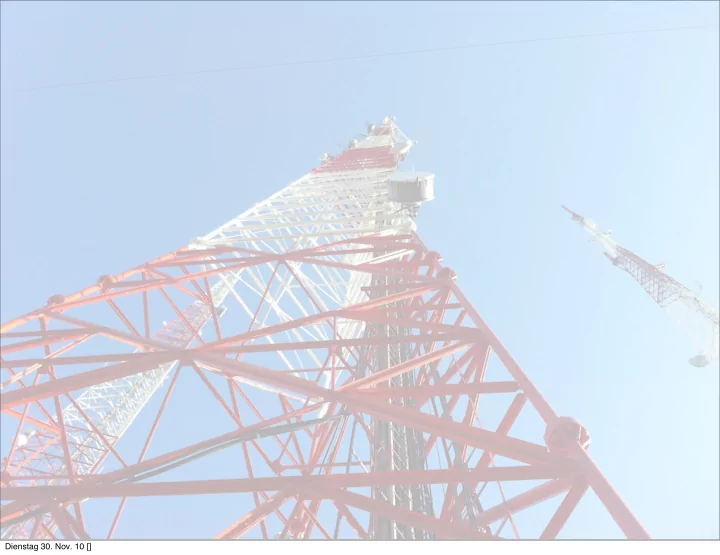
Dienstag 30. Nov. 10 [] All Your Baseband Are over-the-air exploitation of memory corruptions in GSM software Ralf-Philipp Weinmann Laboratory for Algorithmics, Cryptology & Computer Security University of Luxembourg


slide-1
SLIDE 1

Dienstag 30. Nov. 10 []
slide-2
SLIDE 2

All Your Baseband Are

Ralf-Philipp Weinmann Laboratory for Algorithmics, Cryptology & Computer Security University of Luxembourg https://cryptolux.org

  • ver-the-air exploitation of memory corruptions in GSM software

Dienstag 30. Nov. 10 []

slide-3
SLIDE 3

Outline

  • GSM / Smartphone basics
  • Baseband software (in)security
  • How to find bugs
  • Practicality of exploitation
  • Scenarios for the “baseband apocalypse”
  • Disclosure, outlook & conclusions

Dienstag 30. Nov. 10 []

slide-4
SLIDE 4

Part I: GSM and smartphone basics

Dienstag 30. Nov. 10 []

slide-5
SLIDE 5

Lay of the GSM/UMTS land

links to

  • utside world

[BSCs, VLR, HLR/AUC, SS7] BTS (base transceiver station) [Usually located at cell tower] MS (Mobile Station) Um (air) interface

Dienstag 30. Nov. 10 []

slide-6
SLIDE 6

Layers of the GSM Um

Connection Management (MM) Mobility Management (MM) Radio Resource (RR)

LAPDm (Layer 2) Layer 1

Layer 3

Dienstag 30. Nov. 10 []

slide-7
SLIDE 7

Smartphones

  • Somewhen in the late 20th century, PDAs

and cellular phones merged

  • Result: smartphones
  • Have driven PDAs into extinction
  • Usually a multi-CPU architecture:

application processor (APP) and baseband (BB) processor

  • In 99% of all cases, ARM CPUs used for

both

  • Trend: single-chip APP/BB (for cost

Dienstag 30. Nov. 10 []

slide-8
SLIDE 8

Dominant Smartphone archs

vs.

Application Processor Digital Baseband Processor RAM RAM Serial communication

  • r shared memory

Application Processor (slave) RAM Digital Baseband Processor (master)

Dienstag 30. Nov. 10 []

slide-9
SLIDE 9

Let’s do some quick market research before we dive into the technical details...

Dienstag 30. Nov. 10 []

slide-10
SLIDE 10

Baseband market shares 3Q2009

Qualcomm Mediatek Texas Instruments ST-Ericsson Infineon Broadcom Freescale Other Source: Strategy Analytics

Cellular Baseband Suppliers & their 3Q’ 09 shipment share)

Dienstag 30. Nov. 10 []

slide-11
SLIDE 11

Part II: Baseband (in)security

Dienstag 30. Nov. 10 []

slide-12
SLIDE 12

Baseband (in)security

  • Code base created in the 1990s…
  • … with a 1990s attitude towards security
  • Network elements are considered trusted
  • Both GSM and UMTS protocols have

many, many length fields

  • (Almost) no exploit mitigations

[one counter-example: XMM6180 on iPhone4 has hardware DEP enabled]

Dienstag 30. Nov. 10 []

slide-13
SLIDE 13

I know you forgot what the GSM protocol stack looks like, so let’s see it once more before we proceed.

Dienstag 30. Nov. 10 []

slide-14
SLIDE 14

Layers of the GSM Um

Connection Management (MM) Mobility Management (MM) Radio Resource (RR)

LAPDm (Layer 2) Layer 1

Layer 3

Dienstag 30. Nov. 10 []

slide-15
SLIDE 15

Where to look for bugs

  • Layer 1 not fruitful
  • Layer 2: messages to short
  • Layer 3: specified in GSM 04.08

–allows for variable length messages (TLV and LV) –Maximum length: 255 octets (length field: one

  • ctet)
  • However: ASN.1 used as well (e.g. RRLP)
  • GPRS layer very fruitful as well

–GPRS not supported by OpenBTS –layer 1 difgerent

Dienstag 30. Nov. 10 []

slide-16
SLIDE 16

Where to look for bugs

  • Layer 1 not fruitful
  • Layer 2: messages to short
  • Layer 3: specified in GSM 04.08

–allows for variable length messages (TLV and LV) –Maximum length: 255 octets (length field: one

  • ctet)
  • However: ASN.1 used as well (e.g. RRLP)
  • GPRS layer very fruitful as well

–GPRS not supported by OpenBTS –layer 1 difgerent

Dienstag 30. Nov. 10 []

slide-17
SLIDE 17

Where to look for bugs

  • Layer 1 not fruitful
  • Layer 2: messages to short
  • Layer 3: specified in GSM 04.08

–allows for variable length messages (TLV and LV) –Maximum length: 255 octets (length field: one

  • ctet)
  • However: ASN.1 used as well (e.g. RRLP)
  • GPRS layer very fruitful as well

–GPRS not supported by OpenBTS –layer 1 difgerent

Things get interesting

Dienstag 30. Nov. 10 []

slide-18
SLIDE 18

Initial Targets

Apple iPhones (Infineon baseband) HTC Dream [G1] (Qualcomm baseband)

Image credit: Yutaka Tsutano Image credit: Jose A. Gelado

Dienstag 30. Nov. 10 []

slide-19
SLIDE 19

How were the bugs found?

  • Fuzzing was not successful

– Lots of crashes, but no easy way to triage

  • Static analysis
  • No source code publicly available

– exception: TSM30 src was available for some years

  • Conclusion: reverse-engineer binaries

Dienstag 30. Nov. 10 []

slide-20
SLIDE 20

How do we start?

  • Firmware updates often contain

baseband firmware as well

  • Packed multiple times, need to extract
  • Tools for iPhone and HTC phones to do

that

  • Qualcomm firmwares: ELF files
  • Infineon needs custom loaders/relocator
  • Later: ability to dump memory/MMU

17

Dienstag 30. Nov. 10 []

slide-21
SLIDE 21

Reverse-engineering

  • Bootstrap: use BinDifg to port symbols

from known libraries (i.e. compiler runtimes)

  • Identify functions that do memory

transfers using REIL and BinNavi

  • Lots of strings and assertions (!) in

firmwares

  • Often: clean-cut regions for RR/MM/AT

command parser in binary

18

Dienstag 30. Nov. 10 []

slide-22
SLIDE 22

More reversing

  • Identified functions handling GSM frames

– Problem: apparently difgerent tasks – Assertions/logging functions very helpful

19

Dienstag 30. Nov. 10 []

slide-23
SLIDE 23

Types of bugs found

  • Many, many unchecked memory copies

(can be found in binary once memcpy() et al. identified)

  • Object/structure lifecycle issues (e.g. use

after free, uninitialized variables, state engine confusion), can lead to infoleaks as well

  • Protocol foo-bars: Code paths normally

used for UMTS / CDMA can be triggered using GSM frames

Dienstag 30. Nov. 10 []

slide-24
SLIDE 24

An example (in ICE

  • TMSI reallocation:

–TMSI always, always, always is 32 bits –nonetheless encoded as TLV

  • Infineon stack uses length in L3 packet
  • Results: heap overflow
  • Somewhat tricky to exploit in stable way
  • iPhone 2/3G/3GS vs. iPhone 4: difgerent

RTOS –old iPhones: Nucleus –iPhone 4: ThreadX

Dienstag 30. Nov. 10 []

slide-25
SLIDE 25

An example (in QCOM

  • GSM & UMTS use challenge-response auth
  • Originally: fixed-length challenge in GSM

– 16 bytes RAND

  • 3GPP specification 24.008 added variable

length challenge (AUTN)

  • Functionality not needed in GSM!
  • Allows to overwrite stack (limit 251 bytes)
  • Result: remote code exec, pre-auth
  • QCOM fixed after disclosure (pushed to

OEMs)

Dienstag 30. Nov. 10 []

slide-26
SLIDE 26

Baseband Exploitation

  • Baseband: what operating system?
  • Unlock teams often have good info on

this (iPhone dev team, XDA developers)

  • Locate bufgers used for GSM L3

messages

  • Write custom code or use existing

features (e.g. AT+S0=x handler in Infineon baseband)

  • Debugging is hard, write own debugger

Dienstag 30. Nov. 10 []

slide-27
SLIDE 27

The AT+S0=n feature

  • Hayes command to turn on auto-answer
  • present in some software stacks

(verified for Infineon & QCOM)

  • Enable with *5005*AANS# on iPhones,

disable with #5005*AANS#

  • Excellent target to demonstrate memory

corruptions

  • Auto-answer can be made silent/

Dienstag 30. Nov. 10 []

slide-28
SLIDE 28

Part III: Practicality

Dienstag 30. Nov. 10 []

slide-29
SLIDE 29

Why should we care

  • New base stations: expensive (cheapest: 25k

USD)

  • Old gear however often is sold on eBay
  • Threat model has entirely changed: hardware

has become cheap, open-source SW appeared

  • Open-source projects for running GSM base

stations: OpenBSC & OpenBTS

  • OpenBTS provided service at Burning Man

2008-2010

  • HAR2009 had OpenBSC test network

Dienstag 30. Nov. 10 []

slide-30
SLIDE 30

Image credit: Björn Heller

  • Siemens

BS11

  • used by

OpenBSC

  • HEAVY
  • E1/Abis

interface

  • cheap:

EUR 250

  • hard to

come by now.

Dienstag 30. Nov. 10 []

slide-31
SLIDE 31
  • ip.access

nanoBTS

  • supported by

OpenBSC as well

  • Abis over IPv4
  • approx. USD

4500

  • difgerent

versions for GSM900/1800, GSM850/1900

  • supports GPRS

Dienstag 30. Nov. 10 []

slide-32
SLIDE 32
  • software defined radio (SDR)
  • versatile (difgerent daughterboards)
  • OpenBTS support, GSM850/900,

GSM1800/1900

  • no GPRS since layer 1 is difgerent there
  • clock: wrong freq (64Mhz) and imprecise

Our gear: Ettus USRPv1

  • price: approx

USD 1250 plus good clock

Image credit: Synthesis Studios

Dienstag 30. Nov. 10 []

slide-33
SLIDE 33

Part IV: Demo

Dienstag 30. Nov. 10 []

slide-34
SLIDE 34

Common failures (my experience)

  • Lacking clock precision
  • Misinterpreting stack traces
  • Triggering the wrong bug ;)
  • Overlooking code is placed is non-exec

page

Dienstag 30. Nov. 10 []

slide-35
SLIDE 35

Some words about clocks

  • Get a good one, seriously!

– GSM spec requires 0.05ppm – equiv. to 50Hz in 900MHz band

  • Time is too precious for fixing clock

issues

  • Using FA-SY on the road (EUR 40)

– Si570 based design – not optimal: 20ppm uncalibrated – approx. 1ppm when calibrated

Dienstag 30. Nov. 10 []

slide-36
SLIDE 36

Part V: The Baseband Apocalypse

Dienstag 30. Nov. 10 []

slide-37
SLIDE 37

The “Baseband Apocalypse”

  • Place fake BTS in crowded/sensitive

areas: airport lounges, financial districts, near embassies

  • Stealth room monitor: record audio,

compress, store in RAM, piggy-back

  • nto next data connection (mic/camera

usually hang ofg BB CPU)

  • Shared mem CPUs: compromise APP CPU

as well, place backdoor/rootkit

Dienstag 30. Nov. 10 []

slide-38
SLIDE 38

The “Baseband Apocalypse”

  • Ping-pong games: compromise

cellphone, then BTS/BSC, infect more phones from there

  • Brick phones permanently (e.g. erase

SecZone on iPhone)

  • No easy forensics possible in BB land

(JTAG disabled to prevent easy unlocks). Need exploits to perform forensics

Dienstag 30. Nov. 10 []

slide-39
SLIDE 39

The scary bit

  • How do we defend ourselves?

Turn ofg our cell phones? Hardly.

  • Use a sound-proof enclosure for phone

and encrypting Bluetooth Headset? [approach allegedly used by a German company that produces “secure” end-to- end solutions for governments]

Dienstag 30. Nov. 10 []

slide-40
SLIDE 40

37

Is there still hope for the paranoid?

Dienstag 30. Nov. 10 []

slide-41
SLIDE 41

OsmocomBB

  • Free Software GSM baseband stack
  • implements layer 1-3
  • target platform: Calypso chipsets
  • present in OpenMoko phones and

Motorola C11x/C12x (e.g. C123)

  • current functionality: about GSM Phase 1

– supports sending/receiving SMS – supports voice calls

Dienstag 30. Nov. 10 []

slide-42
SLIDE 42

Part VI: Disclosure, outlook, conclusions

Dienstag 30. Nov. 10 []

slide-43
SLIDE 43

Disclosure & Reactions

  • QCOM was fantastic
  • Apple fixed TMSI bug this week
  • Vendor outreach by Microsoft
  • ST-Ericsson:

“We have been using Coverity on our RTOS (incl. the entire L2/3 source code) for a few years – which may detect some of the vulnerabilities. And the canaries have always been there to enable the scheduler to detect stack overflows [...]”

Dienstag 30. Nov. 10 []

slide-44
SLIDE 44

Outlook

  • Will see same problems for 3GPP/UMTS
  • 3GPP uses mutual auth…
  • Need Radio Resource Control (RRC) pre-

auth

  • RRC is about 1800 pages of specification!
  • ASN.1 PER !!
  • Only single vendor for the ASN.1 parser

seen in stacks

  • Femto cells as cheap attack platforms

Dienstag 30. Nov. 10 []

slide-45
SLIDE 45

Conclusions

  • Memory corruptions over the Um interface:

practical even with cheap hardware

  • Vulnerabilities in GSM baseband codebases

plentiful

  • Small number of baseband vendors
  • Malicious code execution on baseband

CPU: compromises security – Shared memory between BB & APP: total compromise

Dienstag 30. Nov. 10 []

slide-46
SLIDE 46

Credits

  • uni.lu for supporting me
  • Anonymous Engineer and Jacob Appelbaum for

the initial trigger

  • Zynamics for providing great RCE tools!
  • Harald Welte, Sylvain Munaut, André Stemper for

technical help

  • Karsten Nohl and Harald Welte for providing

replacement gear

  • Kestrel for writing OpenBTS
  • Qualcomm and Apple for fixing bugs!

Dienstag 30. Nov. 10 []