Diophantine and tropical geometry David Zureick-Brown joint with - - PowerPoint PPT Presentation
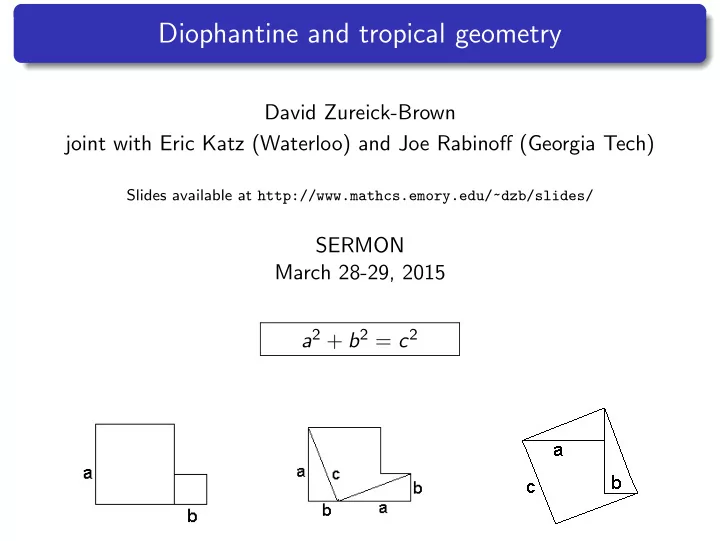
Diophantine and tropical geometry David Zureick-Brown joint with Eric Katz (Waterloo) and Joe Rabinoff (Georgia Tech) Slides available at http://www.mathcs.emory.edu/~dzb/slides/ SERMON March 28-29, 2015 a 2 + b 2 = c 2 Basic Problem (Solving
Basic Problem (Solving Diophantine Equations)
Analysis
Let f1, . . . , fm ∈ Z[x1, ..., xn] be polynomials. Let R be a ring (e.g., R = Z, Q).
Problem
Describe the set
- (a1, . . . , an) ∈ Rn : ∀i, fi(a1, . . . , an) = 0
- .
David Zureick-Brown (Emory University) Diophantine and tropical geometry March 28-29, 2015 2 / 21
Basic Problem (Solving Diophantine Equations)
Analysis
Let f1, . . . , fm ∈ Z[x1, ..., xn] be polynomials. Let R be a ring (e.g., R = Z, Q).
Problem
Describe the set
- (a1, . . . , an) ∈ Rn : ∀i, fi(a1, . . . , an) = 0
- .
Fact
Solving diophantine equations is hard.
David Zureick-Brown (Emory University) Diophantine and tropical geometry March 28-29, 2015 2 / 21
Hilbert’s Tenth Problem
The ring R = Z is especially hard.
David Zureick-Brown (Emory University) Diophantine and tropical geometry March 28-29, 2015 3 / 21
Hilbert’s Tenth Problem
The ring R = Z is especially hard.
Theorem (Davis-Putnam-Robinson 1961, Matijaseviˇ c 1970)
There does not exist an algorithm solving the following problem: input: f1, . . . , fm ∈ Z[x1, ..., xn];
- utput: YES / NO according to whether the set
- (a1, . . . , an) ∈ Zn : ∀i, fi(a1, . . . , an) = 0
- is non-empty.
David Zureick-Brown (Emory University) Diophantine and tropical geometry March 28-29, 2015 3 / 21
Hilbert’s Tenth Problem
The ring R = Z is especially hard.
Theorem (Davis-Putnam-Robinson 1961, Matijaseviˇ c 1970)
There does not exist an algorithm solving the following problem: input: f1, . . . , fm ∈ Z[x1, ..., xn];
- utput: YES / NO according to whether the set
- (a1, . . . , an) ∈ Zn : ∀i, fi(a1, . . . , an) = 0
- is non-empty.
This is still open for many other rings (e.g., R = Q).
David Zureick-Brown (Emory University) Diophantine and tropical geometry March 28-29, 2015 3 / 21
Fermat’s Last Theorem
Theorem (Wiles et. al)
The only solutions to the equation xn + yn = zn, n ≥ 3 are multiples of the triples (0, 0, 0), (±1, ∓1, 0), ±(1, 0, 1), (0, ±1, ±1).
David Zureick-Brown (Emory University) Diophantine and tropical geometry March 28-29, 2015 4 / 21
Fermat’s Last Theorem
Theorem (Wiles et. al)
The only solutions to the equation xn + yn = zn, n ≥ 3 are multiples of the triples (0, 0, 0), (±1, ∓1, 0), ±(1, 0, 1), (0, ±1, ±1). This took 300 years to prove!
David Zureick-Brown (Emory University) Diophantine and tropical geometry March 28-29, 2015 4 / 21
Fermat’s Last Theorem
Theorem (Wiles et. al)
The only solutions to the equation xn + yn = zn, n ≥ 3 are multiples of the triples (0, 0, 0), (±1, ∓1, 0), ±(1, 0, 1), (0, ±1, ±1). This took 300 years to prove!
David Zureick-Brown (Emory University) Diophantine and tropical geometry March 28-29, 2015 4 / 21
Basic Problem: f1, . . . , fm ∈ Z[x1, ..., xn]
Qualitative:
Does there exist a solution? Do there exist infinitely many solutions? Does the set of solutions have some extra structure (e.g., geometric structure, group structure).
David Zureick-Brown (Emory University) Diophantine and tropical geometry March 28-29, 2015 5 / 21
Basic Problem: f1, . . . , fm ∈ Z[x1, ..., xn]
Qualitative:
Does there exist a solution? Do there exist infinitely many solutions? Does the set of solutions have some extra structure (e.g., geometric structure, group structure).
Quantitative
How many solutions are there? How large is the smallest solution? How can we explicitly find all solutions? (With proof?)
David Zureick-Brown (Emory University) Diophantine and tropical geometry March 28-29, 2015 5 / 21
Basic Problem: f1, . . . , fm ∈ Z[x1, ..., xn]
Qualitative:
Does there exist a solution? Do there exist infinitely many solutions? Does the set of solutions have some extra structure (e.g., geometric structure, group structure).
Quantitative
How many solutions are there? How large is the smallest solution? How can we explicitly find all solutions? (With proof?)
Implicit question
Why do equations have (or fail to have) solutions? Why do some have many and some have none? What underlying mathematical structures control this?
David Zureick-Brown (Emory University) Diophantine and tropical geometry March 28-29, 2015 5 / 21
The Mordell Conjecture
Example
The equation y2 + x2 = 1 has infinitely many solutions.
David Zureick-Brown (Emory University) Diophantine and tropical geometry March 28-29, 2015 6 / 21
The Mordell Conjecture
Example
The equation y2 + x2 = 1 has infinitely many solutions.
Theorem (Faltings)
For n ≥ 5, the equation y2 + xn = 1 has only finitely many solutions.
David Zureick-Brown (Emory University) Diophantine and tropical geometry March 28-29, 2015 6 / 21
The Mordell Conjecture
Example
The equation y2 + x2 = 1 has infinitely many solutions.
Theorem (Faltings)
For n ≥ 5, the equation y2 + xn = 1 has only finitely many solutions.
Theorem (Faltings)
For n ≥ 5, the equation y2 = f (x) has only finitely many solutions if f (x) is squarefree, with degree > 4.
David Zureick-Brown (Emory University) Diophantine and tropical geometry March 28-29, 2015 6 / 21
Fermat Curves
Question
Why is Fermat’s last theorem believable?
1 xn + yn − zn = 0 looks like a surface (3 variables) 2 xn + yn − 1 = 0 looks like a curve (2 variables) David Zureick-Brown (Emory University) Diophantine and tropical geometry March 28-29, 2015 7 / 21
Mordell Conjecture
Example
y2 = (x2 − 1)(x2 − 2)(x2 − 3) This is a cross section of a two holed torus. The genus is the number of holes.
Conjecture (Mordell)
A curve of genus g ≥ 2 has only finitely many rational solutions.
David Zureick-Brown (Emory University) Diophantine and tropical geometry March 28-29, 2015 8 / 21
Fermat Curves
Question
Why is Fermat’s last theorem believable?
1 xn + yn − 1 = 0 is a curve of genus (n − 1)(n − 2)/2. 2 Mordell implies that for fixed n > 3, the nth Fermat equation has
- nly finitely many solutions.
David Zureick-Brown (Emory University) Diophantine and tropical geometry March 28-29, 2015 9 / 21
Fermat Curves
Question
What if n = 3?
1 x3 + y3 − 1 = 0 is a curve of genus (3 − 1)(3 − 2)/2 = 1. 2 We were lucky; Ax3 + By3 = Cz3 can have infinitely many solutions. David Zureick-Brown (Emory University) Diophantine and tropical geometry March 28-29, 2015 10 / 21
Faltings’ theorem / Mordell’s conjecture
Theorem (Faltings, Vojta, Bombieri)
Let X be a smooth curve over Q with genus at least 2. Then X(Q) is finite.
Example
For g ≥ 2, y2 = x2g+1 + 1 has only finitely many solutions with x, y ∈ Q.
David Zureick-Brown (Emory University) Diophantine and tropical geometry March 28-29, 2015 11 / 21
Uniformity
Problem
1 Given X, compute X(Q) exactly. 2 Compute bounds on #X(Q).
Conjecture (Uniformity)
There exists a constant N(g) such that every smooth curve of genus g
- ver Q has at most N(g) rational points.
Theorem (Caporaso, Harris, Mazur)
Lang’s conjecture ⇒ uniformity.
David Zureick-Brown (Emory University) Diophantine and tropical geometry March 28-29, 2015 12 / 21
Uniformity numerics
g 2 3 4 5 10 45 g Bg(Q) 642 112 126 132 192 781 16(g + 1)
Remark
Elkies studied K3 surfaces of the form y2 = S(t, u, v) with lots of rational lines, such that S restricted to such a line is a perfect square.
David Zureick-Brown (Emory University) Diophantine and tropical geometry March 28-29, 2015 13 / 21
Coleman’s bound
Theorem (Coleman)
Let X be a curve of genus g and let r = rankZ JacX(Q). Suppose p > 2g is a prime of good reduction. Suppose r < g. Then #X(Q) ≤ #X(Fp) + 2g − 2.
Remark
1 A modified statement holds for p ≤ 2g or for K = Q. 2 Note: this does not prove uniformity (since the first good p might be
large).
Tools
p-adic integration and Riemann–Roch
David Zureick-Brown (Emory University) Diophantine and tropical geometry March 28-29, 2015 14 / 21
Chabauty’s method
(p-adic integration) There exists V ⊂ H0(XQp, Ω1
X) with
dimQp V ≥ g − r such that, Q
P
ω = 0 ∀P, Q ∈ X(Q), ω ∈ V (Coleman, via Newton Polygons) Number of zeroes in a residue disc DP is ≤ 1 + nP, where nP = # (div ω ∩ DP) (Riemann-Roch) nP = 2g − 2. (Coleman’s bound)
P∈X(Fp)(1 + nP) = #X(Fp) + 2g − 2.
David Zureick-Brown (Emory University) Diophantine and tropical geometry March 28-29, 2015 15 / 21
Example (from McCallum-Poonen’s survey paper)
Example
X : y2 = x6 + 8x5 + 22x4 + 22x3 + 5x2 + 6x + 1
1 Points reducing to
Q = (0, 1) are given by x = p · t, where t ∈ Zp y = √ x6 + 8x5 + 22x4 + 22x3 + 5x2 + 6x + 1 = 1 + x2 + · · ·
2
Pt
(0,1)
xdx y = t (x − x3 + · · · )dx
David Zureick-Brown (Emory University) Diophantine and tropical geometry March 28-29, 2015 16 / 21
Chabauty’s method
(p-adic integration) There exists V ⊂ H0(XQp, Ω1
X) with
dimQp V ≥ g − r such that, Q
P
ω = 0 ∀P, Q ∈ X(Q), ω ∈ V (Coleman, via Newton Polygons) Number of zeroes in a residue disc DP is ≤ 1 + nP, where nP = # (div ω ∩ DP) (Riemann-Roch) nP = 2g − 2. (Coleman’s bound)
P∈X(Fp)(1 + nP) = #X(Fp) + 2g − 2.
David Zureick-Brown (Emory University) Diophantine and tropical geometry March 28-29, 2015 17 / 21
Stoll’s hyperelliptic uniformity theorem
Theorem (Stoll)
Let X be a hyperelliptic curve of genus g and let r = rankZ JacX(Q). Suppose r < g − 2. Then #X(Q) ≤ 8(r + 4)(g − 1) + max{1, 4r} · g
Tools
p-adic integration on annuli comparison of different analytic continuations of p-adic integration
David Zureick-Brown (Emory University) Diophantine and tropical geometry March 28-29, 2015 18 / 21
Main Theorem (partial uniformity for curves)
Theorem (Katz, Rabinoff, ZB)
Let X be any curve of genus g and let r = rankZ JacX(Q). Suppose r ≤ g − 2. Then #X(Q) ≤ 84g2 − 123g + 48
Tools
p-adic integration on annuli comparison of different analytic continuations of p-adic integration Non-Archimedean (Berkovich) structure of a curve [BPR] Combinatorial restraints coming from the Tropical canonical bundle
David Zureick-Brown (Emory University) Diophantine and tropical geometry March 28-29, 2015 19 / 21
Comments
Corollary ((Partially) effective Manin-Mumford)
There is an effective constant N(g) such that if g(X) = g, then # (X ∩ JacX,tors) (Q) ≤ N(g)
Corollary
There is an effective constant N′(g) such that if g(X) = g > 3 and X/Q has totally degenerate, trivalent reduction mod 2, then # (X ∩ JacX,tors) (C) ≤ N′(g)
The second corollary is a big improvement
1 It requires working over a non-discretely valued field. 2 The bound only depends on the reduction type. 3 Integration over wide opens (c.f. Coleman) instead of discs and annuli. David Zureick-Brown (Emory University) Diophantine and tropical geometry March 28-29, 2015 20 / 21
Baker-Payne-Rabinoff and the slope formula
(Dual graph Γ of XFp) (Contraction Theorem) τ : X an → Γ. (Combinatorial harmonic analysis/potential theory) f a meromorphic function on X an F := (− log |f |)
- Γ
associated tropical, piecewise linear function div F combinatorial record of the slopes of F (Slope formula) τ∗ div f = div F
David Zureick-Brown (Emory University) Diophantine and tropical geometry March 28-29, 2015 21 / 21