Director Generals Information meeting for Permanent Delegations on - - PowerPoint PPT Presentation

director general s information meeting for permanent
SMART_READER_LITE
LIVE PREVIEW

Director Generals Information meeting for Permanent Delegations on - - PowerPoint PPT Presentation

Director Generals Information meeting for Permanent Delegations on Priority Africa Implementation of the Operational strategy for Africa Mr Luc Rukingama, Director of UNESCO Office in Harare Wednesday 28 May 2014, UNESCO, Paris OUTLINE


slide-1
SLIDE 1

Director General’s Information meeting for Permanent Delegations

  • n Priority Africa

Implementation of the Operational strategy for Africa

Mr Luc Rukingama, Director of UNESCO Office in Harare Wednesday 28 May 2014, UNESCO, Paris

slide-2
SLIDE 2

OUTLINE

  • Project Highlights by

Priority Africa Flagships

  • Partnership and

Resource Mobilization

  • Visibility and knowledge

sharing

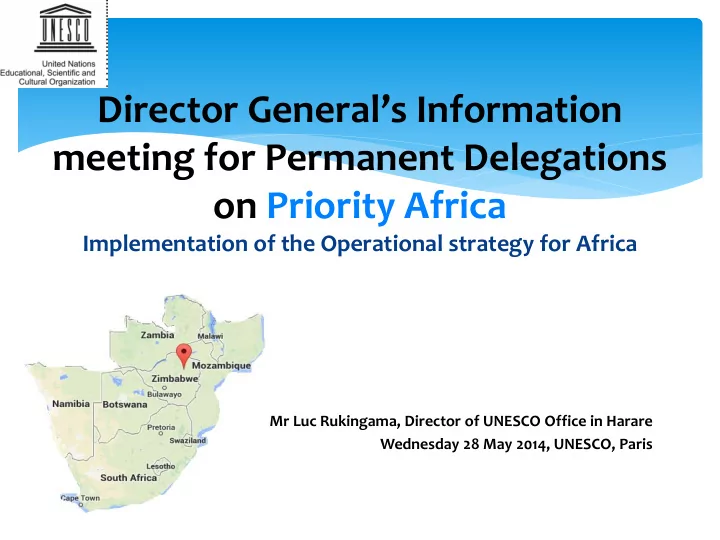
Botswana, Lesotho, Malawi, Mozambique, Namibia, South Africa, Swaziland, Zambia and Zimbabwe

2

slide-3
SLIDE 3
  • I. Flagship 1: Promoting a culture of peace and

non-violence

∗ Objective: to build countries’ capacity in public policies linked to addressing and ensuring social inclusion and reducing poverty. ∗ implementation of 10 Point Plan of Action of the African Coalition of Cities against Racism and Discrimination. 3 Support policy intervention within three selected member states in SADC , particularly at the city level, in favour of the most disadvantaged and the poorest.

slide-4
SLIDE 4

Flagship 2: Strengthening education systems for sustainable development in Africa: improving equity, quality and relevance

Focus of the EFA Acceleration Frameworks are: Zambia and Swaziland: Goal 1 – ECCE, and Goal 2 – UPE for Lesotho

Target: Policy makers, national partners

Objective: To accelerate attainment of Education For All in Southern Africa

Implementation Results:

Launched in March

2013

3 countries

participating from the region: Lesotho, Swaziland and Zambia 4

slide-5
SLIDE 5

Flagship 2: Strengthening education systems for sustainable development in Africa: improving equity, quality and relevance (ctd)

Capacity enhancement in evidence- based policy development; EFA Review supported; enhancement

  • f EMIS

Target: Policy makers, national partners Objective: Strengthen policy and planning in education

Implementation Results:

Language and educator policy in Namibia

Teacher educator policies in Mozambique and Lesotho

Standards for early learning (Swaziland), for ECCE centres (Namibia)

Monitoring and supporting of

  • ngoing EFA reviews

In all SA countries under the lead of UIS

Development of Teacher MIS in 3 countries ongoing

slide-6
SLIDE 6

Flagship 2: Strengthening education systems for sustainable development in Africa: improving equity, quality and relevance (ctd)

Better Education for Africa’s Rice (BEAR Project); Greening TVET; Regional Harmonisation

Target: Policy makers, private sector, national partners

Objective: Strengthen Technical & Vocational Education and Training (TVET)

Implementation Results:

Enhancement of curriculum and standards in selected sectors in the BEAR countries: Botswana, Namibia, Malawi and Zambia.

Toolkit on greening TVET developed and distributed to schools in 15 countries

SADC TVET experts & stakeholders convened and focused on managing TVET systems, youth and skills and TVET for sustainable development

6
slide-7
SLIDE 7

Flagship 2: Strengthening education systems for sustainable development in Africa: improving equity, quality and relevance (ctd)

PROMOTING HEALTH THROUGH EDUCATION

∗ Expected Result 10 (MLA2): Member States deliver good quality health education, HIV and comprehensive sexuality education that contributes to healthy lifestyles and gender equality Specific Objectives ∗ Supporting countries to scale-up good quality of CSE. ∗ Promoting gender equality and ending gender-based violence ∗ Supporting countries to ∗ Eliminate stigma and discrimination. ∗ Reforming both the education sector and non-formal education programs so that they become a safe environment for adolescent key populations, and provide them with the knowledge and skills to prevent new HIV infections and stand for their rights Targets ∗ Ministry of Education and Health, curriculum developers, teachers, learners, young people living with HIV, parents and guardians.

7

slide-8
SLIDE 8

Flagship 2 : Good quality health education, HIV and comprehensive sexuality education Results (cld).

7 December 2013, Ministers of Health and Education from 20 countries in East and Southern Africa affirmed and adopted the ESA Commitment to CSE and services for young people in Cape Town, South Africa www.youngpeopletoday.net 250 curriculum developers from 17 countries trained on CSE and 521 teachers trained . 176 schools provided life skills-based HIV and sexuality education using the new CSE curriculum reaching 139,051 learners. Published a regional report on Young People, CSE and SRH; Toolkit for CSE curriculum devt; Adolescent Treatment lk l f

8

slide-9
SLIDE 9

Flagship 3: Harnessing STI and knowledge for the sustainable socio-economic development of Africa

9 Focal Area 5.2: “Vocational Education and Training of Water Technicians” UNESCO’s Hydro Free and FOSS Platform of Experts (HOPE) Initiative:

  • Report 2013
  • Kit 2013: STOAT/MODFLOW

http://www.hope-initiative.net/

IHP-VII AND RELATED ACTIVITIES OF UNESCO

slide-10
SLIDE 10

Flagship 3: Harnessing STI and knowledge for the sustainable socio-economic development of Africa Capacity Development in STI

∗ Technical assistance advice to member state in developing the critical mass of Africa’s scientists and engineers ∗ Facilitate South-South Cooperation in STI

  • UNESCO’s centre of excellence

in Nanotechnology -South Africa ∗ Malawi University of Science and Technology (MUST) ∗ UNESCO-University of Zimbabwe’s Earth System Science programme

10

slide-11
SLIDE 11

11 Flagship 4: Fostering science for the sustainable management of Africa’s natural resources and disaster risk reduction Focal Area 1.5: “Global change and climate variability in arid and semi-arid regions”  Data access, availability and quality assessment for the development of a flood forecasting model for Namibia (Report April 2014) IHP-VII AND RELATED ACTIVITIES OF UNESCO

slide-12
SLIDE 12

12 Flagship 4: Fostering science for the sustainable management of Africa’s natural resources and disaster risk reduction IHP-VII AND RELATED ACTIVITIES OF UNESCO Focal Area 2.2: “Capacity development for improved governance; enhanced legislation for wise stewardship of water resources” UNESCO WPOIs dealing with Post-Conflict and Post-Disaster situations/ Mapping and assessing sanitation in schools in Namibia and online monitoring

slide-13
SLIDE 13

Flagship 5: Harnessing the power of Culture for Sustainable Development and Peace in a context of regional integration

∗ Target: Policy makers, Cultural Heritage Communities Objectives ∗ Recognising importance of living heritage as a mainspring of cultural diversity and human creativity ∗ Bring human beings closer together and ensuring exchange and understanding among them, fostering cultural diversity, intercultural dialogue and a culture of peace. Results ∗ Sub-regional cooperation mechanism established to support national efforts in safeguarding the intangible cultural heritage

  • f communities in Southern Africa.

Mbende Jerusarema Dance : ICH practiced in Zimbabwe

13

slide-14
SLIDE 14

Flagship 5: Harnessing the power of Culture for Sustainable Development and Peace in a context of regional integration (cld).

∗ Policy, legal and institutional frameworks established or improved at the national level. ∗ Human resources developed at the national level to facilitate the implementation of the 2003 Convention. 14

slide-15
SLIDE 15

Flagship 6: Promoting an environment conducive for freedom of

expression and media development

Promoting an enabling environment for press freedom and facilitating pluralism and participation in media, and supporting sustainable and independent media institutions

Target: Policy makers, Journalists, local community media outlets

Objective: Support the development of freedom of expression, free media and access to information

Implementation Results:

15 local radios

supported to use ICTs (Internet and mobile) for broadcasting and reporting in Lesotho, Namibia, South Africa and Zambia; 15

slide-16
SLIDE 16

∗4 community radios established in Malawi, Mozambique and Zambia; ∗1000 journalists (400 women) trained in ICTs, ethics and investigative journalism in Botswana, Lesotho, Malawi, Mozambique, Namibia, South Africa, Swaziland, Zambia and Zimbabwe

Flagship 6 (Cld)

16

slide-17
SLIDE 17
  • III. Visibility and knowledge sharing

∗ Functional Regional Office Website to be launched in 2014 ∗ SADC National Commissions Familiarization Workshop held in April 2014 in Harare ∗ Workshops organized by UNESCO with the participation of donor country embassies and national authorities of beneficiary countries resulting in wider national media coverage. ∗ Regular reports and articles on sector and project websites at HQ. * Advocacy for UNESCO reform and the 37C/5 flagship programmes. Sensitization of line ministries and multisectoral/bilateral partners. 17

Swedish Ambassador to Zambia in a UNESCO workshop

slide-18
SLIDE 18

Thank you for your attention