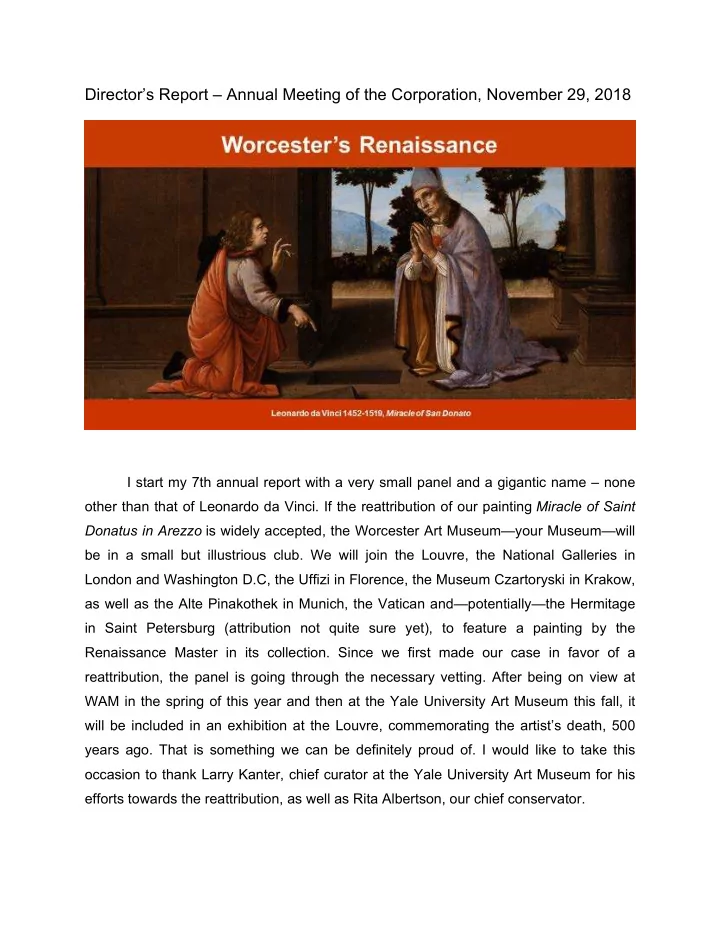
SLIDE 1 Director’s Report – Annual Meeting of the Corporation, November 29, 2018
I start my 7th annual report with a very small panel and a gigantic name – none
- ther than that of Leonardo da Vinci. If the reattribution of our painting Miracle of Saint
Donatus in Arezzo is widely accepted, the Worcester Art Museum—your Museum—will be in a small but illustrious club. We will join the Louvre, the National Galleries in London and Washington D.C, the Uffizi in Florence, the Museum Czartoryski in Krakow, as well as the Alte Pinakothek in Munich, the Vatican and—potentially—the Hermitage in Saint Petersburg (attribution not quite sure yet), to feature a painting by the Renaissance Master in its collection. Since we first made our case in favor of a reattribution, the panel is going through the necessary vetting. After being on view at WAM in the spring of this year and then at the Yale University Art Museum this fall, it will be included in an exhibition at the Louvre, commemorating the artist’s death, 500 years ago. That is something we can be definitely proud of. I would like to take this
- ccasion to thank Larry Kanter, chief curator at the Yale University Art Museum for his
efforts towards the reattribution, as well as Rita Albertson, our chief conservator.
SLIDE 2 But there is another reason for starting this annual report under the headline of “Renaissance.” Over the course of the last century, Worcester has undergone a transformation as the source of its wealth shifted from manufacturing to a knowledge- based economy. Today, another transformation is taking place in the city. Many new buildings are going up, and many old buildings are being repurposed and restored. Our restaurant and nightlife culture continues to expand, and (you may have heard) Worcester will soon become a minor-league baseball destination. Several news outlets have already reported on the “Renaissance of Worcester,” most recently NPR: Forget Oakland or Hoboken: Worcester, Mass. Is the New “It” Town. While comparisons may
- r may not be odious, the good news is that there is movement, and we are benefitting
from the expanding vibrancy of the greater Boston area. What does that have to do with the Worcester Art Museum? A lot! We are, after all, the “Worcester” Art Museum and take seriously our role in the city’s quality of life, vitality, and growth. We are the preeminent cultural destination in the region. As such— and as one of the organizations in Worcester whose reputation reaches far beyond our city—we have always enjoyed inspiring new people to visit Worcester. Now these visitors are increasing, coming more often, and staying longer. Coverage of our
SLIDE 3
exhibitions and programs in the national and international press is growing. Just last year, WAM was featured in The Wall Street Journal five times! Due in part to that coverage and to the newly created Worcester buzz, our programs attract an increasing number of visitors from Metro West and beyond. (For some exhibitions as many as two thirds of our visitors come from outside of Worcester County.) We also see an increase in the number of visitors from throughout New England, New York, as well as visitors from Europe and Asia. As a regional force with a collection of international importance, we must make sure that we are all inclusive—attracting and engaging our increasingly diverse community, and making sure that those who are first and second-generation Americans feel at home and participate in our civic life. This year, we partnered with the Southeast Asian Coalition of Central Massachusetts and the Indochina Arts Partnership to bring two Vietnamese artists to Worcester for a month-long Southeast Asia Artist-in- Residence program at WAM. The two artists brought new ideas and perspectives to the
SLIDE 4 city’s art scene and helped us made lasting connections with the local Southeast Asian community. One of the assets of a strong city is a vibrant arts community, and Worcester is particularly blessed in this area. At WAM, we have worked hard over the years to nurture and support local artists. Many artists teach in our studio art program—and many successful artists have emerged from that program, too. We partner with other
- rganizations, such as ArtsWorcester and the Sprinkler Factory, and also feature the
work of local artists in the Museum. We regularly showcase the work of studio art faculty and their students in the Higgins wing, and also have the opportunity to present talent from our arts community in other spaces and venues. In the last year alone, we have featured works by James Dye, John Pagano, Tony King, and Toby Sisson through our new Central Massachusetts Artist Initiative, a designated rotation space in the Sidney and Rosalie Rose Gallery. Another ingredient of a thriving city is a strong academic community—and again Worcester stands out. With thirteen colleges, Worcester welcomes more than 35,000 students every year—compare with (I know we shouldn’t, but bear with me…) Harvard
SLIDE 5
with “only” 23,000 students and Oxford, England with “only” 24,000! In the last fiscal year, we have partnered with many of these institutions, a synergy that contributes to their academic richness and enhances our scholarship and programming. In addition, many students use our library of no less than 60,000 books, which we run jointly with the College of the Holy Cross. You may remember that last year I highlighted an ongoing project with Clark University, Rediscovering an American Community of Color: The Photographs of William Bullard. This year, I am happy to share that the 24th-annual Historic New England Book prize was awarded just two weeks ago to the catalogue for this exhibition produced by students and teachers. Let us applaud Jeannette Greenwood, professor of history at Clark University, and Nancy Burns, associate curator of prints, drawings and photographs at WAM, for this accomplishment.
SLIDE 6 In addition, I would like to showcase another collaboration, this time with Williams
- College. In the first phase of the project, Professor Antonia Foias, Williams College
chair and professor of anthropology, and her students came to Worcester to mine our amazing collection of Pre-Columbian art for representations of the human and spirit
- body. Thereafter, loans were made for an entire year, giving students an opportunity to
develop both interpretation and presentation of the works, including new labels and audio tour content. We will benefit from this project in the near future by updating research, titles, and dates when we reinstall our gallery of Ancient American art.
SLIDE 7
Among the many programming highlights of last year I would like to focus particularly on the success of our Homer show, a project that we co-organized with the Milwaukee Art Museum. Centerpieces were our respective holdings by Homer— paintings and works on paper—with major loans from other institutions. Besides breaking new ground in scholarly research—as documented in a comprehensive catalogue—Milwaukee and Worcester attracted jointly 120,000 visitors. We successfully applied for national and local grants and grew our respective earned revenue considerably—to the point that WAM could book a surplus at the end of the year. The Worcester Art Museum is considered a preeminent cultural organization because of our distinguished collection—in large part due to the generosity and foresight of many individuals over the past 120 years. Thanks to the generosity of several donors, notably Helen and Robert Stoddard, we benefit from an important endowment that enables us to continuously shape the collection. We fill gaps, we upgrade, and we grow our holdings strategically. Two of the works in question you can check out in our European Galleries, which will be open during the reception in the Renaissance Court.
SLIDE 8 In June, we acquired a major work by a German Impressionist, Max Slevogt, a self- portrait from 1910. This purchase strengthens our unique position in the American Museum landscape for impressionist art: beyond the usual suspects—mostly French and now beyond the reach of most museums and collectors—we can look at other names and schools that are both of very high quality and within our budget. A second work entered our collection in September: Gabriele Münter’s Houses in Riegsee, from 1909. Münter is a prominent representative of the German “Blauer Reiter” (Blue Rider) movement from Munich, working closely with Wassily
is truly beautiful; it also helps bridge the gap between our collection
contemporary art, and increase our holdings
- f important woman artists. Check the work out in our recently reinstalled 211 gallery.
SLIDE 9 Two equally important additions to our collection were made in the realm of contemporary art. First, Barti Kher’s Vegetarian Lion, A Slippery Fish from 2014, helps connect visitors with traditional Indian art. As you can see, miniature versions of all kinds of Indian gods, from different belief systems, are assembled, showing both the vitality of religious faiths in contemporary India and the capacity of contemporary Indian artists to draw inspiration from those traditions. Another new masterwork in our collection is Stan Douglas’ Bumtown. Of black Canadian descent, Douglas is a highly decorated artist working with film, photographs and video
will be shown in the near future in the context of an exhibition. It is the biggest photograph in size that has ever entered our collections. Prepare yourself for a treat
SLIDE 10 The vibrancy of the Worcester Art Museum is based on people: visitors and volunteers such as yourselves, as well as staff. You meet some members of our staff when you visit. Others, however, work behind-the-scenes, to make sure that our programs are reaching our visitors and that our collection is cared for so that future generations can enjoy it. No one knows that better than my esteemed predecessor, Jim
- Welu. In Jim’s honor, through the support and generosity of so many of you, WAM’s
most loyal donors, we have endowed the position European curator. The first curator to carry that title is our recently appointed Director of Curatorial Affairs and now James A. Welu Curator of European Art, Claire Whitner. Claire came to us from the Davis Museum at Wellesley College. She is a woman of action, dare I say, as she has already reinstalled two galleries in our European section, just three months
- n the job, and she has been a vital part in the discussions around the acquisition of the
Gabriele Münter painting. My deep appreciation to all of you who supported this effort. It means a great deal to the Museum and to the ongoing care of our outstanding collection of European Art. You will notice when you adjourn to the Museum, that a new plaque honoring the donors who made this endowment possible, has been installed
SLIDE 11
- utside of the Italian gallery on the second floor at the top of the stairs. Please do take
a look during the reception. I conclude my report with a mention of ongoing and future programs at WAM. Alas, our exhibition of the Hudson River School—incredibly successful both in terms of attendance and revenue—closed last Sunday. However, you can still see a breathtaking presentation of Iranian manuscripts in Preserved Pages: Book as Art in Persia and India 1300-1800, and our longer-term presentation of stained glass by Tiffany and La Farge. Tomorrow night, we open, lumina, an exciting art and light installation in Salisbury Hall. This immersive experience, created by LuminArtz of Boston, will connect visitors with works in our collection in a completely new way. You will find more about programs on our website. I know a lot of you, like me, are already looking forward to Flora in Winter—and given the grey weather and the premature snow we are dealing with, this will be a welcome augur, hopefully, of a peaceful and harmonious new year. In addition, we are gearing up to a spectacular and internationally important presentation of more than half of all of Monet’s Waterloo Bridge
SLIDE 12 depictions in American collections, paired with Hiroshige’s views of bridges, eternalized in woodcuts from the 19th century. Moving forward, the Worcester Art Museum will continue to contribute to the vibrancy of our city and the region, and do our part to drive and support Worcester’s
- Renaissance. I invite you to celebrate a significant year of collective accomplishments in
the Renaissance Court – so aptly named – of the museum directly across the road, and to raise a glass to our continued contributions to Worcester, and to the role the Museum plays in our own lives, those of our friends and families, and the region as a whole.
- - Matthias Waschek, C. Jean and Myles McDonough Director of the Worcester Art Museum