Disclosure Medical Problems in the I have no financial disclosures - - PowerPoint PPT Presentation

disclosure medical problems in the
SMART_READER_LITE
LIVE PREVIEW

Disclosure Medical Problems in the I have no financial disclosures - - PowerPoint PPT Presentation

Disclosure Medical Problems in the I have no financial disclosures or conflicts of interest in relation Young Athlete to this presentation Cases from My Clinic Ossur Americas: I presented an independent lecture on knee osteoarthritis Cindy


slide-1
SLIDE 1

1

Cindy J. Chang, M.D.

UCSF Clinical Professor Primary Care Sports Medicine

  • Depts. of Orthopaedics and Family & Community Medicine

Medical Problems in the Young Athlete

Cases from My Clinic

Cindy J. Chang, M.D.

2

Disclosure

I have no financial disclosures or conflicts of interest in relation to this presentation Ossur Americas: I presented an independent lecture on knee

  • steoarthritis

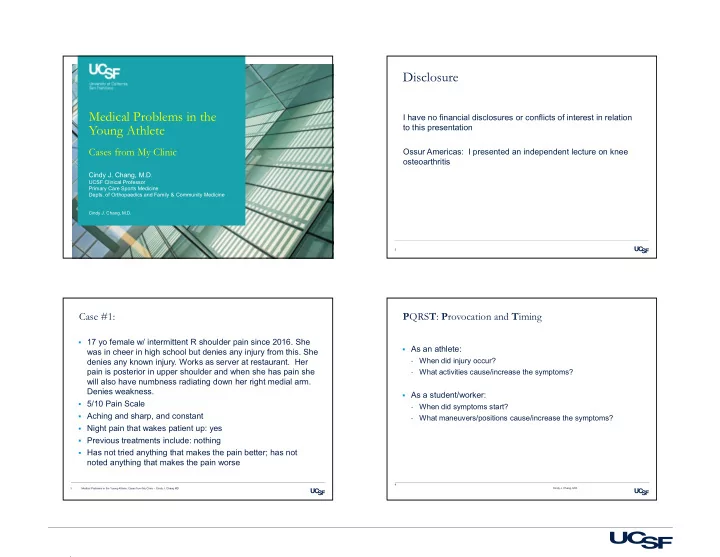
Case #1:

  • 17 yo female w/ intermittent R shoulder pain since 2016. She

was in cheer in high school but denies any injury from this. She denies any known injury. Works as server at restaurant. Her pain is posterior in upper shoulder and when she has pain she will also have numbness radiating down her right medial arm. Denies weakness.

  • 5/10 Pain Scale
  • Aching and sharp, and constant
  • Night pain that wakes patient up: yes
  • Previous treatments include: nothing
  • Has not tried anything that makes the pain better; has not

noted anything that makes the pain worse

3 Medical Problems in the Young Athlete: Cases from My Clinic – Cindy J. Chang MD

PQRST: Provocation and Timing

  • As an athlete:
  • When did injury occur?
  • What activities cause/increase the symptoms?
  • As a student/worker:
  • When did symptoms start?
  • What maneuvers/positions cause/increase the symptoms?

4 Cindy J. Chang, M.D.

slide-2
SLIDE 2

2

5 Cindy J. Chang, M.D.

PQRST: Quality and Radiation

6 Cindy J. Chang, M.D.

Case #1

  • C-spine FROM, no pain, neg Spurlings
  • No erythema, ecchymoses or deformity noted of shoulder

girdle

  • No mm atrophy
  • R shoulder FROM w/o pain. Motor 5/5 w/o pain. Sensory intact.
  • No pain to palpation along the clavicle, scapula
  • Tenderness to palpation over supraclavicular space/first rib,

just lateral to R side of C7, coracoid-clavicular interval

  • Positive Adson's test bilaterally
  • Positive Roos test duplicating ulnar nerve pain

7 Cindy J. Chang, M.D. 8

Areas of Compression:

  • Costoclavicular

triangle

  • Interscalene triangle
  • Subcoracoid space

Cindy J. Chang, M.D.

slide-3
SLIDE 3

3

Classification of Thoracic Outlet Syndrome

  • 1. By Affected structure:
  • a. Neurogenic or vascular (arterial
  • r venous) or a combination
  • 2. By Cause of compression:
  • a. Scalene
  • b. Cervical rib
  • 3. By Event:
  • a. Trauma
  • b. Repetitive stress
  • c. Posture

9

Twaij H et al. BJSM 2013

Cindy J. Chang, M.D.

Vascular TOS

  • Rare; involves subclavian artery and/or vein
  • More likely to occur in younger patients; vigorous overhead arm activity
  • Venous obstruction
  • Can be secondary to thrombosis, Paget-von Schrötter syndrome
  • Diffuse arm, forearm, or hand pain (“tourniquet”); UE swelling; venous distention
  • Arterial obstruction
  • color changes; claudication; diffuse arm, forearm, or hand pain
  • Due to arterial collateral blood flow, initial symptoms may be mild (arm ache and

fatigue, esp. after overhead activity)

10 Cindy J. Chang, M.D.

Neurogenic TOS

  • Compression of brachial plexus; pure neurogenic presentation

also rare

  • Also tends to affect those who perform overhead and repetitive

activities

  • Can present with
  • painless atrophy of intrinsic muscles of hand
  • difficulty grasping a racket or ball due to weakness
  • report of sensory loss or paresthesias
  • Pain usually mild

11 Cindy J. Chang, M.D.

Nonspecific-type or Functional/Dynamic TOS

  • Pain in the arm or both arms, scapular region,

and cervical region

  • Dynamic transient mechanical restriction
  • What event caused/causes/worsens the

symptoms?

  • Traumatic event (eg, MVA, fall)
  • Computer work
  • Mobile device

12 Cindy J. Chang, M.D.

slide-4
SLIDE 4

4

Nonspecific TOS Signs and Tests

  • Weakness and decreased sensation, tingling, heaviness, fatigue,

achiness, coolness

  • Non-focal and non-radicular findings
  • Diffuse UE pain w/ or w/o guarding
  • Poor posture
  • Tenderness over coracoid, pectoralis mm, scalenes; tightness of mm
  • Fullness in supraclavicular space from elevated rib

13 Cindy J. Chang, M.D.

Special TOS Tests

  • Adson’s maneuver - Neck extended and rotated to Affected

side w/ Arm at side while deeply inspiring and holding the breath, pulse checked

  • Wright’s test – (airplane) Affected arm slowly abducted and

externally rotated, pulse checked, while taking a deep breath

  • Roos stress test – (Raise the Roof) Shoulder abducted

above the head, externally rotated and repetitive opening and closing both hands into fists for at least 1 minute Tests considered + if reproduce symptoms and/or a decrease in pulse detected, or paresthesias, or can’t complete Roos

Cindy J. Chang, M.D. 14

Nord KM et al. Electromyog Clin Neurophys 2008

Special TOS Signs and Tests

Cindy J. Chang, M.D. 15

TOS Diagnostic Testing

  • Plain XR films: cervical rib, callus from

a clavicle/upper rib fx, apical tumor

  • Venous US studies, Doppler US,

angiogram, venogram, CT/CTA, NCS/EMG, NeuroMSK US

  • MRI/MRA: brachial plexus anatomy,

subclavian vein anatomy, vascular

  • cclusion/compression
  • Positional scans with arm in dynamic position

to reproduce sx can improve validity of tests

  • MRI alone: 41% sensitivity, 33% specificity
  • Neg predictive value 4%

Cindy J. Chang, M.D. 16

Lewis M et al. J Vasc Diag 2014 Singh VK et al. J Ortho Surg 2014

slide-5
SLIDE 5

5

Case #1

Cindy J. Chang, M.D. 17

Case #1

  • 6 wk follow-up:
  • Pain is worse and now has coldness in the R arm down

ulnar side of arm to ring and pinky fingers, still

  • numbness. Denies swelling or blue tint in arm.
  • PT helping with decreased pain during walking
  • Also quit job to focus on school

Cindy J. Chang, M.D. 18 Cindy J. Chang, M.D. 19

Case #2

  • 15 yo female, referred to see me for second opinion by peds
  • rtho colleague
  • 8 months prior first experienced left iliac crest pain during

dance class

  • Can’t recall injury, was just standing when first had pain
  • Then during summer intensive dance class (12 hrs a week, 3-5

hr max a day, for 4 wks) much worse, and right ant superior iliac crest began hurting as well. Had to quit dance.

  • No relief with ice, stretching, NSAIDs

Cindy J. Chang, M.D. 20

slide-6
SLIDE 6

6

Case #2

  • Hx fractured foot,

stress fx foot left MT, and achilles tendonitis left

  • ankle. Also shin

splints bilat with dance.

  • Injuries since 11

yoa

  • Mom says has had

slow healing esp the achilles injury

Cindy J. Chang, M.D. 21

Case #2

Cindy J. Chang, M.D. 22

Case #2

Cindy J. Chang, M.D. 23

Case #2

Cindy J. Chang, M.D. 24

  • Vit D 22.2; 2000 IU BID started
  • Was on crutches partial weightbearing x 3 wks, then

wheelchair to totally unload x 4 wks, then back to crutches

  • Started using bone stimulator
  • I reviewed her chart
slide-7
SLIDE 7

7

Case #2

Cindy J. Chang, M.D. 25

  • Summary of findings:
  • 12/15/11: had left 5th MT base fracture, treated with cast.
  • 2/22/12: saw Dr. P for left achilles pain that developed since

cast off.

  • 4/4/12: f/u visit and per PT rec had been in walking boot

already x 3 wk.

  • 5/3/12: no real improvement, so MRI ordered.
  • 5/18/12 MRI of left ankle- Mild swelling as well as some fluid

around a portion of the flexor hallucis longus tendon. Achilles tendon is normal.

  • 5/24/12: completely immobilized in walking cast x 4 wks.

Case #2

Cindy J. Chang, M.D. 26

  • Summary of findings (cont.):
  • 6/19/12-10/11/13: began to see Dr. S. No notes accessible in

Epic.

  • 8/23/12 MRI of left foot- Stress injury and/or nondisplaced

fracture of the proximal right 2nd metatarsal bone

  • 11/29/12 - MRI left foot for lat foot pain - Resolving edema in

the metatarsal bone of the 2nd toe.

  • Interval development of marrow edema in the lateral calcaneus

adjacent to the calcaneal cuboid articulation. Minimal adjacent soft tissue edema. May be post traumatic in etiology. Alternatively, this appearance may be on the basis of altered weight bearing mechanics.

Case #2

Cindy J. Chang, M.D. 27

  • Summary of findings (cont.):
  • 5/20/14: visit with Dr. S; still in formal PT once a month, still

unable to do gymnastics, hurts with running. Dr. D second

  • pinion, no good solns. MRI ordered.
  • 6/19/14 - MRI left foot - Minimal ankle joint effusion with

minimal synovial thickening, nonspecific finding. Otherwise normal MRI of the foot.

Case #2

Cindy J. Chang, M.D. 28

  • Summary of findings (cont.):
  • 7/1/14 visit with Dr. S: has had acupuncture, and has drawn
  • labs. "Her pain bothers her with impact from running and jumping.

She has had an extensive work-up that is negative for any specific

  • pathology. She has also seen another orthopaedic surgeon for

second opinion and no cause for her foot pain was found. MRI is negative for pathology in the area of her symptoms. I have done an extensive work-up and do not have a explanation for her pain."

  • 10/8/14: visit with dr. K, for follow up of left leg and foot pain.

Note never able to return to gymnastics. Now left leg pain x 4 months, now in dance.

  • xrays neg and back in PT for this until 10/9/15.
  • 10/9/15: first mention of iliac crest pain to PT. She was to have

been discharged for her shins.

slide-8
SLIDE 8

8

Case #2

  • Summary of chart review
  • Long bouts of pain with no identifiable cause
  • For her last shin splints dx, was seen by PT for one year, before

the onset of this iliac crest pain

  • Although pain in hips started in July 2015, she did not tell her PT until

October 2016.

  • Ordered labs to evaluate bone metabolism and evaluate for

rheumatological/inflammatory process,

Cindy J. Chang, M.D. 29

Case #2

Cindy J. Chang, M.D. 30

Case #2

Cindy J. Chang, M.D. 31

  • Follow up visit following week
  • Labs reviewed; negative
  • She denies any food aversions or avoidances. Weight has been
  • stable. Has not grown for at least one year. Is same height as her
  • parents. 10 menstrual cycles in the last 12 months.
  • Is an only child at home, has older bro and sis in college.
  • Try back brace to support obliques/abdom mm to see if will help

with pain

Case #2

Cindy J. Chang, M.D. 32

  • Follow up visit one month later
  • Brace helps with back achiness but not with iliac crest pain
  • Since getting the brace, she has been getting HA
  • HA occas associated with nausea, sometimes photophobia. No fam hx
  • migraines. No double vision. She uses ipad. Doesn't have a laptop or

desktop.

  • Resolves with ibuprofen
  • HA at back of neck/top of head/more throbbing.
slide-9
SLIDE 9

9

Case #2

Cindy J. Chang, M.D. 33

  • Follow up visit 6 wks later
  • Still using bone stimulator
  • Stopped wearing back brace because of the HA (after a month). It

did help her back pain.

  • After she stopped the brace the back pain never returned and HA

resolved.

  • Gradually improving, progress walking/swimming

Case #2

Cindy J. Chang, M.D. 34

  • Follow up visit 6 wks later
  • 0/10 pain with sitting and walking; can tolerate all PT exercises
  • Running on Alter G, 60% body weight
  • Resumed cheer team but jumps caused iliac crest pain to hurt but

quickly resolved

  • Recently pulled left hamstring
  • Long car ride to go camping caused low back soreness

Case #2

Cindy J. Chang, M.D. 35

  • Follow up visit 3 months later when her back and “hips” flared
  • Got shin splints again early fall season as was taking dance 2x/wk

and cheer 2x/wk 8-10 hr/wk total plus FB game coverage, plus dance class every day 60 min a day

  • Has rested 3 wks since end of FB season, improving
  • Wants to resume bone stimulator
  • Has begun seeing a therapist for anxiety
  • Follow up visit 1 month later
  • May have tweaked low back during stretching
  • On exam, for the first time she has SI joint pain

Case #2

Cindy J. Chang, M.D. 36

slide-10
SLIDE 10

10

Case #2

  • Negative sacroiliitis

Cindy J. Chang, M.D. 37

Case #2

  • Referral to rheumatologist
  • Hx concerning for HLA B27 positive Enthesitis Related Arthritis

(ERA)

  • Sacroiliitis would warrant anti-TNF therapy.
  • Start a standing NSAID to help with current pain from apophysitis.
  • Discussed potential association of ERA with symptomatic uveitis
  • refer to the eye doctor for uveitis screening at baseline, once yearly
  • Symptoms increased after this visit, to include nausea,

abdominal pain, fatigue, HA, light sensitivity

  • Dx with pain overlay syndrome by psychologist
  • Has been dependent on PT x 5 yrs

Cindy J. Chang, M.D. 38

Case #3

  • 14 yo 9th grade female XC athlete (first year running) at very

competitive high school (team consistently top-ranked in state)

  • Presents with pain in L buttocks region, still ran in race 2 d later
  • Tried to X-train on stationary bike; pushing down on pedal hurt
  • Saw pediatrician and referred to PT; first visit was approx 1

month after onset of injury.

  • What else would you like to know?

Cindy J. Chang, M.D. 39

Case #3 – Additional History

  • Onset of menses at age of

13 but irregular

  • 3 cycles in past 12 months
  • No menses in last 4 months
  • Runs all year round with 2

week break.

  • Runs 14 hours a week
  • Diet
  • Older brother has nut allergy
  • Mom hx of breast cancer so

no soy products in house

  • Family Hx
  • Mom has osteopenia
  • Maternal aunt scoliosis

Cindy J. Chang, M.D. 40

slide-11
SLIDE 11

11

Case #3 – Physical Exam

  • Vital signs
  • 5’3”
  • 111# 12 oz
  • BMI 21
  • No pain with hip ROM
  • No pain with mm testing including resisted hip extension and

knee flexion

  • Vague pain on palp of left ischial tuberosity
  • Neg hop test

Cindy J. Chang, M.D. 41

Imaging studies Case #3

  • Menses resumed 1 month after she stopped running
  • Labs
  • Vit D – 24.2
  • Ferritin 28
  • Nutrition referral
  • Running analysis

Cindy J. Chang, M.D. 43

Case #3

  • 8 months later, L lower leg pain
  • Training for cross country season for past 2 months (early

summer), with gradually increasing mileage, now 30 – 40 miles/week

  • Hurts front of the lower leg, worse with running, better with rest.
  • Physical therapy and taping for shin splints have not helped.
slide-12
SLIDE 12

12

Case #3 – Physical Exam

  • Vital signs
  • Height 5’3”
  • Weight 105#
  • BMI 18.6
  • Tender anterior cortex LLE approximately 8 cm proximal to the

medial malleolus

  • Pain with double and single leg hop

45

Case #3 – Physical Exam

46

Case #3 – Physical Exam

47

Female Athlete Triad (The Triad)

Healthy energy status Healthy menstrual cycles Healthy bones Low energy availability with

  • r without eating

d/o Osteoporosis Amenorrhea Low bone density Suboptimal energy availability Irregular menses OPTIMAL HEALTH PATHOLOGY Nattiv A et al, ACSM Position Stand, 2007.

The interrelationships between energy availability, menstrual function, and bone mineral density

slide-13
SLIDE 13

13

Relative energy deficiency in sport (RED-S)

Mountjoy M et al. The IOC consensus statement: beyond the Female Athlete Triad--Relative Energy Deficiency in Sport (RED-S). Br J Sports Med. 2014 Apr;48(7):491-7.

Low energy availability (EA) is key to the Triad and RED-S

  • Clues:
  • BMI
  • High risk: < 17.5 or < 85% expected body weight in adolescents
  • Mod risk: 17.6-18.4 or between 85-90% expected
  • Recent weight loss
  • Disordered eating
  • Sports dietician or exercise physiologist can help assess EA

very scientifically

  • A stable body weight should not be interpreted as adequate EA
  • An athlete may be in energy balance at a stable, low, body weight

but with suppressed physiologic function

Joy E et al. 2014 female athlete triad coalition consensus statement on treatment and return to play of the female athlete triad. Curr Sports Med Rep. 2014.

Prevalence of the Triad

  • Higher in sports where
  • Leanness gives competitive advantage
  • Body conforming uniforms required
  • Sports
  • Long distance running
  • Gymnastics
  • Swimming
  • Diving

Joy EA, Nattiv A. Clearance and Return to Play for the Female Athlete Triad: Clinical Guidelines, Clinical Judgment, and Evolving Evidence. Curr Sports Med Rep. 2017 Nov/Dec;16(6):382-385.

Triad screening questions

  • Menstrual periods
  • LMP?
  • # in past 12

months?

  • Age of menarche
  • Taking any female

hormones, OCPs?

  • Bone health
  • Have you ever

had a stress fracture?

  • Have you ever

been told you have low bone density?

  • Energy availability
  • Do you worry about

your weight?

  • Are you trying to or

has anyone recommended you gain or lose weight?

  • Are you on a special

diet or do you avoid certain foods?

  • Have you ever had

an eating disorder?

De Souza MJ et al. 2014 Female Athlete Triad Coalition Consensus Statement on Treatment and Return to Play of the Female Athlete Triad. Br J Sports Med. 2014 Feb;48(4):289.

slide-14
SLIDE 14

14

Amenorrhea work-up

De Souza MJ et al. 2014 Female Athlete Triad Coalition Consensus Statement on Treatment and Return to Play of the Female Athlete Triad. Br J Sports Med. 2014 Feb;48(4):289.

Functional hypothalamic amenorrhea

  • Due to low energy availability
  • Diagnosis of exclusion
  • Decreased GnRH  decreased LH, FSH  decreased

estrogen

Joy E et al. 2014 female athlete triad coalition consensus statement on treatment and return to play of the female athlete triad. Curr Sports Med Rep. 2014.

Should this athlete have a DEXA?

Indications for DEXA testing in athletes

  • ≥ 1 high-risk triad risk factor
  • DSM-V diagnosed eating

disorder

  • BMI < 17.5, < 85% estimated

weight or recent weight loss ≥ 10% in 1 month

  • Menarche ≥ 16 years of age
  • Currently with < 6 menses
  • ver 12 months
  • 2 prior stress

reactions/fractures, 1 high-risk stress fracture/reaction or a low energy atraumatic fracture

  • Prior z-score < -2.0
  • ≥ 2 moderate-risk triad risk

factors

  • h/o or current disordered

eating ≥ 6 months

  • BMI 17.5-18.5, 85-90%

estimated weight or recent weight loss 5-10% in 1 month

  • Menarche age 15-16 years
  • H/o 6-8 menses over 12

months

  • 1 prior stress

reaction/fracture

OR

Joy E et al. Curr Sports Med Rep. 2014.

DEXA

  • If < 20 y/o
  • Scan whole body or total body less head in addition to lumbar

spine BMD

  • If ≥ 20 y/o
  • Scan femoral neck and lumbar spine
  • In either case for premenopausal girls / women
  • use the Z-score which compares to age-matched controls rather

than T-score which compares to peak BMD.

  • Lowest score guides treatment

Joy EA, Nattiv A. Clearance and Return to Play for the Female Athlete Triad: Clinical Guidelines, Clinical Judgment, and Evolving Evidence. Curr Sports Med Rep. 2017 Nov/Dec;16(6):382-385.

slide-15
SLIDE 15

15

How do you interpret her DEXA?

Definition of low BMD in premenopausal women

  • Z-score ≤ -2.0: below the expected range for age
  • Z-score > -2.0: within the expected range for age

HOWEVER

  • If female athlete in weight-bearing sport
  • Z-score < -1.0: below the expected range for age (low BMD) per

American College of Sports Medicine

  • Osteoporosis
  • Z-score ≤ -2.0 and
  • Clinically significant fracture history (long bone fracture of leg or

vertebral compression fracture or 2 or more long bone fractures

  • f upper extremities)

Can this athlete with female athlete triad safely return to play?

Female athlete triad: Cumulative risk assessment

Mary Jane De Souza et al. Br J Sports Med 2014;48:289.

Can this athlete with female athlete triad safely return to play?

Female Athlete Triad: Clearance and Return-to-Play Guidelines by Medical Risk Stratification.

Mary Jane De Souza et al. Br J Sports Med 2014;48:289.

*Cumulative Risk Score determined by summing the score of each risk factor (low, moderate, high risk) from the Cumulative Risk Assessment.

Female athlete triad treatment: Increase EA

  • Increase dietary energy intake
  • Decrease exercise
  • Has been shown to restore menses
  • Has been shown to increase bone density
  • May benefit from nutritionist, psychiatrist, psychologist
  • Gradual approach over months
  • Team physician may initiate a contract esp in athletes in

moderate – high risk groups that outlines the criteria needed for return to play.

Joy E et al. 2014 female athlete triad coalition consensus statement on treatment and return to play of the female athlete triad. Curr Sports Med Rep. 2014 Jul-Aug;13(4):219-32.

slide-16
SLIDE 16

16

Treatment for low BMD

  • Weight gain and subsequent resumption of menses
  • Calcium-rich foods for goal 1000-1300 mg/d
  • Vitamin D 600 IU/d for goal serum level 32-50 ng/ml
  • Weight-bearing exercise?
  • Further studies needed to weigh risks/benefits in athletes with low

BMD (fx risk)

Joy E et al. Curr Sports Med Rep. 2014 Jul-Aug;13(4):219-32.

Treatment for low BMD

  • Pharmacologic tx:
  • if lack of response at least 1 year and if new fractures occur during

nonpharm management.

  • Combined oral contraceptive pill:
  • not associated consistently with improved BMD in athletes with

amenorrhea

  • Transdermal estrogen with cyclic progesterone:
  • increases BMD in adolescent girls with anorexia. Needs more

investigation for use in the Triad.

Joy E et al. Curr Sports Med Rep. 2014 Jul-Aug;13(4):219-32.

3 components of the triad recovery at different rates

De Souza MJ et al. 2014 Female Athlete Triad Coalition Consensus Statement on Treatment and Return to Play of the Female Athlete Triad. Br J Sports Med. 2014 Feb;48(4):289.

slide-17
SLIDE 17

17