Disclosure-Shan Lin, MD LPI: When, Where, and How Large? Research - - PowerPoint PPT Presentation

disclosure shan lin md
SMART_READER_LITE
LIVE PREVIEW

Disclosure-Shan Lin, MD LPI: When, Where, and How Large? Research - - PowerPoint PPT Presentation

Disclosure-Shan Lin, MD LPI: When, Where, and How Large? Research Affiliation No relevant financial conflicts Allergan, Inc. Memantine Study National Eye Institute Shan Lin, MD Professor OHTS study Director, Glaucoma


slide-1
SLIDE 1

1

LPI: When, Where, and How Large?

Shan Lin, MD Professor Director, Glaucoma Service

  • Dept. of Ophthalmology

UCSF School of Medicine

Koret Vision Center UCSF Medical School

Disclosure-Shan Lin, MD

  • Research Affiliation
  • Allergan, Inc.
  • Memantine Study
  • National Eye Institute
  • OHTS study
  • Chinese Eye Study
  • Carl Zeiss Meditec
  • Visante OCT study
  • Genentech
  • Lucentis/Ahmed valve

study

  • No relevant financial

conflicts

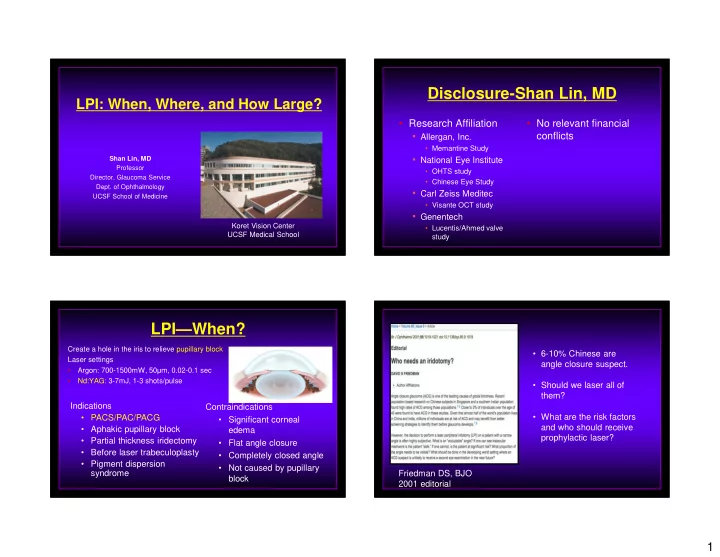
LPI—When?

Create a hole in the iris to relieve pupillary block Laser settings

  • Argon: 700-1500mW, 50µm, 0.02-0.1 sec
  • Nd:YAG: 3-7mJ, 1-3 shots/pulse

Indications

  • PACS/PAC/PACG
  • Aphakic pupillary block
  • Partial thickness iridectomy
  • Before laser trabeculoplasty
  • Pigment dispersion

syndrome Contraindications

  • Significant corneal

edema

  • Flat angle closure
  • Completely closed angle
  • Not caused by pupillary

block Friedman DS, BJO 2001 editorial

  • 6-10% Chinese are

angle closure suspect.

  • Should we laser all of

them?

  • What are the risk factors

and who should receive prophylactic laser?

slide-2
SLIDE 2

2 Risk gradient of angle closure (Narrow angle to angle closure)

Fellow eyes of acute attack

  • At least half of fellow eye will develop acute attack in 5 years

[Lowe RF 1962, Snow JT, 1977]

From occludable angles to primary angle closure

  • 16% in 10 years develop acute or appositional closure

(Alsbirk 1992, Eskimos)

  • 22% in 5 years (Thomas 2003, Indians)
  • 17.3% in 4 years (Baskaran 2015, Singaporeans)
  • 20.4% in 6 years (Yip 2008, Mongolians)
  • 6% in a mean of 2.7 years (Wilensky 1993, Caucasians)

Laser Iridotomy—When

  • Pupillary block
  • Considered first line Rx
  • Other mechanisms (eg, Plateau iris)
  • LPI still considered first line Rx to remove

pupillary block component

  • Indication: ≥180 degrees grade 0-1 angle

20% do not respond to prophylactic LPI Who will likely NOT respond to LPI?

  • Smaller AOD (0.052mm remain close VS 0.108mm open)
  • More anterior iris insertion (SS-IR: 0.085 vs 0.125mm)
  • Thicker peripheral iris (0.447 vs 0.415 mm)
  • More CB anterior rotation (TCPD: 0.514 vs 0.562mm)

He M Ophthalmology 2007

Laser Iridotomy—Efficacy

  • Progression of ACG forms after LPI
  • PAC Suspect
  • 22% PAC
  • 4% PAC Glaucoma
  • PAC
  • 5% PAC Glaucoma
  • Cataract Surgery was significant factor in

reducing risk for PACS progression

Peng P…Lin S. Br J Ophthalmol. 2011 Sep;95(9):1207-11.

slide-3
SLIDE 3

3

Laser Iridotomy—Where, How Large?

  • Recommendations
  • Horizontal position
  • Less photopsias
  • Avoid if ≥180 degrees of PAS
  • Risk for IOP spike and persistent IOP elevation
  • Large iridotomy
  • Need more than just patent PI
  • 217 subjects with superior LPI vs 250 controls
  • Objective glare measurement
  • Cortical cataract is the only predictor for straylight score (Beta=0.04, P<0.01)
  • Not associated with

– Age, sex – Presenting VA, Nuclear / subcapsular cataract grade – Size of LPI: vertical / horizontal diameter, circumference, area – Lid coverage: fully covered / partially covered / totally uncovered – Location: LPI distance to pupil center / lid margin / limbus, clock hour – Iris color

Ophthalmology 2012;119(7):1375–1382

  • New Linear dysphotopsia
  • Superior LPI (10.7%) > Temporal LPI (2.4%) (P<0.001)
  • All of the superior LPI cases occurred in either fully or partially covered
  • Partially or completely covered LPIs > completely exposed LPIs.
  • Pain
  • Temporal LPI resulted in 1.5 times more pain than the superior LPI.
  • Visual symptoms were not associated with the color of the iris.

Vera et al. AJO 2014

The tear film forms a triangular lake at both the upper and lower lid margin, which can act as a base-up prism for incumbent light

Light redirected superiorly strikes the superior peripheral retina after a relatively short path, and remains relatively focused Light passing through the temporal iris in a straight path to strike the temporal posterior pole, creating a defocused image

Vera et al. AJO 2014

slide-4
SLIDE 4

4

Nanophthalmos Case

Right Eye Left Eye

Nanophthalmos Case

Right Eye Left Eye

LPI Enlargement

  • What is a patent LPI?
  • 150-200 um traditionally
  • Theoretical factors
  • Bochmann et al., 2008
  • Case series (6)
  • Assess angle

parameters after LPI enlargement

Bochmann et al. Klin Monatsbl Augenheilkd 2008;225:349–352

PRE POST Grade I Grade III

slide-5
SLIDE 5

5

PRE POST

Summary

  • LPI—first line of defense
  • WHEN?
  • Occludable angles
  • Contralateral eyes of Acute ACG
  • Closed angle cases unless angle mostly closed
  • WHERE?
  • Horizontal
  • HOW LARGE?
  • More than 150 microns