Disclosures Crash, Snap: Falls Cause Osteoporosis- related - - PDF document

disclosures crash snap falls cause osteoporosis related
SMART_READER_LITE
LIVE PREVIEW

Disclosures Crash, Snap: Falls Cause Osteoporosis- related - - PDF document

Disclosures Crash, Snap: Falls Cause Osteoporosis- related Fractures. Research support Novartis What Can a Clinician Do? Viking NAMS Pre-meeting October 10, 2017 Consultant Neil Binkley, M.D. Amgen Some of this


slide-1
SLIDE 1

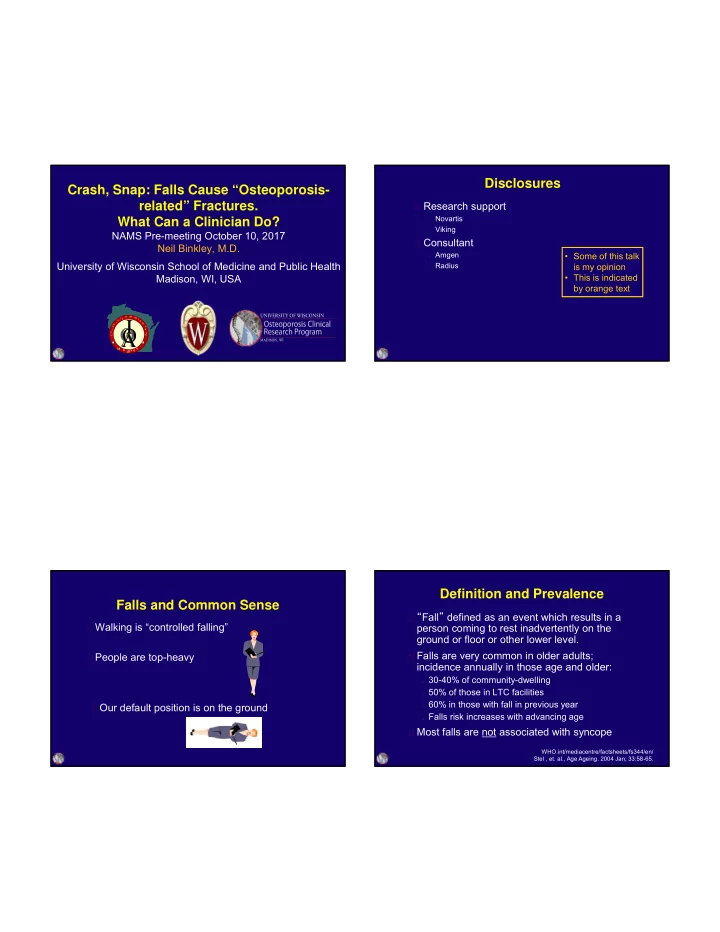
Crash, Snap: Falls Cause “Osteoporosis- related” Fractures. What Can a Clinician Do?

NAMS Pre-meeting October 10, 2017 Neil Binkley, M.D. University of Wisconsin School of Medicine and Public Health Madison, WI, USA

Disclosures

Research support

Novartis Viking

Consultant

Amgen Radius

  • Some of this talk

is my opinion

  • This is indicated

by orange text

Falls and Common Sense

Walking is “controlled falling” People are top-heavy Our default position is on the ground

Definition and Prevalence

“Fall” defined as an event which results in a

person coming to rest inadvertently on the ground or floor or other lower level.

Falls are very common in older adults;

incidence annually in those age and older:

30-40% of community-dwelling 50% of those in LTC facilities 60% in those with fall in previous year Falls risk increases with advancing age

Most falls are not associated with syncope

WHO.int/mediacentre/factsheets/fs344/en/ Stel , et. al., Age Ageing. 2004 Jan; 33:58-65.

slide-2
SLIDE 2

Why Are We Talking About Falls in An Osteoporosis Session?? Why Are We Treating “Osteoporosis?” Fracture is What’s Important Falls Cause “Osteporosis-related” Fracture

Reports vary, but some find that 10-15% of falls

result in fracture or other serious injury

~95% of hip fractures are from falls

Usually from falling sideways

Preventing falls prevents fracture…..

Parkkari, et. al., Calcif Tissue Int, 1999; 65:183-187 Hayes, et. al., Calcif Tissue Int; 52: 192-198

Fracture Incidence and Morbidity

National Electronic Injury

Surveillance System All Injury Program

Generated national estimates

  • f ED visits for fall related

fracture in adults age 65+; 2001-2008

Orces CH. BMJ Open 2013;3 e001772

Estimated 4.05 million fall-related fracture during the 8 yrs

Fracture rate increased ~24% during study period 48% required hospitalization

Fracture rates increased with age; 2X higher in women

slide-3
SLIDE 3

Risk Factors for Falls

Mean relative risk or odds ratios from 16 studies

  • Muscle weakness 4.4
  • History of falls 3.0
  • Balance deficit 2.9
  • Gait deficit 2.9
  • Assist device 2.6
  • Visual deficit 2.5
  • Arthritis 2.4
  • Impaired ADL 2.3
  • Depression 2.2
  • Cognitive impairment 1.8
  • Age > 80 years 1.7

Rubenstein & Josephsen, Clin Ger Med

Impaired Physical Performance Increases Hip Fracture Risk

Adapted from Cawthon, et. al., J Bone Miner Res, 2008, 23:1037- 1044

Evaluated the association of physical performance and hip fracture risk in MrOS; 5995 men age 65+

“Poor physical function is independently associated with an increased risk of hip fracture in older men.”

Sarcopenia: the Age-related Gradual Loss

  • f Muscle mass, Strength and Function

Sarc for flesh (muscle), penia for deficiency

Fielding, et. al, J Am Med Dir Assoc 2011; 12: 249-256

Term coined in 1989; more recently defined as: “The age- associated loss of skeletal muscle mass and function…. a complex syndrome associated with muscle mass loss alone or in conjunction with increased fat mass.”

Sarcopenia Pathogenesis is Multifactorial

Hormonal declines

GH/IGF-1, testosterone, estrogen

Increased inflammation

IL-6, TNF-alpha, etc, etc.

Malnutrition

Protein, vitamin D

Sedentariness/Diseases leading to decreased use Toxin exposure Neuronal loss Reduced muscle “quality” expressed ultimately as

reduced function

Changes in structure, fat and connective tissue

Jensen, J Parenter Enteral Nutr, 32;656-659, 2008

Are osteoporosis and sarcopenia the same process? With the disease being fracture? Osteoporosis

bone

slide-4
SLIDE 4

We Need to Get Past Treating “Osteoporosis” and Treat People

Fractures result from a syndrome: treatment should be directed at various conditions to reduce fracture risk

Osteoporosis Sarcopenia

Toxins, e.g., tobacco

Diabetes

Family History

Obesity Falls & Fractures Reduced QOL Healthcare Cost Death

Dysmobility Syndrome Advancing age

Binkley, et. al., J Bone Miner Res. 2017 Jul;32(7):1391-1394

Etc, etc

This Paradigm is Identical to Metabolic Syndrome

Hyperlipidemia Hypertension

Toxins, e.g., tobacco

Diabetes

Family History

Obesity

Heart Attack

Reduced QOL Healthcare Cost Death

Metabolic Syndrome Advancing age

Treating Osteoporosis Without Considering Other Parts of the Syndrome Causing Fractures is Comparable to Treating Hyperlipidemia and Ignoring Hypertension and Diabetes in Patients With Metabolic Syndrome

Personal opinion

It’s My Bias That “We” Haven’t Done a Good Job in Conveying Information That “Fractures Are Bad”

slide-5
SLIDE 5

www.share.iofbonehealth.org/WOD/2012

Fractures Reduce Quantity and Quality of Life Fractures Cause Dependency Loss of Independence is a Huge Concern

Telephone Survey of ~800 Older Adults in 2007

www.slideshare.net/clarityproducts/clarity-2007- aginig-in-place-in-america-2836029

What do you fear most?

Loss of independence: 26% Moving out of home into

nursing home: 13%

Giving up driving: 11% Loss of family/friends: 11% Death: 3%

Maintaining Independence is THE Reason to Treat The Fracture Risk Syndrome So, What Can a Clinician Do to Reduce Falls Risk?

slide-6
SLIDE 6

Appreciate the Age-related Changes That Increase Falls Risk

Visual system: acuity, depth perception, contrast

sensitivity, dark adaptation

Proprioceptive system: lower extremities Vestibular system: loss of labyrinthine hair cells,

vestibular ganglion cells, nerve fibers

Recognize Conditions That Increase Falls

Risk Factors for Recurrent Falls

Age Female History of falls Fear of falling Impaired mobility Sedentariness Arthritis/OA Parkinson’s disease

Modified from De Jong, et. al., Ther Adv Drug Saf. 2013 Aug; 4(4): 147–154

Vision impairment Postural hypotension Depression Urinary incontinence Stroke CV disease Chronic pain Drug use

A Couple of Concrete Examples of Chronic Conditions That Increase Falls and Fracture Risk

Parkinson’s disease

Rigidity of lower extremity musculature Slow movement initiation to correct body sway Hypotensive drug effects Cognitive impairment

Osteoarthritis, especially in knees

Can affect mobility Inability to step over objects Avoid complete weight bearing on joint

Review (and Reduce) the Medications

Common fall risk factor; potentially easily modifiable Certain classes associated with hip fracture

Benzodiazepines Antidepressants (including SSRIs) Antipsychotic drugs

Increased risk of fall…

With recent change in dose With increasing total number of prescriptions

slide-7
SLIDE 7

“The exact number of falls caused by drugs or drug intoxication is not known because falls are not officially recognized as an ADR.”

Drug Class Odds ratio for falls Antidepressants 1.68 Neuroleptics/antipsychotics 1.59 Benzodiazepines 1.57 Sedative/hypnotics 1.47 Antihypertensives 1.24 NSAIDs 1.21

De Jong, et. al., Ther Adv Drug Saf. 2013 Aug; 4(4): 147–154 Woolcott , et. al. . 2009 Arch Intern Med 169: 1952–1960

Post Hospitalization is a High-risk Time

After hospital discharge, falls rates are increased

compared to community dwelling older adults1

40+% fall within 6 months; over half are injurious falls2

Hospitalization doubles the risk of hip fracture,

notably in the month after discharge3

~ one-third experience ADL functional decline

compared to their preadmission level of activities

  • f daily living4

1Mahoney, et. al., Arch Intern Med 2000;160:2788–95 2Hill, et. al. . J Gerontol A Biol Sci Med Sci. 2011 Sep;66(9):1001-12 3Wolinsky, et. Al. J Gerontol A Biol Sci Med Sci. 2009 Feb;64(2):249-55 4Kovinsky, et. al., J Am Geriatr Soc. 2003 Apr;51(4):451-8

Sarcopenia Medicaitons Might Ideally be Used After Illnesses/Events to Get Back to Baseline

Diagnostic Approach: History

The most important question is:

When was the last time you fell down?

Among ~2800 older adults that reported

fall within the last year

50% of women and 60% of men did not talk

with a healthcare provider about falls

Falls prevention was discussed with a healcare

provider by 31% of women and 24% of men

Stevens, et. al., Am J Prev Med 2012; 43:59-62

slide-8
SLIDE 8

Circumstances at time of fall

Activity Prodromal symptoms Time of fall Medication use Environmental factors (lighting, floor furniture, etc.)

Loss of consciousness?

Increase index of suspicion for orthostatic

hypotensions, CV event or neurologic etiology

Diagnostic Approach: History

Focus on risk factors Assess for gait disturbance, postural stability Integrated musculoskeletal assessment most important

TUG Rhomberg Clinic walk

Diagnostic Approach: Physical Exam Laboratory and Diagnostic Tests

No specific lab evaluation; tailor to problems and risks Vitamin deficiencies; B1, B6, B12 and D Holter, spine radiographs, MRI, echocardiography only if

indicted by exam or history

Imaging studies if lumbar stenosis or cervical spondylosis

suspected or hyperreflexia or spasticity on PE

Modify home environment (multifactorial)

Done by healthcare professional Effective for fallers with visual impairment

Minimize/taper medications; including OTC

Sedtives, anxiolytics, antidepressants, antipsychotics Reduction in total # of meds should be pursued

Exercise; esp balance, strength and gait training

Tai Chi with balance and strength is effective

Panel on Prevention of Falls in Older Persons, AGS and BGS, J Am Geriatr Soc. 2011 Jan;59:148-57

slide-9
SLIDE 9

Treat visual impairment

Routine eye screening with visual correction effective

  • nly if part of a multifactorial intervention

Assess postural hypotension

Treat orthostatic hypotension to reduce dizziness,

e.g., fluid optimization, medication review and reduction and behavioral changes

Pacemaker for carotid sinus hypersensitivity Supplement vitamin D; at least 800 IU/day

Panel on Prevention of Falls in Older Persons, AGS and BGS, J Am Geriatr Soc. 2011 Jan;59:148-57

Identify and manage foot and footwear problems

Walking shoes of low heel height and high surface

contact area may reduce falls risk

Non-slip shoe coverings (e.g., Yaktrax) on ice

Education and information programs

Panel on Prevention of Falls in Older Persons, AGS and BGS, J Am Geriatr Soc. 2011 Jan;59:148-57

Multiple Excellent Evidence-Based Falls Risk Reduction Resources Exist

American Geriatric & British Geriatric Society Guideline

JAGS 2010 www.amerciangeriatrics.org

STEADI (Stopping Elderly Accidents, Deaths & Injuries)

ww.cdc.gov/steadi/index.html

National Falls Prevention Resource Center www.ncoa.org Area Agency on Aging www.eldercare.gov State Falls Prevention Coalition www.ncoa.org/resources/list-of-state-falls-

prevention-coalitions/

Go4Life www. go4life.nia.nih.gov

A Common Sense, Clinical Falls Approach

  • 1. Ask About Falls

“When was the last time that you fell down?” “Tell me about it”

Circumstances, prodrome, environmental factors, time Can risk taking behaviors be addressed?

“How many times have you fallen in the last year?” “Did any of these falls cause injury?”

Based on AGS/BGS 2010 Guideline: Prevention of Falls in Older Persons available at americangeriatrics.org

slide-10
SLIDE 10

A Common Sense, Clinical Falls Approach

  • 2. Medications: Reduce or Eliminate

Neuroleptics, antiphyschotics, antidepressants Incontinence medications (strong anti-cholinergics) Sleepers; including OTC Antihistamines, 1st and 2nd generation Any medication with: “drowsiness, dizziness, dry

mouth, ataxia, confusion….” as adverse effects

Ask about ETOH; alone or interacting with meds

Based on AGS/BGS 2010 Guideline: Prevention of Falls in Older Persons available at americangeriatrics.org

A Common Sense, Clinical Falls Approach

  • 3. Physical Therapy Evaluation

For “gait abnormality, falls, balance and

strengthening assessment and treatment”

Assess need for assistive device and if so teaching

Based on AGS/BGS 2010 Guideline: Prevention of Falls in Older Persons available at americangeriatrics.org

A Common Sense, Clinical Falls Approach

  • 4. Single Vision Lenses for Walking

Based on AGS/BGS 2010 Guideline: Prevention of Falls in Older Persons available at americangeriatrics.org

“Ban the Bifocal!” Robert Przybelski, M.D.

A Common Sense, Clinical Falls Approach

  • 5. Nutrition/Correct Vitamin D Deficiency

Undernutrition is not rare in older adults

~1/3 in recent Canadian report

Need to measure 25(OH)D Don’t use high dose vitamin D supplementation

Huge doses increase falls risk

Aim for ~40 ng/mL

Don’t be amazed if it take 2000-4000 IU of vitamin D3 daily

Based on AGS/BGS 2010 Guideline: Prevention of Falls in Older Persons available at americangeriatrics.org Personal opinion

slide-11
SLIDE 11

www.acc.co.nz www.acc.co.nz

“The good physician treats the disease; the great physician treats the patient who has the disease.”

Sir William Osler

Treat the Person, Not Just Their Bones

slide-12
SLIDE 12

Thank You