Disclosures Definitions Seizure-a transient occurrence of signs - - PowerPoint PPT Presentation

disclosures definitions
SMART_READER_LITE
LIVE PREVIEW

Disclosures Definitions Seizure-a transient occurrence of signs - - PowerPoint PPT Presentation

Outline Seizures in Children and Overview of Epilepsy in Children Youth with DD Evolution of seizures though development Joseph E. Sullivan,MD Associate Professor of Clinical Neurology & Pediatrics Director, UCSF Pediatric Epilepsy Center


slide-1
SLIDE 1

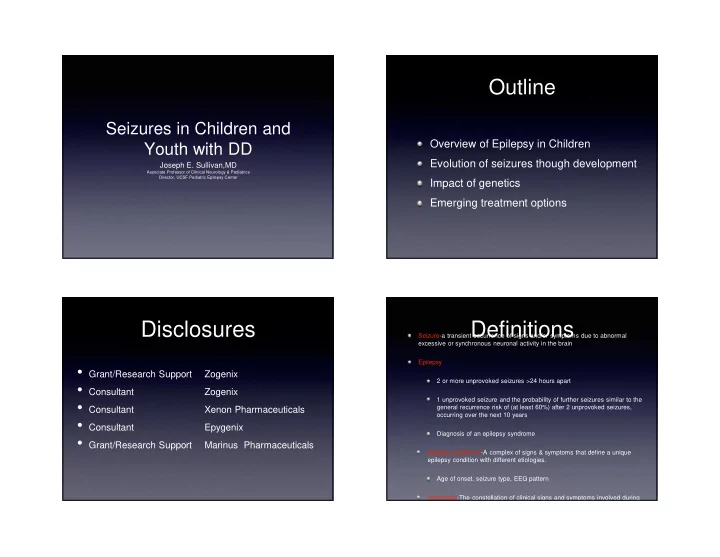
Seizures in Children and Youth with DD

Joseph E. Sullivan,MD

Associate Professor of Clinical Neurology & Pediatrics Director, UCSF Pediatric Epilepsy Center

Outline

Overview of Epilepsy in Children Evolution of seizures though development Impact of genetics Emerging treatment options

Disclosures

  • Grant/Research Support

Zogenix

  • Consultant

Zogenix

  • Consultant

Xenon Pharmaceuticals

  • Consultant

Epygenix

  • Grant/Research Support Marinus Pharmaceuticals

Definitions

Seizure-a transient occurrence of signs and/or symptoms due to abnormal excessive or synchronous neuronal activity in the brain Epilepsy 2 or more unprovoked seizures >24 hours apart 1 unprovoked seizure and the probability of further seizures similar to the general recurrence risk of (at least 60%) after 2 unprovoked seizures,

  • ccurring over the next 10 years

Diagnosis of an epilepsy syndrome Epilepsy syndrome-A complex of signs & symptoms that define a unique epilepsy condition with different etiologies. Age of onset, seizure type, EEG pattern Semiology-The constellation of clinical signs and symptoms involved during

slide-2
SLIDE 2

Epilepsy in Children with ID

Epilepsy affects between 0.5-1% of the population Children with ID-5% Mild vs Severe (8-32% vs 45-59%) ID with CP-48%

Trevathan E et al. Ann Neurol 1988;24:321 Goulden KJ, et al, Epilepsia 32(5):690-697,1991

Why?

Epilepsy is a disorder of brain function Development and cognition rely on normal brain function Development is not a static process This affects the expression of the epilepsy and seizures!

Pediatric Epilepsy

A moving target

Child with new onset infantile spasms MRI shows a brain malformation Spasms treated medically 2 years later, new seizure types including tonic and atonic seizures Now diagnosis of Lennox-Gastaut syndrome As an adult has daytime “complex partial seizures” and nocturnally predominant generalized seizures.

Infantile Spasms

slide-3
SLIDE 3

Video

Age onset 4-9 months

Seizure semiology

  • flexor/extensor “spasm”, clusters 20-40 spasms 5-30 seconds apart
  • may have some asymmetric features, may involved neck or eyes only

EEG findings

  • classical hypsarrhythmia-high voltage, disorganized, random spikes and slow waves
  • may only be apparent during drowsiness or sleep
  • look for focal/asymmetric features
  • if EEG normal-be sure to capture sleep, repeat in 2 weeks

Etiology

  • malformations of cortical development or ischemic injury in 60-90%
  • neurocutaneous syndromes, ie TSC, NF
  • genetic diseases=X-linked lissencephaly, Down’s syndrome
  • “cryptogenic” (40% have family history of epilepsy)

Treatment

  • Steroids (ACTH, hydrocortisone, prednisolone)
  • vigabatrin
  • valproate, topiramate, zonisamide, vitamin B6
  • surgery in cases of isolated cortical dysplasia

Prognosis

  • spasms often remit spontaneousluy-evolve into other seizure types
  • 11% may have NORMAL cognitive outcome (cryptogenic cases)
  • 20% die, usually in first 2 years
  • 70-80% have MR (50% severe)

Lennox-Gastaut Syndrome

slide-4
SLIDE 4

Video

Age onset Ages 3-10, peak 3-5, unusual after age 8

Seizure semiology

  • tonic axial seizures
  • atonic
  • atypical absence-gradual onset & offset, may not completely lose consciousness
  • may be accompanied by oral myoclonias
  • non-convulsive status is common
  • Generalized tonic-clonic are relatively uncommon

EEG findings

  • almost always abnormal at onset
  • slow and poorly organized
  • diffuse slow spike/wave (2-2.5 Hz), anterior predominance
  • paroxysmal fast activity during sleep (clinical or no clinical signs)

Etiology

  • cerebral dysgenesis/dysplasia
  • may follow infantile spasms/West Syndrome
  • Associated with Down’s, Angelman’s
  • few autopsy specimen’s show dysplastic cortex
  • largely unknown

Treatment

  • valproate, lamotrigine (possibly together)
  • benzodiazepines
  • felbamate

Prognosis

  • severe MR in 45-50%
  • chronic treatment resistant seizures with variable evolution
  • atonic seizures may decrease with age, tonic seizure may become prolonged

The Approach to Diagnosis

Targeted gene testing Targeted gene testing

  • Treat based on seizure type
  • Treat based on seizure type
  • Treat based on seizure type
  • Use literature to guide based on

collective experience

  • Treat based on seizure type
  • Use literature to guide based on

collective experience

Brain MRI Chromosomal Microarray Epilepsy gene panel or Exome Brain MRI Chromosomal Microarray Epilepsy gene panel or Exome

Seizures & DD Seizures & DD

Features of a specific genetic syndrome? Non-specific or normal findings? Specific diagnosis ie Down’s, Angelman? Imaging abnormal? Specific genetic diagnosis?

  • Treat based on seizure type
  • Rational drug choice based on

genetic findings, i.e. (SCN1A, Tuberous Sclerosis, PCDH19)

  • Treat based on seizure type
  • Rational drug choice based on

genetic findings, i.e. (SCN1A, Tuberous Sclerosis, PCDH19)

slide-5
SLIDE 5

Helbig I, et al, Epilepsia, 57(6), 86-68, 2016

Why does this matter?

Personal story Unexplained Lennox-Gastaut Hundreds of seizures per month Multiple medication trials-ineffective Weekly use of rescue meds Exome sequencing revealed mutation in Ca channel gene Started on Ca channel blocker

Results...

95% reduction in seizures No need for rescue medications Reduced other medications Improved alertness and cognitive function

slide-6
SLIDE 6

Epilepsy in Down’s Syndrome

Infantile spasms are common (0.6-13%) Treatment response may be more favorable Can still evolve into Lennox-Gastaut May have other seizure types such as generalized tonic-clonic or other focal seizures EEG’s may be abnormal even with no history of seizures

Arya R, et al, Epileptic Disorders 2011 Mar;13(1):1-7

Detailed Seizure Phenotyping Video

CDKL5 encephalopathy

May initially present with spasms but at an earlier age Evolution into the hypermotor-tonic-spasm sequence should raise clinical concern for this diagnosis New epilepsy syndromes lead to focused treatments, research and family/caregiver support.

slide-7
SLIDE 7

Emerging treatments

Despite many new drugs-30% of patients with epilepsy continue to have seizures Drugs are still treating symptoms-SEIZURES More accurate diagnoses may lead to better treatments

Cannabidiol

Derivatives of cannabis sativa have long been used for various disorders Over 80 different phytocannabinoids in the plant 2 compounds THC and CBD are currently getting the most attention Parental frustration with currently available treatments for Dravet syndrome and increasing use of social media as medical support groups catapulted interest in CBD- “Charlotte’s Web”

Does it work?

214 patients with treatment resistant epilepsy Treated with open-label pure CBD-Epidiolex 4 week baseline followed by 12 week treatment 36.5% Median reduction in motor seizures Somnolence, decreased appetite, diarrhea, weight loss seen in 10-25% of patients

Devinsky O, et al, Lancet Neurology 2016

slide-8
SLIDE 8

Drug Development in 2017

If we know the genetic cause we are in a better position to study effective treatments Zebrafish and epilepsy? CRISPR gene editing technology Create an animal model for drug screening of currently available compounds Then bring these compounds to clinical trials in appropriate patient populations

Take home points

Epilepsy has many different faces and not all seizures are the same Patients with developmental disabilities are particularly challenging due to the many different underlying etiologies Accurate classification of seizures is critical Tailored treatment approach based on clinical

  • bservations

Additional gene discoveries Precision Medicine based on actual etiology