Distributed Optimistic Algorithm Assumptions 1. Synchronized - - PowerPoint PPT Presentation

distributed optimistic algorithm
SMART_READER_LITE
LIVE PREVIEW

Distributed Optimistic Algorithm Assumptions 1. Synchronized - - PowerPoint PPT Presentation

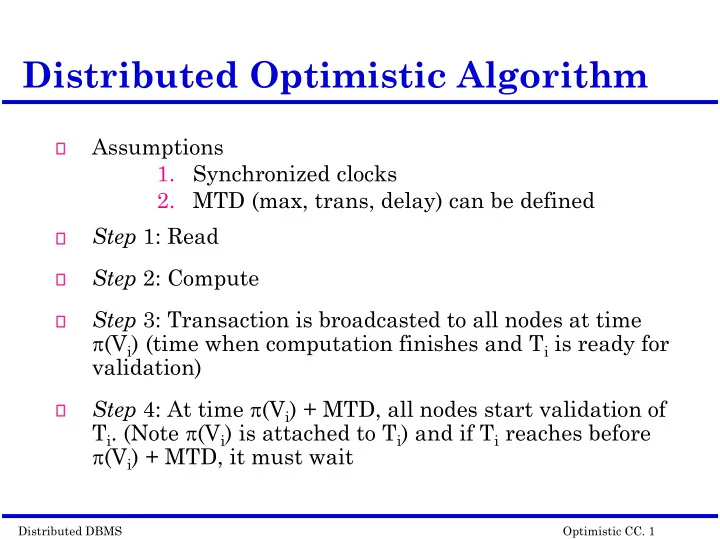
Distributed Optimistic Algorithm Assumptions 1. Synchronized clocks 2. MTD (max, trans, delay) can be defined Step 1: Read Step 2: Compute Step 3: Transaction is broadcasted to all nodes at time (V i ) (time when computation finishes and T


slide-1
SLIDE 1

Distributed DBMS Optimistic CC. 1

Distributed Optimistic Algorithm

Assumptions 1. Synchronized clocks 2. MTD (max, trans, delay) can be defined Step 1: Read Step 2: Compute Step 3: Transaction is broadcasted to all nodes at time (Vi) (time when computation finishes and Ti is ready for validation) Step 4: At time (Vi) + MTD, all nodes start validation of

  • Ti. (Note (Vi) is attached to Ti) and if Ti reaches before

(Vi) + MTD, it must wait

slide-2
SLIDE 2

Distributed DBMS Optimistic CC. 2

Distributed Optimistic Algorithm

Step 5: IF validation succeeds, all nodes write S(wi) ELSE all nodes except “X” ignore Ti At node X, Ti is restarted and repeated until Ti validates THEOREM: The dist. opt. algorithm produces only correct histories at each node and all histories are identical. PROOF: ONLY correct histories are produced. Because of Theorem 1 ELSE UPDATE S(Ri) and repeat from step 2

slide-3
SLIDE 3

Distributed DBMS Optimistic CC. 3

Centralized Optimistic Algorithm

A node(C) is chosen as central node 1. Read S(Ri) 2. Execute (compute) and get S(wi) Note S(wi) is semantic write set (actual) Locking may require syntactic (potential) write set S'(wi) S(wi) leq S'(wi) Ti goes to node C (if X  C) If Ti succeeds, send write set to all nodes

CASE 1: Validation takes place only at central node When Ti arrives at a node “X”

slide-4
SLIDE 4

Distributed DBMS Optimistic CC. 4

Centralized Optimistic Algorithm

1. Same 2. Same 3. Ti validates at X 4. IF successful, Ti commits at X and is sent to C 5. ELSE UPDATE S(Ri) and repeat from step 2 6. If successful at C, send write set to all nodes ELSE UPDATE S(Ri) at C and execute at C and repeat validation until successful. CASE 2: Validation takes place at local node and then at central node

slide-5
SLIDE 5

Distributed DBMS Optimistic CC. 5

Centralized Optimistic

CASE 1: Validation takes place only at central node

  • nly

CASE 2: Validation takes place at local node and then central node Distributed Optimistic Validation takes place at all nodes after a delay of MTD (Max. transmission Delay)

slide-6
SLIDE 6

Distributed DBMS Optimistic CC. 6

When to synchronize (assert concurrency control)

First access to an entity (locking, pessimistic validation) At each access (granularity level) After all accesses and before commitment (optimistic validation)

slide-7
SLIDE 7

Distributed DBMS Optimistic CC. 7

Information needed for synchronization

Locks on database entities (system R, INGRES, Rosenkrantz,…) Time stamps on database entities (Thomas, Reed,…) Time stamps on transactions (Kung, SDD-1, Schlageter,…) OBSERVATIONS

  • Time stamps more fundamental than locking
  • Time stamps carry more information
  • Time stamp checking costs more than checking locks
slide-8
SLIDE 8

Distributed DBMS Optimistic CC. 8

T1 T2 T11: X ← X + 1 T21: X ← X + 1 T12: X ← 2 * X History Serial T1 T2 or T2 T1  f12(f11(f21(x)))  f21(f12(f11(x))) f: Herbrand fn. non serializable T11, T21, T12 f12(f21(f11(x))) So given interpretation of fij’s allows us to include histories which are not allowed by SERIALIZABILITY and hence allows us higher concurrency

slide-9
SLIDE 9

Distributed DBMS Optimistic CC. 9

Figure 2

Obtain S(Ri)

I/O

Local Validation Successful? Send transaction to

  • ther sites

Trans- action (Ti) arrives From TM' I/O Q (Lo) Read S(Ri) Write S(Wi) Transaction (Ti) Finishes I/O Q (Hi) Execute Obtain S(Wi) and Validate CPU No Yes Yes No Global Validation Successful? CPUQ

slide-10
SLIDE 10

Distributed DBMS Optimistic CC. 10

C.P.U.

Obtain S(Ri) S(Wi) Locks granted Obtain locks from lock table for S(Ri) and S(Wi) Execute Release locks CPUQ (med) CPUQ (Hi) CPUQ (low) No Yes Arrive IOQ (Hi) IOQ (Hi) Write S(Wi) Read S(Ri)

I/O

Done

Locking Mechanism (Pessimistic)

slide-11
SLIDE 11

Distributed DBMS Optimistic CC. 11

Steps of a Transaction (Ti) Non- Locking Algorithm

1. The transaction (Ti) arrives in the system 2. The read S'(Ri) and write S’(Wi) set of the transaction is

  • btained. These sets are syntactic

3. The transaction goes to an I/O queue to obtain item values for read set S‘(Ri) 4. The transaction goes to CPU queue and completes execution to

  • btain write set values. Also actual read set S(Ri) and write set

S(wi) are determined. These sets represent semantic information 5. The transaction’s read sets are validated against other active transactions according consistency constraints (such as serializability)

slide-12
SLIDE 12

Distributed DBMS Optimistic CC. 12

Steps of a Transaction (Ti) … (cont)

6. If validation fails due to conflict among transaction Ti and some

  • ther transaction Tj, then one of the transaction is required to

repeat its execution. For example, if consistency constraint is “strongly serializable”, then the transaction that arrived later (let us say Ti) is selected for re-execution. Moreover the conflict among Ti and Tj is resolved and the values of S'(Ri) are updated with values from S(Wj) at the time of validation. This is useful because Ti does not have to go and do its I/O once again. 7. The transaction is sent to CPU queue to do its computation. 8. The transaction Ti’s write set is validated against write set of some transaction Tj (that has not completed but arrived before Ti). If conflict occurs, then Ti is delayed and writes after Tj writes in the database.

slide-13
SLIDE 13

Distributed DBMS Optimistic CC. 13

Steps of a Transaction (Ti) … (cont)

9. The transaction goes to an I/O queue and update its write set S(Wi).

  • 10. The transaction Ti waits in memory for validation against

transactions that arrived in the interval between its arrival time and validation time.

slide-14
SLIDE 14

Distributed DBMS Optimistic CC. 14

Performance Techniques

Complexity Analytical Simulation Empirical

slide-15
SLIDE 15

Distributed DBMS Optimistic CC. 15

Performance model at each node

CPO server From Users From Network To users To network I/O server

Parameters

1. Arrival rate 2. Base set (size of write set/read 4. Size of database 5. Number of sets 6. Transmission delay 7. CPU time 8. I/O time 9. Retry delay

  • 10. Read only trans/write & read

trans ratio

  • 11. Multiprogramming level
  • 12. Degree of conflict