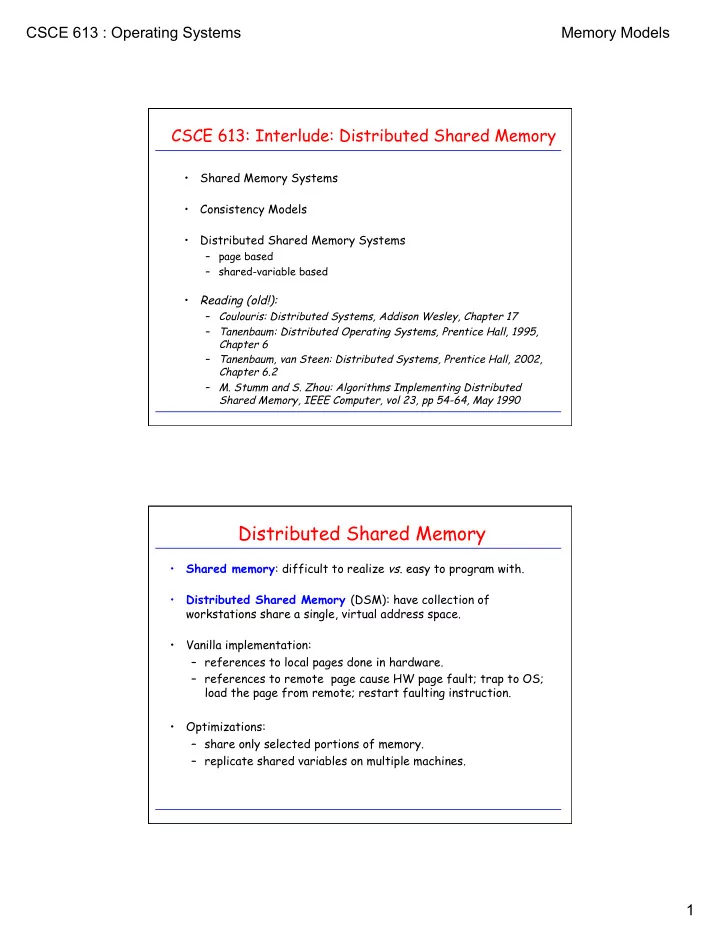
Distributed Shared Memory Shared memory : difficult to realize vs . - - PDF document

distributed shared memory
SMART_READER_LITE
LIVE PREVIEW

Distributed Shared Memory Shared memory : difficult to realize vs . - - PDF document

CSCE 613 : Operating Systems Memory Models CSCE 613: Interlude: Distributed Shared Memory Shared Memory Systems Consistency Models Distributed Shared Memory Systems page based shared-variable based Reading (old!):


slide-1
SLIDE 1

CSCE 613 : Operating Systems Memory Models 1

CSCE 613: Interlude: Distributed Shared Memory

  • Shared Memory Systems
  • Consistency Models
  • Distributed Shared Memory Systems

– page based – shared-variable based

  • Reading (old!):

– Coulouris: Distributed Systems, Addison Wesley, Chapter 17 – Tanenbaum: Distributed Operating Systems, Prentice Hall, 1995, Chapter 6 – Tanenbaum, van Steen: Distributed Systems, Prentice Hall, 2002, Chapter 6.2 – M. Stumm and S. Zhou: Algorithms Implementing Distributed Shared Memory, IEEE Computer, vol 23, pp 54-64, May 1990

Distributed Shared Memory

  • Shared memory: difficult to realize vs. easy to program with.
  • Distributed Shared Memory (DSM): have collection of

workstations share a single, virtual address space.

  • Vanilla implementation:

– references to local pages done in hardware. – references to remote page cause HW page fault; trap to OS; load the page from remote; restart faulting instruction.

  • Optimizations:

– share only selected portions of memory. – replicate shared variables on multiple machines.

slide-2
SLIDE 2

CSCE 613 : Operating Systems Memory Models 2

Shared Memory

  • DSM in context of shared memory for multiprocessors.
  • Shared memory in multiprocessors:

– On-chip memory

  • multiport memory, huh?

– Bus-based multiprocessors

  • cache coherence

– Ring-based multiprocessors

  • no centralized global memory.

– Switched multiprocessors

  • directory based

– NUMA (Non-Uniform Memory Access) multiprocessors

  • no attempt made to hide remote-memory access latency

Comparison of (old!) Shared Memory Systems

single-bus multi- processor switched multi- processor NUMA machine Page-based DSM Shared variable DSM Object based DSM managed by MMU managed by OS managed by language runtime system hardware-controlled caching software-controlled caching remote access in hardware remote access in software sequent firefly Dash Alewife Cm* Butterfly Ivy Mirage Munin Midway Linda Orca

slide-3
SLIDE 3

CSCE 613 : Operating Systems Memory Models 3

Prologue for DSM: Memory Consistency Models

  • Perfect consistency is expensive.
  • How to relax consistency requirements?
  • Definition: Consistency Model: Contract between application and
  • memory. If application agrees to obey certain rules, memory

promises to work correctly.

Memory Consistency: Example

  • Example: Critical Section
  • Relies on all CPUs seeing update of counter before update of

mutex

  • Depends on assumptions about ordering of stores to memory

/* lock(mutex) */ < implementation of lock would come here> /* counter++ */ load r1, counter add r1, r1, 1 store r1, counter /* unlock(mutex) */ store zero, mutex

slide-4
SLIDE 4

CSCE 613 : Operating Systems Memory Models 4

Consistency Models

  • Strict consistency
  • Sequential consistency
  • Causal consistency
  • PRAM (pipeline RAM) consistency
  • Weak consistency
  • Release consistency
  • increasing restrictions on application software
  • increasing performance

Strict Consistency

  • Most stringent consistency model:

Any read to a memory location x returns the value stored by the most recent write operation to x.

  • strict consistency observed in simple uni-processor systems.
  • has come to be expected by uni-processor programmers

– very unlikely to be supported by any multiprocessor

  • All writes are immediately visible by all processes
  • Requires that absolute global time order is maintained
  • Two scenarios:

P1: W(x)1 P2: R(x)1 P1: W(x)1 P2: R(x)NIL R(x)1

slide-5
SLIDE 5

CSCE 613 : Operating Systems Memory Models 5

Example of Strong Ordering: Sequential Ordering

  • Strict Consistency is impossible to implement.
  • Sequential Consistency:

– Loads and stores execute in program order – Memory accesses of different CPUs are “sequentialised”; i.e., any valid interleaving is acceptable, but all processes must see the same sequence of memory references.

  • Traditionally used by many architectures

CPU 0 CPU 1 store r1, adr1 store r1, adr2 load r2, adr2 load r2, adr1

  • In this example, at least one CPU must load the other's new value.

Sequential Consistency

  • Strict consistency impossible to implement.
  • Programmers can manage with weaker models.
  • Sequential consistency [Lamport 79]

The result of any execution is the same as if the operations of all processors were executed in some sequential order, and the

  • perations of each individual processor appear in this sequence

in the order specified by its program.

  • Memory accesses of different CPUs are “sequentialised”; Any

valid interleaving is acceptable, but all processes must see the same sequence of memory references.

  • Scenarios:

P1: W(x)1 P2: W(x)0 P3: R(x)0 R(x)1 P4: R(x)0 R(x)1 P1: W(x)1 P2: W(x)0 P3: R(x)0 R(x)1 P4: R(x)1 R(x)0

slide-6
SLIDE 6

CSCE 613 : Operating Systems Memory Models 6

Sequential Consistency: Observations

  • Sequential consistency does not guarantee that read returns

value written by another process anytime earlier.

  • Results are not deterministic.
  • Sequential consistency is programmer-friendly, but expensive.
  • Lipton & Sandbert (1988) show that improving the read

performance makes write performance worse, and vice versa.

  • Modern HW features interfere with sequential consistency; e.g.:

– write buffers to memory (aka store buffer, write-behind buffer, store pipeline) – instruction reordering by optimizing compilers – superscalar execution – pipelining

Linearizability (Herlihy and Wing, 1991)

  • Assume that events are timestamped with clock with finite

precision (e.g.loosely synchronized clocks).

  • Let tsOP(x) be timestamp of operation OP on data item x. OP is

either a read(x) or a write(x).

The result of any execution is the same as if the operations of all processors were executed in some sequential order, and the operations

  • f each individual processor appear in this sequence in the order

specified by its program. In addition, if tsOP1(x) < tsOP2(x), then

  • peration OP1(x) should precede OP2(x) in this sequence.
  • Stricter than Sequential Consistency.
slide-7
SLIDE 7

CSCE 613 : Operating Systems Memory Models 7

Weaker Consistency Models: Total Store Order

  • Total Store Ordering (TSO) guarantees that the

sequence in which store, FLUSH, and atomic load-store instructions appear in memory for a given processor is identical to the sequence in which they were issued by the processor.

  • Both x86 and SPARC processors support TSO.
  • A later load can bypass an earlier store
  • peration. (!)
  • i.e., local load operations are permitted to obtain

values from the write buffer before they have been committed to memory.

Total Store Order (cont)

  • Example:

CPU 0 CPU 1 store r1, adr1 store r1, adr2 load r2, adr2 load r2, adr1

  • Both CPUs may read old value!
  • Need hardware support to force global ordering of

privileged instructions, such as: – atomic swap – test & set – load-linked + store-conditional – memory barriers

  • For such instructions, stall pipeline and flush write

buffer.

slide-8
SLIDE 8

CSCE 613 : Operating Systems Memory Models 8

It gets weirder: Partial Store Ordering

  • Partial Store Ordering (PSO) does not guarantee that the

sequence in which store, FLUSH, and atomic load-store instructions appear in memory for a given processor is identical to the sequence in which they were issued by the processor.

  • The processor can reorder the stores so that the sequence of

stores to memory is not the same as the sequence of stores issued by the CPU.

  • SPARC processors support PSO; x86 processors do not.
  • Ordering of stores is enforced by memory barrier (instruction

STBAR for Sparc) : If two stores are separated by memory barrier in the issuing order of a processor, or if the instructions reference the same location, the memory order of the two instructions is the same as the issuing order.

Partial Store Order (cont)

  • Example:
  • Store to mutex can “overtake” store to counter.
  • Need to use memory barrier to separate issuing order.
  • Otherwise, we have a race condition.

/* lock(mutex) */ < implementation of lock would come here> /* counter++ */ load r1, counter add r1, r1, 1 store r1, counter /* MEMORY BARRIER */ STBAR /* unlock(mutex) */ store zero, mutex

slide-9
SLIDE 9

CSCE 613 : Operating Systems Memory Models 9

Causal Consistency

  • Weaken sequential consistency by making distinction between

events that are potentially causally related and events that are not.

  • Distributed forum scenario: causality relations may be violated

by propagation delays.

  • Causal consistency:

Writes that are potentially causally related must be seen by all processes in the same order. Concurrent writes may be seen in a different order on different machines.

  • Scenario

P1: W(x)1 W(x)3 P2: R(x)1 W(x)2 P3: R(x)1 R(x)3 R(x)2 P4: R(x)1 R(x)2 R(x)3

Causal Consistency (cont)

P1: W(x)1 P2: R(x)1 W(x)2 P3: R(x)2 R(x)1 P4: R(x)1 R(x)2

  • Other scenarios:

P1: W(x)1 P2: W(x)2 P3: R(x)2 R(x)1 P4: R(x)1 R(x)2

slide-10
SLIDE 10

CSCE 613 : Operating Systems Memory Models 10

  • Drop requirement that causally-related writes must be seen in

same order by all machines.

  • PRAM consistency:

Writes done by a single process are received by all other processes in the order in which they were issued, but writes from different processes may be seen in a different order by different processes.

  • Scenario:
  • Easy to implement: all writes generated by different processors

are concurrent

  • Counterintuitive result:

PRAM (pipelined RAM) Consistency

P1: W(x)1 P2: R(x)1 W(x)2 P3: R(x)1 R(x)2 P4: R(x)2 R(x)1

P2: b = 1; if (a==0) kill(P1); P1: a = 1; if (b==0) kill(P2);

Weak Consistency

  • PRAM consistency still unnecessarily restrictive for many

applications: requires that writes originating in single process be seen everywhere in order.

  • Example:

– reading and writing of shared variables in tight loop inside a critical section. – Other processes are not supposed to touch variables, but writes are propagated to all memories anyway.

  • Introduce synchronization variable:

– When synchronization completes, all writes are propagated

  • utward and all writes done by other machines are brought

in. – All shared memory is synchronized.

slide-11
SLIDE 11

CSCE 613 : Operating Systems Memory Models 11

Weak Consistency (cont)

  • 1. Accesses to synchronization variables are sequentially ordered.
  • 2. No access to a synchronization variable is allowed to be

performed until all previous writes have completed everywhere.

  • 3. No data access (read or write) is allowed to be performed until all

previous accesses to synchronization variables have been performed.

  • All processes see accesses to synchronization variables in same
  • rder.
  • Accessing a synchronization variable “flushes the pipeline” by forcing

writes to complete.

  • By doing synchronization before reading shared data, a process can

be sure of getting the most recent values.

  • Scenarios: P1: W(x)1 W(x)2) S

P2: R(x)1 R(x)2 S P3: R(x)2 R(x)1 S P1: W(x)1 W(x)2) S P2: S R(x)1

Release Consistency

  • Problem with weak consistency:

– When synchronization variable is accessed, we don’t know if process is finished writing shared variables or about to start reading them. – Need to propagate all local writes to other machines and gather all writes from other machines.

  • Operations:

– acquire critical region: c.s. is about to be entered.

  • make sure that local copies of variables are made consistent

with remote ones.

– release critical region: c.s. has just been exited.

  • propagate shared variables to other machines.

– Operations may apply to a subset of shared variables

  • Scenario:

P1: Acq(L) W(x)1 W(x)2) Rel(L) P2: Acq(L) R(x)2 Rel(L) P3: R(x)1

slide-12
SLIDE 12

CSCE 613 : Operating Systems Memory Models 12

Release Consistency (cont)

  • Possible implementation

– Acquire:

  • 1. Send request for lock to synchronization processor; wait until granted.
  • 2. Issue arbitrary read/writes to/from local copies.

– Release:

  • 1. Send modified data to other machines.
  • 2. Wait for acknowledgements.
  • 3. Inform synchronization processor about release.

– Operations on different locks happen independently.

  • Release consistency:
  • 1. Before an ordinary access to a shared variable is performed, all previous

acquires done by the process must have completed successfully.

  • 2. Before a release is allowed to be performed, all previous reads and writes

done by the process must have completed.

  • 3. The acquire and release accesses must be PRAM consistent (processor

consistent) (sequential consistency is not required!)

Consistency Models: Summary

slide-13
SLIDE 13

CSCE 613 : Operating Systems Memory Models 13

Page-Based DSM

  • NUMA

– processor can directly reference local and remote memory locations – no software intervention

  • Workstations on network

– can only reference local memory

  • Goal of DSM

– add software to allow NOWs to run multiprocessor code – simplicity of programming – “dusty deck” problem

Basic Design

  • Emulate cache of multiprocessor using the MMU and system

software 1 2 3 4 5 6 7 8 9 10 11 12 13 14 2 5 9 CPU 1 3 6 8 CPU 4 7 11 12 CPU 15 10 14 13 15 CPU

slide-14
SLIDE 14

CSCE 613 : Operating Systems Memory Models 14

Design Issues

  • Replication

– replicate read-only portions – replicate read and write portions

  • Granularity

– restriction: memory portions multiples of pages – pros of large portions:

  • amortize protocol overhead
  • locality of reference

– cons of large portions

  • false sharing!

A B Processor 1 code using A A B Processor 2 code using B

Design Issues (cont)

  • Update Options: Write-Update vs. Write-Invalidate
  • Write-Update:

– Writes made locally are multicast to all copies of the data item. – Multiple writers can share same data item. – Consistency depends on multicast protocol.

  • E.g. Sequential consistency achieved with totally ordered

multicast. – Reads are cheap

  • Write-Invalidate:

– Distinguish between read-only (multiple copies possible) and writable (only one copy possible). – When process attempts to write to remote or replicated item, it first sends a multicast message to invalidate copies; If necessary, get copy of item. – Ensures sequential consistency.

slide-15
SLIDE 15

CSCE 613 : Operating Systems Memory Models 15

A Protocol for Sequential Consistency (reads)

Processor 1 P W

  • wner

Processor 2 Processor 1 P R

  • wner

Processor 2 Processor 1 P R

  • wner

Processor 2 R Processor 1 P R Processor 2 R

  • wner

Processor 1 P Processor 2 R

  • wner

Processor 1 P Processor 2 W

  • wner

A Protocol for Sequential Consistency (write)

Processor 1 P W

  • wner

Processor 2 Processor 1 P R

  • wner

Processor 2 Processor 1 P R

  • wner

Processor 2 R Processor 1 P R Processor 2 R

  • wner

Processor 1 P Processor 2 R

  • wner

Processor 1 P Processor 2 W

  • wner
slide-16
SLIDE 16

CSCE 613 : Operating Systems Memory Models 16

Design Issues (cont)

  • Finding the Owner

– broadcast request for owner

  • combine request with requested operation
  • problem: broadcast effects all participants (interrupts all

processors), uses network bandwidth – page manager

  • possible hot spot
  • multiple page manager, hash on page address

– probable owner

  • each process keeps track of probable owner
  • Update probable owner whenever

– Process transfers ownership of a page – Process handles invalidation request for a page – Process receives read access for a page from another process – Process receives request for page it does not own (forwards request to probable owner and resets probable owner to requester)

  • periodically refresh information about current owners

Probable Owner Chains

B A C D E

  • wner

B A C D E

  • wner

A issues write B A C D E

  • wner

A issues read B A C D E

  • wner

alternatively …

slide-17
SLIDE 17

CSCE 613 : Operating Systems Memory Models 17

Design Issues (cont)

  • Finding the copies

– How to find the copies when they must be invalidated – broadcast requests

  • what when broadcasts are not reliable?

– copysets

  • maintained by page manager or by owner

3 4 CPU 2 3 4 CPU 1 2 3 CPU 2 3 CPU 2 4 1 CPU 4 1 3 4 5 2 4

Design Issues (cont)

  • Synchronization

– locks – semaphores – barrier locks – Traditional synchronization mechanisms for multiprocessors don’t work; why? – Synchronization managers

slide-18
SLIDE 18

CSCE 613 : Operating Systems Memory Models 18

Shared-Variable DSM

  • Is it necessary to share entire address space?
  • Share individual variables.
  • more variety in possible in update algorithms for replicated

variables

  • pportunity to eliminate false sharing
  • Examples: Munin (predecessor of Threadmarks)

[Bennet, Carter, Zwaenepoel, “Munin: Distributed Shared Memory Based on Type-Specific Memory Coherence”, Proc Second ACM Symp. on Principles and Practice of Parallel Programming, ACM, pp. 168-176, 1990.]

Munin [Bennet et al, 1990]

  • Use MMU: place each shared object onto separate page.
  • Annotate declarations of shared variables.

– keyword shared – compiler puts variable on separate page

  • Synchronization:

– lock variables – barriers – condition variables

  • Release consistency
  • Multiple update protocols
  • Directories for data location
slide-19
SLIDE 19

CSCE 613 : Operating Systems Memory Models 19

Release Consistency in Munin/Treadmarks

  • Uses (eager) release consistency
  • Critical regions

– writes to shared variables occur inside critical region – reads can occur anywhere – when critical region exited, modified variables are brought up to date on all machines.

  • Three classes of variables:

– ordinary variable:

  • not shared; can be written only by process that created

them. – shared data variables:

  • visible to multiple processes; appear sequentially

consistent. – synchronization variable:

  • accessible via system-supplied access procedures
  • lock/unlock for locks, increment/wait for barriers

Release Consistency in Munin (cont)

  • Example:
  • Eager vs. Lazy Release Consistency

lock(L); a=1; /* changes to b=2; * shared c=3; * variables*/ unlock(L);

a,b,c a,b,c

slide-20
SLIDE 20

CSCE 613 : Operating Systems Memory Models 20

Multiple Protocols

  • Annotations for shared-variable declarations:

– read-only

  • do not change after initialization; no consistency problems
  • protected by MMU

– migratory

  • not replicated; migrate from machine to machine as critical

regions are entered

  • associated with a lock

– write-shared

  • safe for multiple programs to write to it
  • use “diff” protocol to resolve multiple writes to same

variable – conventional

  • treated as in conventional page-based DSM: only one copy
  • f writeable page; moved between processors.

– others…

Twin Pages in Munin/Treadmarks

  • Initially, write-shared page is marked as read-only.
  • When write occurs, twin copy of page is made, and original

page becomes read/write

  • Release:

1. word-by-word comparison of dirty pages with their twins 2. send the differences to all processes needing them 3. reset page to read-only 4. receiver compare incoming pages for modified words 5. if both local and incoming word have been modified, signal runtime error

6 R 6 RW 6 twin 8 RW 6 twin 8 RW 6 twin word 4 6->8 message sent initially before write after write during release

slide-21
SLIDE 21

CSCE 613 : Operating Systems Memory Models 21

Effect of Using Twin Pages (no twins)

Process1: /* wait for process 2 */ wait_at_barrier(b); for(i=0;i<n;i+=2) a[i] = a[i]+f(i); /* wait until proc 2 is done */ wait_at_barrier(b); Process2: /* wait for process 1 */ wait_at_barrier(b); for(i=1;i<n;i+=2) a[i] = a[i]+g(i); /* wait until proc 1 is done */ wait_at_barrier(b); ........ barrier barrier a[0]= a[2]= a[n-1]= a[1]= a[3]= a[n]= P1: P2: barrier manager

Effect of Twin Pages (with twins)

Process1: /* wait for process 2 */ wait_at_barrier(b); for(i=0;i<n;i+=2) a[i] = a[i]+f(i); /* wait until proc 2 is done */ wait_at_barrier(b); ........ barrier barrier a[0]= a[2]= a[n-1]= a[1]= a[3]= a[n]= P1: P2: barrier manager send changes Process2: /* wait for process 1 */ wait_at_barrier(b); for(i=1;i<n;i+=2) a[i] = a[i]+g(i); /* wait until proc 1 is done */ wait_at_barrier(b);