Divide and Conquer: The transform named in his honor is a - - PDF document

divide and conquer
SMART_READER_LITE
LIVE PREVIEW

Divide and Conquer: The transform named in his honor is a - - PDF document

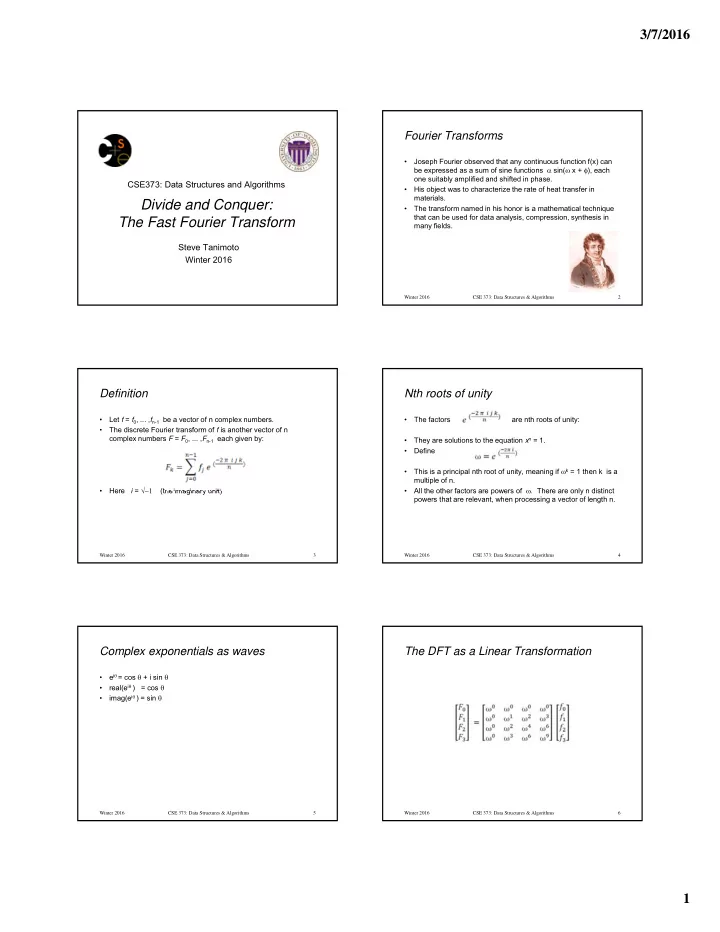
3/7/2016 Fourier Transforms Joseph Fourier observed that any continuous function f(x) can be expressed as a sum of sine functions sin( x + ), each one suitably amplified and shifted in phase. CSE373: Data Structures and


slide-1
SLIDE 1

3/7/2016 1

CSE373: Data Structures and Algorithms

Divide and Conquer: The Fast Fourier Transform

Steve Tanimoto Winter 2016

Fourier Transforms

  • Joseph Fourier observed that any continuous function f(x) can

be expressed as a sum of sine functions  sin( x + ), each

  • ne suitably amplified and shifted in phase.
  • His object was to characterize the rate of heat transfer in

materials.

  • The transform named in his honor is a mathematical technique

that can be used for data analysis, compression, synthesis in many fields.

Winter 2016 2 CSE 373: Data Structures & Algorithms

Definition

  • Let f = f0, ... ,fn-1 be a vector of n complex numbers.
  • The discrete Fourier transform of f is another vector of n

complex numbers F = F0, ... ,Fn-1 each given by:

  • Here i = 

(the imaginary unit)

Winter 2016 3 CSE 373: Data Structures & Algorithms

Nth roots of unity

  • The factors are nth roots of unity:
  • They are solutions to the equation xn = 1.
  • Define
  • This is a principal nth root of unity, meaning if k = 1 then k is a

multiple of n.

  • All the other factors are powers of . There are only n distinct

powers that are relevant, when processing a vector of length n.

Winter 2016 4 CSE 373: Data Structures & Algorithms

Complex exponentials as waves

  • ei = cos  + i sin 
  • real(ei ) = cos 
  • imag(ei ) = sin 

Winter 2016 5 CSE 373: Data Structures & Algorithms

The DFT as a Linear Transformation

Winter 2016 6 CSE 373: Data Structures & Algorithms

slide-2
SLIDE 2

3/7/2016 2

Computing the Discrete Fourier Transform

Winter 2016 7 CSE 373: Data Structures & Algorithms

Direct method: Assume the complex exponentials are precomputed. n2 complex multiplications n(n-1) complex additions

Divide and Conquer

  • Divide the problem into smaller subproblems,

solve them, and combine into the overall solution

  • Solve subproblems recursively or with a direct method
  • Combine the results of subproblems
  • Apply dynamic programming, if possible

Winter 2016 8 CSE 373: Data Structures & Algorithms

A Recursive Fast Fourier Transform

def FFT(f): n = len(f) if n==1: return [f[0]] # basis case F = n*[0] # Initialize results to 0. f_even = f[0::2] # Divide – even subproblem. f_odd = f[1::2] # “ - odd subproblem F_even = FFT(f_even) # recursive call F_odd = FFT(f_odd) # “ n2 = int(n/2) # Prepare to combine results for i in range(n2): twiddle = exp(-2*pi*1j*i/n) # These could be precomputed

  • ddTerm = F_odd[i] * twiddle

# Odd terms need an adjustment F[i] = F_even[i] + oddTerm # Compute a new term F[i+n2] = F_even[i] – oddTerm # Compute one more new term return F

Winter 2016 9 CSE 373: Data Structures & Algorithms

An N log N algorithm

Like in merge sort, in each recursive call, we divide the number of elements in half. The number of levels of recursive calls is therefore log2 N. When we combine subproblem results, we spend linear time. Total time is bounded by c N log N.

Winter 2016 10 CSE 373: Data Structures & Algorithms

Unrolling the FFT (more detailed views

  • f how an FFT works)

Recursive FFT

FFT(n, [a0, a1, …, an-1]): if n=1: return a0 Feven = FFT(n/2, [a0, a2, …, an-2]) Fodd = FFT(n/2, [a1, a3, …, an-1]) for k = 0 to n/2 – 1: ωk = e2πik/n yk = Feven k + ωk Fodd k yk+n/2 = Feven k – ωk Fodd k return [y0, y1, …, yn-1]

slide-3
SLIDE 3

3/7/2016 3

The Butterfly Step

A data‐flow diagram connecting the inputs x (left) to the outputs y that depend on them (right) for a "butterfly" step of a radix‐2 Cooley– Tukey FFT. This diagram resembles a butterfly. http://en.wikipedia.org/wiki/Butterfly_diagram

Recursion Unrolled Comments

  • The FFT can be implemented:
  • Iteratively, rather than recursively.
  • In-place, (after putting the input in bit-reversed order)
  • This diagram shows a radix-2, Cooley-Tukey, “decimation in

time” FFT.

  • Using a radix-4 implementation, the number of scalar multiplies

and adds can be reduced by about 10 to 20 percent.

FFTs in Practice

There are many varieties of fast Fourier transforms. They typically depend on the fact that N is a composite number, such as a power of 2. The radix need not be 2, and mixed radices can be used. Formulations may be recursive or iterative, serial or parallel, etc. There are also analog computers for Fourier transforms, such as those based on optical lens properties. The Cooley-Tukey Fast Fourier Transform is often considered to be the most important numerical algorithm ever invented. This is the method typically referred to by the term “FFT.” The FFT can also be used for fast convolution, fast polynomial multiplication, and fast multiplication of large integers.

Winter 2016 16 CSE 373: Data Structures & Algorithms