Divisibility properties of sporadic Ap ery-like numbers Symbolic - - PowerPoint PPT Presentation

divisibility properties of sporadic ap ery like numbers
SMART_READER_LITE
LIVE PREVIEW

Divisibility properties of sporadic Ap ery-like numbers Symbolic - - PowerPoint PPT Presentation

Divisibility properties of sporadic Ap ery-like numbers Symbolic Computation and Special Functions OPSFA-13, NIST Armin Straub June 2, 2015 University of Illinois at UrbanaChampaign n 2 n + k 2 n A ( n ) = k k k


slide-1
SLIDE 1

Divisibility properties of sporadic Ap´ ery-like numbers

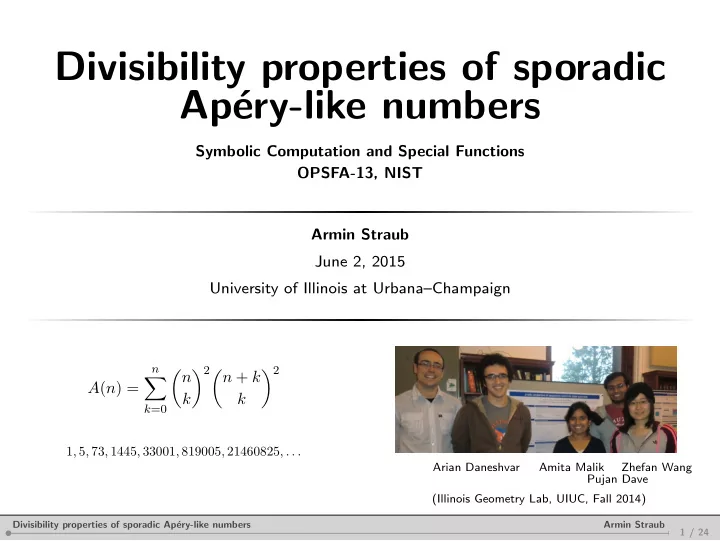
Symbolic Computation and Special Functions OPSFA-13, NIST Armin Straub June 2, 2015 University of Illinois at Urbana–Champaign A(n) =

n

  • k=0

n k 2n + k k 2

1, 5, 73, 1445, 33001, 819005, 21460825, . . .

Arian Daneshvar Amita Malik Zhefan Wang Pujan Dave (Illinois Geometry Lab, UIUC, Fall 2014)

Divisibility properties of sporadic Ap´ ery-like numbers Armin Straub 1 / 24

slide-2
SLIDE 2

Illinois Geometry Lab, UIUC, Fall 2014

Arian Daneshvar Amita Malik Zhefan Wang Pujan Dave

  • semester-long project to introduce undergraduate students to research
  • graduate student team leader: Amita Malik

Divisibility properties of sporadic Ap´ ery-like numbers Armin Straub 2 / 24

slide-3
SLIDE 3

Rough outline

  • introducing Ap´

ery-like numbers

  • Lucas-type congruences
  • applications
  • primes never dividing Ap´

ery-like numbers

  • periodicity modulo p
  • a little more on supercongruences (time permitting)

Divisibility properties of sporadic Ap´ ery-like numbers Armin Straub 3 / 24

slide-4
SLIDE 4

Positivity of rational functions

  • For a smooth transition from Wadim’s talk, consider the following
  • pen problem:

All Taylor coefficients of the following function are positive:

1 1 − (x + y + z + w) + 2(yzw + xzw + xyw + xyz) + 4xyzw.

CONJ

Kauers- Zeilberger 2008

Divisibility properties of sporadic Ap´ ery-like numbers Armin Straub 4 / 24

slide-5
SLIDE 5

Positivity of rational functions

  • For a smooth transition from Wadim’s talk, consider the following
  • pen problem:

All Taylor coefficients of the following function are positive:

1 1 − (x + y + z + w) + 2(yzw + xzw + xyw + xyz) + 4xyzw.

CONJ

Kauers- Zeilberger 2008

The diagonal coefficients of the Kauers–Zeilberger function are

D(n) =

n

  • k=0

n k 22k n 2 .

PROP

S-Zudilin 2015

  • D(n) is an example of an Ap´

ery-like sequence.

Divisibility properties of sporadic Ap´ ery-like numbers Armin Straub 4 / 24

slide-6
SLIDE 6

Positivity of rational functions

  • For a smooth transition from Wadim’s talk, consider the following
  • pen problem:

All Taylor coefficients of the following function are positive:

1 1 − (x + y + z + w) + 2(yzw + xzw + xyw + xyz) + 4xyzw.

CONJ

Kauers- Zeilberger 2008

The diagonal coefficients of the Kauers–Zeilberger function are

D(n) =

n

  • k=0

n k 22k n 2 .

PROP

S-Zudilin 2015

  • D(n) is an example of an Ap´

ery-like sequence. Can we conclude the conjectured positivity from the positivity of D(n) together with the (obvious) positivity of

1 1−(x+y+z)+2xyz?

Q

S-Zudilin 2015

Divisibility properties of sporadic Ap´ ery-like numbers Armin Straub 4 / 24

slide-7
SLIDE 7

Ap´ ery numbers and the irrationality of ζ(3)

  • The Ap´

ery numbers

1, 5, 73, 1445, . . .

A(n) =

n

  • k=0

n k 2n + k k 2 satisfy (n + 1)3A(n + 1) = (2n + 1)(17n2 + 17n + 5)A(n) − n3A(n − 1).

Divisibility properties of sporadic Ap´ ery-like numbers Armin Straub 5 / 24

slide-8
SLIDE 8

Ap´ ery numbers and the irrationality of ζ(3)

  • The Ap´

ery numbers

1, 5, 73, 1445, . . .

A(n) =

n

  • k=0

n k 2n + k k 2 satisfy (n + 1)3A(n + 1) = (2n + 1)(17n2 + 17n + 5)A(n) − n3A(n − 1). ζ(3) = ∞

n=1 1 n3 is irrational.

THM

Ap´ ery ’78

The same recurrence is satisfied by the “near”-integers B(n) =

n

  • k=0

n k 2n + k k 2  

n

  • j=1

1 j3 +

k

  • m=1

(−1)m−1 2m3n

m

n+m

m

 . Then, B(n)

A(n) → ζ(3). But too fast for ζ(3) to be rational.

proof

Divisibility properties of sporadic Ap´ ery-like numbers Armin Straub 5 / 24

slide-9
SLIDE 9

Zagier’s search and Ap´ ery-like numbers

  • Recurrence for Ap´

ery numbers is the case (a, b, c) = (17, 5, 1) of (n + 1)3un+1 = (2n + 1)(an2 + an + b)un − cn3un−1. Are there other tuples (a, b, c) for which the solution defined by u−1 = 0, u0 = 1 is integral?

Q

Beukers, Zagier

Divisibility properties of sporadic Ap´ ery-like numbers Armin Straub 6 / 24

slide-10
SLIDE 10

Zagier’s search and Ap´ ery-like numbers

  • Recurrence for Ap´

ery numbers is the case (a, b, c) = (17, 5, 1) of (n + 1)3un+1 = (2n + 1)(an2 + an + b)un − cn3un−1. Are there other tuples (a, b, c) for which the solution defined by u−1 = 0, u0 = 1 is integral?

Q

Beukers, Zagier

  • Essentially, only 14 tuples (a, b, c) found.

(Almkvist–Zudilin)

  • 4 hypergeometric and 4 Legendrian solutions (with generating functions

3F2

1

2, α, 1 − α

1, 1

  • 4Cαz
  • ,

1 1 − Cαz 2F1 α, 1 − α 1

  • −Cαz

1 − Cαz 2 ,

with α = 1

2, 1 3, 1 4, 1 6 and Cα = 24, 33, 26, 24 · 33)

  • 6 sporadic solutions
  • Similar (and intertwined) story for:
  • (n + 1)2un+1 = (an2 + an + b)un − cn2un−1

(Beukers, Zagier)

  • (n + 1)3un+1 = (2n + 1)(an2 + an + b)un − n(cn2 + d)un−1

(Cooper)

Divisibility properties of sporadic Ap´ ery-like numbers Armin Straub 6 / 24

slide-11
SLIDE 11

The six sporadic Ap´ ery-like numbers

(a, b, c) A(n) (17, 5, 1)

Ap´ ery numbers

  • k

n k 2n + k n 2

(12, 4, 16)

  • k

n k 22k n 2

(10, 4, 64)

Domb numbers

  • k

n k 22k k 2(n − k) n − k

  • (7, 3, 81)

Almkvist–Zudilin numbers

  • k

(−1)k3n−3k n 3k n + k n (3k)! k!3

(11, 5, 125)

  • k

(−1)k n k 3 4n − 5k − 1 3n

  • +

4n − 5k 3n

  • (9, 3, −27)
  • k,l

n k 2n l k l k + l n

  • Divisibility properties of sporadic Ap´

ery-like numbers Armin Straub 7 / 24

slide-12
SLIDE 12

Ap´ ery-like numbers and modular forms

  • The Ap´

ery numbers A(n) satisfy

1, 5, 73, 1145, . . .

η7(2τ)η7(3τ) η5(τ)η5(6τ)

1 + 5q + 13q2 + 23q3 + O(q4)

modular form

=

  • n0

A(n) η12(τ)η12(6τ) η12(2τ)η12(3τ) n

q − 12q2 + 66q3 + O(q4) q = e2πiτ

modular function

.

Divisibility properties of sporadic Ap´ ery-like numbers Armin Straub 8 / 24

slide-13
SLIDE 13

Ap´ ery-like numbers and modular forms

  • The Ap´

ery numbers A(n) satisfy

1, 5, 73, 1145, . . .

η7(2τ)η7(3τ) η5(τ)η5(6τ)

1 + 5q + 13q2 + 23q3 + O(q4)

modular form

=

  • n0

A(n) η12(τ)η12(6τ) η12(2τ)η12(3τ) n

q − 12q2 + 66q3 + O(q4) q = e2πiτ

modular function

. Not at all evidently, such a modular parametrization exists for all known Ap´ ery-like numbers!

FACT

Divisibility properties of sporadic Ap´ ery-like numbers Armin Straub 8 / 24

slide-14
SLIDE 14

Ap´ ery-like numbers and modular forms

  • The Ap´

ery numbers A(n) satisfy

1, 5, 73, 1145, . . .

η7(2τ)η7(3τ) η5(τ)η5(6τ)

1 + 5q + 13q2 + 23q3 + O(q4)

modular form

=

  • n0

A(n) η12(τ)η12(6τ) η12(2τ)η12(3τ) n

q − 12q2 + 66q3 + O(q4) q = e2πiτ

modular function

. Not at all evidently, such a modular parametrization exists for all known Ap´ ery-like numbers!

FACT

  • As a consequence, with z =

√ 1 − 34x + x2,

  • n0

A(n)xn = 17 − x − z 4 √ 2(1 + x + z)3/2 3F2 1

2, 1 2, 1 2

1, 1

1024x (1 − x + z)4

  • .
  • Context:

f(τ) modular form of (integral) weight k x(τ) modular function y(x) such that y(x(τ)) = f(τ) Then y(x) satisfies a linear differential equation of order k + 1.

Divisibility properties of sporadic Ap´ ery-like numbers Armin Straub 8 / 24

slide-15
SLIDE 15

Supercongruences for Ap´ ery numbers

  • Chowla, Cowles, Cowles (1980) conjectured that, for primes p 5,

A(p) ≡ 5 (mod p3).

Divisibility properties of sporadic Ap´ ery-like numbers Armin Straub 9 / 24

slide-16
SLIDE 16

Supercongruences for Ap´ ery numbers

  • Chowla, Cowles, Cowles (1980) conjectured that, for primes p 5,

A(p) ≡ 5 (mod p3).

  • Gessel (1982) proved that A(mp) ≡ A(m)

(mod p3).

Divisibility properties of sporadic Ap´ ery-like numbers Armin Straub 9 / 24

slide-17
SLIDE 17

Supercongruences for Ap´ ery numbers

  • Chowla, Cowles, Cowles (1980) conjectured that, for primes p 5,

A(p) ≡ 5 (mod p3).

  • Gessel (1982) proved that A(mp) ≡ A(m)

(mod p3). The Ap´ ery numbers satisfy the supercongruence

(p 5)

A(mpr) ≡ A(mpr−1) (mod p3r).

THM

Beukers, Coster ’85, ’88

Divisibility properties of sporadic Ap´ ery-like numbers Armin Straub 9 / 24

slide-18
SLIDE 18

Supercongruences for Ap´ ery numbers

  • Chowla, Cowles, Cowles (1980) conjectured that, for primes p 5,

A(p) ≡ 5 (mod p3).

  • Gessel (1982) proved that A(mp) ≡ A(m)

(mod p3). The Ap´ ery numbers satisfy the supercongruence

(p 5)

A(mpr) ≡ A(mpr−1) (mod p3r).

THM

Beukers, Coster ’85, ’88

Mathematica 7 miscomputes A(n) =

n

  • k=0

n k 2n + k k 2

for n > 5500.

A(5 · 113) = 12488301. . .about 2000 digits. . .about 8000 digits. . .795652125

Weirdly, with this wrong value, one still has

A(5 · 113) ≡ A(5 · 112) (mod 116).

EG

Divisibility properties of sporadic Ap´ ery-like numbers Armin Straub 9 / 24

slide-19
SLIDE 19

Supercongruences for Ap´ ery numbers

  • Chowla, Cowles, Cowles (1980) conjectured that, for primes p 5,

A(p) ≡ 5 (mod p3).

  • Gessel (1982) proved that A(mp) ≡ A(m)

(mod p3). The Ap´ ery numbers satisfy the supercongruence

(p 5)

A(mpr) ≡ A(mpr−1) (mod p3r).

THM

Beukers, Coster ’85, ’88

  • The congruences a(mpr) ≡ a(mpr−1) modulo pr occur frequently:
  • a(n) = tr An with A ∈ Zd×d

Arnold ’03, Zarelua ’04, . . .

Divisibility properties of sporadic Ap´ ery-like numbers Armin Straub 9 / 24

slide-20
SLIDE 20

Supercongruences for Ap´ ery numbers

  • Chowla, Cowles, Cowles (1980) conjectured that, for primes p 5,

A(p) ≡ 5 (mod p3).

  • Gessel (1982) proved that A(mp) ≡ A(m)

(mod p3). The Ap´ ery numbers satisfy the supercongruence

(p 5)

A(mpr) ≡ A(mpr−1) (mod p3r).

THM

Beukers, Coster ’85, ’88

  • The congruences a(mpr) ≡ a(mpr−1) modulo pr occur frequently:
  • a(n) = tr An with A ∈ Zd×d

Arnold ’03, Zarelua ’04, . . .

  • realizable sequences a(n), i.e., for some map T : X → X,

a(n) = #{x ∈ X : T nx = x} “points of period n”

Everest–van der Poorten–Puri–Ward ’02, Arias de Reyna ’05

Divisibility properties of sporadic Ap´ ery-like numbers Armin Straub 9 / 24

slide-21
SLIDE 21

Supercongruences for Ap´ ery-like numbers

  • Conjecturally, supercongruences like

A(mpr) ≡ A(mpr−1) (mod p3r) hold for all Ap´ ery-like numbers.

Osburn–Sahu ’09

  • Current state of affairs for the six sporadic sequences from earlier:

(a, b, c) A(n) (17, 5, 1)

  • k

n

k

2n+k

n

2

Beukers, Coster ’87-’88

(12, 4, 16)

  • k

n

k

22k

n

2

Osburn–Sahu–S ’14

(10, 4, 64)

  • k

n

k

22k

k

2(n−k)

n−k

  • Osburn–Sahu ’11

(7, 3, 81)

  • k(−1)k3n−3k n

3k

n+k

n

(3k)!

k!3

  • pen!!

modulo p2 Amdeberhan ’14

(11, 5, 125)

  • k(−1)kn

k

3 4n−5k−1

3n

  • +

4n−5k

3n

  • Osburn–Sahu–S ’14

(9, 3, −27)

  • k,l

n

k

2n

l

k

l

k+l

n

  • pen

Robert Osburn Brundaban Sahu

(University of Dublin) (NISER, India) Divisibility properties of sporadic Ap´ ery-like numbers Armin Straub 10 / 24

slide-22
SLIDE 22

Lucas congruences

  • Lucas showed that the beautiful congruences

n k

n0 k0 n1 k1

  • · · ·

nr kr

  • (mod p),

where ni, respectively ki, are the p-adic digits of n and k.

Divisibility properties of sporadic Ap´ ery-like numbers Armin Straub 11 / 24

slide-23
SLIDE 23

Lucas congruences

  • Lucas showed that the beautiful congruences

n k

n0 k0 n1 k1

  • · · ·

nr kr

  • (mod p),

where ni, respectively ki, are the p-adic digits of n and k.

  • The Ap´

ery numbers A(n) satisfy the Lucas congruences (Gessel 1982) A(n) ≡ A(n0)A(n1) · · · A(nr) (mod p).

Divisibility properties of sporadic Ap´ ery-like numbers Armin Straub 11 / 24

slide-24
SLIDE 24

Lucas congruences

  • Lucas showed that the beautiful congruences

n k

n0 k0 n1 k1

  • · · ·

nr kr

  • (mod p),

where ni, respectively ki, are the p-adic digits of n and k.

  • The Ap´

ery numbers A(n) satisfy the Lucas congruences (Gessel 1982) A(n) ≡ A(n0)A(n1) · · · A(nr) (mod p). Every sporadic sequence satisfies these Lucas congruences mod- ulo every prime.

THM

Malik–S 2015

Divisibility properties of sporadic Ap´ ery-like numbers Armin Straub 11 / 24

slide-25
SLIDE 25

Primes not dividing Ap´ ery numbers

  • The values of Ap´

ery numbers A(0), A(1), . . . , A(6) modulo 7 are 1, 5, 3, 3, 3, 5, 1.

EG

Divisibility properties of sporadic Ap´ ery-like numbers Armin Straub 12 / 24

slide-26
SLIDE 26

Primes not dividing Ap´ ery numbers

  • The values of Ap´

ery numbers A(0), A(1), . . . , A(6) modulo 7 are 1, 5, 3, 3, 3, 5, 1.

  • Hence, the Lucas congruences imply that 7 does not

divide any Ap´ ery number.

EG

Divisibility properties of sporadic Ap´ ery-like numbers Armin Straub 12 / 24

slide-27
SLIDE 27

Primes not dividing Ap´ ery numbers

  • The values of Ap´

ery numbers A(0), A(1), . . . , A(6) modulo 7 are 1, 5, 3, 3, 3, 5, 1.

  • Hence, the Lucas congruences imply that 7 does not

divide any Ap´ ery number.

EG

  • Likewise, 2, 3, 7, 13, 23, 29, 43, 47, . . . do not divide any Ap´

ery number. Are there infinitely many such primes?

(Rowland–Yassawi 2013) Q

Divisibility properties of sporadic Ap´ ery-like numbers Armin Straub 12 / 24

slide-28
SLIDE 28

Primes not dividing Ap´ ery numbers

  • The values of Ap´

ery numbers A(0), A(1), . . . , A(6) modulo 7 are 1, 5, 3, 3, 3, 5, 1.

  • Hence, the Lucas congruences imply that 7 does not

divide any Ap´ ery number.

EG

  • Likewise, 2, 3, 7, 13, 23, 29, 43, 47, . . . do not divide any Ap´

ery number. Are there infinitely many such primes?

(Rowland–Yassawi 2013) Q

  • The primes below 100 not dividing sporadic sequences, as well as the

proportion of primes below 10, 000 not dividing any term

(δ) 2, 5, 7, 11, 13, 19, 29, 41, 47, 61, 67, 71, 73, 89, 97 0.6192 (η) 2, 3, 17, 19, 23, 31, 47, 53, 61 0.2897 (α) 3, 5, 13, 17, 29, 31, 37, 41, 43, 47, 53, 59, 61, 67, 71, 83, 89 0.5989 (ǫ) 3, 7, 13, 19, 23, 29, 31, 37, 43, 47, 61, 67, 73, 83, 89 0.6037 (ζ) 2, 5, 7, 13, 17, 19, 29, 37, 43, 47, 59, 61, 67, 71, 83, 89 0.6046 (γ) 2, 3, 7, 13, 23, 29, 43, 47, 53, 67, 71, 79, 83, 89 0.6168

Divisibility properties of sporadic Ap´ ery-like numbers Armin Straub 12 / 24

slide-29
SLIDE 29

Primes not dividing Ap´ ery numbers, cont’d

250 500 750 1000 1250 1500 1750 2000 2250 2500 2750 3000 3250 3500 3750 4000 4250 4500 4750 5000 5250 5500 5750 6000 6250 6500 6750 7000 7250 7500 7750 8000 8250 8500 8750 9000 9250 9500 9750 10000 0.5 0.55 0.6 0.65 0.7 0.75 5 1 2 3 4 5

. . .

250 500 750 1000 1250 1500 1750 2000 2250 2500 2750 3000 3250 3500 3750 4000 4250 4500 4750 5000 5250 5500 5750 6000 6250 6500 6750 7000 7250 7500 7750 8000 8250 8500 8750 9000 9250 9500 9750 10000 0.5 0.55 0.6 0.65 0.7 0.75 5 1 2 3 4 5

proportion of primes not dividing any Ap´ ery number

The proportion of primes not dividing any Ap´ ery number A(n) is e−1/2 ≈ 60.65%.

CONJ

DDMSW 2015

Divisibility properties of sporadic Ap´ ery-like numbers Armin Straub 13 / 24

slide-30
SLIDE 30

Primes not dividing Ap´ ery numbers, cont’d

250 500 750 1000 1250 1500 1750 2000 2250 2500 2750 3000 3250 3500 3750 4000 4250 4500 4750 5000 5250 5500 5750 6000 6250 6500 6750 7000 7250 7500 7750 8000 8250 8500 8750 9000 9250 9500 9750 10000 0.5 0.55 0.6 0.65 0.7 0.75 5 1 2 3 4 5

. . .

250 500 750 1000 1250 1500 1750 2000 2250 2500 2750 3000 3250 3500 3750 4000 4250 4500 4750 5000 5250 5500 5750 6000 6250 6500 6750 7000 7250 7500 7750 8000 8250 8500 8750 9000 9250 9500 9750 10000 0.5 0.55 0.6 0.65 0.7 0.75 5 1 2 3 4 5

proportion of primes not dividing any Ap´ ery number

The proportion of primes not dividing any Ap´ ery number A(n) is e−1/2 ≈ 60.65%.

CONJ

DDMSW 2015

  • Heuristically, combine Lucas congruences,
  • palindromic behavior of Ap´

ery numbers, that is A(n) ≡ A(p − 1 − n) (mod p),

  • and e−1/2 = lim

p→∞

  • 1 − 1

p (p+1)/2 .

Divisibility properties of sporadic Ap´ ery-like numbers Armin Straub 13 / 24

slide-31
SLIDE 31

Primes not dividing Ap´ ery numbers, cont’d2

(δ) 2, 5, 7, 11, 13, 19, 29, 41, 47, 61, 67, 71, 73, 89, 97 0.6192 (η) 2, 3, 17, 19, 23, 31, 47, 53, 61 0.2897 (α) 3, 5, 13, 17, 29, 31, 37, 41, 43, 47, 53, 59, 61, 67, 71, 83, 89 0.5989 (ǫ) 3, 7, 13, 19, 23, 29, 31, 37, 43, 47, 61, 67, 73, 83, 89 0.6037 (ζ) 2, 5, 7, 13, 17, 19, 29, 37, 43, 47, 59, 61, 67, 71, 83, 89 0.6046 (γ) 2, 3, 7, 13, 23, 29, 43, 47, 53, 67, 71, 79, 83, 89 0.6168

Divisibility properties of sporadic Ap´ ery-like numbers Armin Straub 14 / 24

slide-32
SLIDE 32

Primes not dividing Ap´ ery numbers, cont’d2

(δ) 2, 5, 7, 11, 13, 19, 29, 41, 47, 61, 67, 71, 73, 89, 97 0.6192 (η) 2, 3, 17, 19, 23, 31, 47, 53, 61 0.2897 (α) 3, 5, 13, 17, 29, 31, 37, 41, 43, 47, 53, 59, 61, 67, 71, 83, 89 0.5989 (ǫ) 3, 7, 13, 19, 23, 29, 31, 37, 43, 47, 61, 67, 73, 83, 89 0.6037 (ζ) 2, 5, 7, 13, 17, 19, 29, 37, 43, 47, 59, 61, 67, 71, 83, 89 0.6046 (γ) 2, 3, 7, 13, 23, 29, 43, 47, 53, 67, 71, 79, 83, 89 0.6168 For all primes p = 3 of the form 3x2 − 3xy + 7y2, with x, y ∈ Z0, Aη p − 1 3

  • ≡ 0

(mod p).

CONJ

Malik–S 2015

  • Together with another such congruence, we expect the proportion of

primes not dividing any Aη(n) to be 1

2e−1/2 ≈ 30.33%.

Divisibility properties of sporadic Ap´ ery-like numbers Armin Straub 14 / 24

slide-33
SLIDE 33

Modular (super)congruences

The Ap´ ery numbers satisfy A p − 1 2

  • ≡ a(p)

(mod p2) with

  • n=1

a(n)qn = η4(2τ)η4(4τ).

THM

Ahlgren– Ono ’00

  • conjectured by Beukers ’87, and proved modulo p
  • similar congruences modulo p for other Ap´

ery-like numbers

Divisibility properties of sporadic Ap´ ery-like numbers Armin Straub 15 / 24

slide-34
SLIDE 34

Periodicity of residues

A(n) ≡

  • 1

(mod 8), if n even, 5 (mod 8), if n odd.

THM

Gessel ’82

  • conjectured by Chowla–Cowles–Cowles ’80
  • not eventually periodic modulo 16 (Rowland–Yassawi ’13)

Divisibility properties of sporadic Ap´ ery-like numbers Armin Straub 16 / 24

slide-35
SLIDE 35

Periodicity of residues

A(n) ≡

  • 1

(mod 8), if n even, 5 (mod 8), if n odd.

THM

Gessel ’82

  • conjectured by Chowla–Cowles–Cowles ’80
  • not eventually periodic modulo 16 (Rowland–Yassawi ’13)

If C(n) satisfies Lucas congruences modulo p and is eventually periodic modulo p, then C(n) ≡ C(1)n (mod p) for all n = 0, 1, . . . , p − 1.

PROP

Gessel ’82

For the Almkvist–Zudilin sequence

Z(n) =

n

  • k=0

(−3)n−3k n 3k n + k n (3k)! k!3 ,

Z(3) − Z(1)3 = 24. So can be periodic only modulo 2 and 3.

EG

Divisibility properties of sporadic Ap´ ery-like numbers Armin Straub 16 / 24

slide-36
SLIDE 36

Periodicity of residues

The Almkvist–Zudilin numbers

Z(n) =

n

  • k=0

(−3)n−3k n 3k n + k n (3k)! k!3

satisfy the congruences

Z(n) ≡

  • 1

(mod 8), if n even, 5 (mod 8), if n odd.

THM

DDMSW 2015

  • This can be proved using computer algebra in two steps.

Divisibility properties of sporadic Ap´ ery-like numbers Armin Straub 17 / 24

slide-37
SLIDE 37

Periodicity of residues

The Almkvist–Zudilin numbers

Z(n) =

n

  • k=0

(−3)n−3k n 3k n + k n (3k)! k!3

satisfy the congruences

Z(n) ≡

  • 1

(mod 8), if n even, 5 (mod 8), if n odd.

THM

DDMSW 2015

  • This can be proved using computer algebra in two steps.

The Almkvist–Zudilin numbers are the diagonal coefficients of

1 1 − (x1 + x2 + x3 + x4) + 27x1x2x3x4 . That is, Z(n) equals the coefficient of (x1x2x3x4)n.

LEM

S 2014

Divisibility properties of sporadic Ap´ ery-like numbers Armin Straub 17 / 24

slide-38
SLIDE 38

Diagonals

  • The diagonal of a multivariate series

F(x1, . . . , xd) =

  • n1,...,nd0

a(n1, . . . , nd)xn1

1 · · · xnd d ,

is the univariate function

n0 a(n, . . . , n)xn.

  • The diagonal of an algebraic function is D-finite.

Gessel Zeilberger Lipshitz

Divisibility properties of sporadic Ap´ ery-like numbers Armin Straub 18 / 24

slide-39
SLIDE 39

Diagonals

  • The diagonal of a multivariate series

F(x1, . . . , xd) =

  • n1,...,nd0

a(n1, . . . , nd)xn1

1 · · · xnd d ,

is the univariate function

n0 a(n, . . . , n)xn.

  • The diagonal of an algebraic function is D-finite.

Gessel Zeilberger Lipshitz

1 1 − x − y

has diagonal coefficients 2n

n

  • .

EG

Divisibility properties of sporadic Ap´ ery-like numbers Armin Straub 18 / 24

slide-40
SLIDE 40

Diagonals

  • The diagonal of a multivariate series

F(x1, . . . , xd) =

  • n1,...,nd0

a(n1, . . . , nd)xn1

1 · · · xnd d ,

is the univariate function

n0 a(n, . . . , n)xn.

  • The diagonal of an algebraic function is D-finite.

Gessel Zeilberger Lipshitz

1 1 − x − y =

  • n=0

(x + y)n

has diagonal coefficients 2n

n

  • .

EG

Divisibility properties of sporadic Ap´ ery-like numbers Armin Straub 18 / 24

slide-41
SLIDE 41

Diagonals

  • The diagonal of a multivariate series

F(x1, . . . , xd) =

  • n1,...,nd0

a(n1, . . . , nd)xn1

1 · · · xnd d ,

is the univariate function

n0 a(n, . . . , n)xn.

  • The diagonal of an algebraic function is D-finite.

Gessel Zeilberger Lipshitz

1 1 − x − y =

  • n=0

(x + y)n

has diagonal coefficients 2n

n

  • . The diagonal is

  • n=0

2n n

  • xn =

1 √1 − 4x.

EG

Divisibility properties of sporadic Ap´ ery-like numbers Armin Straub 18 / 24

slide-42
SLIDE 42

Finite state automata

1 1 − x − y =

  • n=0

(x + y)n

has diagonal coefficients 2n

n

  • . The diagonal is

  • n=0

2n n

  • xn =

1 √1 − 4x.

EG

Divisibility properties of sporadic Ap´ ery-like numbers Armin Straub 19 / 24

slide-43
SLIDE 43

Finite state automata

1 1 − x − y =

  • n=0

(x + y)n

has diagonal coefficients 2n

n

  • . The diagonal is

  • n=0

2n n

  • xn =

1 √1 − 4x.

EG

  • The diagonal of a rational function F(x, y) is always algebraic.

To see this, express the diagonal as

1 2πi

  • |x|=ε F(x, y

x) dx x .

  • Not true for more than two variables.

Divisibility properties of sporadic Ap´ ery-like numbers Armin Straub 19 / 24

slide-44
SLIDE 44

Finite state automata

1 1 − x − y =

  • n=0

(x + y)n

has diagonal coefficients 2n

n

  • . The diagonal is

  • n=0

2n n

  • xn =

1 √1 − 4x.

EG

  • The diagonal of a rational function F(x, y) is always algebraic.

To see this, express the diagonal as

1 2πi

  • |x|=ε F(x, y

x) dx x .

  • Not true for more than two variables. However:

(Furstenberg ’67, Deligne ’84 and Denef–Lipshitz ’87)

Diagonals of algebraic functions in Zp[[x1, . . . , xd]] are algebraic

  • ver Zp(x). Equivalently, the diagonal coefficients modulo pr

are generated by a finite state automaton.

THM

Divisibility properties of sporadic Ap´ ery-like numbers Armin Straub 19 / 24

slide-45
SLIDE 45

Finite state automata

  • Recall: the AZ numbers (−1)nZ(n) are the diagonal coefficients of

1 1 − (x1 + x2 + x3 + x4) + 27x1x2x3x4 .

Divisibility properties of sporadic Ap´ ery-like numbers Armin Straub 20 / 24

slide-46
SLIDE 46

Finite state automata

  • Recall: the AZ numbers (−1)nZ(n) are the diagonal coefficients of

1 1 − (x1 + x2 + x3 + x4) + 27x1x2x3x4 .

  • Rowland–Yassawi (2013) give an

algorithm to compute a finite state automaton for these numbers modulo 7 (or any pr).

  • For instance:

Z(63) = Z(120base 7) ≡ 1 (mod 7).

Of course, modulo primes it is easier to use Lucas congruences.

0,4,5,6 1,3 2 2 0,4,5,6 1,3 1,3 2 0,4,5,6

1 4 2

Divisibility properties of sporadic Ap´ ery-like numbers Armin Straub 20 / 24

slide-47
SLIDE 47

Finite state automata

  • The Almkvist–Zudilin numbers Z(n) modulo 8:

This automatically generated automaton can, of course, be simplified.

1 1 1 1 1 1 1 1 1

1 1 5 1 5 1 1 5 5

Divisibility properties of sporadic Ap´ ery-like numbers Armin Straub 21 / 24

slide-48
SLIDE 48

Finite state automata

  • The Almkvist–Zudilin numbers Z(n) modulo 8:

This automatically generated automaton can, of course, be simplified.

1 1 1 1 1 1 1 1 1

1 1 5 1 5 1 1 5 5

  • The automaton makes it obvious that, indeed,

Z(n) ≡

  • 1

(mod 8), if n even, 5 (mod 8), if n odd.

Divisibility properties of sporadic Ap´ ery-like numbers Armin Straub 21 / 24

slide-49
SLIDE 49

Ap´ ery numbers as diagonals

Every holonomic integer sequence with at most exponential growth is the diagonal of a rational function.

CONJ

Christol 1990

Divisibility properties of sporadic Ap´ ery-like numbers Armin Straub 22 / 24

slide-50
SLIDE 50

Ap´ ery numbers as diagonals

Every holonomic integer sequence with at most exponential growth is the diagonal of a rational function.

CONJ

Christol 1990

The Ap´ ery numbers are the diagonal coefficients of

1 (1 − x1 − x2)(1 − x3 − x4) − x1x2x3x4 .

THM

S 2014

Divisibility properties of sporadic Ap´ ery-like numbers Armin Straub 22 / 24

slide-51
SLIDE 51

Ap´ ery numbers as diagonals

Every holonomic integer sequence with at most exponential growth is the diagonal of a rational function.

CONJ

Christol 1990

The Ap´ ery numbers are the diagonal coefficients of

1 (1 − x1 − x2)(1 − x3 − x4) − x1x2x3x4 .

THM

S 2014

  • Univariate generating function:
  • n0

A(n)xn = 17 − x − z 4 √ 2(1 + x + z)3/2 3F2 1

2, 1 2, 1 2

1, 1

1024x (1 − x + z)4

  • ,

where z = √ 1 − 34x + x2.

Divisibility properties of sporadic Ap´ ery-like numbers Armin Straub 22 / 24

slide-52
SLIDE 52

Ap´ ery numbers as diagonals

Every holonomic integer sequence with at most exponential growth is the diagonal of a rational function.

CONJ

Christol 1990

The Ap´ ery numbers are the diagonal coefficients of

1 (1 − x1 − x2)(1 − x3 − x4) − x1x2x3x4 .

THM

S 2014

  • Univariate generating function:
  • n0

A(n)xn = 17 − x − z 4 √ 2(1 + x + z)3/2 3F2 1

2, 1 2, 1 2

1, 1

1024x (1 − x + z)4

  • ,

where z = √ 1 − 34x + x2.

  • Well-developed theory of multivariate asymptotics

e.g., Pemantle–Wilson

Divisibility properties of sporadic Ap´ ery-like numbers Armin Straub 22 / 24

slide-53
SLIDE 53

Ap´ ery numbers as diagonals

Every holonomic integer sequence with at most exponential growth is the diagonal of a rational function.

CONJ

Christol 1990

The Ap´ ery numbers are the diagonal coefficients of

1 (1 − x1 − x2)(1 − x3 − x4) − x1x2x3x4 .

THM

S 2014

  • Let A(n) be the coefficient of xn = xn1

1 · · · xn4 4 .

Then, for p 5, we have the multivariate supercongruences A(npr) ≡ A(npr−1) (mod p3r).

Divisibility properties of sporadic Ap´ ery-like numbers Armin Straub 22 / 24

slide-54
SLIDE 54

Ap´ ery numbers as diagonals

Every holonomic integer sequence with at most exponential growth is the diagonal of a rational function.

CONJ

Christol 1990

The Ap´ ery numbers are the diagonal coefficients of

1 (1 − x1 − x2)(1 − x3 − x4) − x1x2x3x4 .

THM

S 2014

  • Let A(n) be the coefficient of xn = xn1

1 · · · xn4 4 .

Then, for p 5, we have the multivariate supercongruences A(npr) ≡ A(npr−1) (mod p3r).

  • Numerical evidence suggests the same congruences for

1 1 − (x1 + x2 + x3 + x4) + 27x1x2x3x4 .

Divisibility properties of sporadic Ap´ ery-like numbers Armin Straub 22 / 24

slide-55
SLIDE 55

Some of many open problems

  • Supercongruences for all Ap´

ery-like numbers

  • proof of all the classical ones
  • uniform explanation, proofs not relying on binomial sums
  • Ap´

ery-like numbers as diagonals

  • find minimal rational functions
  • extend supercongruences
  • any structure?
  • polynomial analogs of Ap´

ery-like numbers

  • find q-analogs (e.g., for Almkvist–Zudilin sequence)
  • q-supercongruences
  • is there a geometric picture?
  • Many further questions remain.
  • is the known list complete?
  • Ap´

ery-like numbers as diagonals and multivariate supercongruences

  • higher-order analogs, Calabi–Yau DEs
  • modular supercongruences

Beukers ’87, Ahlgren–Ono ’00

A p − 1 2

  • ≡ a(p)

(mod p2),

  • n=1

a(n)qn = η4(2τ)η4(4τ)

  • . . .

Divisibility properties of sporadic Ap´ ery-like numbers Armin Straub 23 / 24

slide-56
SLIDE 56

THANK YOU!

Slides for this talk will be available from my website: http://arminstraub.com/talks

  • A. Malik, A. Straub

Divisibility properties of sporadic Ap´ ery-like numbers Preprint, 2015

  • A. Straub

Multivariate Ap´ ery numbers and supercongruences of rational functions Algebra & Number Theory, Vol. 8, Nr. 8, 2014, p. 1985-2008

  • R. Osburn, B. Sahu, A. Straub

Supercongruences for sporadic sequences to appear in Proceedings of the Edinburgh Mathematical Society, 2014

  • A. Straub, W. Zudilin

Positivity of rational functions and their diagonals Journal of Approximation Theory (special issue dedicated to Richard Askey), Vol. 195, 2015, p. 57-69 Divisibility properties of sporadic Ap´ ery-like numbers Armin Straub 24 / 24