Domain-Driven Design SWEN-610 Foundations of Software Engineering - - PowerPoint PPT Presentation

domain driven design
SMART_READER_LITE
LIVE PREVIEW

Domain-Driven Design SWEN-610 Foundations of Software Engineering - - PowerPoint PPT Presentation

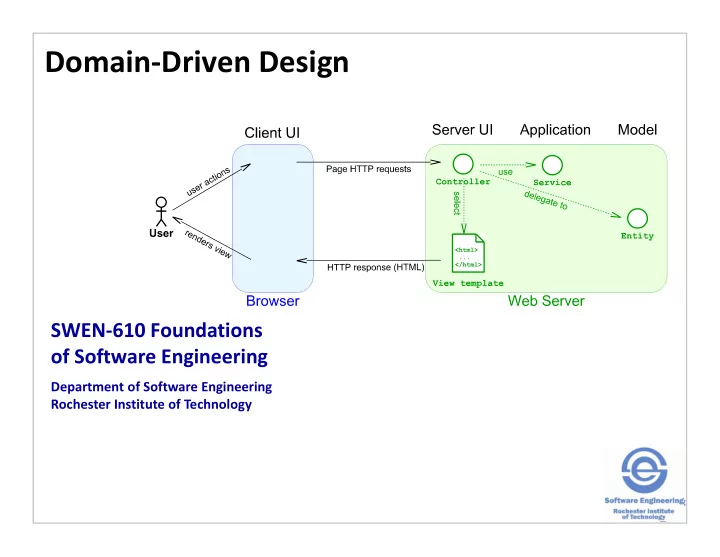
Domain-Driven Design SWEN-610 Foundations of Software Engineering Department of Software Engineering Rochester Institute of Technology Domain driven design centers the architecture on the problem domain. Quote from the DDD Community:

slide-1
SLIDE 1

SWEN-610 Foundations

  • f Software Engineering

Department of Software Engineering Rochester Institute of Technology

Domain-Driven Design

slide-2
SLIDE 2

Domain driven design centers the architecture on the problem domain. Quote from the DDD Community:

Domain-driven design (DDD) is an approach to developing software for complex needs by deeply connecting the implementation to an evolving model of the core business concepts

The premise:

  • Place the project’s primary focus on the core domain

and domain logic

  • Base complex designs on a model
  • Initiate a creative collaboration between technical

and domain experts to iteratively cut ever closer to the conceptual heart of the problem

2

slide-3
SLIDE 3

Let's review our project architecture.

3

Client UI Application Model

HTML, CSS & JavaScript Java Web server (Jetty) Any OS and HW Any Browser Any OS/HW

Server UI

Spark & FreeMarker

Frameworks Platform OS/Hardware

Spark

(for Session) Network Connection

What goes in these two tiers?

slide-4
SLIDE 4

DDD provides guidance for the remaining tiers.

4

Client UI Application Model

HTML, CSS & JavaScript Java Web server (Jetty) Any OS and HW Any Browser Any OS/HW

Server UI

Spark & FreeMarker

Frameworks Platform OS/Hardware

Spark

(for Session) Network Connection

slide-5
SLIDE 5

Services provide application logic. The Application tier is responsible for managing the user's interaction with the application. It is not responsible for domain logic.

  • The difference is subtle so we will restrict your use

to dealing with the web session.

Services provide this type of logic:

  • Manage application-wide logic and information
  • Maintain Model objects in the Session

5

slide-6
SLIDE 6

Entities provide domain logic. The Model tier is responsible for managing domain entities and domain logic. Entity responsibilities are:

  • Process user requests/commands
  • Effect changes based on user requests/commands
  • Validate application rules
  • Maintain the state of the application

Entities are great for representing information about the world:

  • Customers, products and orders in e-commerce
  • Shapes in a drawing app

6

slide-7
SLIDE 7

Value objects provide values for entity attributes. We all intuitively know what values are.

  • They are primitives in programming languages, such

as int and float in Java.

  • But Java String objects are also value objects.

Values don't change.

  • A 47 cannot be changed into a 42.
  • You cannot capitalize the first character of "fred";

instead you have to create a new string "Fred"

  • This is called "immutable"

Lots of things can be considered values:

  • Measurements, dates, credit card numbers, money,

colors, (x,y) coordinates, to name only a few

  • Java enums are natural value objects

7

slide-8
SLIDE 8

Model objects are frequently used in collections. Many of the algorithms used in Model and Application components require using Entities and Value Objects in hash-based collections. Normal Java equality semantics are not adequate with dealing with Entities and VOs

  • An Entity must have a distinct id such that two
  • bjects with the same id must be considered equal.
  • Two Value Objects with the same data must be equal.
  • These semantic requirements imply specialized

equals and hashCode methods.

The post-class activity provides instructions on how to create these methods.

8

slide-9
SLIDE 9

Let's review the architecture again.

9

slide-10
SLIDE 10

This is the list of component responsibilities.

10

UI Tier Application Tier Model Tier UI Controller:

  • Control the views based on the state of the

application

  • Query the Model and Control as necessary to

get information to present to the user

  • Perform simple input validation and data

conversion based on input modality, e.g. String to Object

  • Initiate processing of user

requests/commands possibly providing data the user input

  • Perform data conversion for display by views

UI View:

  • Provide an interface to the user
  • Present information to the user in a variety
  • f ways
  • Provide a mechanism for user to input data

and requests

Service:

  • Manage application-wide

logic and information

  • Maintain Model objects in

the Session

Entity:

  • Process user requests/commands
  • Effect changes to the Model based
  • n user requests/commands
  • Validate application rules
  • Maintain the state of the

application

Value Object:

  • Provide immutable value semantics
  • Provide value-based logic