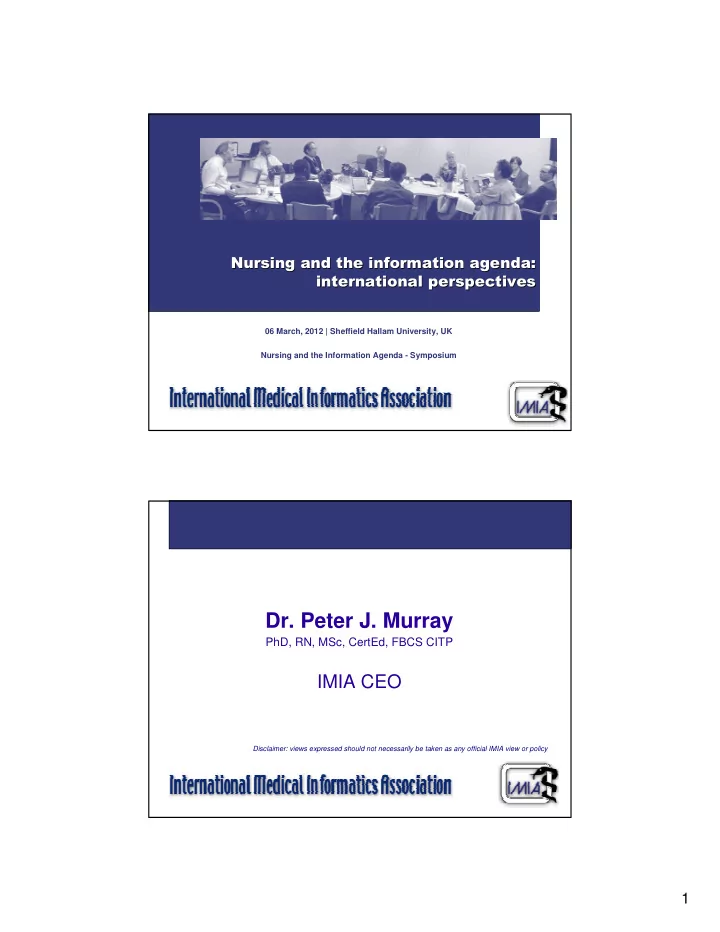
SLIDE 1 1
- 06 March, 2012 | Sheffield Hallam University, UK
Nursing and the Information Agenda - Symposium
PhD, RN, MSc, CertEd, FBCS CITP
IMIA CEO
Disclaimer: views expressed should not necessarily be taken as any official IMIA view or policy
SLIDE 2 2
About me: Registered nurse Coronary care specialisation Qualified nurse teacher (plus MSc Nursing) Informatics 'professional' (mainly self-taught in ICT) Web and social media user, 'ambassador'
- Photo courtesy Antoine Geissbuhler
SLIDE 3 3
- Three key areas:
- the changing environment in which nurses work
- the role of ICT in providing better patient care
- the implications for higher education institutions
- ffering healthcare programmes
- About IMIA - the International Medical Informatics Association
A view on records and information Nursing, information, technology – the intersection Same seas, different boats?
SLIDE 4 4
- An 'association of associations'
- a 'bridging organisation' to bring together the members o
the global health and biomedical informatics communities
- almost 60 Member Societies – contacts in over 85
countries
- over 50 Academic and Corporate Members
- represents over 50,000 people in health informatics
Nurses have always been well-represented.
- The basic aims of IMIA:
- to advance international cooperation;
- to stimulate research, development and routine application;
- to move informatics from theory into practice in all settings;
- to further the dissemination and exchange of knowledge,
information and technology.
SLIDE 5 5
- IMIA-NI (Nursing Informatics) SIG - one of the
most active parts of IMIA. NI Congress every 3 years since first in London in 1982: 2009 Helsinki, Finland 2012 Montreal, Canada (June 23-27 - www.ni2012.org) 2014 Taipei
SLIDE 6 6
- "In attempting to arrive at the truth, I have applied
everywhere for information but in scarcely an instance have I been able to obtain hospital records fit for any purpose of comparison. If they could be obtained, they would enable us to decide many other questions besides the one alluded to. They would show subscribers how their money was being spent, what amount of good was really being done with it or whether the money was not doing mischief rather than good."
- So, nursing has long been about
the information and records, and supporting care
- not (just) using the technology
SLIDE 7
7
!!! !!! !!!
Nursing informatics science and practice integrates nursing, its information and knowledge and their management with information and communication technologies to promote the health of people, families and communities world wide.
IMIA-NI definition - adopted July 2009, Helsinki, Finland www.imiani.org
!!! !!! !!!
Turley, 1996 model
SLIDE 8
8
"!!! "!!! "!!!
How do we exchange information, ideas, experiences, best practice, etc?
Face to face events/conferences (inter/national) Publications Email discussions (from early 1990s and before – eg E.T.Net, NURSENET, nrsing-l) – are these now dying out? Increasingly through social media? - or maybe not? (Even NMC and RCN there now - but not NHS CfH) How much interaction/sharing do we REALLY get, as opposed to just 'push'?
"!!! "!!! "!!!
Some common issues in health and informatics
Many countries and healthcare facilities moving electronic (inc. LMIC) Development of electronic health/medical records About reducing errors, improving quality of care, benefitting patients (and clinicians?) Stand-alone systems? - (how) do they interact, exchange information to benefit patient care? Who is the driving force? - government, IT, vendors, clinicians, patients?
SLIDE 9
9
"!!! "!!! "!!!
Some common issues in health and informatics
Often lack of clinical engagement in developments – so, resistance The rise of patient empowerment The rise of mobile/connected devices – mHealth, etc. Global lessons that can be applied locally – or local lessons that can have global relevance Political change/expediency often gets in the way ...
"!!! "!!! "!!!
SLIDE 10 10
#$!!! #$!!! #$!!!
What will influence health in the future?
- by 2010, 50% of the world's population will live in cities and urban areas;
- increasing global inequalities, with continuation of absolute poverty for
many people;
- continuing population growth, and increasing competition for scare
resources, such as water;
- the continuing impact of communicable diseases in many countries;
- the effects of conflict and global or local crises in displacing large numbers
- f people;
- increasing pervasiveness of information and communications
technologies, with impact of information access; Strategic Trends; UK Ministry of Defence, 2007
#$!!! #$!!! #$!!!
What issues will nursing (informatics) need to take account of in the future? More and more information – the elephant in the room? The empowered and tech-savvy citizen – their relationship with healthcare and professionals (whose health is it anyway?) Continuing education and professional development to enable dealing with change
SLIDE 11 11
%!!! %!!! %!!!
(Nurses) must become more involved at every level, or the Informatics Revolution will pass the nursing profession by, to the detriment of healthcare consumers.
- This symposium considers:
- the changing environment in which nurses work
Common issues in many countries irrespective of type of healthcare system, level of economic development, political/social context Increasing use of ICT, reducing resources, growing populations, demographics (especially ageing), ageing/falling health workforce, patient empowerment, mHealth, ….
SLIDE 12 12
- This symposium considers:
- the role of ICT in providing better patient care
Investments increasing – but evidence of effect? The nursing role/input – is there one? Error reduction (esp. medication) The changing locus of care can be supported by ICT
- This symposium considers:
- the implications for higher education institutions
- ffering healthcare programmes
Sharing experiences – through ICT Consumer ICT as a driver to healthcare ICT? (transfer skills in everyday use) Drivers of patient expectations Reducing workforces with the necessary skills
SLIDE 13
13
& & & '$ '$ '$
Further information and contact
peterjmurray@gmail.com imia@imia-services.org @peterjmurray @IMIATweets (on Twitter)