
SLIDE 1
Th The e use use of
- f metaphor
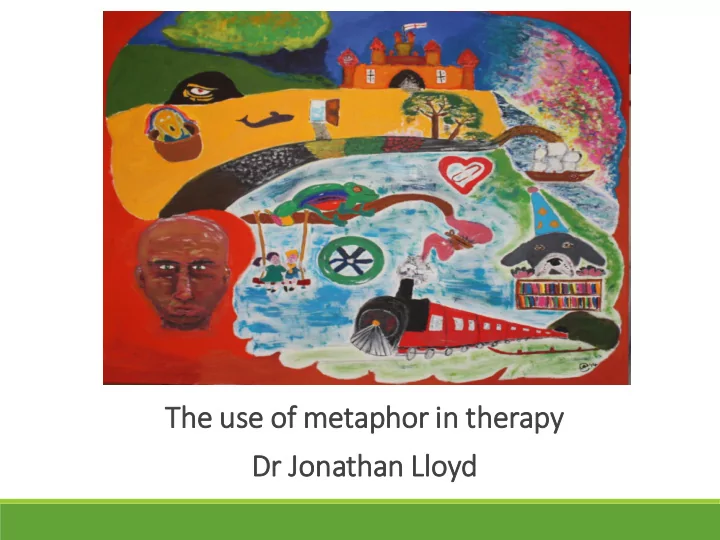
Dr r Jo Jona nathan Ll Lloyd Introductions Group Introductions - - PowerPoint PPT Presentation
Th The e use use of of metaphor r in n the therapy Dr r Jo Jona nathan Ll Lloyd Introductions Group Introductions including hopes and fears for the day, why you are here & describe yourself as a therapist metaphorically
09:30 – 09:50 Introductions 09:50 – 10:00 Definitions 10:10 – 11:00 Models of Therapy and their use of metaphor (including negative aspects)– what the literature tells us. 11:00 – 11:15 Coffee Break 11:15 – 12:00 Findings - a brief discussion including standing-in-for discussion. 12:00 – 12:30 Therapist Generated Metaphors including practice. 12:30 – 13:00 Lunch 13:00 – 13:30 Client Generated Metaphors including exercise. 13:30 – 14:00 Clean language – DVD and demonstration 14:00 – 15:30 Co-constructed/moving metaphors/plus practice 15:30 – 16:00 Conclusion
METAPHOR Overarching definition of metaphor: "as the phenomenon whereby we talk, and potentially think about something in terms of something else". The term metaphor is derived from the Greek word metapherein, to transfer over. The etymological roots of the word are meta meaning beyond or over, plus pherein meaning to bring or bear. In this context a metaphor is something that is brought or carried over or beyond.
Similes make use of the same cognitive mechanism as metaphors and have a rational or logical element to them. For example, ‘she smiled like a Cheshire Cat’
Examples of a British culturally specific metonym includes ‘the Crown’ meaning the
perhaps with a with a more universal application would be ‘plastic’ meaning credit cards. They stand-in-for.
Deep Metaphors are defined as: "consistent, recurring images of a life story that give coherence to, and aid in, the interpretation of the events of that life....and are used by clients to both circumscribe and frame possible solutions to the problems in their lives" (Mallinson et al., 1996, p.2).
developed/potential movement, often contain an element of hope.
awareness
Person Centred The absence of the promotion of the specific use of metaphors in the traditional person-centred literature is probably due to the authentic person to person “therapy as relationship encounter” (Rogers, 1962, p.185) stance which takes precedence over techniques and theory (Wyatt, 2001). It is about “a way of being” (Rogers, 1980, p.227).
Stott et al. (2010) explain the importance of metaphors in CT and CBT: "Cognitive Therapy has, as a central task, the aim of transforming meaning to further the client's goals and help journey towards a more helpful, realistic and adaptive view
therefore be a powerful companion" (p.14).
Working with dreams can be an fundamental element
indicate unconscious wish fulfilment and latent transferential issues (Sharpe, 1988). Sharpe (1988, p.7) suggests that dreams indicate the individual psychical product of the individual: “The dream-life holds within itself not only the evidence of instinctual drives and mechanisms, by which those dreams are harnessed or neutralised, but also the actual experiences through which we have passed…dreams are like individual works of art.”
Potential pitfalls with using metaphors;
elegant more appropriate description
meanings
Potential pitfalls with using metaphors;
when the client is silent and ‘creatively reflective’ is regarded by some (C&T)as ill placed and contaminating
not involve a “string of avoidance” .
if it has been introduced by the therapist, factors may include low self-esteem or a difficulty to visualise
conflict or as part of a power struggle with their counsellor
There may also be difficulties relating to certain mental health issues, for example, the following of client generated metaphors with those with Psychosis or Borderline Personality Disorders can make them become extremely anxious as they may experience metaphors as a form of direct revelation of a concrete, and
significant percentage of clients on the Autistic Spectrum can also struggle with the non-logical viewpoint that metaphors engage.
A BRIEF DISCUSSION
I am like.... I am like the wind I am the train on the tracks that runs and runs and runs I am from you me us them I am like the glue that binds the magnet that repels the missing in the fog I am like my child I can play I can smile can cry I can find strength from here I am like a bird I can fly I can drift as high as the cloud I can burrow deep into the cloud I am always there ready
in the dream in this moment I am like the creator I can change colour shape Your world and mine I am like the gift the chameleon pathway to your mind I am like the knot in your gut I rest in your heart I rest in your neck like the blade in your side I hold the dreams you cannot tell I am like what you are like change me you
I am like the monster sleeping in the dark that can lead to doors doors hiding smiles behind I am like the crack in the cult the safe dungeon the shiny hub the frozen rose I am like the tissues in the box I am hope I am like.
STANDING IN FOR – THE METONYMS OF THE THERAPEUTIC RELATIONSHIP
The therapist is a metaphor for a lover, a care- giver, a teacher, a maiden, a
a shape shifter, a chameleon, "whoever your client needs you to be. While still being yourself”.
‘Bank Metaphors’ or ‘off-the-shelf’ metaphors include:- Castles Trains Wheels Rivers Trees (& Plants) Desert Islands Poems/Literature/Films/TV/Radio/Plays – cultural metaphors? Shapes (Tomkins)
“Attend. Witness. Wait. Discern, formulate, potentiate, and reflect mutative metaphorical material.
The Black Parrot By Dorothy Nimmo Kill the black parrot. Choke the sodding bird, it never said a kind thing or a true word,
I only heard it squawking in my ear things no-one in their right mind wants to hear that made me cold with shame and white with fear. Behave yourself. Control yourself. You know you don't think that, you only think you do. You can't just please yourself, I told you so. You're being selfish. It's for your own good. You must. You must not. But you know you should. If you try harder, I am sure you could. I'm disappointed in you. Never say I didn't tell you. But you had your own way, you'd not be told. There'll be a price to pay. Where was it polly learned that canting word? It's time to wring its neck, the stupid bird. What made us think that was the voice of God? 1. Nimmo (1993, 3-4)
Samuel Beckett’s ‘Happy Days’
"Mrs. Potter's Lullaby" Well I woke up in mid afternoon cause that's when it all hurts the most I dream I never know anyone at the party and I'm always the host If dreams are like movies then memories are films about ghosts You can never escape, you can only move south down the coast Well I am an idiot walking a tightrope of fortune and fame I am an acrobat swinging trapezes through circles of flame If you've never stared off into the distance then your life is a shame And though I'll never forget your face sometimes I can't remember my name Hey, Mrs. Potter, don't cry Hey, Mrs. Potter, I know why But, hey, Mrs. Potter, won't you talk to me Well there's a piece of Maria in every song that I sing And the price of a memory is the memory of the sorrow it brings And there is always one last light to turn out and one last bell to ring And the last one out of the circus has to lock up everything Or the elephants will get out and forget to remember what you said Oh and the ghosts of the tilt-o-whirl will linger inside of your head Oh and the Ferris wheel junkies will spin there forever instead When I see you, a blanket of stars covers me in my bed Hey, Mrs. Potter, don't go, I said Hey, Mrs. Potter, I don't know, but Hey, Mrs. Potter, won't you talk to me Well all the blue light reflections that color my mind when I sleep
And the lovesick rejections that accompany the company I keep All the razor perceptions that cut just a little too deep Hey, I can bleed as well as anyone but I need someone to help me sleep So I throw my hand into the air and it swims in the beams It's just a brief interruption of the swirling dust sparkle jet stream Well I know I don't know you and you're probably not what you seem Aw, but I'd sure like to find out So why don't you climb down off that movie screen Hey, Mrs. Potter, don't turn Hey, Mrs. Potter, I burn for you Hey, Mrs. Potter, won't you talk to me When the last king of Hollywood shatters his glass on the floor And orders another Well, I wonder what he did that for That's when I know that I have to get out cause I have been there before So I gave up my seat at the bar and I head for the door. Yeah. We drove out to the desert just to lie down beneath this bowl of stars We stand up in the Palace, like it's the last of the great pioneer town bars Aw, we shout out these songs against the clang of electric guitars Well, you can see a million miles tonight But you can't get very far Aw, you can see a million miles tonight But you can't get very far Hey, Mrs. Potter, I won't touch and Hey, Mrs. Potter, it's not much but Hey, Mrs. Potter, won't you talk to me [3X]
David Grove DVD (10 mins) & Explanation Example of working with Mrs Potter metaphors Experiential of working with each other.
“The meaning of metaphor is revealed within a personal and cultural context, within a society
(Hobson, 1985, p.60)
Cox & Theilgaard (1987, p.49): (Client) “because I don’t
“It is the impact of the inner world of the patient on that of the therapist and vice versa which promotes movement”. I would tentatively offer my view on this phenomenon that metaphors arise from the therapeutic relationship and for them to be therapeutically useful they need to be mutually understood and developed (they need to impact on each
about dialogue and conversation in a given context (Hobson, 1985). Even in person-centred circles it is now accepted that the therapist inevitably influences what is said, it is a co- constructive, contextualised process (Worsley, 2002).
A full list of references is available along with a copy of the thesis by emailing me at jonathan@calmminds.com Or call 0161 439 7773