Drainage network analysis Drainage network analysis 4 flooding 9 - - PowerPoint PPT Presentation

drainage network analysis drainage network analysis
SMART_READER_LITE
LIVE PREVIEW

Drainage network analysis Drainage network analysis 4 flooding 9 - - PowerPoint PPT Presentation

Drainage network analysis Drainage network analysis 4 flooding 9 6 5 8 3 7 1 2 flow routing watershed labelling flow routing flow accumulation flow accumulation 1 25 612 1 25 612 1350 1350 compute for each


slide-1
SLIDE 1

Drainage network analysis

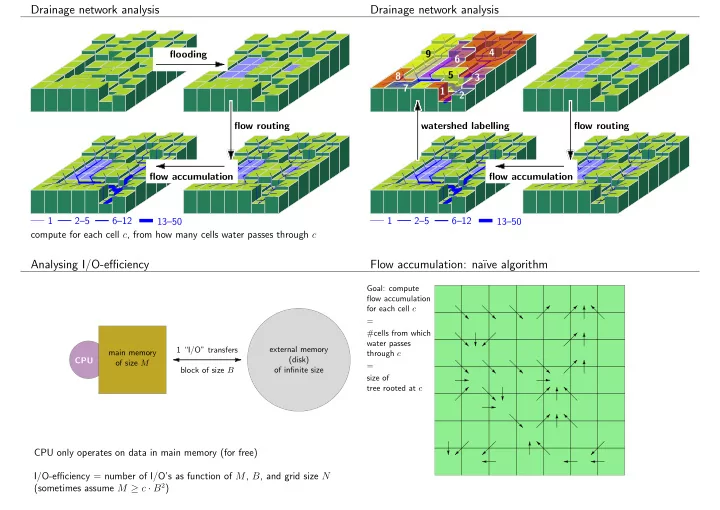
1 2–5 6–12 13–50 flow routing compute for each cell c, from how many cells water passes through c flooding flow accumulation 1 2–5 6–12 13–50 1 2 4 6 8 7 3

Drainage network analysis

flow routing watershed labelling flow accumulation 9 5

Analysing I/O-efficiency

main memory

  • f size M

external memory (disk)

  • f infinite size

1 “I/O” transfers block of size B CPU

CPU only operates on data in main memory (for free) I/O-efficiency = number of I/O’s as function of M, B, and grid size N (sometimes assume M ≥ c · B2)

Flow accumulation: na¨ ıve algorithm

Goal: compute flow accumulation for each cell c = #cells from which water passes through c = size of tree rooted at c

slide-2
SLIDE 2

1 1 1 1 1 1 1 1 1 1 1 Flow accumulation: na¨ ıve algorithm

Goal: compute flow accumulation for each cell c = #cells from which water passes through c = size of tree rooted at c

1 1

2 1 1 2 2 2 2 2 2 2 2 Flow accumulation: na¨ ıve algorithm

Goal: compute flow accumulation for each cell c = #cells from which water passes through c = size of tree rooted at c

1 1 2

5

2 1 1

2 6

1 1 1

5 5 5 5 5 5 5 Flow accumulation: na¨ ıve algorithm

Goal: compute flow accumulation for each cell c = #cells from which water passes through c = size of tree rooted at c

Row-by-row scan

1 1 1 1 1 1 1 1 1 1 1 1 1 1 1 1 1 1 1 1 1 1 1 1 1 1 1 1 1 1 1 1 1 1 1 1 1 1 1 1 1 1 1 1 1 1 1 1 1

Goal: compute flow accumulation for each cell c = #cells from which water passes through c = size of tree rooted at c

slide-3
SLIDE 3

Row-by-row scan

1 1 1 1 3 35 1 1 2 2 2 1 32 1 1 6 1 1 1 30 1 1 4 7 2 28 1 1 1 1 13 1 22 1 1 1 1 1 19 1 1 1 3 3 1 1 4 3 1 Running time: Θ(N)

Goal: compute flow accumulation for each cell c = #cells from which water passes through c = size of tree rooted at c

N = #cells in grid

Row-by-row scan Row-by-row scan

N = #cells in grid

Θ(N) I/O’s in the worst case ≈ 1 year for 28 GB grid

Z-order scan

slide-4
SLIDE 4

Z-order scan Z-order scan Z-order scan

√ B

Z-order scan on Z-order file

B = #bytes in one I/O

While working

  • n a block,

have its neighbours in memory too

slide-5
SLIDE 5

√ B

While working

  • n a block,

have its neighbours in memory too

Z-order scan on Z-order file

B = #bytes in one I/O

√ B

Only long paths require additional swapping

Z-order scan on Z-order file

B = #bytes in one I/O

While working

  • n a block,

have its neighbours in memory too

Worst-case terrains vs. real terrains

Worst-case, size N Worst-case, size 4N Realistic, size N Realistic, size 4N Ω( √ N) big bends Θ(1) big bends

N = #cells in grid

Worst-case terrains vs. real terrains

Worst-case, size N Worst-case, size 4N Q′ = Q scaled by factor 3. Far cells of Q: cells on boundary of Q′ where water from Q collects. In the worst case, maximum number of far cells grows with resolution.

N = #cells in grid

slide-6
SLIDE 6

Worst-case terrains vs. real terrains

Realistic, size N Realistic, size 4N Q′ = Q scaled by factor 3. Far cells of Q: cells on boundary of Q′ where water from Q collects. Confluence assumption: number of far cells for any square Q ≤ constant γ

N = #cells in grid

Z-order scan on Z-order file

√ B

Only long paths require additional swapping Θ(N/B) I/Os N/B blocks × γ swaps × 9-block window = Θ(N/B) I/Os ≈ few hours

N = #cells in grid B = #bytes in one I/O

While working

  • n a block,

have its neighbours in memory too

Flow accumulation by scanning in practice

algorithm file order worst case ‘realistic’ bytes per cell time (mins)

bytes of disk I/O per cell calculated based on: N = 232, M = 1 GB, B = 16 to 64KB time: 3 GHz Pentium, one disk for data + scratch, N = 3.5 · 109 (Neuse), M = 1 GB

row-by-row scan Z-order scan Z-order scan

*) needs tall cache: M ≥ cB2

row by row row by row Z-order O(N) O(N) O(N/ √ B) O(N/B)∗ O(N/B) O(N/ √ B) tenthousands thousands hundreds 111 41 Easy implementation:

  • needs efficient conversion (row nr., column nr.) ↔ index in Z-order
  • Z-order scan → good caching by OS, no need to tune to hardware / implement I/O-control

N = #cells in grid B = #bytes in one I/O

Z-order-traversal has many other applications, e.g.:

  • I/O-efficient matrix operations
  • I/O-efficient algorithms and data structures for geographic maps

theoretical analysis experiments

(row, column) ↔ Z-index

(0) (1) (4) (5) (16) (17) (20) (21) (2) (3) (6) (7) (18) (19) (22) (23) (8) (9) (12) (13) (24) (25) (28) (29) (10) (11) (14) (15) (26) (27) (30) (31) (32) (33) (36) (37) (48) (49) (52) (53) (34) (35) (38) (39) (50) (51) (54) (55) (40) (41) (44) (45) (56) (57) (60) (61) (42) (43) (46) (47) (58) (59) (62) (63) 0 0 0 0 0 1 0 1 0 0 1 1 1 0 0 1 0 1 1 1 0 1 1 1 0 0 0 0 0 1 0 1 0 0 1 1 1 0 0 1 0 1 1 1 0 1 1 1 0 0 0 0 0 1 0 1 0 0 1 1 1 0 0 1 0 1 1 1 0 1 1 1 0 0 0 0 0 1 0 1 0 0 1 1 1 0 0 1 0 1 1 1 0 1 1 1 0 0 0 0 0 1 0 1 0 0 1 1 1 0 0 1 0 1 1 1 0 1 1 1 0 0 0 0 0 1 0 1 0 0 1 1 1 0 0 1 0 1 1 1 0 1 1 1 0 0 0 0 0 1 0 1 0 0 1 1 1 0 0 1 0 1 1 1 0 1 1 1 0 0 0 0 0 1 0 1 0 0 1 1 1 0 0 1 0 1 1 1 0 1 1 1 0 0 0 0 0 1 0 1 0 0 1 1 1 0 0 1 0 1 1 1 0 1 1 1 0 0 0 0 0 1 0 1 0 0 1 1 1 0 0 1 0 1 1 1 0 1 1 1 0 0 0 0 0 1 0 1 0 0 1 1 1 0 0 1 0 1 1 1 0 1 1 1 0 0 0 0 0 1 0 1 0 0 1 1 1 0 0 1 0 1 1 1 0 1 1 1 0 0 0 0 0 1 0 1 0 0 1 1 1 0 0 1 0 1 1 1 0 1 1 1 0 0 0 0 0 1 0 1 0 0 1 1 1 0 0 1 0 1 1 1 0 1 1 1 0 0 0 0 0 1 0 1 0 0 1 1 1 0 0 1 0 1 1 1 0 1 1 1 0 0 0 0 0 1 0 1 0 0 1 1 1 0 0 1 0 1 1 1 0 1 1 1 0 0 0 0 0 1 0 1 0 0 1 1 1 0 0 1 0 1 1 1 0 1 1 1 0 0 0 0 0 1 0 1 0 0 1 1 1 0 0 1 0 1 1 1 0 1 1 1

slide-7
SLIDE 7

(row, column) ↔ Z-index

Quick conversion through look-ups in tables of size √ N (example: √ N = 16) spread rowdigits coldigits 0000 0000000 00 00 0001 0000001 00 01 0010 0000100 01 00 0011 0000101 01 01 0100 0010000 00 10 0101 0010001 00 11 0110 0010100 01 10 0111 0010101 01 11 1000 1000000 10 00 1001 1000001 10 01 1010 1000100 11 00 1011 1000101 11 01 1100 1010000 10 10 1101 1010001 10 11 1110 1010100 11 10 1111 1010101 11 11 row number column number look up in spread row number column number look up in spread append 0 add Z-index first half second half look up in rowdigits look up in rowdigits look up in coldigits look up in coldigits concatenate concatenate 0110 0011 0010100 0000101 00101000 00101101 0010 1101 01 00 10 11 0110 0011 can be adapted to non-square grids

Flow accumulation: separator-based algorithm

Θ( √ M) Separator cells: each Θ( √ M)-th row/column → divide grid into Θ(N/M) subgrids of size Θ(M)

N = #cells in grid M = main memory size

1 1 1 1 1 1 1 1 1 1 1 1 1 1 1 1 1 1 1 1 1 1 1 1 1 1 1 1 1 1 1 1 1

Θ( √ M) input separator flow accumul. separator flow directions

  • 1. move flow from interior
  • f subgrids to separators

and compute flow connec- tions between separators

Flow accumulation: separator-based algorithm

N = #cells in grid M = main memory size

1 1 1 1 1 1 1 1 1 1 1 1 1 1 1 1 1 1 1 1 1 1 1 1 1 1 1 1 1 1 1 1 1 1 1 3 1 3 1

  • 1. move flow from interior
  • f subgrids to separators

and compute flow connec- tions between separators

Θ( √ M) input separator flow accumul. separator flow directions

Flow accumulation: separator-based algorithm

N = #cells in grid M = main memory size

slide-8
SLIDE 8

1 1 1 1 1 1 1 1 1

4 2

1 1 1 1 1 1 1 1 1 1 1 1 1 1 1 1 1 1 1 1 1 1 1 1 3 1 3 1

  • 1. move flow from interior
  • f subgrids to separators

and compute flow connec- tions between separators

Θ( √ M) input separator flow accumul. separator flow directions

Flow accumulation: separator-based algorithm

N = #cells in grid M = main memory size

1 1 1 1 1 1 1 1 1

4 2

1 1 1 1 1 1 1 1 1 1 1 1 1 1 1 1 1 1 1 1 1 1

  • 1. move flow from interior
  • f subgrids to separators

and compute flow connec- tions between separators

Θ( √ M) input separator flow accumul. separator flow directions

Flow accumulation: separator-based algorithm

N = #cells in grid M = main memory size

1 1 1 1 1 1 1 1 1

4 2

1 1 1 1 1 1 1 1 1 1 1 1 1 1 1 1 1 1 1 1 1 1

  • 1. move flow from interior
  • f subgrids to separators

and compute flow connec- tions between separators

Θ( √ M) input separator flow accumul. separator flow directions

Flow accumulation: separator-based algorithm

N = #cells in grid M = main memory size

1 1 1 1 1 5 1 1 1 4 2 5 1 1 2 2 1 1 1 1 1 1 3 1 1 1 1 1 1 1 1 1 1

  • 1. move flow from interior
  • f subgrids to separators

and compute flow connec- tions between separators

Θ( √ M) separator flow accumul. separator flow directions

Flow accumulation: separator-based algorithm

N = #cells in grid M = main memory size

slide-9
SLIDE 9

1 1 1 1 1 5 1 1 1 4 2 5 1 1 2 2 1 1 1 1 1 1 3 1 1 1 1 1 1 1 1 1 1

  • 1. move flow from interior
  • f subgrids to separators

and compute flow connec- tions between separators

  • 2. compute flow accumula-

tion of separators

Flow accumulation: separator-based algorithm

1 1 1 1 3 35 1 4 1 7 2 28 1 1 3 3 1 1 4 3 1 1 19 1 1 1 1 1 1 1 1 2 1

  • 1. move flow from interior
  • f subgrids to separators

and compute flow connec- tions between separators

  • 2. compute flow accumula-

tion of separators

Flow accumulation: separator-based algorithm

1 1 1 1 3 35 1 4 1 7 2 28 1 1 3 3 1 1 4 3 1 1 19 1 1 1 1 1 1 1 1 2 1

  • 1. move flow from interior
  • f subgrids to separators

and compute flow connec- tions between separators

  • 2. compute flow accumula-

tion of separators

Flow accumulation: separator-based algorithm

1 1 1 1 1 1 1 1 4 1 7 2 1 1 1 2 1 1 1 1 3 35 1 4 1 7 2 28 1 1 3 3 1 1 4 3 1 1 19 1 1 1 1 1 1 1 1 2 1

  • 1. move flow from interior
  • f subgrids to separators

and compute flow connec- tions between separators

  • 2. compute flow accumula-

tion of separators

  • 3. move flow from separa-

tors into subgrids

Flow accumulation: separator-based algorithm

slide-10
SLIDE 10

2 2 6 1 1 1 1 4 1 7 1 1 1 1 1 1 1 3 35 1 2 28 1 1 1 1 2 1 1 1 1 1 3 35 1 4 1 7 2 28 1 1 3 3 1 1 4 3 1 1 19 1 1 1 1 1 1 1 1 2 1

  • 1. move flow from interior
  • f subgrids to separators

and compute flow connec- tions between separators

  • 2. compute flow accumula-

tion of separators

  • 3. move flow from separa-

tors into subgrids

Flow accumulation: separator-based algorithm

2 2 6 1 1 1 1 4 1 7 1 1 1 32 1 30 1 3 35 1 2 28 1 1 1 1 2 1 1 1 13 1 22 1 1 1 1 1 19 1 1 1 3 3 1 1 4 3 1 1 1 1 1 3 35 1 4 1 7 2 28 1 1 3 3 1 1 4 3 1 1 19 1 1 1 1 1 1 1 1 2 1

  • 1. move flow from interior
  • f subgrids to separators

and compute flow connec- tions between separators

  • 2. compute flow accumula-

tion of separators

  • 3. move flow from separa-

tors into subgrids

Flow accumulation: separator-based algorithm

1 1 1 1 3 35 1 4 1 7 2 28 1 1 3 3 1 1 4 3 1 1 19 1 1 1 1 1 1 1 1 2 1

  • 1. move flow from interior
  • f subgrids to separators

and compute flow connec- tions between separators

  • 2. compute flow accumula-

tion of separators

  • 3. move flow from separa-

tors into subgrids

  • 1. Θ(N/M) subgrids ×

Θ(M/B + √ M) = Θ(M/B) = Θ(N/B) I/O’s

  • 2. linear-time algo, input

Θ(N/ √ M) = O(N/B)

  • 3. Θ(N/B) I/O’s

(like phase 1)

  • 1. 1 byte of I/O per cell
  • 2. no I/O in practice
  • 3. 9 bytes of I/O per cell

Total: 10 bytes per cell if grid stored in Z-order Total: 20 to 60 bytes if grid stored row by row (for 1/4 ≤ M/B2 ≤ 4)

Flow accumulation: separator-based algorithm

N = #cells in grid M = main memory size B = #bytes in one I/O M ≥ cB2

Flow accumulation: Z-order scan versus separators

algorithm file order worst case ‘realistic’ bytes per cell time (mins) row-by-row scan Z-order scan Z-order scan separator-based separator-based row by row row by row Z-order row by row Z-order O(N) O(N) O(N/ √ B) O(N/B)∗ O(N/B) O(N/B)∗ O(N/B) O(N/ √ B) tenthousands thousands hundreds 20 to 60 10 111 41 39 should try!

bytes of disk I/O per cell calculated based on: N = 232, M = 1 GB, B = 16 to 64KB time: 3 GHz Pentium, one disk for data + scratch, N = 3.5 · 109 (Neuse), M = 1 GB *) needs tall cache: M ≥ cB2

Other applications of separators: minimum spanning trees & flooding; BFS & flow routing; single-source shortest paths. Easy implementation: no need to tune to hardware / implement I/O-control Implementation must explicitly adapt subgrid size to available memory M

N = #cells in grid M = main memory size B = #bytes in one I/O

theoretical analysis experiments

slide-11
SLIDE 11

input

  • utput

pqueue sort

Time-forward processing (Arge et al.)

Goal: compute flow accumulation for each cell c = #cells from which water passes through c = size of tree rooted at c

input

  • utput

pqueue 1

Time-forward processing (Arge et al.)

Goal: compute flow accumulation for each cell c = #cells from which water passes through c = size of tree rooted at c

input

  • utput

pqueue 1 1

1

1 1 1 1 1 1 1 1 1

1 1 1 1 1 1 1 1

Time-forward processing (Arge et al.)

Goal: compute flow accumulation for each cell c = #cells from which water passes through c = size of tree rooted at c

input

  • utput

pqueue 1 1 1 1 1 1 1 1 1 1 1 2 2 7 10 14

Time-forward processing (Arge et al.)

Goal: compute flow accumulation for each cell c = #cells from which water passes through c = size of tree rooted at c

slide-12
SLIDE 12
  • utput

1 1 1 1 1 1 1 1 1 1 1 2 2 7 10 14 1 1 1 1 1 1 1 1 1 1 2 7 10 14 1 1 sort

Time-forward processing (Arge et al.)

Goal: compute flow accumulation for each cell c = #cells from which water passes through c = size of tree rooted at c

Time-forward processing

Worst-case I/O’s: Θ( N

B logM/B N B ) (Arge et al.)

I/O-volume per grid cell (optimistic): Sorting grid into list of 2 × 2 × 24 = 96 bytes (xy-location, topological nr., out-neighbour top. nr.) Flow accumulation, input: 24 bytes Flow accumulation, output: 16 bytes (xy-location, flow) Sorting output into grid 2 × 2 × 16 = 64 bytes Total: 200 bytes I/O-volume per grid cell (pessimistic): Sorting grid into list of 3 × 2 × 24 = 144 bytes (xy-location, topological nr., out-neighbour top. nr.) Flow accumulation, input: 24 bytes Flow accumulation, priority queue: 2 × 16 = 32 bytes Flow accumulation, output: 16 bytes (xy-location, flow) Sorting output into grid 3 × 2 × 16 = 96 bytes Total: 312 bytes

N = #cells in grid M = main memory size B = #bytes in one I/O

mergesort, recursion depth = 2 each level: read once, write once 24 bytes per element assume each element written once, read once 16 bytes per element (key + amount) topological number = sorting key ≈ elevation mergesort, recursion depth = 3 mergesort recursion depth = 2; priority queue fits in memory mergesort recursion depth = 3; priority queue does not fit

Results on flow accumulation

time-fwd proc. any O( N

B logM/B N B )

70 to 300

  • sev. hundred

bytes of disk I/O per cell calculated based on: N = 232, M = 1 GB, B = 16 to 64KB time: 3 GHz Pentium, one disk for data + scratch, N = 3.5 · 109 (Neuse), M = 1 GB *) needs tall cache: M ≥ cB2

N = #cells in grid M = main memory size B = #bytes in one I/O

algorithm file order worst case ‘realistic’ bytes per cell time (mins) row-by-row scan Z-order scan Z-order scan separator-based separator-based row by row row by row Z-order row by row Z-order O(N) O(N) O(N/ √ B) O(N/B)∗ O(N/B) O(N/B)∗ O(N/B) O(N/ √ B) tenthousands thousands hundreds 20 to 60 10 111 41 39 should try! Easy implementation: no need to tune to hardware / implement I/O-control Implementation must explicitly adapt subgrid size to available memory M Flexible; requires I/O-efficient sorting and priority queue theoretical analysis experiments

Extensions / other applications

Z-order traversal (easy to implement, no tuning to hardware):

  • flow accumulation (single-directional flow)
  • visibility maps
  • matrix operations
  • spatial data structures

Separator-based technique (tuned to available memory size):

  • flooding local minima (minimum spanning trees)
  • flow accumulation (single-directional flow)
  • (?) single-source shortest paths

Time-forward processing (using library for I/O-efficient priority queue):

  • flow accumulation (multi-directional flow, also irregular network models)

Confluence constant for water flow ≈ highway dimension for shortest paths (Abraham et al.) http://haverkort.net → research → algorithms for geographic elevation models and I/O-efficient graph algorithms