DVHA SFY 2019 Budget Adjustment Act (BAA) Recommendation DVHA Budget - - PDF document

dvha sfy 2019 budget adjustment act baa recommendation
SMART_READER_LITE
LIVE PREVIEW

DVHA SFY 2019 Budget Adjustment Act (BAA) Recommendation DVHA Budget - - PDF document

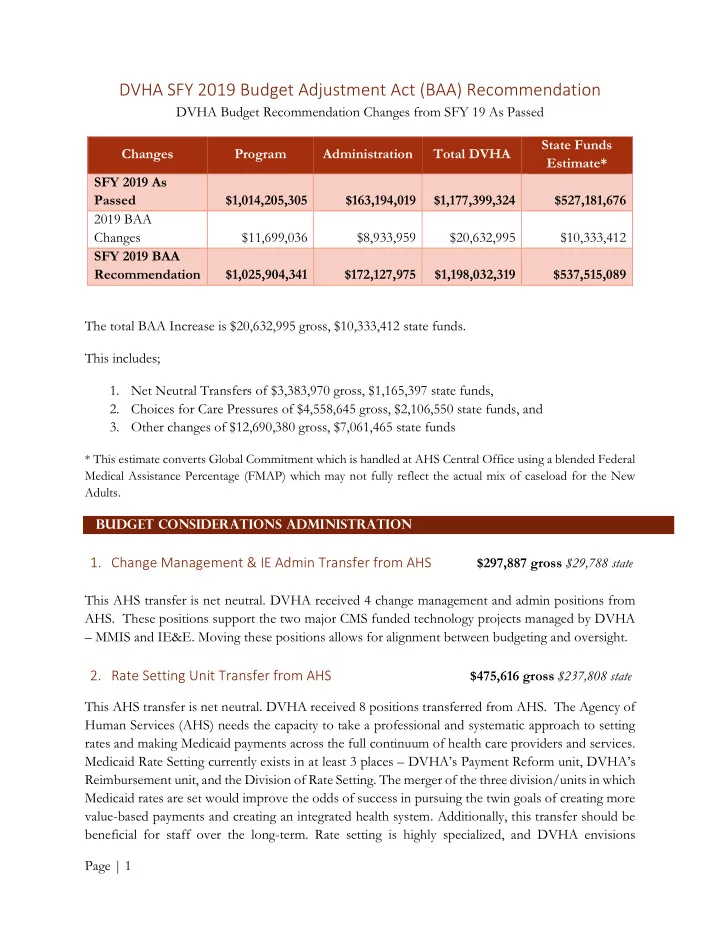
DVHA SFY 2019 Budget Adjustment Act (BAA) Recommendation DVHA Budget Recommendation Changes from SFY 19 As Passed State Funds Changes Program Administration Total DVHA Estimate* SFY 2019 As Passed $1,014,205,305 $163,194,019


slide-1
SLIDE 1

Page | 1

DVHA SFY 2019 Budget Adjustment Act (BAA) Recommendation

DVHA Budget Recommendation Changes from SFY 19 As Passed Changes Program Administration Total DVHA State Funds Estimate* SFY 2019 As Passed $1,014,205,305 $163,194,019 $1,177,399,324 $527,181,676 2019 BAA Changes $11,699,036 $8,933,959 $20,632,995 $10,333,412 SFY 2019 BAA Recommendation $1,025,904,341 $172,127,975 $1,198,032,319 $537,515,089 The total BAA Increase is $20,632,995 gross, $10,333,412 state funds. This includes;

  • 1. Net Neutral Transfers of $3,383,970 gross, $1,165,397 state funds,
  • 2. Choices for Care Pressures of $4,558,645 gross, $2,106,550 state funds, and
  • 3. Other changes of $12,690,380 gross, $7,061,465 state funds

* This estimate converts Global Commitment which is handled at AHS Central Office using a blended Federal Medical Assistance Percentage (FMAP) which may not fully reflect the actual mix of caseload for the New Adults. Budget Considerations Administration

  • 1. Change Management & IE Admin Transfer from AHS $297,887 gross $29,788 state

This AHS transfer is net neutral. DVHA received 4 change management and admin positions from

  • AHS. These positions support the two major CMS funded technology projects managed by DVHA

– MMIS and IE&E. Moving these positions allows for alignment between budgeting and oversight.

  • 2. Rate Setting Unit Transfer from AHS

$475,616 gross $237,808 state This AHS transfer is net neutral. DVHA received 8 positions transferred from AHS. The Agency of Human Services (AHS) needs the capacity to take a professional and systematic approach to setting rates and making Medicaid payments across the full continuum of health care providers and services. Medicaid Rate Setting currently exists in at least 3 places – DVHA’s Payment Reform unit, DVHA’s Reimbursement unit, and the Division of Rate Setting. The merger of the three division/units in which Medicaid rates are set would improve the odds of success in pursuing the twin goals of creating more value-based payments and creating an integrated health system. Additionally, this transfer should be beneficial for staff over the long-term. Rate setting is highly specialized, and DVHA envisions

slide-2
SLIDE 2

Page | 2

  • pportunities for increased professional development, cross-training, collaboration, and a career

ladder for rate setting professionals. Also, the move unites the setting of nursing home rates with that spending in DVHA’s budget, linking authority and accountability. This transfer includes salary and fringe and operating expenses.

  • 3. State & Federal Portion Premium Processing Contract $1,896,600 gross $948,300 state

WEX is the State's current Maintenance and Operations (M&O) premium processing vendor for Vermont Heath Connect. The State is working collaboratively to craft a plan to transition the responsibility for qualified heath plan premium billing from Vermont Health Connect to insurance

  • carriers. The current target for this transition is calendar year/plan year 2021. The decision to

continue contracting with WEX in the interim will be both operationally and financially advantageous to the State. It ensures stability as the State plans for the larger premium billing transition and avoids gaps in services. In addition, the State, through renegotiation, will save money through reduced Per Member Per Month (PMPM) pricing and a reduced fixed monthly cost.

  • 2018 and 2019 PMPM $3.17
  • 2020 PMPM $2.50
  • 2018 Base Services Fee $222,000 per month
  • 2019 Base Services Fee $200,000 per month
  • 2020 Base Services Fee $180,000 per month

These changes result in a savings to the State of approximately $541,000. Wex also collects Medicaid premiums for the Dr Dynasaur population. The State is reviewing the business processes and technology associated with this premium collection responsibility as a part of the Integrated Eligibility & Enrollment initiative and expects to both improve upon and expand functionality in the coming years. This line item is AHS budget neutral. The general funds were appropriated to AHS in FY18 and carried forward to cover the cost of the FY19 agreement.

  • 4. E&E Maintenance and Operations Contract Increases $2,981,250 gross $859,073state

The cost of DVHA E&E maintenance and operations (M&O) technology costs has risen overall, even as individual contracts are increasing and decreasing in value. Archetype – Based on 7/1/18 amendment, should be $1,748,960 for M&O. The ’19 Gov Rec amount is only $1,000,000. Archetype is the State’s reporting vendor for Vermont Health Connect. DVHA has been working collaboratively with ADS to bring these services in house and retire the Archetype

  • agreement. Delays in hiring technical staff resulted in a slower timeline for transition of duties,

requiring the State to extend the contract term and add additional scope to account for new federally

slide-3
SLIDE 3

Page | 3 mandated reporting requirements. The State is on track to fully transition VHC reporting responsibilities to state staff as of July 1, 2019. Optum – August 2018 amendment increased the contract to $13,476,750, from $11,818,750. Added to scope – Automated Regression Test Suite M&O; Reconciliation Services; Request Services. Additionally, the M&O portion of the Optum Hosting contract increased.

  • 5. MMIS Maintenance and Operations Contracts

$808,808 gross $404,404 state DXC is the claims process and fiscal agent for the Medicaid program. The contract was amended to enlarge its scope to meet legislative mandates and adding PMM for cloud service components. The contract value increased from $14,528,743 to $15,850,379.18.

  • 6. Reduction in Design Development and Implementation (DDI) Contracts

($2,852,096) gross ($276,650) state

DVHA continues to evaluate its portfolio of DDI contracts to better match the budget with anticipated spending. The reduction proposed here is due to some projects coming in under budget for SFY 2019.

  • Care Management: The State is implementing a Care Management Solution to support

individual and population-based approaches to health management. DVHA evaluates the Vermont Medicaid population and focuses on the top 5-10% utilizers of the healthcare system, accounting for 39% of healthcare costs. Care Management development work is close to completion and projected to be ($793,263) under budget for SFY 19.

  • Electronic Visit Verification (EVV): Section 12006 of the 21st Century CURES Act requires

states to implement an Electronic Visit Verification (EVV) system for (1) Personal Care Services (PCS) by January 1, 2020 (Recent legislative) and (2) Home Health Care Services (HHCS) by January 1, 2023. The EVVS enables home care workers to digitally record information about the visit—specific care or services rendered—and to report changes in patient condition for follow-up. EVV work will be both less expensive than anticipated and begin later than anticipated. The change in date for EVVS is related to timeline changes from

  • CMS. Savings projected of ($658,833).
  • Systems Integrator: This effort provides the hiring of a vendor to assist the State with: 1)

system integration services and integration platform for MMIS Enterprise and 2) TA services to assist with RFP creation and evaluation of bids. The work is delayed resulting in savings of $1,400,000.

  • 7. ACO Analytic Investment

$1,625,000 gross $812,500 state Continued Delivery System Reform (DSR) investment to expand the ACO’s ability to develop tools and advanced analytics to support ACO providers in decision-making and care coordination. OneCare’s care coordination model emphasizes active patient and family participation and

slide-4
SLIDE 4

Page | 4 coordinated, team-based approach across the continuum of care. To achieve this, OneCare developed a care coordination platform in which patients and caregivers can access their shared care plan and are actively involved in the selection of their care coordination team and care coordination plans, which enables them to participate in and improve the outcomes of their care experience. In tandem, OneCare developed a complementary health management analytics platform that integrates data from the care coordination platform with cost, utilization, and quality data so that providers can identify gaps in care, drive clinical insights, and identify variations in engagement and care across organizations and

  • communities. This DSR investment is IT-driven and will support and enhance both of the above

technology platforms. Enhancements will include the ability to develop a variety of specialized reports and tools to help providers understand their progress on quality measure performance, the cost of care they are providing, the impact of longer-term care coordination activities, and outcomes for the population of attributed members. Enhancements will also include developing a mobile patient portal and expanding the use of the mobile provider portal so that members and providers may more easily access information in the care coordination platform. This investment will also help providers by offering them trainings about how to use tools and interpret reports so that information can be used to help identify what patients need and so providers can better coordinate care for members across the broader health system.

  • 8. VHC Swap

$0 gross $0 state This item swaps SHCRF funding, $168,621, for the VHC, with an interdepartmental transfer (IDT).

  • 9. SFY18 Purchase Order Carryforward (AHS net-neutral)

$386,000 gross $386,000 state

DVHA continues to improve its business office functions. Review of past work indicated that some invoices had been paid to ADS while drawing down the incorrect match rate. This created an un anticipated general fund pressure in SFY 2018 related to prior year payments of ADS invoices. This amount is required to cover the SFY 2018 remaining purchase order obligations.

  • 10. HIT Fair Share FMAP Change

$0 gross $544,499 state

Health Information Technology match rates are reduced when the technology is used by non- Medicaid populations. This Fair Share calculation is required by CMS and is based on the proportion

  • f insurer coverage as compared to Medicaid coverage in Vermont. The HIT Fair Share FMAP

calculation changed from ~78% federal to ~65% federal effective 10/1/2018, effectively making the HIT Fair Share contracts within the HIT fund more expensive for the State.

  • 11. Acupuncture Pilot

$100,000 gross $100,000 state

The legislature required DVHA to conduct a two-year research study to explore the effects of increased access to acupuncture care on the utilization of and expenditures on other medical services for individuals enrolled in Medicaid and commercial health insurance in Vermont. This effort

slide-5
SLIDE 5

Page | 5 requires the reallocation of funds from the Evidence Based and Education and Advertising Fund. DVHA is in the process of posting a Request for Proposal (RFP).

  • 12. ADS True-up from AHSCO (AHS net-neutral)

$3,214,894 gross $438,774 state There is a transition of ADS technical staff for the Enterprise Project Management Office (EPMO)for healthcare project and operations (IE, MMIS, E&E Operations, & HIE) from AHS to

  • DVHA. This transfer moves the spending authority to support that transition.

Budget Considerations Program

  • 13. ASFCME – Collective Bargaining Agreement Yr. 1

$229,826 gross $106,203 state

In 2013 the Vermont Legislature passed Act 48, authorizing collective bargaining agreements (CBA) between independent direct support providers and the State of Vermont. The DVHA funded Children’s personal care attendant providers are included in the CBA. The amounts referenced above are for CY Year 1 increases as determined by the agreement.

  • 14. Medicaid Caseload and Utilization Revisions

$1,718,736 gross $1,002,699 state By statute, Vermont uses a consensus process to forecast Medicaid caseload and spending. This program spending is based on projected enrollment, utilization of services, and the price of those

  • services. The consensus forecast proceeded in two steps this year. The forecast group made

enrollment adjustments in October 2018 and PMPM cost adjustments in December 2018. These two adjustments are shown as two distinct rows in the ups/downs document. Generally, caseload is down as compared to As Passed and utilization and price pressures are up, increasing our PMPM. Overall, program costs are changing due to multiple factors:

  • Declining enrollment 0.68% reduction in Adults as compared to SFY 2018 actuals and 0.11%

reduction in children.

  • Changes to MEG enrollment Individuals that were previously ABD with a higher PMPM are

now classified as New or General Adults.

  • Increases to utilization of healthcare services 1.4% increase in utilization per member as

compared to SFY 2018. This increase in utilization is offsetting the decline in enrollment.

  • Hep C utilization
  • Brattleboro Retreat Rate Increase $3.5M rate increase
  • Non-Emergency Transportation increase $2.175M rate increase
  • Professionalize DME fee schedule
  • Reset VPharm Rebate expectations ongoing $3M less in State Only rebates per year
slide-6
SLIDE 6

Page | 6

  • Federally mandated increases for FQHCs/RHCs $2.2M more in reimbursements for SFY

2019.

  • 15. Buy-In Adjustment

$3,360,254 gross $1,075,025 state The federal government allows for states to use Medicaid dollars to “buy-in” to Medicare on behalf

  • f dually eligible beneficiaries who would otherwise be fully covered by Medicaid programs. Caseload

and member month costs vary from year to year. This change incorporates a rate increase and trend in member months. DVHA experienced an increase to Buy-In enrollment as a result of progress correcting and updating the eligibility files exchanged between CMS and DVHA. The Medicare Buy-In Programs help people with a low income pay their Medicare premium. There are three distinct Buy-in programs and each has different eligibility requirements:

  • Qualified Medicare Beneficiary (QMB)– Individuals who qualify for QMB are eligible to have

Medicaid pay for Medicare Premiums for Parts A and B, Medicare deductibles, and Medicare coinsurance within the prescribed limits.

  • Special Low-Income Medicare Beneficiary (SLMB)-Individuals who are eligible for SLMB are eligible to

have Medicaid pay Medicare directly for Medicare premiums for Part B.

  • Qualified Individuals (QI-1)-Individuals who are eligible for QI1 are eligible to have Medicaid pay

Medicare directly for Medicare premiums for Part B. The income limits are higher than SLMB and payment is only guaranteed through the end of the year the application was made. This is the

  • nly Medicaid benefit.

16.

DMH Interdepartmental Transfer (AHS Net Neutral) ($2,098,926) gross ($969,914) state DVHA is engaged in a variety of payment reform projects. Overall, payment reform is intended to pursue the twin goals of making more value based payments and creating a more integrated system of care across the care continuum. The Applied Behavioral Analysis (ABA) Payment Reform project seeks to create bundled payments that incentivize appropriate clinical treatment and accessibility to services for autism supports. It is scheduled for implementation in January 2019. This transfer effectively reverses the previous transfers from DVHA to DMH that included ABA services in NCSS’s IFS case rate. ABA Transfer from DMH: $697,000 gross In addition to the ABA payment report project, DVHA and DMH have implemented a payment reform project for Designated Agencies in January 2019. This is in the form of a prospective alternative payment and effectively combines DVHA and DMH spending for similar services. Designated Agency Transfer to DMH: ($2,796,026) gross

slide-7
SLIDE 7

Page | 7

  • 17. DCF Interdepartmental Transfer (AHS Net Neutral) $262,054 gross $121,095 state

DCF eliminated two contracts because the autism and deaf child services they were covering are Medicaid eligible and can be direct billed by the provider.

  • 18. DCF Interdepartmental Transfer (AHS Net Neutral) ($101,855) gross ($47,067) state

Washington County Youth Services Bureau will be a bundled CIS provider effective 01/01/2019. DVHA is transferring fund for formerly direct billed services to DCF.

  • 19. ACO Close Out Payment for CY 2017 Plan Year

$2,364,754 gross $1,092,753 state

DVHA and the ACO agree on a set price for Medicaid services. A portion of that price is paid monthly to the ACO. The remainder is paid using Fee for Service reimbursement. This one-time payment represents the portion of the set price not paid in SFY 2018 to the ACO for calendar year 2017.

Choices for Care Changes Decision Items $4,558,645 gross $2,106,550state

DVHA reimburses providers for the Choices for Care (CFC) services, but DAIL is responsible for managing the long-term care component. DAIL is implementing the following changes and DVHA defers to DAIL for an explanation of each of the changes:

20.

ASFCME - Collective Bargaining Agreement - Year 1 (BAA item) $533,145 gross

21.

Carryforward funds from SFY 18 to SFY 19 $2,058,502 gross

22.

Vermont Veteran’s Home Cost Settlement for SFY 2017 $1,966,998 gross

23.

VPHARM Rebate Credit Balance

$3,500,000 gross $3,500,000 state

VPHARM assists Vermonters who are enrolled in Medicare Part D, prescription drug coverage, with paying for their out-of-pocket prescription medicines. This includes people aged 65 and over as well as people of all ages with disabilities. For Medicare-Medicaid dual eligible, it covers all non-covered Part D drugs. For pharmaceutical-only benefits, it will cover all costs of premium, copay, coinsurance and donut hole. DVHA can claim a rebate on the pharmaceutical only benefit, commonly referred to as the VPHARM Rebate. As Medicare is also a payer of the same prescriptions, the rebate is prorated based on the percentage of VPHARM payment. Over the past 4 years, DVHA has over- collected VPHARM Rebates as some manufacturers continue to pay at the higher Medicaid Rebate

  • amount. This has led to a credit balance of approximately $7.3 million as of September 30, 2018

(Current Credit Balance is $6.9 million). DVHA has reached agreements with manufacturers to use their credit balances beginning in SFY 2019.

  • 24. “Clawback” Enrollment Decrease

($2,094,452) gross ($2,094,452) state

slide-8
SLIDE 8

Page | 8 The Medicare Prescription Drug Improvement and Modernization Act of 2003 (MMA), which established the Medicare Part D prescription drug program, eliminated Medicaid prescription drug coverage for people dually eligible for Medicare and Medicaid (duals), and required all duals to receive their drug coverage through a Medicare Part D plan. This reduced state costs; however, MMA also required states to reimburse the federal government for costs associated with the transfer of prescription drug coverage for this population from state Medicaid programs to Medicare. Since the implementation of the Affordable Care Act, DVHA has seen a marked decline in the number

  • f VPharm Enrollees. Part D members who have high prescription drug expenses currently must

pay more once the total cost of their medicines reaches a certain threshold. That’s due to an aspect of Part D called the coverage gap, also known as the “donut hole”. The donut hole has been narrowing each year since the Affordable Care Act (ACA) was passed in

  • 2010. Beginning in 2019, Part D enrollees will pay 25 percent of the cost of all their prescription drugs

from the time they enter the gap until they reach catastrophic coverage. The narrowing of the donut hole, results in fewer members needing the wrapped benefit of VPharm. DVHA’s Clawback enrollment has dropped 7% from a high of 21,347 (Oct 2015) to a current 19,825.

Fee For Service Claims Tail

DVHA is changing how and when it pays for medical services. Fee for service billing means DVHA pays after each visit. The ACO program pre-pays for medical costs. Changing from one system to the

  • ther means DVHA temporarily pays for both systems at the same time creating a one-time cost that

would be repaid if the ACO program ended. There is risk to the program if this remains unfunded as the claims runout expense will occur in SFY 2019 as ~99% of claims pay within 3 months from the date of service. AHS proposed the following language to address the claims tail as Medicaid members become attributed to the ACO at the start of each plan year.

  • Sec. 6. CONTINGENCY FUNDING FOR THE ACO CLAIMS TAIL

(a) In the event that costs are incurred during fiscal year 2019 specifically attributable to the Medicaid claims tail for beneficiaries within the Accountable Care Organization, and that exceed available statewide Global Commitment appropriations, commensurate funds may be used from the AHS Non-budgeted Revenue account.

slide-9
SLIDE 9

Page | 1

DVHA FY 2019 BAA Recommendation – Administration Appropriation

GF SF IdptT FF VT Health Connect (Portion Funded By SHCRF) Medicaid GCF Invmnt GCF Total DVHA Administration - As Passed FY19 26,674,061 3,522,585 7,246,989 118,955,295 6,795,089 163,194,019

  • ther changes:

FY19 after other changes Total after FY19 other changes 26,674,061 3,522,585 7,246,989 118,955,295 6,795,089 163,194,019 FY19 after other changes Personal Services: 1.Transfer Change Management Staff and Admin from AHS to DVHA (AHS net-neutral) 29,788 268,099 297,887

  • 2. Transfer Rate Setting from AHS to DVHA (AHS net-neutral)

201,389 201,389 402,778

  • 3. AHS Carryforward from SFY18 - Wex Premium Processing (AHS net-

neutral) 948,300 948,300

  • 3. Federal Portion of the Wex Contract

948,300 948,300

  • 4. Enrollment & Eligibility Contract Increase

690,812 2,122,177 168,261 2,981,250

  • 5. MMIS Contract Increases (non-certified modules)

404,404 404,404 808,808

  • 6. Reduction in DDI Contracts

(224,056) (55,594) (2,572,446) (2,852,096)

  • 7. OneCare Vermont Accountable Care Organization Quality and Health

Management Measurement Improvement Investment 1,625,000 1,625,000

  • 8. VHC swap

168,261 (168,261)

  • 9. SFY18 PO carryforward (AHS net-neutral)

386,000 386,000 10.HIT Fair Share FMAP change impact 544,499 (544,499)

  • 11. Acupuncture Pilot

100,000 100,000 Operating Expenses:

  • 2. Transfer Rate Setting from AHS to DVHA (AHS net-neutral)

36,419 36,419 72,838

  • 12. ADS true-up from AHSCO (AHS net-neutral)

186,473 12,965 239,336 2,776,120 3,214,894 Grants: FY19 BAA Changes 2,629,741 657,464 381,791 3,639,963 1,625,000 8,933,959 FY19 BAA Gov Recommended 29,303,802 4,180,049 7,628,780 122,595,258 8,420,089 172,127,978 FY19 BAA Legislative Changes FY19 BAA Subtotal of Legislative Changes FY19 BAA As Passed - Dept ID 3410010000 29,303,802 4,180,049 7,628,780 122,595,258 8,420,089 172,127,978

slide-10
SLIDE 10

Page | 2

DVHA FY 2019 BAA Recommendation – GC Program Appropriation

GF SF IdptT FF VT Health Connect (Portion Funded By SHCRF) Medicaid GCF Invmnt GCF Total DVHA Global Commitment - As Passed FY19 730,388,202 730,388,202

  • ther changes:

FY19 after other changes Total after FY19 other changes 730,388,202 730,388,202 FY19 after other changes Grants:

  • 13. ASFCME - Collective Bargaining Agreement Year 1

229,826 229,826

  • 14. Medicaid Consensus October 2018

(2,804,968) (2,804,968)

  • 14. Medicaid Consensus December 2018

1,191,319 1,191,319

  • 15. Buy In

2,350,324 2,350,324

  • 16. Transfer from DMH to support ABA Payment Model (AHS net-neutral)

697,100 697,100

  • 17. CIS from DCF (AHS net-neutral)

262,054 262,054

  • 18. Transfer to DCF for WCMH CIS (AHS net-neutral)

(101,855) (101,855) 16.Transfer to DMH to support MH Payment Reform (AHS net-neutral) (2,740,105) (2,740,105)

  • 19. ACO One Time Payout

2,364,754 2,364,754 FY19 BAA Changes 1,448,449 1,448,449 FY19 BAA Gov Recommended 731,836,651 731,836,651 FY19 BAA Legislative Changes FY19 BAA Subtotal of Legislative Changes FY19 BAA As Passed - Dept ID 3410015000 731,836,651 731,836,651

slide-11
SLIDE 11

Page | 3

DVHA FY 2019 BAA Recommendation – LTC Program Appropriation

GF SF IdptT FF VT Health Connect (Portion Funded By SHCRF) Medicaid GCF Invmnt GCF Total DVHA - Med Prog - LTC Waiver-As Passed FY19 204,515,915 204,515,915

  • ther changes:

FY19 after other changes Total after FY19 other changes 204,515,915 204,515,915 FY19 after other changes Grants:

  • 20. ASFCME - Collective Bargaining Agreement Year 1

533,145 533,145

  • 21. Carryforward funds from SFY18 to SFY19 (GF $951,233.66 from AHS-

CO to make this a budget neutral adjustment) 2,058,502 2,058,502

  • 22. Vermont Veterans Home (VVH) SFY17 cost settlement - (statewide

budget neutral) 1,966,998 1,966,998 FY19 BAA Changes 4,558,645 4,558,645 FY19 BAA Gov Recommended 209,074,560 209,074,560 FY19 BAA Legislative Changes FY19 BAA Subtotal of Legislative Changes FY19 BAA As Passed - Dept ID 3410016000 209,074,560 209,074,560

slide-12
SLIDE 12

Page | 4

DVHA FY 2019 BAA Recommendation – State Only Program Appropriation

GF SF IdptT FF VT Health Connect (Portion Funded By SHCRF) Medicaid GCF Invmnt GCF Total DVHA - Medicaid Program - State Only - As Passed FY19 39,074,163 8,881,777 47,955,940

  • ther changes:

FY19 after other changes Total after FY19 other changes 39,074,163 8,881,777 47,955,940 FY19 after other changes Grants:

  • 14. Medicaid Consensus October 2018

228,754 2,737,353 2,966,107

  • 14. Medicaid Consensus December 2018

243,171 243,171

  • 23. Vpharm Rebate (all g.f.)

3,500,000 3,500,000

  • 15. Buy In

(23,933) (23,933)

  • 24. Clawback (all g.f.)

(2,094,452) (2,094,452) FY19 BAA Changes 1,877,473 2,713,420 4,590,893 FY19 BAA Gov Recommended 40,951,636 11,595,197 52,546,833 FY19 BAA Legislative Changes FY19 BAA Subtotal of Legislative Changes FY19 BAA As Passed - Dept ID 3410017000 40,951,636 11,595,197 52,546,833

slide-13
SLIDE 13

Page | 5

DVHA FY 2019 BAA Recommendation – Non-Waiver Program Appropriation

GF SF IdptT FF VT Health Connect (Portion Funded By SHCRF) Medicaid GCF Invmnt GCF Total DVHA - Medicaid Matched NON Waiver Expenses - As Passed FY19 11,400,406 19,944,842 31,345,248

  • ther changes:

FY19 after other changes Total after FY19 other changes 11,400,406 19,944,842 31,345,248 FY19 after other changes Grants: Medicaid Consensus October 2018 5,636 54,645 60,281 Medicaid Consensus December 2018 5,874 56,952 62,826

  • 15. Buy In

1,033,863 1,033,863

  • 16. Transfer to DMH to support MH Payment Reform (AHS net-neutral)

(5,229) (50,692) (55,921) FY19 BAA Changes 6,282 1,094,767 1,101,049 FY19 BAA Gov Recommended 11,406,688 21,039,609 32,446,297 FY19 BAA Legislative Changes FY19 BAA Subtotal of Legislative Changes FY19 BAA As Passed - Dept ID 3410018000 11,406,688 21,039,609 32,446,297

slide-14
SLIDE 14

Page | 6

DVHA FY 2019 BAA Recommendation – Total

GF SF IdptT FF VT Health Connect (Portion Funded By SHCRF) Medicaid GCF Invmnt GCF Total TOTAL FY19 DVHA Big Bill As Passed 77,148,630 3,522,585 7,246,989 138,900,137 934,904,117 15,676,866 1,177,399,324 TOTAL FY19 DVHA Reductions & other changes TOTAL FY19 BAA DVHA Starting Point 77,148,630 3,522,585 7,246,989 138,900,137 934,904,117 15,676,866 1,177,399,324 TOTAL FY19 BAA DVHA ups & downs 4,513,496 657,464 381,791 4,734,730 6,007,094 4,338,420 20,632,995 TOTAL FY19 BAA DVHA Gov Recommended 81,662,126 4,180,049 7,628,780 143,634,867 940,911,211 20,015,286 1,198,032,319 TOTAL FY19 BAA DVHA Legislative Changes TOTAL FY19 BAA DVHA As Passed 81,662,126 4,180,049 7,628,780 143,634,867 940,911,211 20,015,286 1,198,032,319