Dwingeloo goes SDR Paul Boven PE1NUT Free Radio Devroom, FOSDEM - - PowerPoint PPT Presentation

dwingeloo goes sdr
SMART_READER_LITE
LIVE PREVIEW

Dwingeloo goes SDR Paul Boven PE1NUT Free Radio Devroom, FOSDEM - - PowerPoint PPT Presentation

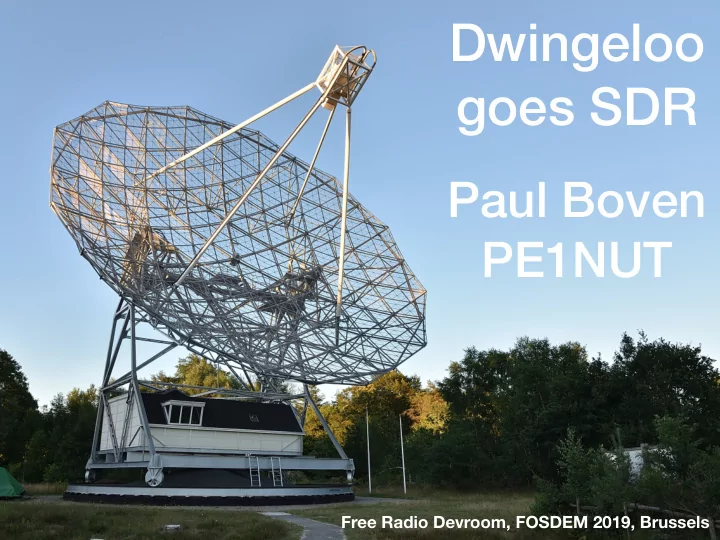
Dwingeloo goes SDR Paul Boven PE1NUT Free Radio Devroom, FOSDEM 2019, Brussels The Dwingeloo Radiotelescope 12. April 1956: Opening by Queen Juliana 25m Diameter Stainless mesh 7.7mm Rails: 12m diameter


slide-1
SLIDE 1

Dwingeloo 
 goes SDR

Paul Boven PE1NUT

Free Radio Devroom, FOSDEM 2019, Brussels
slide-2
SLIDE 2

The Dwingeloo Radiotelescope

  • 12. April 1956:


Opening by Queen Juliana


  • 25m Diameter

  • Stainless mesh 7.7mm

  • Rails: 12m diameter
  • 120 ton
  • Azimuth: 540°
  • Elevation: 0° - 90°
slide-3
SLIDE 3

CAMRAS

  • Foundation: C.A. Muller 


Radioastronomy Station

  • Named after prof. 


Lex Muller (PA0CAM)


  • Founded in 2007
  • Over 300 sponsors
  • About 50 volunteers
  • Radio amateurs, amateur


astronomers, mechanics,
 teachers, ...


slide-4
SLIDE 4

(Some of) Our Volunteers

Telescope restauration completed, reopened in 2014

slide-5
SLIDE 5

CAMRAS

Our three goals:

  • Making the Dwingeloo Radio telescope available to the


communities of amateur astronomers and radio amateurs


  • Stimulating interest in science and technology, in 


particular for youth, by offering access to the
 Dwingeloo Telescope

  • Preserving and maintaining the Dwingeloo Telescope 


as an industrial and scientific monument

  • C. A. Muller Radio Astronomy Station
slide-6
SLIDE 6

Signal Flow

  • Signal gets converted from 1420 MHz to 21.4 MHz
  • Intermediate step of 420 MHz
  • IF Bandwidth: ~25 MHz centered at 21.4 MHz
  • Backend: Sampling at 70 MHz

420 R&S ESMC A D FPGA ETH 140 MHz 1000 MHz PC + Storage 1420 MHz 420 MHz 10 MHz Rb Atomic clock 21.4 MHz

LNA R&S SML03 LO Receiver Backend Clock Backend mercurius Downconverter

slide-7
SLIDE 7

LO

Downconverter Backend Receiver Backend Clock mercurius

Signal Chain (inside the telescope)

Rubidium

slide-8
SLIDE 8

AD9218 65MHz dual 10bit A/D converter

slide-9
SLIDE 9

Xilinx Spartan-3A DSP starter kit

RS232 VGA 1Gb/s 5V FPGA LEDS

slide-10
SLIDE 10

On my Kitchen Table (2008)

slide-11
SLIDE 11

Boxed (2010)

JTAG (Parallel) Fuse Mains Ethernet Inputs Display Clock On/Off

slide-12
SLIDE 12
slide-13
SLIDE 13

Backend FPGA Contents

(line mode)

70 MS/s 10 bit

Squaring Power (per bin) 140 MHz X2 X2 Integrate (Sum)

slide-14
SLIDE 14

Personalities for the Backend

Pulsar mode

  • 512 samples, 256 bins, 64 integrations
  • 137 kHz resolution
  • 2136 spectra per second

Line mode

  • 4096 samples, 2048 bins, 64 integrations
  • 17.1 kHz resolution
  • 267 spectra per second

Raw mode (ADC mode)

  • 70M samples / second, 10 bit
  • Sends 700Mb/s to RAID server
  • 300GB per hour

Rotating line shows that the backend is active

slide-15
SLIDE 15

Pulsars

  • Stellar Core Remnant
  • Result of Supernova Explosion
  • Mass: app 1.4 x Sun
  • Diameter: 20km
  • Extremely Dense
  • Rotating Lighthouse
  • Delay depends on frequency (dispersion)
slide-16
SLIDE 16

B0329+54

  • Brightest Pulsar of the Northern Hemisphere
  • Distance: 3460 lightyears
  • P = 0.71452s
  • We can detect single pulses
  • And make them audible
slide-17
SLIDE 17

Hydrogen (HI)

  • Most abundant element in the universe
  • Concentrated in Galaxies, low density ( 1 / cm^3 )
  • Two spin states with very small energy difference
  • ‘Forbidden’ transition: half-life 11 million years
  • 1.420.405.575 Hz (21cm)
  • Predicted by H. C. van de Hulst
  • Observed Frequency depends on Doppler Shift
slide-18
SLIDE 18

Hydrogen Signal in the Galactic Plane

slide-19
SLIDE 19
  • We can see individual bits - before de-spreading using a simple COSTAS
  • 1500
  • 1000
  • 500

500 1000 1500 20 40 60 80 100 120 140 Zeit (us)

GPS L1 and L2 signals

slide-20
SLIDE 20

GnuRadio Mode

Input: 70MS/s 10 bit

sin cos

Dual port BRAM 512 x 16 350 sin/cos lookup values Generates -21.4 MHz

I Q

FIR LPF FIR LPF

2.5MHz /7 Decimation Inter- leave Ethernet 1Gb/s Output rate: 2x 16x 5MS/s = 160Mb/s Xilinx FIR block 101 coefficients 0 - 2.5 MHz < 0.01dB 5 - 35 MHz > -60dB

FIR LPF FIR LPF

2.5MHz /2 Decimation Xilinx FIR block 353 coefficients 0 - 2.45 MHZ < 0.01dB 2.55 - 5 MHz > -60dB

  • Cascaded FIR filter
  • First Filter: Large transition band
  • Second filter: steep halfband
  • Implemented in FPGA
  • Input: 70Ms/s real samples
  • Output: 5Ms/s complex data
  • GnuRadio compatible:
  • Interleaved 16 bits ints
  • Ethernet UDP Jumbo Frames
  • 160Mb/s traffic
slide-21
SLIDE 21

Weight Overlap Add

  • Sinc window (perhaps multiplied with e.g. hamming)
  • Same behaviour as polyphase, just different implementation
  • More overlaps allows less truncated sinc(x)
  • Better frequency box shape
  • Worse time resolution

Source: https://arxiv.org/pdf/1607.03579.pdf

slide-22
SLIDE 22

Weight Overlap Add (WOLA)

  • sinc_sample_locations: np.arange(-np.pi*4/2.0, np.pi*4/2.0, np.pi/chans)
  • sinc: np.sinc(sinc_sample_locations/np.pi)
  • custom_window: sinc*np.hamming(4*chans)
  • Top to bottom: custom_window[-chans:], [2*chans:3*chans], [chans:2*chans], [0:chans]
  • Based on: http://wvurail.org/dspira/labs/05/
slide-23
SLIDE 23

M74 / NGC 628

ESO/PESSTO/S. Smart

  • 2300s on-source, 2400s off-source (100s integrations)
  • Red-shift: 657km/s (3.1 MHz)
  • Distance: 30 (±6) Million Lightyears
slide-24
SLIDE 24

SETI

  • 2.5 Ms/s IQ data
  • 1 bit quantised
  • Compatible with SETI@HOME 


(Berkely) format and tools

  • CAMRAS is launching a 


SETI project

slide-25
SLIDE 25

DSLWP-B

Flowgraphs for receiving DSLWP-B: https://github.com/bg2bhc/gr-dslwp Images and telemetry: http://lilacsat.hit.edu.cn/dashboard/pages_en/telemetry-b.html

  • A Chinese satellite orbiting the Moon, with an amateur radio payload
  • We often track DSLWP-B and stream the downlinks live
slide-26
SLIDE 26

Astronomy and Resolution

θ ≈ 1.2 λ/D (λ = wavelength, D = diameter)

  • λ = 600nm (visible light)
  • D = 2.4 m
  • θ = 0.06 arcsecond
  • λ = 6cm (5 GHz)
  • D = 25 m
  • θ = 600 arcsecond

Wanted: Dish of 240km ?

slide-27
SLIDE 27

Very Long Baseline Interferometry

slide-28
SLIDE 28

Dwingeloo VLBI

  • Runs on Ettus X310 with dual TwinRX
  • Four of these flowcharts to get 256MHz of spectrum, 1024Mb/s data
slide-29
SLIDE 29

Dwingeloo VLBI fringes (again) !

2018-08-25

  • Using a Rubidium (Todo: White Rabbit link to H-Maser in WSRT)
  • batches of 40s (making RFNoC version for real time use)

Westerbork Synthesis Radio Telescope Dwingeloo Jodrell Bank (UK)

slide-30
SLIDE 30

Keep in Touch

  • Website: http://www.camras.nl/
  • Mail: info@camras.nl
  • Gitlab: http://gitlab.camras.nl/public
  • Including Backend design
  • Twitter:
  • @Radiotelescoop (Dutch, general public)
  • @PI9CAM (English, more technical)
  • Observation data:
  • http://charon.camras.nl/public
  • Pulsars, SETI, DSLWP-B

  • We welcome new members!