Dynamic analysis and preliminary design of twin-cylinder engines for - - PowerPoint PPT Presentation

dynamic analysis and preliminary design of twin cylinder
SMART_READER_LITE
LIVE PREVIEW

Dynamic analysis and preliminary design of twin-cylinder engines for - - PowerPoint PPT Presentation

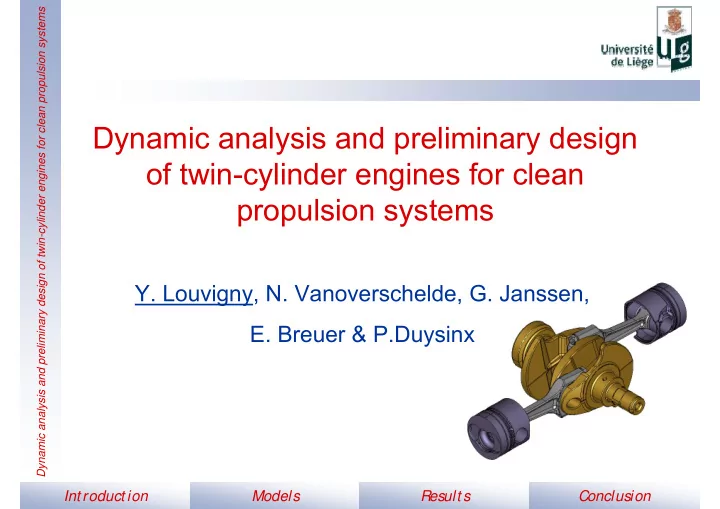
Dynamic analysis and preliminary design of twin-cylinder engines for clean propulsion systems Dynamic analysis and preliminary design of twin-cylinder engines for clean propulsion systems Y. Louvigny, N. Vanoverschelde, G. Janssen, E. Breuer


slide-1
SLIDE 1

Dynamic analysis and preliminary design of twin-cylinder engines for clean propulsion systems

Introduction Models Results Conclusion

Dynamic analysis and preliminary design

  • f twin-cylinder engines for clean

propulsion systems

  • Y. Louvigny, N. Vanoverschelde, G. Janssen,
  • E. Breuer & P.Duysinx
slide-2
SLIDE 2

Dynamic analysis and preliminary design of twin-cylinder engines for clean propulsion systems

Introduction Models Results Conclusion

Introduction

slide-3
SLIDE 3

Dynamic analysis and preliminary design of twin-cylinder engines for clean propulsion systems

Introduction

Models Results Conclusion

Project background

  • Growing industrial interest for small internal combustion

engine (ICE) for urban or hybrid vehicles

  • Support to the prototyping of a twin-cylinder diesel

engine by BTD

  • Research efforts in non-accurate methods for the design
  • f unusual engine configurations

– Preliminary design tools – Calculation based on multibody systems simulation

slide-4
SLIDE 4

Dynamic analysis and preliminary design of twin-cylinder engines for clean propulsion systems

Introduction

Models Results Conclusion

Topics of the study

  • Developing several models of twin-cylinder engine (from

analytical models to flexible multibody simulations)

  • Computing inertia forces and moments in the engine
  • Balancing the engine (counterweight or balance shafts)
  • Comparing different engine configurations
  • Taking care of the gas pressure effect on the

component’s strains and stresses (crankshaft)

slide-5
SLIDE 5

Dynamic analysis and preliminary design of twin-cylinder engines for clean propulsion systems

Introduction Models Results Conclusion

Engines modeling

slide-6
SLIDE 6

Dynamic analysis and preliminary design of twin-cylinder engines for clean propulsion systems

Introduction

Models

Results Conclusion

Boxer In-line Out-of-phase In-phase

Engine configurations

slide-7
SLIDE 7

Dynamic analysis and preliminary design of twin-cylinder engines for clean propulsion systems

Introduction

Models

Results Conclusion

Balancing systems

  • Optimization of the crankshaft counterweights
  • Addition of first or second order balance shafts

Normal balance shaft (inertia forces) Double balance shaft (inertia moments)

slide-8
SLIDE 8

Dynamic analysis and preliminary design of twin-cylinder engines for clean propulsion systems

Introduction

Models

Results Conclusion

Analytical model

  • Calculation of inertia forces produced by pistons motion

...)] 6 cos 4 cos 2 cos (cos cos [

6 4 2 2

+ ⋅ + ⋅ + ⋅ + ⋅ + ⋅ ⋅ ⋅ = θ θ θ θ θ ω A A A m m r F

  • r

x

θ ω sin

2

⋅ ⋅ ⋅ =

r y

m r F

2 2 y x res

F F F + =

2 1

3 2 m m mr ⋅ + =

2 3

3 1 m m mo ⋅ + =

slide-9
SLIDE 9

Dynamic analysis and preliminary design of twin-cylinder engines for clean propulsion systems

Introduction

Models

Results Conclusion

Rigid multibody model

  • Rigid multibody model using finite element approach

(with SamcefField Mecano software)

  • Real engine parts geometry from CAD models
  • Two simulations

– Kinematic simulation with imposed crankshaft rotation speed => position, speed & acceleration (inertia force) – Dynamic simulation with gas pressure effect => total forces acting on each part of the engine

slide-10
SLIDE 10

Dynamic analysis and preliminary design of twin-cylinder engines for clean propulsion systems

Introduction

Models

Results Conclusion

Gas pressure model

  • Gas pressure inside one cylinder (experimental data)

100 200 300 400 500 600 700 20 40 60 80 100 120 140 160 180 200

Gas pressure in one cylinder

Crank angle (°) Gas pressure (bar)

1000 rpm 2000 rpm 3000 rpm 4000 rpm

slide-11
SLIDE 11

Dynamic analysis and preliminary design of twin-cylinder engines for clean propulsion systems

Introduction

Models

Results Conclusion

Flexible multibody models

  • Simulation of flexible model thanks to the finite element

approach

  • Two types of simulation are carried out to determine

crankshaft strains and stresses

– Static simulations of the crankshaft using forces calculated in the rigid multibody simulation (critical load cases) – Dynamic multibody simulation with pistons and connecting rods considered as rigid bodies and crankshaft meshed with flexible finite elements (several models of bearing surface are compared)

slide-12
SLIDE 12

Dynamic analysis and preliminary design of twin-cylinder engines for clean propulsion systems

Introduction Models Results Conclusion

Results and discussion

slide-13
SLIDE 13

Dynamic analysis and preliminary design of twin-cylinder engines for clean propulsion systems

Introduction Models

Results

Conclusion

Analytical model

  • Calculation of inertia forces generated by one cylinder
  • Maximum value ≈ 11000 N => balancing system needed

50 100 150 200 250 300 350

  • 1
  • 0.5

0.5 1 x 10

4

Inertia forces (in the x direction) for one cylinder

Angular crankshaft position (°) Fx (N)

First order force Second order force Four order force Total force

slide-14
SLIDE 14

Dynamic analysis and preliminary design of twin-cylinder engines for clean propulsion systems

Introduction Models

Results

Conclusion

Reference level of force Reference level

  • f moments

Engines comparison

  • Forces and moments depending of the ICE configuration
  • They can be highly reduced by appropriate balancing

systems at the price of a higher complexity (compromise)

  • fobs: first order balance

shaft(s) (rotating at the crankshaft speed)

  • sobs: second order

balance shaft(s) (rotating at twice the crankshaft speed)

slide-15
SLIDE 15

Dynamic analysis and preliminary design of twin-cylinder engines for clean propulsion systems

Introduction Models

Results

Conclusion

Rigid multibody model

  • Kinematic simulation with imposed crankshaft speed

(varies from 0 to 4000 rpm in 0,015 s then constant)

  • 50

50 100 150 200 250 0,01 0,02 0,03 0,04 0,05 0,06 0,07 Time (s) Speed (m/s) & Position (mm)

  • 12000
  • 10000
  • 8000
  • 6000
  • 4000
  • 2000

2000 4000 6000 8000 Acceleration (m/s²) Speed (m/s) Position (mm) Acceleration (m/s²)

slide-16
SLIDE 16

Dynamic analysis and preliminary design of twin-cylinder engines for clean propulsion systems

Introduction Models

Results

Conclusion

Rigid multibody model

  • Dynamic simulation taking into account the gas pressure

force

  • Radial (red) and tangential (blue) forces on one crankpin
slide-17
SLIDE 17

Dynamic analysis and preliminary design of twin-cylinder engines for clean propulsion systems

Introduction Models

Results

Conclusion

Rigid multibody model

  • Load cases for the

strain and stress analysis

– “Maximal tangential force” load case – “Top dead center” load case – “Maximal radial force” load case

slide-18
SLIDE 18

Dynamic analysis and preliminary design of twin-cylinder engines for clean propulsion systems

Introduction Models

Results

Conclusion

Flexible multibody model

  • Static simulations are performed to evaluate crankshaft

maximal strains and stresses

– Critical load cases are deduced from the rigid simulation – Crankshaft is meshed with 4 mm second order tetrahedral elements – Forces and boundary conditions are applied on the crankshaft by means of flexible rings added on the bearing surfaces to avoid

  • verstress problems
slide-19
SLIDE 19

Dynamic analysis and preliminary design of twin-cylinder engines for clean propulsion systems

Introduction Models

Results

Conclusion

Flexible multibody model

– Crankshaft stresses for the “maximal radial force” load case

slide-20
SLIDE 20

Dynamic analysis and preliminary design of twin-cylinder engines for clean propulsion systems

Introduction Models

Results

Conclusion

Flexible multibody model

– Crankshaft displacements for the “maximal radial force” load case

slide-21
SLIDE 21

Dynamic analysis and preliminary design of twin-cylinder engines for clean propulsion systems

Introduction Models

Results

Conclusion

Flexible multibody model

  • Dynamic simulation of the engine

– Crankshaft strains and stresses are calculated for the complete cycle – Different models of bearing surfaces are simulated – Crankshaft is meshed with 8 mm first order tetrahedral elements – Results are first given for the top dead center position of the piston (“top dead center” load case) and then some results are given for the most critical load case

slide-22
SLIDE 22

Dynamic analysis and preliminary design of twin-cylinder engines for clean propulsion systems

Introduction Models

Results

Conclusion

Flexible multibody model

– “Rigid hinge” bearing model

slide-23
SLIDE 23

Dynamic analysis and preliminary design of twin-cylinder engines for clean propulsion systems

Introduction Models

Results

Conclusion

Flexible multibody model

– “Flexible-rigid contact” bearing model with a clearance of 50 µm

slide-24
SLIDE 24

Dynamic analysis and preliminary design of twin-cylinder engines for clean propulsion systems

Introduction Models

Results

Conclusion

Flexible multibody model

– “Radial bushing” bearing model (stiffness equal to 2*106 N/m)

slide-25
SLIDE 25

Dynamic analysis and preliminary design of twin-cylinder engines for clean propulsion systems

Introduction Models

Results

Conclusion

Flexible multibody model

– “Hydrodynamic bearing” model (viscosity equal to 0,01 Pa*s)

slide-26
SLIDE 26

Dynamic analysis and preliminary design of twin-cylinder engines for clean propulsion systems

Introduction Models

Results

Conclusion

Flexible multibody model

  • “Maximal tangential force” load case (critical)

– “Hydrodynamic bearing” model (viscosity equal to 0,01 Pa*s)

slide-27
SLIDE 27

Dynamic analysis and preliminary design of twin-cylinder engines for clean propulsion systems

Introduction Models Results Conclusion

Conclusion

slide-28
SLIDE 28

Dynamic analysis and preliminary design of twin-cylinder engines for clean propulsion systems

Introduction Models Results

Conclusion

Conclusion

  • Each configuration of engine has its own characteristics

in term of inertia forces and moments, which can be reduced by addition of counterweights or balance shafts

Yes No No Yes Boxer, out-of-phase Yes Yes No No Boxer, in-phase No Yes Yes No In-line, out-of-phase No No Yes Yes In-line, in-phase High order moments First order moments High order forces First order forces

slide-29
SLIDE 29

Dynamic analysis and preliminary design of twin-cylinder engines for clean propulsion systems

Introduction Models Results

Conclusion

Conclusion

  • Multibody simulations offer interesting prospects for

engine design:

– Calculations of inertia forces and moments (rigid body simulation) – Fast (a few minutes) evaluation of crankshaft maximal strains and stresses thanks to static simulations – Flexible body dynamic simulation allows making more precise strain and stress analysis for all crankshaft positions

  • Main difficulty is to make correct bearing surfaces models
slide-30
SLIDE 30

Dynamic analysis and preliminary design of twin-cylinder engines for clean propulsion systems

Introduction Models Results

Conclusion

Perspectives

  • Creating multibody models of other twin-cylinder engine

configurations

  • Comparison of engines based on crankshaft strains and

stresses

  • Stress analysis of other engine parts (pistons and

connecting rods)

slide-31
SLIDE 31

Dynamic analysis and preliminary design of twin-cylinder engines for clean propulsion systems

Introduction Models Results Conclusion

Thank you for your attention