Dynamic model of vegetation pattern in Nothern Euro-Asia based on - - PowerPoint PPT Presentation

dynamic model of vegetation pattern in nothern euro asia
SMART_READER_LITE
LIVE PREVIEW

Dynamic model of vegetation pattern in Nothern Euro-Asia based on - - PowerPoint PPT Presentation

Dynamic model of vegetation pattern in Nothern Euro-Asia based on probabilistic plant types interaction scheme Nikolay N.Zavalishin Laboratory of mathematical ecology, A.M.Obukhov Institute of atmospheric physics RAS, 3, Pyzhevsky Lane, Moscow,


slide-1
SLIDE 1

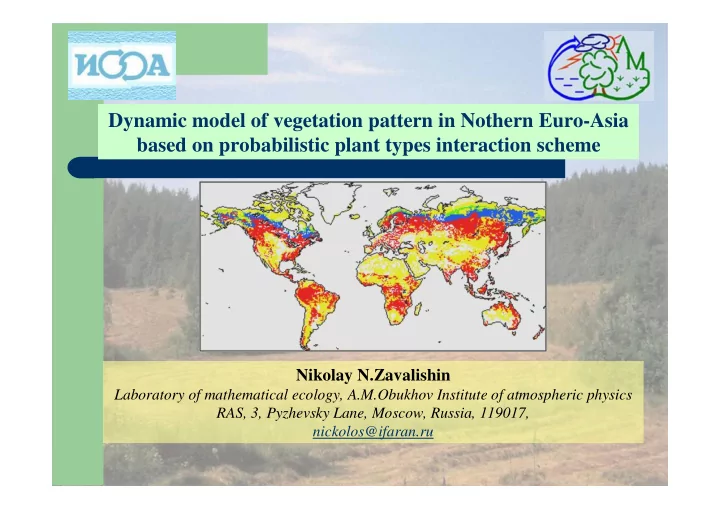
Dynamic model of vegetation pattern in Nothern Euro-Asia based on probabilistic plant types interaction scheme

Nikolay N.Zavalishin

Laboratory of mathematical ecology, A.M.Obukhov Institute of atmospheric physics RAS, 3, Pyzhevsky Lane, Moscow, Russia, 119017, nickolos@ifaran.ru

slide-2
SLIDE 2

Global Vegetation Pattern is a mosaic of terrestrial plant functional types varying under the Climate Change and anthropogenic perturbations

Bioclimatic schemes

Climatic parameters best define the distribution of plant communities around the Earth surface initiating Static Global Vegetation Models

(Holdridge, 1947; Prentice, 1990)

Global cycles functioning models

Methods based on the dependence of physiological growth processes on climate and carbon cycle functioning

(Foley et al., 1996; Hybrid v.3.0 – Friend et al., 1997; LPJ: Sitch et al., 2003)

Mathematical ecology approach

Dynamic equations for fractions of competing vegetation types with coefficients induced by climatic variables, soil properties, carbon, nitrogen and water cycles etc.

(Svirezhev, Ecological Modelling, v.124, 1999)

Two spatial scales are introduced at the terrestrial point (x, y) : micro-unit as the small area occupied by the only vegetation type, macro-unit as a set of micro-units.

slide-3
SLIDE 3

), ( ) ( ) 1 ( 2 + ) ( ) 1 ( ), ( ) ( 2 ) ( ) 1 (

2 2

t q t p t q t q t q t p t p t p π π − = + + = +

pq q pq p ) 1 2 ( , ) 1 2 ( − − = ∆ − = ∆ π π 2 / 1 if 1 ) ( 2 / 1 if ) ( > → < → π π t p t p

Simplest probabilistic scheme with two vegetation types in a spatial “macro-unit” – the primitive case

Forest fraction: grass fraction: N t y x N t y x p

f

/ ) , , ( ) , , ( = N t y x N t y x q

g

/ ) , , ( ) , , ( = Let Nf(x,y,t) – the number of forest “micro-units” at point (x, y) at time t, Ng(x,y,t) – the number of grass “micro-units”, N = Nf + Ng – the total number of micro-units. f – forest particle, g – grass particle π – probability of forest particle to win the grass one

slide-4
SLIDE 4

Simplest probabilistic scheme with two vegetation types with primitive forest age structure

Discrete-time dynamic system : f – forest micro-unit, g – grass micro-unit π – probability of forest to win grass, s – probability for forest to survive, 1- s – forest mortality Equilibrium points:

) 1 2 ( 1 2 and

2 1

− − = =

∗ ∗

π π s s p p

[ ] [ ]

p t s p t p t q t q t q t p t q t s p t p t q t ( ) ( ) ( ) ( ) , ( ) ( ) ( ) ( ) ( ) ( ) ( ) ( ) ( ) + = + + = − + − + 1 2 1 2 1 1 2

2 2 2

π π π +

Stability conditions: 1 2 and 1 s if , 1

2

> ≤ ≤ <

s p π

slide-5
SLIDE 5

Probabilistic scheme of three vegetation type interactions with simple forest age structure

[ ] [ ] [ ]

) 1 )( 1 ( ) 1 ( ) ( ) ( 2 ) 1 )( 1 ( ) 1 ( ) ( ) ( 2 ) ( ) 1 ( ) ( ) 1 ( ) ( ) 1 ( ), ( ) ( 2 ) ( ) ( ) 1 ( 2 ) ( ) ( ) 1 ( 2 + ) ( ) 1 ( , ) ( 2 ) ( 2 ) ( ) ( ) 1 (

2 2 2 2

ω µ µ ω σ σ ω ω ω µ ω σ ω µ σ − − + − + − − + − + − + − + = + + − + − = + + + = + s t r t p s t q t p t q t p s t r t r t q t r t r t p t q t p t q t q t r t q t p t sp t p

Discrete-time dynamic system:

N t y x N t y x p

f

/ ) , , ( ) , , ( =

N t y x N t y x q

g

/ ) , , ( ) , , ( = N t y x N t y x r

d

/ ) , , ( ) , , ( =

  • desert fraction

q 2 p 2 2 r p 2 q r β γ μ ω r 2

t t+ 1

s 1 -s 1 -s s s 1 -s 1 -s s 1 -s s s 1 -s 1 -s s u v δ 1 -s s η w v 1 -v 1 -v v

T im e

te rre s tria l m a c ro -u n it 2 q p f d f g f f f f g g f f d d d d f d f f d f g d f d f d f g g d d g f d f d f g d d g d g g

Let Nf (x,y,t) – the number of forest micro-units at point (x, y) at time t, Ng (x,y,t) – the number of grass micro-units, Nd (x,y,t) – the number of desert micro-units, N = Nf + Ng+Nd – the total number of micro-units. Forest fraction:

  • grass fraction:

Factors and probabilities of vegetation types interaction:

  • competition forest – grass (β, γ, δ );
  • interaction forest – desert (μ, η, ω );
  • interaction grass – desert (u, w, v );
  • natural mortality of forest (m=1 – s ).

f – forest micro-unit, g – grass micro-unit, d – desert micro-unit

slide-6
SLIDE 6

Probabilistic scheme of vegetation type interactions with complex forest age structure

fi – forest of age i, i=1,…,n

q 2 p i p j 2rp i 2qr σ ij σ ji α ij β i γi δ i μ i ω i η i 1 1 1 1 r 2 s i 1-si 1 s i 1-s i 1 1 1 1 s i 1-si s i 1-si 1 s i 1-s i 1 s i 1-s i 1-sj s j s j 1-sj 1 1 1

t t+1

u 1-u 1-u u terrestrial macro-unit 2qp i g d g g fi d fi g fi fj fi f0 fi fj fj f0 fi f0 fi g g g fi f0 fi d d d d d d d d d d f1 fi+1 f1 fi+1 g g g f1 fi+1 fi+1 f1 fi+1 f1 fi+1 f1 fj+1 f1 g g g d g

Factors and probabilities of vegetation interaction:

  • competition in n forest age groups (σij,

αij )

  • competition forest of group i – grass (βi,

γi, δi );

  • interaction forest of group i – desert (μi,

ηi, ωi );

  • interaction grass – desert (u, w, v );
  • natural mortality of forest (mi = 1 – si ).
slide-7
SLIDE 7

Dynamic model of vegetation pattern with continuous forest age structure and continuous time

)] ) ) , ( ) , ( ) ( ) ( ) ( ) ( ))( ( 1 ( ) ( )[ , (

+∞

+ + − + − = ξ ξ τ ξ σ τ ω τ γ τ τ τ d t p t r t q m m t p

] ) , ( )) ( ) ( ( ) )( ( )[ (

+∞

− + − = τ τ τ β τ γ d t p v u t r t q

Renewal equation for p (τ=0):

τ τ τ ∂ ∂ + ∂ ∂ ) , ( ) , ( t p t t p dt t dq ) , ( τ dt t dr ) , ( τ

] ) , ( )) ( ) ( ( ) )( ( )[ (

+∞

− + − = τ τ τ µ τ ω d t p u v t q t r

( )

+∞

+ − + + − − =

2

)) ( 1 )( ( ) ( ) , ( ) ( ) 1 ( ) , ( τ τ γ τ τ β τ d m t p t q r q t p

( ) ( )

τ ξ τ ξ σ ξ τ τ τ τ ω τ τ µ τ d d t p t p m d m t p t r ) , ( 1 ) , ( ) , ( )) ( 1 ( )) ( 1 )( ( ) ( ) , ( ) ( − − + − +

∫ ∫ ∫

+∞ +∞ +∞

Dynamic system for vegetation types with a continuous forest age τ:

pi(t) → p( t,τ ): τm = τm(T,P) - average maturity age of trees τl = τl(T,P) - a life span (maximal age) of trees

2 1 2 1

) , ( ) ( ) , ( ) ( p p p d t p t p d t p t p

m m

+ = = =

∫ ∫

∞ τ τ

τ τ τ τ New model variables - fractions of young and mature trees and total forest fraction:

slide-8
SLIDE 8

Simplification of a continuous-time model for two-age classes forest

Simplifying hypothesis on competition coefficients - they are constants for each of two forest age-groups:

m m m

m m

( ) , , τ τ τ τ τ = ≤ >   

1 if

, if

2

β τ β τ τ β τ τ ( ) , , . = ≤ >   

1 2

if ,if

m m

γ τ γ τ τ γ τ τ ( ) , , . = ≤ >   

1 2

if ,if

m m

     Ω ∈ Ω ∈ Ω ∈ Ω ∈ = , , if , , , if , , , if , , , if , ) , (

4 22 3 21 2 12 1 11

τ ξ σ τ ξ σ τ ξ σ τ ξ σ τ ξ σ

   +∞ < ≤ < ≤ = τ τ µ τ τ µ τ µ

m m

if , if , ) (

2 1

   +∞ < ≤ < ≤ = τ τ ω τ τ ω τ ω

m m

if , if , ) (

2 1

m m

p t p τ τ

1

) , ( =

12 2 2 1

= = = = σ µ γ β

Ω Ω Ω Ω

Final Vegetation Pattern model for a one spatial macro-unit

) ( ) (

2 2 2 22 2 2 2

q p a p a p a A p dt dp

m

+ + − + − = ω σ ω τ

) ( ) )( 1 (

2 1 1 2 2 1

p p k q p p k q p dt dp − + − − − = γ ω

[ ]

) ) 1 )( 1 (

2 1 3 3 1

p k p k k q q dt dq − + − − =γ

m l m

A τ τ τ − + = 1 1

m l

a τ τ − − = 1 1

1 2 1

1 γ β + = k

1 2 2

1 ω µ + = k

1 3

1 γ v u k − − =

slide-9
SLIDE 9

Steady states, stability and calibration of the simplified model

. 255.4 ) ( , 431.5 ) ( 51 . 144 78 . 69 73 . 4 ) ( , 3 . 1235 ) (

05 . 05 . 2 05 . T GH T EF CD T AB

e T P e T P T T T P e T P = = + − − = =

Exponent-polynomial form of boundaries between biomes on the Lieth diagram:

) ( ; ) ( 178 ) (

85 .

T k T T T

m l cr m

τ τ τ

τ

= − =

(T)P b (T) b (T,P) k 1

1

+ =

The model has steady states corresponding to pure desert, grass, forest, forest- desert, forest-grass, and fully mixed vegetation in the macro-unit. Stability boundaries in the {k1, k2, k3} space acquire the particular form with linking competition coefficients to the climatic parameters – average temperature and annual precipitation.

(T)P c (T) c (T,P) k 1

2

+ =

Approximation of mean forest ages:

kτ=const for coniferous and deciduous trees

slide-10
SLIDE 10

Numerical simulation of the Vegetation Pattern in Nothern Euro-Asia under the Climate Change

Any explicit climate scenario as a sequence of temperature – precipitation values, generates dynamics of the vegetation cover as a spatial mosaic with initial distribution calculated for the modern climate in Northern Euro-Asia. Using scenarios generated by some climatic models and based on A2 and B1 carbon emission scenarios by IPCC, we estimate the vegetation dynamics for Northern Euro-Asia over 120-year time interval and pay attention to the evolution of regions with transient dynamics. Initial state of vegetation cover in 1980s ( a - forest fraction, b - grass fraction)

a b

slide-11
SLIDE 11

Numerical simulation of the Vegetation Pattern in Nothern Euro-Asia under the Climate Change

a

Final state of vegetation pattern in 2100 under scenario SRES B1 ( a - forest fraction, b - grass fraction )

b a

Final state of vegetation pattern in 2100 under scenario SRES A2 ( a - forest fraction, b - grass fraction)

b

slide-12
SLIDE 12

Conclusions

1) The vegetation pattern model satisfactorily reproduces the initial state of vegetation cover in terms of a forest function (Brovkin et al., Ecological Modelling, 1997); 2) Steady states of the model have clear biogeographic interpretation, and their stability conditions can be connected with current biome boundaries in the climatic parameter space

  • f temperature-precipitation;

3) Under both climate change scenarios A2 and B1 areas occupied by transition zones - mixed steady states - increase. SRES A2 scenario initiates stronger changes in vegetation pattern than B1, especially in Russian Western Siberia and Far East.

Thank you for attention !