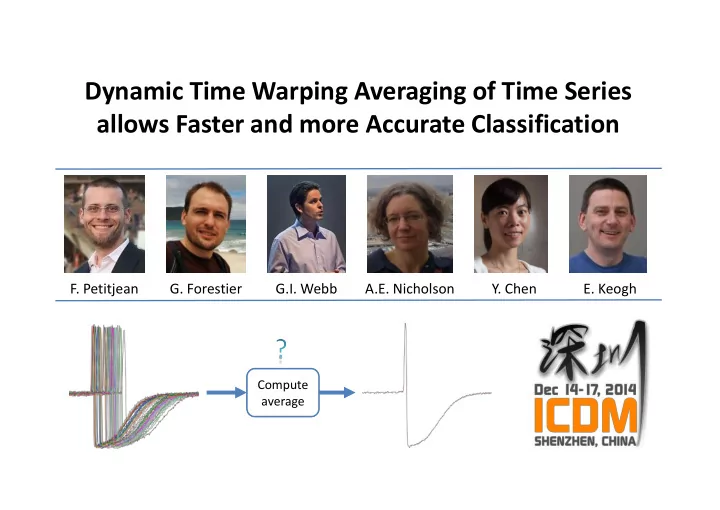
Dynamic Time Warping Averaging of Time Series allows Faster and more Accurate Classification
- F. Petitjean
- G. Forestier
G.I. Webb A.E. Nicholson
- Y. Chen
- E. Keogh
Compute average
Dynamic Time Warping Averaging of Time Series allows Faster and more - - PowerPoint PPT Presentation
Dynamic Time Warping Averaging of Time Series allows Faster and more Accurate Classification F. Petitjean G. Forestier G.I. Webb A.E. Nicholson Y. Chen E. Keogh Compute average The Ubiquity of Time Series Sensors on machines Stock prices Wearables
G.I. Webb A.E. Nicholson
Compute average
Astronomy: star light curves
20 40 60 80 100 120
Sensors on machines Stock prices Web clicks
Unstructured audio stream
Wearables
2
[a] A. Bagnall and J. Lines, “An experimental evaluation of nearest neighbour time series classification. technical report #CMPC1401,” Department of Computing Sciences, University of East Anglia, Tech. Rep., 2014. [b] X. Xi, E. Keogh, C. Shelton, L. Wei, and C. A. Ratanamahatana, “Fast time series classification using numerosity reduction,” in Int. Conf. on Machine Learning, 2006, pp. 1033–1040. [c] X. Wang, A. Mueen, H. Ding, G.Trajcevski, P. Scheuermann, E. Keogh: Experimental comparison of representation methods and distance measures for time series data. Data Min. Knowl. Discov. 26(2): 275309 (2013) 3
Dynamic Time Warping
Texas Horned Lizard
Phrynosoma cornutum
Flattailed Horned Lizard
Phrynosoma mcallii
Without time warping, insignificant differences in time axis appear as very significant differences in the Yaxis
4
Laser line source
Phototransistor Array
3000
5
6000 16kHz
Culex stigmatosoma
Male Female
3000
Musca domestica
(unsexed)
amplitude spectrum
6
100 101 102 103 104 0.1 0.2 Nearest Neighbor Algorithm Nearest Centroid Algorithm
Error-Rate
0.1 0.2 0.3 0.4 0.5 0.6 0.7 0.8 0.9 1 0.1 0.2 0.3 0.4 0.5 0.6 0.7 0.8 0.9 1 Test Data7
Condesed_Oil=Reduce(Oil-13,1) Oil-13 Condesed_Oil
8
𝑝 𝑝∈𝑃
The mean of a set minimizes the sum of the squared distances.
9
𝑝 𝑝∈𝑃
Optimization problem
The arithmetic mean solves the problem exactly 𝑝 = 1 𝑂
𝑝∈𝑃
𝑝
The arithmetic mean does not solve the problem
10
[a] L. Gupta, D. L. Molfese, R. Tammana, and P. G. Simos, “Nonlinear alignment and averaging for estimating the evoked potential,” IEEE Transactions on Biomedical Engineering, vol. 43, no. 4, pp. 348–356, 1996. [b] V. Niennattrakul and C. A. Ratanamahatana, “On Clustering Multimedia Time Series Data Using KMeans and Dynamic Time Warping,” IEEE International Conference on Multimedia and Ubiquitous Engineering, pp.733738, 2007. [c] S. Ongwattanakul and D. Srisai, “Contrast enhanced dynamic time warping distance for time series shape averaging classification,” in Int.
[d] V. Niennattrakul and C. A. Ratanamahatana, “Shape averaging under time warping,” in Int. Conf. on Electrical Engineering/Electronics, Computer, Telecommunications and Information Technology, IEEE, vol. 2, 2009, pp. 626–629.
11
[a] F. Petitjean and P. Gançarski, “Summarizing a set of time series by averaging: From Steiner sequence to compact multiple alignment,” Theoretical Computer Science, 2012. [b] V. Niennattrakul and C. A. Ratanamahatana, “Inaccuracies of Shape Averaging Method Using Dynamic Time Warping for Time Series Data,” International Conference on Computational Science, 2007.
12
⇒ consensus sequence computable “column by column”
13
14
[a] F. Petitjean, A. Ketterlin and P. Gançarski, “A global averaging method for dynamic time warping, with applications to clustering,” Pattern Recognition, vol. 44, no. 3, pp. 678–693, 2011.
#particles in the
15
[a] F. Petitjean, A. Ketterlin and P. Gançarski, “A global averaging method for dynamic time warping, with applications to clustering,” Pattern Recognition, vol. 44, no. 3, pp. 678–693, 2011.
16
[a] F. Petitjean, A. Ketterlin and P. Gançarski, “A global averaging method for dynamic time warping, with applications to clustering,” Pattern Recognition, vol. 44, no. 3, pp. 678–693, 2011.
𝑝 𝑝∈𝑃
Optimization problem
17
Condesed_Oil=Reduce(Oil-13,1) Oil-13 Condesed_Oil
18
20 40 60 80 100 0.1 0.2 0.3
Error-Rate Items per class in reduced training set
Laser line source
Phototransistor Array
19
20 40 60 80 100 0.1 0.2 0.3 random
Error-Rate The full dataset error-rate is 0.14, with 100 pairs of objects Items per class in reduced training set
Laser line source
Phototransistor Array
20
20 40 60 80 100 0.1 0.2 0.3 random Drop2 KMEDOIDS Drop3 Drop1 SR
Error-Rate The full dataset error-rate is 0.14, with 100 pairs of objects Items per class in reduced training set
Laser line source
Phototransistor Array
21
20 40 60 80 100 0.1 0.2 0.3 Kmeans AHC random Drop2 KMEDOIDS Drop3 Drop1 SR
Error-Rate The full dataset error-rate is 0.14, with 100 pairs of objects Items per class in reduced training set
Laser line source
Phototransistor Array
22
20 40 60 80 100 0.1 0.2 0.3 Kmeans AHC random Drop2 KMEDOIDS Drop3 Drop1 SR
Error-Rate The minimum error-rate is 0.092, with 19 pairs of objects The full dataset error-rate is 0.14, with 100 pairs of objects Items per class in reduced training set
Laser line source
Phototransistor Array
23
24
25
26
http://www.francois-petitjean.com/Research/ICDM2014-DTW
27
http://www.francois-petitjean.com/Research/ICDM2014-DTW
given a maximum number of prototypes to use.
accuracy to reach.
[a] J. Demšar, “Statistical comparisons of classifiers over multiple data sets,” The Journal of Machine Learning Research, vol. 7, pp. 1–30, 2006. 28
1. Faster 2. More accurate
1. We tested our approach on 40+ datasets from the UCR archive 2. We computed the statistical significance of the results 3. The source code is online
Web: http://www.francois-petitjean.com/Research/ICDM2014-DTW Email: francois.petitjean@monash.edu Twitter: @LeDataMiner
Compute average
29
Support and funding
G.I. Webb A.E. Nicholson