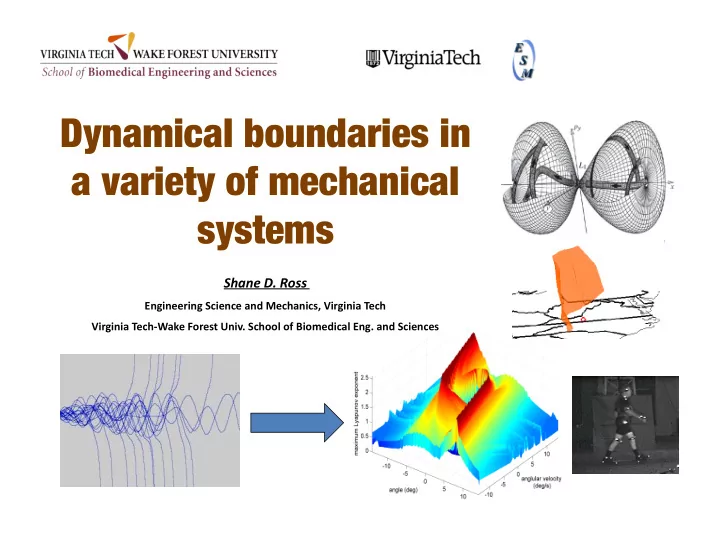
Dynamical boundaries in a variety of mechanical systems ShaneD.Ross - - PowerPoint PPT Presentation

dynamical boundaries in a variety of mechanical systems
SMART_READER_LITE
LIVE PREVIEW

Dynamical boundaries in a variety of mechanical systems ShaneD.Ross - - PowerPoint PPT Presentation

Dynamical boundaries in a variety of mechanical systems ShaneD.Ross EngineeringScienceandMechanics,VirginiaTech VirginiaTechWakeForestUniv.SchoolofBiomedicalEng.andSciences


slide-1
SLIDE 1

Dynamical boundaries in a variety of mechanical systems

Shane
D.
Ross


Engineering
Science
and
Mechanics,
Virginia
Tech

 Virginia
Tech‐Wake
Forest
Univ.
School
of
Biomedical
Eng.
and
Sciences

slide-2
SLIDE 2

Separatrices:
dynamical
boundaries


Coastal
flow


 Transport
barriers
in
state
space

 separating
qualitatively
different
kinds
of
behavior


slide-3
SLIDE 3

Separatrices:
dynamical
boundaries


Coastal
flow


 Transport
barriers
in
state
space

 separating
qualitatively
different
kinds
of
behavior


Region
A
 Region
B


slide-4
SLIDE 4

Separatrices:
high
dimensions


Coastal
flow


System
with
many
basins,
not
necessarily
 attracting
sets
or
attractors
 Potential
surface
with
several
minima
 (“bowls”)
separated
by
ridges

 Basins
are
“almost‐invariant
structures”
 System
known
analytically:
vector
field
or
map


slide-5
SLIDE 5

Separatrices:
high
dimensions


Coastal
flow


Small
body
in
solar
system:
Transport
from


  • ne
basin
to
another
controlled
by
high


dimensional
separatrix
surfaces
 Geometrically
tubes
in
this
case
 Tubes
are
attached
to
practically
 unobservable
periodic
orbits
or
other
bound


  • rbits

slide-6
SLIDE 6

Realms and tubes

Planetary and sun realms connected by tubes1

L1 Sun

y x py Sun Realm Planetary Realm

L1

Position Space Phase Space (Position + Velocity)

1Conley & McGehee, 1960s, found these locally, speculated use for “low energy transfers” 6

slide-7
SLIDE 7

Transport between realms

Asymptotic orbits form 4D invariant manifold tubes (S3 × R), separatrices in 5D energy surface2

2Ross [2006] The interplanetary transport network, American Scientist 7

slide-8
SLIDE 8

Transport between realms

Moon

L2 Ballistic Capture Into Elliptical Orbit

Earth Moon

P

Incoming Tube Outgoing Tube

Tubes in phase space

  • Objects mediating transport through bottlenecks

8

slide-9
SLIDE 9

Tube dynamics

y x py Earth Realm Moon Realm

L1

Tube dynamics: All motion between realms connected by bottlenecks must occur through the interior of tubes

9

slide-10
SLIDE 10

Multi-scale dynamics

Slices of energy surface: Poincar´ e sections Ui Tube dynamics: evolution between Ui What about evolution on on Ui?

Poincare Section L1 Earth Poincare Section U2 U1

f1 f2 f12 f2 f1 z0 z1 z2 z3 z4 z5 U2 U1 Exit Entrance

10

slide-11
SLIDE 11

Some remarks on tube dynamics

Tubes are general; consequence of rank 1 saddle – saddle × center × · · · × center – e.g., ubiquitous in chemistry Tubes persist – in presence of additional massive body – when primary bodies’ orbit is eccentric

11

slide-12
SLIDE 12

Tubes in elliptic restricted 3-body problem

Poincare Section L1 Earth Poincare Section U2 U1

x

x

Trajectories about to be captured

Consider first cut of stable manifold of L1 NHIM

12

slide-13
SLIDE 13

Tubes in elliptic restricted 3-body problem

Gawlik, Marsden, Du Toit, Campagnola [2008] “Lagrangian coherent structures in the planar elliptic re- stricted three-body problem,” submitted to Celestial Mechanics and Dynamical Astronomy.

13

slide-14
SLIDE 14

Tubes in elliptic restricted 3-body problem

Gawlik, Marsden, Du Toit, Campagnola [2008] “Lagrangian coherent structures in the planar elliptic re- stricted three-body problem,” submitted to Celestial Mechanics and Dynamical Astronomy.

14

slide-15
SLIDE 15

Some remarks on tube dynamics

Tubes are general; consequence of rank 1 saddle – saddle × center × · · · × center – e.g., ubiquitous in chemistry Tubes persist – in presence of additional massive body – when primary bodies’ orbit is eccentric Observed in the solar system (e.g., Oterma) Even on galactic and atomic scales!

Koon, Lo, Marsden, & Ross [2000], G´

  • mez, Koon, Lo, Marsden, Masdemont, & Ross [2004], Yamato

& Spencer [2003], Wilczak & Zgliczy´ nski [2005], Ross & Marsden [2006], Gawlik, Marsden, Du Toit, Campagnola [2008], Combes, Leon, Meylan [1999], Heggie [2000], Romero-G´

  • mez, et al. [2006,2007,2008]

15

slide-16
SLIDE 16

Multi-scale dynamics

Slices of energy surface: Poincar´ e sections Ui Tube dynamics: evolution between Ui − → What about evolution on on Ui? ← −

Poincare Section L1 Earth Poincare Section U2 U1

f1 f2 f12 f2 f1 z0 z1 z2 z3 z4 z5 U2 U1 Exit Entrance

16

slide-17
SLIDE 17

Infinity to capture about small companion in binary pair?

After consecutive gravity assists, large orbit changes

17

slide-18
SLIDE 18

Kicks at periapsis Key idea: model particle motion as “kicks” at periapsis

m1

Δa− Δa+ Δa− Δa+

Semimajor Axis vs. Time

m2

In rotating frame where m1, m2 are fixed

18

slide-19
SLIDE 19

Kicks at periapsis Sensitive dependence on argument of periapse ω

m1

Δa− Δa+ Δa− Δa+

Semimajor Axis vs. Time

m2

In rotating frame where m1, m2 are fixed

19

slide-20
SLIDE 20

Kicks at periapsis Construct update map (ω1, a1, e1) → (ω2, a2, e2) using average perturbation per orbit by smaller mass

(ω1,a1,e1)

20

slide-21
SLIDE 21

Kicks at periapsis Construct update map (ω1, a1, e1) → (ω2, a2, e2) using average perturbation per orbit by smaller mass

(ω1,a1,e1) (ω2,a2,e2)

21

slide-22
SLIDE 22

Not hyperbolic swing-by Occur outside sphere of influence (Hill radius) – not the close, hyperbolic swing-bys of Voyager

22

slide-23
SLIDE 23

Capture by secondary Dynamically connected to capture thru tubes

23

slide-24
SLIDE 24

Capture by secondary Particle assumed on near-Keplerian orbit around m1 In the frame co-rotating with m2 and m1, Hrot(l, ω, L, G) = K(L) + µR(l, ω, L, G) − G, in Delaunay variables Evolution is Hamitlon’s equations: d dt(l, ω, L, G) = f(l, ω, L, G) Jacobi constant, CJ = −2Hrot conserved along trajectories

24

slide-25
SLIDE 25

Change in orbital elements over one particle orbit Evolution of G (angular momentum) dG dt = −µ∂R ∂ω, Picard’s approximation:

∆G = −µ T/2

−T/2

∂R ∂ω dt = − µ G π

−π

r r2 3 sin(ω + ν − t(ν)) dν

  • − sin ω
  • 2

π cos(ν − t(ν)) dν

  • ∆K = Keplerian energy change over an orbit

∆K = ∆G − µ∆R

25

slide-26
SLIDE 26

Energy kick function Changes have form ∆K = µf(ω), f is the energy kick function with parameters K, CJ

−1 −0.8 −0.6 −0.4 −0.2 0.2 0.4 0.6 0.8 1 −20 −10 10 20

f ω/π

26

slide-27
SLIDE 27

Maximum changes on either side of perturber

m1

Δa− Δa+ Δa− Δa+

Semimajor Axis vs. Time

m2

ω max − ω m

ax

−1 −0.8 −0.6 −0.4 −0.2 0.2 0.4 0.6 0.8 1 −20 −10 10 20

f ω/π

27

slide-28
SLIDE 28

The periapsis kick map (Keplerian Map) Cumulative effect of consecutive passes by perturber Can construct an update map (ωn+1, Kn+1) = F(ωn, Kn) on the cylinder Σ = S1×R, i.e., F : Σ → Σ where ωn+1 Kn+1

  • =
  • ωn − 2π(−2(Kn + µf(ωn)))−3/2

Kn + µf(ωn)

  • Area-preserving (symplectic twist) map

Example: particle in Jupiter-Callisto system µ = 5 × 10⁻⁵

28

slide-29
SLIDE 29

Verification of Keplerian map: phase portrait

Keplerian map

29

slide-30
SLIDE 30

Verification of Keplerian map: phase portrait

Keplerian map numerical integration of ODEs

  • Keplerian map = fast orbit propagator
  • preserves phase space features

— but breaks left-right symmetry present in original system — can be removed using another method (Hamilton-Jacobi)

30

slide-31
SLIDE 31

Dynamics of Keplerian map

  • 1
  • 0.8
  • 0.6
  • 0.4
  • 0.2

0.2 0.4 0.6 0.8 1 1.5 1.6 1.7 1.8

a ω/π

.

Resonance zone3

Structured motion around resonance zones

3in the terminology of MacKay, Meiss, and Percival [1987] 31

slide-32
SLIDE 32

Dynamics of Keplerian map

  • 1
  • 0.8
  • 0.6
  • 0.4
  • 0.2

0.2 0.4 0.6 0.8 1 1.5 1.6 1.7 1.8

a ω/π

.

Resonance zone4

Structured motion around resonance zones

4in the terminology of MacKay, Meiss, and Percival [1987] 32

slide-33
SLIDE 33

Large orbit changes via multiple resonance zones multiple flybys for orbit reduction or expansion

P m1 m2

33

slide-34
SLIDE 34

Large orbit changes, Γn = F n(Γ0)

  • 1
  • 0.8
  • 0.6
  • 0.4
  • 0.2

0.2 0.4 0.6 0.8 1

  • 0.05

0.05 0.10

Δa

ω/π

Γ0

34

slide-35
SLIDE 35

Large orbit changes, Γn = F n(Γ0)

  • 1
  • 0.8
  • 0.6
  • 0.4
  • 0.2

0.2 0.4 0.6 0.8 1

  • 0.05

0.05 0.10

Δa

ω/π

Γ0 Γ2

35

slide-36
SLIDE 36

Large orbit changes, Γn = F n(Γ0)

0.005 0.01 0.015 0.02 0.025

  • 1
  • 0.8
  • 0.6
  • 0.4
  • 0.2

0.2 0.4 0.6 0.8 1

  • 0.05

0.05 0.10

Δa

ω/π

Γ0 Γ2 Γ10

  • 0.05
  • 0.10
  • 0.15

0.05 0.10

Γ2

36

slide-37
SLIDE 37

Large orbit changes, Γn = F n(Γ0)

0.005 0.01 0.015 0.02 0.025

  • 1
  • 0.8
  • 0.6
  • 0.4
  • 0.2

0.2 0.4 0.6 0.8 1

  • 0.05

0.05 0.10 0.005 0.006 0.007 0.008 0.009 0.010

Δa

ω/π

Γ0 Γ2 Γ10

  • 0.05
  • 0.10
  • 0.15

0.05 0.10

Γ2 Γ13 Γ10

  • 0.05
  • 0.10
  • 0.15

37

slide-38
SLIDE 38

Large orbit changes, Γn = F n(Γ0)

0.005 0.01 0.015 0.02 0.025

  • 1
  • 0.8
  • 0.6
  • 0.4
  • 0.2

0.2 0.4 0.6 0.8 1

  • 0.05

0.05 0.10 0.005 0.006 0.007 0.008 0.009 0.010 0.008461 0.008463 0.008465 0.008467 0.008469

Δa

ω/π

Γ0 Γ2 Γ10 Γ25

b

  • 0.05
  • 0.10
  • 0.15

0.05 0.10

Γ2 Γ13 Γ10

  • 0.05
  • 0.10
  • 0.15

Γ10

  • 0.05
  • 0.10
  • 0.15
  • 0.20

0.05

38

slide-39
SLIDE 39

Large orbit changes, Γn = F n(Γ0)

0.005 0.01 0.015 0.02 0.025

  • 1
  • 0.8
  • 0.6
  • 0.4
  • 0.2

0.2 0.4 0.6 0.8 1

  • 0.05

0.05 0.10 0.005 0.006 0.007 0.008 0.009 0.010 0.008461 0.008463 0.008465 0.008467 0.008469

Δa

ω/π

Γ0 Γ2 Γ10 Γ25

b

  • 0.05
  • 0.10
  • 0.15

0.05 0.10

Γ2 Γ13 Γ10

  • 0.05
  • 0.10
  • 0.15

Γ10

  • 0.05
  • 0.10
  • 0.15
  • 0.20

0.05

example trajectory

39

slide-40
SLIDE 40

Reachable orbits and diffusion

5 10 15 20 25 1.2 1.4 1.6 1.8 2 2.2 2.4

a n Reachable Orbits CJ = 2.99 CJ = 3.00

Diffusion in semimajor axis ... increases as CJ decreases (larger kicks)

40

slide-41
SLIDE 41

Reachable orbits: upper boundary for small µ

A rotational invariant circle (RIC) RIC found in Keplerian map for µ = 5 × 10⁻⁶

41

slide-42
SLIDE 42

Identify Keplerian map as Poincar´ e return map

F(ω,a) Σ F (ω,a)

Poincar´ e map at periapsis in orbital element space F : Σ → Σ where Σ = {l = 0 | CJ = constant}

42

slide-43
SLIDE 43

Relationship to capture around perturber

Jupiter Jovian Moon P Σe: Poincare Section

at Periapsis

exit from jovicentric to moon region

Exit: where tube of capture orbits intersects Σ

43

slide-44
SLIDE 44

Relationship to capture around perturber

Jovian Moon L2

exit from jovicentric to moon region

Exit: where tube of capture orbits intersects Σ Orbits reaching exit are ballistically captured, passing by L2

44

slide-45
SLIDE 45

Relationship to capture from infinity

−1 1

K > 0 ω/π K < 0 Hyperbolic orbits Elliptical orbits

Captured from infinity after previous periapsis

45

slide-46
SLIDE 46

Final word about Keplerian map Extensions:

  • out of plane motion (4D map)
  • control in the presence of uncertainty
  • eccentric orbits for the perturbers
  • multiple perturbers

transfer from one body to another

G E

  • Consider other problems with

localized perturbations? – chemistry, vortex dynamics, ... Reference: Ross & Scheeres, SIAM J. Applied Dynamical Systems, 2007.

46

slide-47
SLIDE 47

Separatrices:
biomechanics


  • Boundaries
between
qualitatively
(functionally)
different
kinds
of
behavior

  • For
example,
walking
or
standing
versus
falling

  • Based
on
analytical
models
or
experimentally
observed
data

slide-48
SLIDE 48

Planar
2‐dof
model
of
biped
walking


Coastal
flow


Two
segment
“compass
biped”
walker1


  • Simplest
model
of
walking


  • Double
pendulum
w/pin‐joint
at
stance
foot

  • Point
masses
at
hip
and
feet

  • Massless
legs
of
equal
length

  • Walks
down
slope

  • Piecewise
holonomic
system

  • Swing
phase:
Hamiltonian
dynamics

  • Foot‐strike
event:
discrete,
dissipative


1McGeer
1990.

Garcia
et
al.
1998.

Norris,
Marsh,
Granata,
Ross,
2008,
Physica
D.


slide-49
SLIDE 49

Planar
2‐dof
model
of
biped
walking


Coastal
flow


1McGeer
1990.

Garcia
et
al.
1998.

Norris,
Marsh,
Granata,
Ross,
2008,
Physica
D.


slide-50
SLIDE 50

Walking
solutions 


Coastal flow

Poincare section at foot-strike

  • Search for period n solutions
  • Period one solution shown

Σ

slide-51
SLIDE 51

Walking
solution
stability 


Coastal flow

Orbital stability

  • Maximum Floquet multipliers shown

0.02 0.04 0.06 0.08 0.1 0.005 0.01 0.015 0.02 Mass ratio, β Slope, γ (rad) 0.2 0.6 1.0 1 . 4

β = 0.02 γ = 0.003

0.02 0.04 0.06 0.08 0.1 0.005 0.01 0.015 0.02 Mass ratio, β Slope, γ (rad) 0.2 0.6 1.0 1 . 4

β = 0.02 γ = 0.003

slide-52
SLIDE 52

Walking
solution
stability 


Coastal flow

Orbital stability

  • Maximum Floquet multipliers shown
  • Swing phase has one dimensional

unstable direction

0.02 0.04 0.06 0.08 0.1 0.005 0.01 0.015 0.02 Mass ratio, β Slope, γ (rad) 0.2 0.6 1.0 1 . 4

β = 0.02 γ = 0.003

0.02 0.04 0.06 0.08 0.1 0.005 0.01 0.015 0.02 Mass ratio, β Slope, γ (rad) 0.2 0.6 1.0 1 . 4

β = 0.02 γ = 0.003

slide-53
SLIDE 53

Walking
solution
stability 


Coastal flow

Orbital stability

  • Maximum Floquet multipliers shown
  • Swing phase has one dimensional

unstable direction

0.02 0.04 0.06 0.08 0.1 0.005 0.01 0.015 0.02 Mass ratio, β Slope, γ (rad) 0.2 0.6 1.0 1 . 4

β = 0.02 γ = 0.003

0.02 0.04 0.06 0.08 0.1 0.005 0.01 0.015 0.02 Mass ratio, β Slope, γ (rad) 0.2 0.6 1.0 1 . 4

β = 0.02 γ = 0.003

  • Dissipation at foot-strike can lead to
  • verall stability
slide-54
SLIDE 54

Analysis
of
bipedal
walking 


Coastal flow

  • Walking gait data -- nearly cyclic in
  • high dimensional phase space
  • Orbital stability (maximum Floquet
  • multiplier) typically around 0.7

Norris, Marsh, Granata, Ross, 2007.

slide-55
SLIDE 55

Walking
solution
stability


Coastal flow

  • From 4D model of bipedal walking

(Norris, Marsh, Granata, Ross 2008)

  • Separatrix bounds region of

recovery around walking solution stable walking solution

  • Outside of this “tube”, falling occurs

basin of recovery

Norris et al, Physica D (2008)

slide-56
SLIDE 56

Separatrices:
biological
phenomena


  • Structure
even
when
no
vector
field
known

  • For
example,
experimental
time
series
data


Refs:
Tanaka
&
Ross
(2008),
Nonlinear
Dynamics


Tanaka,
Nussbaum,
Ross
(2008),
Journal
of
Biomechanics


slide-57
SLIDE 57

Time
series
to
state
space
structure


Coastal
flow


  • From
time‐series
data
to
state
space
trajectories


Trajectory
1
 Trajectory
2
 Time
series
1
 Time
series
2


State
space

 reconstruction


slide-58
SLIDE 58

Time
series
to
state
space
structure


Coastal
flow


  • Two
green
points
have
small


divergence


  • Two
blue
points
have
small


divergence


  • Green
and
blue
points
diverge


rapidly


slide-59
SLIDE 59

Time
series
to
state
space
structure


Coastal
flow


  • Two
green
points
have
small


divergence


  • Two
blue
points
have
small


divergence


  • Green
and
blue
points
diverge


rapidly


  • A
thin
region
of
high
divergence

slide-60
SLIDE 60

Time
series
to
state
space
structure


Coastal
flow


  • Two
green
points
have
small


divergence


  • Two
blue
points
have
small


divergence


  • Green
and
blue
points
diverge


rapidly


  • A
thin
region
of
high
divergence

  • This
dynamical
boundary
separates
a


region
of
recovery
from
one
of
 failure


Recovery
 Failure
 Separatrix


slide-61
SLIDE 61

Comparison
with
other
methods


  • Other
methods
obtaining
divergence
measures
from
time
series:

  • Yield
only
one
number
(a
state‐space
average)

  • Assume
an
attracting
set
exists
and
there
may
not
be
one


  • E.g.,
Wolf
et
al
1985,
Sano
&
Sawada
1985,
Kantz
&
Schreiber
2004

  • This
method
yields
a
sensitivity
field,
yielding
important
state
space
structure

  • Even
for
noisy,
messy
experimental
data


  • Or
mechanical
systems
with
no
attractors

slide-62
SLIDE 62

Torso
instability
is
often
associated
with
LBP


Torso
Instability


Excessive
Strain


Injury


Low
Back
Pain


Local

 Instability


>10°
Rotation


slide-63
SLIDE 63

Basins
of
recovery
in
balance
control


  • Wobble chair (measure torso stability, linked to low back pain)
  • Movement of lumbar spine maintains stability
slide-64
SLIDE 64

Wobble
chair


Coastal flow

  • Wobble chair schematic (slice through fore-aft plane)
slide-65
SLIDE 65

Wobble
Chair
Model
(2
dof)


  • Anthropometric
data
was
used
to


calibrate
the
model


  • System
reduced
to
a
double
inverted


pendulum
(2D
CS
4D
SS)


  • Solved
using
Lagrange’s
equations


Joint 2: L4-L5
 Trunk
 Head
 Upper Arms
 Forearms
 Hands
 Thighs
 Shanks
 Feet
 Pelvis
 Joint 1: Ball & Socket
 Springs


L1
 L2
 c2
 c1
 Y X Z θ

g


Total
 COM


_
 _
 _
 _


slide-66
SLIDE 66

Wobble
Chair
Simulation


slide-67
SLIDE 67

Experimental
trials:
sampling
state
space


Previous
wobble
chair
experiments


[Tanaka
and
Granata
2007,
Lee
and
Granata
2008]


  • Averaged
over
the
entire
time
series

  • Result
was
a
single
scalar
value

λmax


Measure 
 orientation 
 time 
 history 
 for 
 multiple
 trials
 
Attempt
to
identify
boundaries


slide-68
SLIDE 68

Experimental
trials:
sampling
state
space


Previous
wobble
chair
experiments


[Tanaka
and
Granata
2007,
Lee
and
Granata
2008]


  • Averaged
over
the
entire
time
series

  • Result
was
a
single
scalar
value

λmax


Measure 
 orientation 
 time 
 history 
 for 
 multiple
 trials
 
Attempt
to
identify
boundaries


!"# !"$ !# $ # "$ "# !%$ !&$ !'$ !"$ $ "$ '$ &$ %$ ()*+,-./,*0 ()*1+23-4,+56789-./,*:;0

slide-69
SLIDE 69

Boundary
of
basin
of
recovery


  • Measure motion
  • Time-series data to state space trajectories, even sparse data
  • Compute the recovery/failure boundary, the envelope of recovery

envelope of recovery

Recovery Failure Failure

slide-70
SLIDE 70

Basin
of
recovery
bounded
by
ridges
in
 sensitivity
field


Coastal flow

  • Sensitivity field could be max finite-time Lyapunov exponent field
  • Measures divergence between trajectories starting near a point
  • Ridges are boundaries between qualitatively different trajectories; originally

developed as “Lagrangian coherent structures” in fluid mechanics Sensitivity
field
 reveals
structure
 as
evolution
time
 increases


slide-71
SLIDE 71

Boundaries
in
higher
dimension


  • Basin of recovery in n-dim system bounded by (n-1)-dim surface
  • 2 angles and their rates (2D X 2D = 4D system)
  • Hard to visualize, but can compute 4D basin bounded by 3D surface
  • Basin size affected by environmental conditions
slide-72
SLIDE 72

Recovery
envelope:
the
basin
boundary


Coastal flow

  • Size and shape of basin is function of possible natural dynamics
  • Kinematic variability: currently explored region of state space
  • When kinematic variability exceeds basin of recovery => failure

Basin of Recovery Kinematic Variability Recovery Region Failure Region Kinematic Variability Recovery Region Case 1: failure not likely Case 2: failure likely

slide-73
SLIDE 73


A
new
tool
in
the
evaluation
of
risk
of
failure?


  • Minimum distance between kinematic variability and recovery envelope can

measure risk of failure

slide-74
SLIDE 74

Separatrices
(LCS)


Coastal
flow


Ozone
concentration
 Separatrices
from
wind
data
 2002
Ozone
Hole
Splitting
Event


  • Structure
of
trajectories
and
transport
in
chaotic,
time‐dependent
vector
field

slide-75
SLIDE 75

Atmospheric
transport
barriers


Are
there
isolated
“aero‐ecosystems”?


slide-76
SLIDE 76

Atmospheric
transport
of
pathogens


Determine
atmospheric
pathways


  • For
airborne
biological
pathogens
which
lead
to


spread
of
plant
disease


Relevant
scales


  • Horizontal
spread
over
large
areas

  • Pathogens
may
separate
from
fluid
flow
and


change
shape
or
clump


Airborne
pathogen
 Crop
diseases
spread
by
 airborne
spores
 Long‐distance
 transport

 possible


1Schmale,
et
al
[2006]


slide-77
SLIDE 77

Atmospheric
transport
barriers
(3D)


slide-78
SLIDE 78

Outlook


  • Dynamical boundaries/separatrices reveal state space structure

displayed by trajectories; even in noisy, experimental time series data

  • Ridges in finite-time Lyapunov exponent field over sampled state space
  • Field average gives usual Lyapunov exponent quoted by others
  • Applications: torso stability, walking stability,

bipedal robotics, prosthetics, ship capsize

  • Limitations
  • Applicable only to mechanical systems?
  • Data requirements? Quantity and quality of data to see structure?
  • High dimensions difficult; choose appropriate coarse variables