Eamonn T. Gardiner 14/09/2013 Overview Show the capabilities - - PowerPoint PPT Presentation

eamonn t gardiner 14 09 2013 overview show the
SMART_READER_LITE
LIVE PREVIEW

Eamonn T. Gardiner 14/09/2013 Overview Show the capabilities - - PowerPoint PPT Presentation

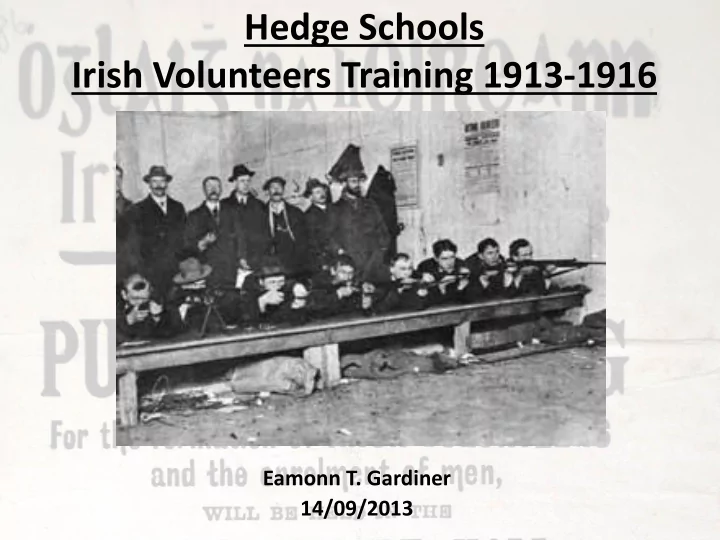
Hedge Schools Irish Volunteers Training 1913-1916 Eamonn T. Gardiner 14/09/2013 Overview Show the capabilities which the IV possessed to be able to train recruits. Do this by examining The Volunteers The Facilities/Equipment


slide-1
SLIDE 1

Hedge Schools Irish Volunteers Training 1913-1916

Eamonn T. Gardiner 14/09/2013

slide-2
SLIDE 2

Overview

  • Show the capabilities which the IV possessed to be able to train recruits.
  • Do this by examining

– The Volunteers – The Facilities/Equipment available to their Companies – And Trainers and Methods used to instruct

  • Use Primary and Secondary Source Documents.

– Bureau of Military History Witness Statements – Archival Material

  • Use contemporaneous photographs and maps.

– Training areas – Camps – Equipment/Facilities

slide-3
SLIDE 3

Volunteer Manifesto & Initial Concept

Manifesto of the Irish Volunteers, 1913, declared that it was the right of all Irishmen, ‘To dr drill, ill, to to learn learn the the use se of

  • f arm

arms, s, to to acq acqui uire re the the habi habit of

  • f

conc

  • ncerte

rted an and discip isciplined ined action, action, to to fo form rm a citi citizen zen army army fro from a popu

  • pula

lation ion now now at at the he me mercy rcy of

  • f almos

lmost an any

  • rg
  • rganise

anised agg aggre ress ssion, ion, this this beyon beyond all ll doubt doubt is is a pro rogramme gramme that that ap appe peal als to to all all Ire rela land, d, but but especi specially ally to to You

  • ung

Irel eland nd.’ Decided that Volunteers would use, ‘a por portio tion of

  • f time

time sp spar ared, d, not not fr from wor work, bu but fr from

  • m plea

leasure re an and re recr creation ation, a voluntar voluntary ad adoptio ption of

  • f di

discip sciplin line, a purpo purpose se fir firmly mly and and st steadi adily ly car carried ried throu through, h, wi will re renew new the vitality tality of

  • f the nati

tion

  • n.’
slide-4
SLIDE 4

The Men I

  • Irish Youth ‘primed’ for militarism, tumultuous recent history with:

– Lockout – Gaelic Revival – Home Rule & Generations of populist national politics – Resurgent IRB

  • Family important in such matters

– Familial link to previous nationalism (Fenians, Land League) and support helpful.

  • Membership transcended socio-economic boundaries.

– Clerks – Farmers – Store men – Labourers/Builders – Ex-military

slide-5
SLIDE 5

The Men II

  • Attitude

– Generally High Esprit de Corps – Good Discipline – Positive Attitude towards Instruction, interest in learning

  • Varied reasons for joining

– Excitement – Boredom – Desire to support Ireland – Drinking (Getting a Wet, Mallow), etc.

slide-6
SLIDE 6

The Equipment

  • Very poorly armed, e.g. Musketry Instructor

– Stealing arms from soldiers – Clubbing together to purchase arms – Wooden rifles for arms & foot drill

  • Miniature rifles & Sporting rifles more plentiful

– Smaller, less powerful calibres were not as strictly regulated as were used for general recreation – Miniature Indoor rifles were used on small ranges in converted IV Halls. Same methods used today (Royal Marines Training Facility, Lympstone/Digital Indoor Range Training, Irish Army).

slide-7
SLIDE 7

Wooden Rifle & Leather bandolier

  • wned by Capt. Seán Mulcahy, IV.

Photo Adams Auction Rooms, 18/04/2012

slide-8
SLIDE 8

Training Rifle held in Kilmainham Gaol Photo www.southdublinlibraries.ie Using a Miniature Rifle, note the special rear aperture sight and front sight

slide-9
SLIDE 9

Practicing Musketry on an Indoor Range

slide-10
SLIDE 10

The Facilities

  • Volunteers initially trained in Foot Drill outside, usually public spaces (wide streets,

village squares, Cornmarket Cork).

  • Needed more suitable facilities.

– Instruction of classes and musketry, indoors with classrooms – Larger rooms for marching in inclement weather.

  • Cork Volunteers initial Hall (An Dún) was not big enough for purposes.

– Fisher Street facility was large enough. – Post Split moved to facility on Sheare’s Street, on Mardyke. Large Facility with own rifle range.

  • Volunteers in Dinlge drilled outside Church.
  • Mallow & Mitchelstown had own halls.
  • Belfast Regiment had a number of training facilities, but was difficult to get them

due to local tensions with Ulster Volunteer Force

slide-11
SLIDE 11

Cork IV Halls 1913-1916

Fisher Street Sheare’s Street Cornmarket An Dún

slide-12
SLIDE 12

Cork IV Hall Sheare’s Street

slide-13
SLIDE 13

Limerick IV Hall

Limerick IV Hall initially built for Na Fianna by the Fenian John Daly, at the rear of his house on Barrington St.

  • Photo. Limerick City Museum
slide-14
SLIDE 14

IV Parading in Dungarvan Town Square

Photo Waterford Co. Museum

slide-15
SLIDE 15

Kilkenny IV Route March

Photo Kilkenny Co. Council Library

slide-16
SLIDE 16

Trainers: Military Experience

  • Form 5: ‘General Instructions for Forming Companies’,

– ‘secure the services of a competent instructor. Utilise all ex-military men possible.’

  • Form 6: ‘Military Instructions for Units’,

– ‘follow exactly the drill set out in the ‘British Infantry Manual, 1911’

  • IV modelled on British Army

– Former BA Drill Instructors sought to teach drill and tactical training. – Outbreak of WWI all BA Instructors recalled to units for wartime service. – New instructors needed for IV

slide-17
SLIDE 17

Trainers: NCOs & Officers

  • Paradigm Shift

– Recognition of Prior Learning/Experience established informally within units. – Thomas Meldon, Dublin: Experience with shooting, promoted to Musketry Instructor. – NCO & Officer training classes and lectures

  • ffered. ‘Train the Trainer.’
  • Galtee Battalion
  • Belfast Regiment
  • Dublin Regiment
slide-18
SLIDE 18

Training Programmes

  • Allowed IV units to plan for their training and allowed recruits to see what

they were working towards.

  • Belfast IV Training plan

– Musketry training at St. Mary’s Hall at 8pm on Monday, Wednesday, Thursday and Friday.

  • Battalion Sgt. Major was to detail companies to attend for instruction to St. Mary’s Hall,

in succession.

– The Volunteer Regimental Headquarters staffed to facilitate enlistment. – The Military Committee meet Thursday nights. – Recruit parade St. Mary’s on Tuesday, Thursday, Saturday and Sunday. – A local sporting event (Shaun’s Sports) was to be held, with IV parade to assist and two bands were to play.

  • Reduced Rate for IV.
slide-19
SLIDE 19

Training Camps

  • Full Time Training (FTT) Camps held to allow IV to reinforce

and consolidate knowledge accumulated on Training Nights.

  • Camps held in Athenry (Galway), Ticknock (Dublin/Wicklow)

and Galtee (Cork/Limerick/Tipperary).

  • Subjects covered included

– Fieldcraft – Tactical Training – Military Organisation – Navigation & Camping – First Aid

slide-20
SLIDE 20

Galtee Training Camp Locations

MITCHELSTOWN CHARLEVILLE County Cork County Limerick County Tipperary

slide-21
SLIDE 21

Galtee Training Camp

Galtee IV Training camp Photo BMH P-15-002

slide-22
SLIDE 22

Galtee Training Camp

Galtee IV Training camp Photo BMH P-15-002

slide-23
SLIDE 23

Conclusions

  • Uniform nature as set out by IV GHQ too rigid

– Fire and manoeuvre as set out in training docs difficult due to lack

  • f weaponry and support weapons.

– Need to change training doctrine to cope with shortfall.

  • Instructors worked well with difficult situations

– Dedicated Officers established good programmes and good NCOs implemented them

  • Beset by lack of resources continually.

– Needed 1916 to force organisation to change to more aggressive stance.

slide-24
SLIDE 24

Questions??