
SLIDE 1
Earth Observations in next development agenda Water societal benefit - - PowerPoint PPT Presentation
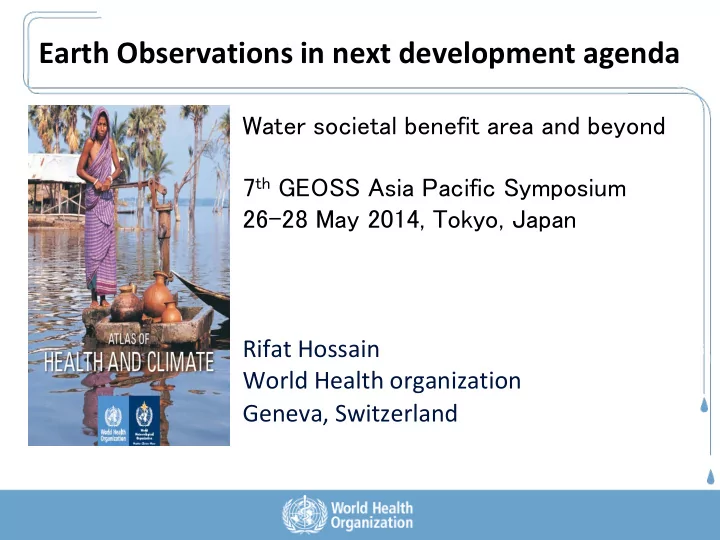
Earth Observations in next development agenda Water societal benefit area and beyond 7 th GEOSS Asia Pacific Symposium 26-28 May 2014, Tokyo, Japan Rifat Hossain World Health organization Geneva, Switzerland Water related diseases, a leading
http://www.who.int/mediacentre/factsheets/fs310/en/index.html
Targe get 7.A: Integrate the principles of sustainable development into country policies and programmes and reverse the loss of environmental resources 7.5 Proportion of total water resources used Targe get 7c: Halve, by 2015, the proportion of people without
sustainable access to safe e drink inking ing wa water er and basic sanitation
Indi dicato tor to to mon
tor (pr prox
to safe dr drinking-water er):
7.8/7.9 Proportion of the population that uses an im improved ed drinking-water source/sanitation facility (urban + rural)
0% 10% 20% 30% 40% 50% 60% 70% 80% 90% 100% 1990 2010 All water infrastructure+surface water All water infrastructure Improved water sources Safe water sources safe water sources that is within 30mins of home safe water sources at home 0% 10% 20% 30% 40% 50% 60% 70% 80% 90% 100% 1990 2010 All water infrastructure+surface water All water infrastructure Improved water sources Safe water sources safe water sources that is within 30mins of home safe water sources at home
Ur Urban Rur ural
5
In In 2010 2010 UN UN ad adopted the Rig ight ht to Dr Drink nking ing-Wat ater an and san anitat ation bring inging ing addit itio iona nal l cr crit iter eria ia
6
Water Sanitation Hygiene Equity & Non- Discrim- ination
Water accessibility: (combination of layers ‘a’ and ‘d’) Access measured in amount of energy per capita (calories) needed to collect water, highlighting access limitations due to terrain. Also shows populations living on marginal land without water access. Water resources per person: (combination of layers ‘b’ and ‘d’) Determines whether underlying water resources (aquifer yield) can meet demand of overlying population based
Areas with improved water access: (combination of layers ‘c’ and ‘d’) Displays 1-km LandScan areas that have achieved water access per guidelines, i.e. at least one access point per 1- sq.km (a) Digital Elevation Model (DEM): Worldwide coverage from NASA’s ASTER mission with 30-meter resolution. (b) Water Resource Map: Aquifer yield data from multiple sources. (c) Improved water source location: Location of wells continually updated with new water projects via interactive Web 2.0 application. (d) LandScan Population Database: commercially available 1-kilometer population database updated yearly (http://www.ornl.gov/sci/landscan /landscan_data_avail.shtml).
(a) (b) (c) (d)
INPUT LAYERS: COMBINED OUTPUT LAYERS:
10
SDG G on n water er WWWQ WWWQ & WRM RM
Cholera outbreaks in areas where WASH coverage is poor, and more likely with higher precipitation anomalies
http:// //www.who.int nt/g /globalch chang nge/p /public ations/a /atlas/r /report/e /en/ n/ind ndex ex.ht html ml