Earthworms pharynx pumps food and soil into the esophagus. The - PowerPoint PPT Presentation
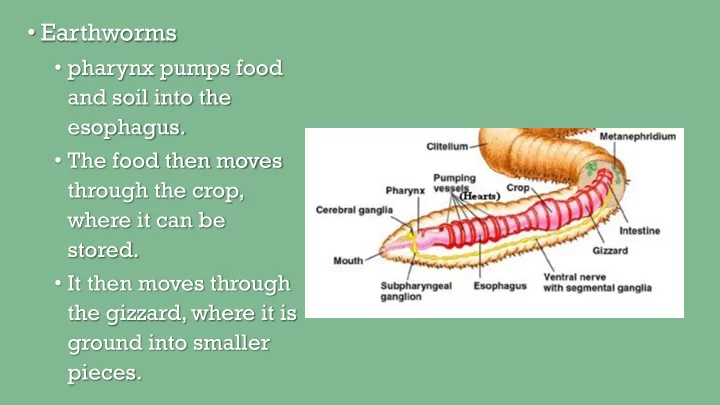
Earthworms pharynx pumps food and soil into the esophagus. The food then moves through the crop, where it can be stored. It then moves through the gizzard, where it is ground into smaller pieces. CIRCULATION Annelids
• Earthworms • pharynx pumps food and soil into the esophagus. • The food then moves through the crop, where it can be stored. • It then moves through the gizzard, where it is ground into smaller pieces.
CIRCULATION • Annelids typically have a closed circulatory system • blood is contained within a network of blood vessels • Ventral and Dorsal Vessels • Smaller vessels connect dorsal to ventral • Supply blood to internal organs • Dorsal bllod vessel function like a heart • Contracts and pumps blood
RESPIRATION • Aquatic annelids often breathe through gills. • Feather duster worms • Land-dwelling annelids take in oxygen and give off carbon dioxide through their moist skin • Diffusion • Secrete a thin protective coating of mucus which keeps skin moist
EXCRETION • Two types of waste • Digestive waste • Passes through anus • Cellular Waste • Eliminated by nephridia • Filter fluid in coelom
RESPONSE • Most annelids have a well-developed nervous system • consisting of a brain and several nerve cords. • Free living marine • Developed sense organs • Sensory bristles • Statocysts • Chemical receptors • Light detection
MOVEMENT • Annelids have two groups of body muscles that function as part of a hydrostatic skeleton. • Longitudinal muscles • Front to rear • Contract to make worm shorter and fatter • Circular muscles • Around each segment • Contract to make worm longer and thinner • These muscles contract alternatively to move
REPRODUCTION • Most annelids reproduce sexually. • Earthworms are hermaphrodites. • Two worms attach to each other, exchange sperm • store the sperm in special sacs.
Recommend
More recommend
Explore More Topics
Stay informed with curated content and fresh updates.