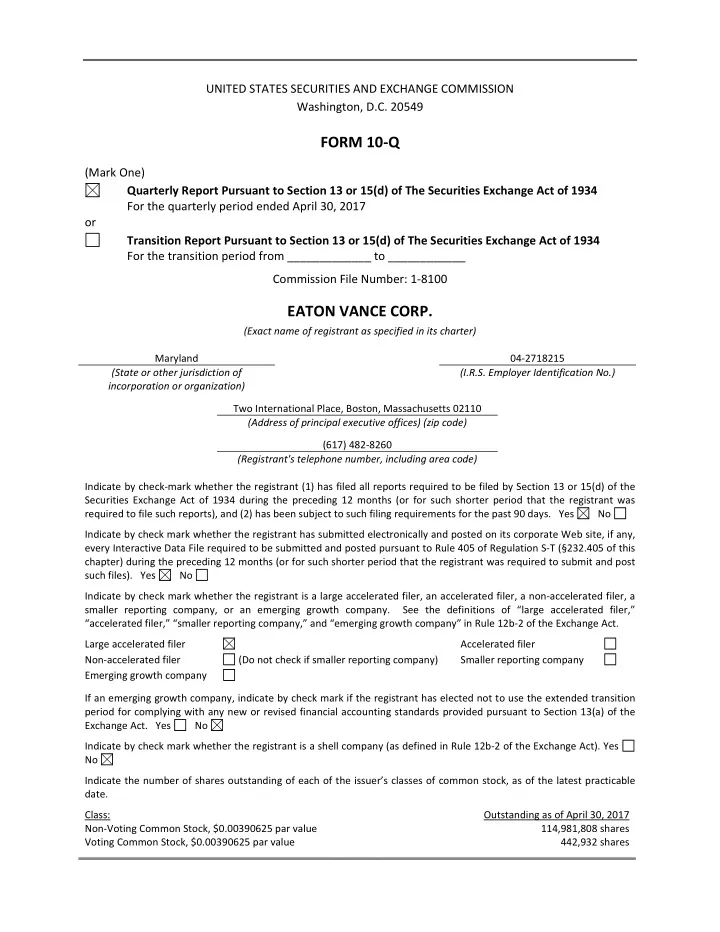
SLIDE 1 UNITED STATES SECURITIES AND EXCHANGE COMMISSION Washington, D.C. 20549
FORM 10‐Q
(Mark One) Quarterly Report Pursuant to Section 13 or 15(d) of The Securities Exchange Act of 1934 For the quarterly period ended April 30, 2017
Transition Report Pursuant to Section 13 or 15(d) of The Securities Exchange Act of 1934 For the transition period from _____________ to ____________ Commission File Number: 1‐8100
EATON VANCE CORP.
(Exact name of registrant as specified in its charter) Maryland 04‐2718215 (State or other jurisdiction of (I.R.S. Employer Identification No.) incorporation or organization) Two International Place, Boston, Massachusetts 02110 (Address of principal executive offices) (zip code) (617) 482‐8260 (Registrant's telephone number, including area code) Indicate by check‐mark whether the registrant (1) has filed all reports required to be filed by Section 13 or 15(d) of the Securities Exchange Act of 1934 during the preceding 12 months (or for such shorter period that the registrant was required to file such reports), and (2) has been subject to such filing requirements for the past 90 days. Yes No Indicate by check mark whether the registrant has submitted electronically and posted on its corporate Web site, if any, every Interactive Data File required to be submitted and posted pursuant to Rule 405 of Regulation S‐T (§232.405 of this chapter) during the preceding 12 months (or for such shorter period that the registrant was required to submit and post such files). Yes No Indicate by check mark whether the registrant is a large accelerated filer, an accelerated filer, a non‐accelerated filer, a smaller reporting company, or an emerging growth company. See the definitions of “large accelerated filer,” “accelerated filer,” “smaller reporting company,” and “emerging growth company” in Rule 12b‐2 of the Exchange Act. Large accelerated filer Accelerated filer Non‐accelerated filer (Do not check if smaller reporting company) Smaller reporting company Emerging growth company If an emerging growth company, indicate by check mark if the registrant has elected not to use the extended transition period for complying with any new or revised financial accounting standards provided pursuant to Section 13(a) of the Exchange Act. Yes No Indicate by check mark whether the registrant is a shell company (as defined in Rule 12b‐2 of the Exchange Act). Yes No Indicate the number of shares outstanding of each of the issuer’s classes of common stock, as of the latest practicable date. Class: Outstanding as of April 30, 2017 Non‐Voting Common Stock, $0.00390625 par value 114,981,808 shares Voting Common Stock, $0.00390625 par value 442,932 shares
SLIDE 2
2 Eaton Vance Corp. Form 10‐Q As of April 30, 2017 and for the Three and Six Month Periods Ended April 30, 2017 Table of Contents Required Information Page Number Reference Part I Financial Information Item 1. Consolidated Financial Statements (unaudited) ........................ 3 Item 2. Management’s Discussion and Analysis of Financial Condition and Results of Operations ....................................... 40 Item 3. Quantitative and Qualitative Disclosures About Market Risk ............................................................................... 65 Item 4. Controls and Procedures ............................................................ 65 Part II Other Information Item 1. Legal Proceedings ....................................................................... 66 Item 1A. Risk Factors ................................................................................. 66 Item 2. Unregistered Sales of Equity Securities and Use of Proceeds .... 66 Item 6. Exhibits ....................................................................................... 67 Signatures .................................................................................................... 68
SLIDE 3
3 Part I ‐ Financial Information Item 1. Consolidated Financial Statements (unaudited) Eaton Vance Corp. Consolidated Balance Sheets (unaudited) April 30, October 31,
(in thousands)
2017 2016 Assets Cash and cash equivalents $ 663,458 $ 424,174 Management fees and other receivables 191,284 186,172 Investments 750,121 589,773 Deferred sales commissions 32,474 27,076 Deferred income taxes 67,996 73,295 Equipment and leasehold improvements, net 46,341 44,427 Intangible assets, net 94,290 46,809 Goodwill 259,681 248,091 Loan to affiliate 5,000 5,000 Other assets 56,428 85,565 Total assets $ 2,167,073 $ 1,730,382 See notes to Consolidated Financial Statements.
SLIDE 4
4 Eaton Vance Corp. Consolidated Balance Sheets (unaudited) (continued) April 30, October 31,
(in thousands, except share data)
2017 2016 Liabilities, Temporary Equity and Permanent Equity Liabilities: Accrued compensation $ 100,087 $ 173,485 Accounts payable and accrued expenses 64,527 59,927 Dividend payable 38,079 36,525 Debt 868,272 571,773 Other liabilities 107,504 75,069 Total liabilities 1,178,469 916,779 Commitments and contingencies (Note 19) Temporary Equity: Redeemable non‐controlling interests 200,114 109,028 Permanent Equity: Voting Common Stock, par value $0.00390625 per share: Authorized, 1,280,000 shares Issued and outstanding, 442,932 and 442,932 shares, respectively 2 2 Non‐Voting Common Stock, par value $0.00390625 per share: Authorized, 190,720,000 shares Issued and outstanding, 114,981,808 and 113,545,008 shares, respectively 449 444 Additional paid‐in capital 16,399 ‐ Notes receivable from stock option exercises (10,185) (12,074) Accumulated other comprehensive loss (60,064) (57,583) Retained earnings 841,127 773,000 Total Eaton Vance Corp. shareholders' equity 787,728 703,789 Non‐redeemable non‐controlling interests 762 786 Total permanent equity 788,490 704,575 Total liabilities, temporary equity and permanent equity $ 2,167,073 $ 1,730,382 See notes to Consolidated Financial Statements.
SLIDE 5 5 Eaton Vance Corp. Consolidated Statements of Income (unaudited) Three Months Ended Six Months Ended April 30, April 30, (in thousands, except per share data) 2017 2016 2017 2016 Revenue: Management fees $ 321,629 $ 276,883 $ 626,282 $ 559,925 Distribution and underwriter fees 19,918 18,275 38,877 37,333 Service fees 30,067 25,794 58,978 53,053 Other revenue 3,018 2,338 5,454 4,535 Total revenue 374,632 323,290 729,591 654,846 Expenses: Compensation and related costs 135,467 121,519 270,602 244,029 Distribution expense 32,007 28,239 63,124 56,722 Service fee expense 27,827 23,610 54,754 48,205 Amortization of deferred sales commissions 4,026 3,957 7,880 8,001 Fund‐related expenses 11,848 8,031 22,723 17,194 Other expenses 45,537 42,166 87,152 84,302 Total expenses 256,712 227,522 506,235 458,453 Operating income 117,920 95,768 223,356 196,393 Non‐operating income (expense): Gains and other investment income, net 9,288 3,789 9,782 6,629 Interest expense (8,065) (7,340) (15,412) (14,682) Other income (expense) of consolidated collateralized loan obligation (CLO) entity: Gains and other investment income, net ‐ 13,908 ‐ 17,187 Interest expense ‐ (2,878) ‐ (4,714) Total non‐operating income (expense) 1,223 7,479 (5,630) 4,420 Income before income taxes and equity in net income of affiliates 119,143 103,247 217,726 200,813 Income taxes (44,654) (36,169) (81,402) (73,012) Equity in net income of affiliates, net of tax 3,144 2,377 5,650 4,886 Net income 77,633 69,455 141,974 132,687 Net income attributable to non‐controlling and
- ther beneficial interests
(5,658) (14,488) (9,288) (19,334) Net income attributable to Eaton Vance Corp. shareholders $ 71,975 $ 54,967 $ 132,686 $ 113,353 Earnings per share: Basic $ 0.65 $ 0.50 $ 1.20 $ 1.02 Diluted $ 0.62 $ 0.48 $ 1.15 $ 0.99 Weighted average shares outstanding: Basic 110,875 110,459 110,375 110,852 Diluted 115,962 113,667 115,188 114,308 Dividends declared per share $ 0.280 $ 0.265 $ 0.560 $ 0.530 See notes to Consolidated Financial Statements.
SLIDE 6
6 Eaton Vance Corp. Consolidated Statements of Comprehensive Income (unaudited) Three Months Ended Six Months Ended April 30, April 30,
(in thousands)
2017 2016 2017 2016 Net income $ 77,633 $ 69,455 $ 141,974 $ 132,687 Other comprehensive income (loss): Change in unrealized losses on derivatives, net of tax (413) ‐ (413) ‐ Amortization of net gains on derivatives, net of tax 5 4 9 7 Unrealized holding gains (losses) on available‐for‐sale investments and reclassification adjustments, net of tax 325 605 652 (53) Foreign currency translation adjustments, net of tax (8,526) 21,841 (2,729) 7,776 Other comprehensive income (loss), net of tax (8,609) 22,450 (2,481) 7,730 Total comprehensive income 69,024 91,905 139,493 140,417 Comprehensive income attributable to non‐controlling and other beneficial interests (5,658) (14,488) (9,288) (19,334) Total comprehensive income attributable to Eaton Vance Corp. shareholders $ 63,366 $ 77,417 $ 130,205 $ 121,083 See notes to Consolidated Financial Statements.
SLIDE 7 7
Eaton Vance Corp. Consolidated Statements of Shareholders' Equity (unaudited)
Permanent Equity Temporary Equity (in thousands) Voting Common Stock Non‐Voting Common Stock Additional Paid‐In Capital Notes Receivable from Stock Option Exercises Accumulated Other Comprehensive Loss Retained Earnings Non‐ Redeemable Non‐ Controlling Interests Total Permanent Equity Redeemable Non‐ Controlling Interests Balance, November 1, 2016 $ 2 $ 444 $ ‐ $ (12,074) $ (57,583) $ 773,000 $ 786 $ 704,575 $ 109,028 Net income ‐ ‐ ‐ ‐ ‐ 132,686 1,837 134,523 7,451 Other comprehensive loss ‐ ‐ ‐ ‐ (2,481) ‐ ‐ (2,481) ‐ Dividends declared ($0.560 per share) ‐ ‐ ‐ ‐ ‐ (64,559) ‐ (64,559) ‐ Issuance of Non‐Voting Common Stock: On exercise of stock options ‐ 6 41,873 (771) ‐ ‐ ‐ 41,108 ‐ Under employee stock purchase plans ‐ ‐ 1,516 ‐ ‐ ‐ ‐ 1,516 ‐ Under employee stock purchase incentive plan ‐ ‐ 2,791 ‐ ‐ ‐ ‐ 2,791 ‐ Under restricted stock plan, net of forfeitures ‐ 6 ‐ ‐ ‐ ‐ ‐ 6 ‐ Stock‐based compensation ‐ ‐ 39,214 ‐ ‐ ‐ ‐ 39,214 ‐ Tax benefit of stock option exercises ‐ ‐ 7,183 ‐ ‐ ‐ ‐ 7,183 ‐ Tax benefit of non‐controlling interest repurchases ‐ ‐ 3,659 ‐ ‐ ‐ ‐ 3,659 ‐ Repurchase of Non‐Voting Common Stock ‐ (7) (78,977) ‐ ‐ ‐ ‐ (78,984) ‐ Principal repayments on notes receivable from stock option exercises ‐ ‐ ‐ 2,660 ‐ ‐ ‐ 2,660 ‐ Net subscriptions (redemptions/distributions)
- f non‐controlling interest holders
‐ ‐ ‐ ‐ ‐ ‐ (1,797) (1,797) 90,509 Net consolidations (deconsolidations) of sponsored investment funds ‐ ‐ ‐ ‐ ‐ ‐ ‐ ‐ (488) Reclass to temporary equity ‐ ‐ ‐ ‐ ‐ ‐ (64) (64) 64 Purchase of non‐controlling interests ‐ ‐ ‐ ‐ ‐ ‐ ‐ ‐ (7,310) Other changes in non‐controlling interests ‐ ‐ (860) ‐ ‐ ‐ ‐ (860) 860 Balance, April 30, 2017 $ 2 $ 449 $ 16,399 $ (10,185) $ (60,064) $ 841,127 $ 762 $ 788,490 $ 200,114 See notes to Consolidated Financial Statements.
SLIDE 8 8
Eaton Vance Corp. Consolidated Statements of Shareholders' Equity (unaudited) (continued)
Permanent Equity Temporary Equity (in thousands) Voting Common Stock Non‐Voting Common Stock Additional Paid‐In Capital Notes Receivable from Stock Option Exercises Accumulated Other Comprehensive Loss Appropriated Retained Earnings (Deficit) Retained Earnings Non‐ Redeemable Non‐ Controlling Interests Total Permanent Equity Redeemable Non‐ Controlling Interests Balance, November 1, 2015 $ 2 $ 451 $ ‐ $ (11,143) $ (48,586) $ (5,338) $ 684,845 $ 1,725 $ 621,956 $ 88,913 Net income ‐ ‐ ‐ ‐ ‐ 12,701 113,353 1,863 127,917 4,770 Other comprehensive income ‐ ‐ ‐ ‐ 7,730 ‐ ‐ ‐ 7,730 ‐ Dividends declared ($0.530 per share) ‐ ‐ ‐ ‐ ‐ ‐ (60,495) ‐ (60,495) ‐ Issuance of Voting Common Stock ‐ ‐ 232 ‐ ‐ ‐ ‐ ‐ 232 ‐ Issuance of Non‐Voting Common Stock: On exercise of stock options ‐ 3 22,056 (531) ‐ ‐ ‐ ‐ 21,528 ‐ Under employee stock purchase plans ‐ ‐ 1,610 ‐ ‐ ‐ ‐ ‐ 1,610 ‐ Under employee stock purchase incentive plan ‐ ‐ 2,710 ‐ ‐ ‐ ‐ ‐ 2,710 ‐ Under restricted stock plan, net of forfeitures ‐ 6 ‐ ‐ ‐ ‐ ‐ ‐ 6 ‐ Stock‐based compensation ‐ ‐ 36,607 ‐ ‐ ‐ ‐ ‐ 36,607 ‐ Tax benefit of stock option exercises ‐ ‐ 1,714 ‐ ‐ ‐ ‐ ‐ 1,714 ‐ Repurchase of Voting Common Stock ‐ ‐ (77) ‐ ‐ ‐ ‐ ‐ (77) ‐ Repurchase of Non‐Voting Common Stock ‐ (17) (63,737) ‐ ‐ ‐ (80,317) ‐ (144,071) ‐ Principal repayments on notes receivable from stock option exercises ‐ ‐ ‐ 1,283 ‐ ‐ ‐ ‐ 1,283 ‐ Net subscriptions (redemptions/distributions)
- f non‐controlling interest holders
‐ ‐ ‐ ‐ ‐ ‐ ‐ (1,767) (1,767) (434) Net consolidations (deconsolidations) of sponsored investment funds ‐ ‐ ‐ ‐ ‐ ‐ ‐ ‐ ‐ (698) Reclass to temporary equity ‐ ‐ ‐ ‐ ‐ ‐ ‐ (119) (119) 119 Purchase of non‐controlling interests ‐ ‐ ‐ ‐ ‐ ‐ ‐ ‐ ‐ (6,202) Other changes in non‐controlling interests ‐ ‐ (1,115) ‐ ‐ ‐ ‐ ‐ (1,115) 1,115 Balance, April 30, 2016 $ 2 $ 443 $ ‐ $ (10,391) $ (40,856) $ 7,363 $ 657,386 $ 1,702 $ 615,649 $ 87,583 See notes to Consolidated Financial Statements.
SLIDE 9 9 Eaton Vance Corp. Consolidated Statements of Cash Flows (unaudited) Six Months Ended April 30, (in thousands) 2017 2016 Cash Flows From Operating Activities: Net income $ 141,974 $ 132,687 Adjustments to reconcile net income to net cash provided by
Depreciation and amortization 10,328 10,396 Unamortized loss on derivative instrument (684) ‐ Amortization of deferred sales commissions 7,884 8,006 Stock‐based compensation 39,214 36,607 Deferred income taxes 8,823 10,551 Net losses (gains) on investments and derivatives 453 (1,374) Equity in net income of affiliates, net of amortization (5,650) (4,996) Dividends received from affiliates 5,100 5,785 Consolidated CLO entity's operating activities: Net gains on bank loans, other investments and note obligations ‐ (8,594) Amortization ‐ (269) Net increase in other assets and liabilities, including cash and cash equivalents ‐ 82,263 Changes in operating assets and liabilities: Management fees and other receivables (5,083) 17,698 Investments in trading securities (162,692) (24,446) Deferred sales commissions (13,280) (8,621) Other assets 8,406 13,135 Accrued compensation (73,589) (91,086) Accounts payable and accrued expenses 4,550 (3,738) Other liabilities 46,947 (157) Net cash provided by operating activities 12,701 173,847 Cash Flows From Investing Activities: Additions to equipment and leasehold improvements (6,066) (5,293) Issuance of loan to affiliate ‐ (5,000) Net cash paid in acquisitions (63,605) (10,130) Cash paid for intangible assets ‐ (25) Proceeds from sale of investments 5,992 8,808 Purchase of investments (67) (113) Consolidated CLO entity's investing activities: Proceeds from sales and maturities of bank loans and other investments ‐ 33,141 Purchase of bank loans and other investments ‐ (118,289) Net cash used for investing activities (63,746) (96,901) See notes to Consolidated Financial Statements.
SLIDE 10 10 Eaton Vance Corp. Consolidated Statements of Cash Flows (unaudited) (continued) Six Months Ended April 30, (in thousands) 2017 2016 Cash Flows From Financing Activities: Purchase of additional non‐controlling interest (9,451) (15,580) Debt issuance costs (2,761) ‐ Proceeds from issuance of debt 298,896 ‐ Proceeds from issuance of Voting Common Stock ‐ 232 Proceeds from issuance of Non‐Voting Common Stock 45,421 25,854 Repurchase of Voting Common Stock ‐ (77) Repurchase of Non‐Voting Common Stock (78,984) (144,071) Principal repayments on notes receivable from stock
2,660 1,283 Excess tax benefit of stock option exercises 8,182 3,023 Dividends paid (63,005) (60,201) Net subscriptions received from (redemptions/distributions paid to) non‐controlling interest holders 88,859 (2,201) Net cash provided by (used for) financing activities 289,817 (191,738) Effect of currency rate changes on cash and cash equivalents 512 395 Net increase (decrease) in cash and cash equivalents 239,284 (114,397) Cash and cash equivalents, beginning of period 424,174 465,558 Cash and cash equivalents, end of period $ 663,458 $ 351,161 Supplemental Cash Flow Information: Cash paid for interest $ 14,205 $ 14,206 Cash paid for income taxes, net of refunds 40,367 47,040 Supplemental Disclosure of Non‐Cash Information: Increase in equipment and leasehold improvements due to non‐cash additions $ 110 $ 1,651 Exercise of stock options through issuance of notes receivable 771 531 Non‐controlling interest call option exercise recorded in
320 ‐ Net Consolidations (Deconsolidations) of Sponsored Investment Funds: Increase (decrease) in investments $ 136,611 $ (720) Increase in other assets, net of other liabilities 22,073 ‐ Increase (decrease) in non‐controlling interests 73,843 (698) See notes to Consolidated Financial Statements.
SLIDE 11 11 Eaton Vance Corp. Notes to Consolidated Financial Statements (unaudited)
- 1. Summary of Significant Accounting Policies
Basis of presentation In the opinion of management, the accompanying unaudited interim Consolidated Financial Statements of Eaton Vance Corp. (the Company) include all adjustments necessary to present fairly the results for the interim periods in accordance with accounting principles generally accepted in the United States of America (U.S. GAAP). Such financial statements have been prepared in accordance with the instructions to Form 10‐Q pursuant to the rules and regulations of the Securities and Exchange Commission. Certain information and footnote disclosures have been omitted pursuant to such rules and regulations. As a result, these financial statements should be read in conjunction with the audited Consolidated Financial Statements and related notes included in the Company’s latest Annual Report on Form 10‐K. During the first quarter of fiscal 2017, the Company changed the description of a line item in the Consolidated Statements of Income from investment advisory and administrative fees to management
- fees. The change in the description had no impact on the Company’s previously reported net income or
financial position, and does not represent a restatement of previously reported financial
- results. Management fees are defined as including both investment advisory fees and administration fees
for all periods presented. Adoption of new accounting standards The Company adopted the following accounting standards as of November 1, 2016: Consolidation ‐ Accounting Standards Update (ASU) 2015‐02, Amendments to the Consolidation Analysis Consolidation ‐ ASU 2016‐17, Interests Held through Related Parties That Are under Common Control Debt issuance costs ‐ ASU 2015‐03, Simplifying the Presentation of Debt Issuance Costs The adoption of the amendments to the consolidation guidance did not result in the consolidation of a previously unconsolidated legal entity or the deconsolidation of a previously consolidated entity. The amendment to the consolidation guidance that had the most significant impact on the Company’s consolidation analysis is the elimination of the deferral of accounting guidance that required separate evaluation for investment company variable interest entities (VIEs). The elimination of this deferral reduced the threshold used to evaluate whether the Company has a controlling financial interest in the Company’s sponsored funds in which the Company holds a seed investment from an ownership percentage of 50 percent to 10 percent. The amended guidance also impacted the Company’s evaluation
- f limited partnerships. Under the amended guidance, if limited partners with equity at risk in a limited
partnership or similarly structured entity do not have either substantive kick‐out rights over the general partner or substantive participation rights, the limited partnership is deemed to be a VIE. This update to the guidance resulted in the Company identifying that a private equity partnership managed by a third party that was previously considered a voting interest entity is now considered a VIE. The Company holds a variable interest in, but is not deemed to be the primary beneficiary of, this VIE. Refer to disclosure of this variable interest in Note 6, under the heading Other Entities.
SLIDE 12 12 The adoption of the new guidance related to debt issuance costs resulted in the Company changing the classification of certain debt issuance costs in its Consolidated Balance Sheets. All debt issuance costs were previously reported as a component of other assets. Debt issuance costs related to the Company’s term debt are now presented as a component of debt on the Company’s Consolidated Balance Sheets. Amounts for the comparative prior fiscal year have been restated to conform to the current year presentation. This reclassification had no impact on previously reported net income or previously reported financial results. The following table presents the effects of the change in presentation of debt issuance costs on the Company’s previously reported Consolidated Balance Sheet: October 31, 2016 (in thousands) As Previously Reported Reclassification As Restated Other assets $ 87,759 $ (2,194) $ 85,565 Total assets 1,732,576 (2,194) 1,730,382 Debt 573,967 (2,194) 571,773 Total liabilities 918,973 (2,194) 916,779 Total permanent equity 704,575 ‐ 704,575 Total liabilities, temporary equity and permanent equity 1,732,576 (2,194) 1,730,382 In addition to the above updates, the Company adopted ASU 2017‐01, Clarifying the Definition of a Business, in conjunction with the acquisition of the assets of Calvert Investment Management, Inc. (Calvert), which closed on December 30, 2016. This new standard provides for an up‐front quantitative approach, which is referred to as a “screen,” to determine whether an entity is acquiring assets or a
- business. In applying the screen, the Company determined that substantially all of the fair value of the
gross assets acquired was concentrated in a single identifiable asset or group of similar assets and that the assets acquired, therefore, did not qualify as a business. Disclosure of the acquisition is included in Note 9. The Company’s significant accounting policies related to each of the ASUs adopted as of November 1, 2016 are summarized below, as amended. Principles of consolidation With limited exceptions, each of the Company’s sponsored mutual funds is organized as a separately managed component (or series) of a series trust. All assets of a series irrevocably belong to that series and are subject to the liabilities of that series; under no circumstances are the liabilities of one series payable by another series. The Company’s series trusts have no equity investment at risk, rather, all equity is issued at the series level. However, decisions regarding the trustees of the trust and certain key activities of each series (i.e., sponsored fund) within the trust, such as appointment of each sponsored fund’s investment adviser, typically reside at the trust level. As a result, shareholders of a sponsored fund that is organized as a series of a series trust lack the ability to control the key decision‐making processes that most directly affect the performance of the sponsored fund. Accordingly, the Company believes that each trust is a VIE and each sponsored fund within the trust is a silo that also meets the definition of a VIE. Having concluded that each silo is a VIE, the primary beneficiary evaluation is focused on an analysis of economic interests in the silo. The Company may hold a significant interest in the shares of a sponsored fund during the seed
SLIDE 13 13 investment stage when the sponsored fund’s investment track record is being established. The Company consolidates a sponsored fund when it has a controlling financial interest in the fund. Given that the fees earned from each sponsored fund are commensurate with the services provided and consistent with market‐based terms, the Company has generally concluded that its asset management arrangements with sponsored funds represent variable interests that convey both power and economics to the Company in instances in which the Company holds a greater than 10 percent ownership interest in the fund. Fee revenue earned on, as well as investments in, consolidated sponsored funds are eliminated in consolidation. The Company regularly seeds new sponsored funds and may consolidate one or more sponsored funds during a given reporting period. Due to the similarity of risks related to the Company’s involvement with each sponsored fund, disclosures required under the VIE model, such as disclosures regarding the carrying amount and classification of assets of sponsored funds and the gains and losses that the Company recognizes from sponsored funds, are aggregated. When the Company is no longer deemed to hold a controlling financial interest in a sponsored fund, the Company deconsolidates the sponsored fund and removes the related assets, liabilities and non‐ controlling interests from its balance sheet and classifies the Company’s remaining investment as available‐for‐sale. Because consolidated sponsored funds carry their assets and liabilities at fair value, there is no incremental gain or loss recognized upon deconsolidation. The extent of the Company’s exposure to loss with respect to a consolidated sponsored fund is limited to the amount of the Company’s investment in the sponsored fund. The Company is not obligated to provide financial support to sponsored funds. Only the assets of a sponsored fund are available to settle its
- bligations. Beneficial interest holders of sponsored funds do not have recourse to the general credit of
the Company. Consolidation of VIEs Accounting guidance provides a framework for determining whether an entity should be considered a VIE and, if so, whether a company’s involvement with the entity results in a variable interest in the entity. If the Company determines that it does have a variable interest in an entity, it must perform an analysis to determine whether it is the primary beneficiary of the VIE. If the Company determines it is the primary beneficiary of the VIE, it is required to consolidate the assets, liabilities, results of operations and cash flows of the VIE. The Company’s evaluation of whether it qualifies as the primary beneficiary of a VIE is complex. The Company is the primary beneficiary of a VIE if it has a controlling financial interest in the VIE. A company is deemed to have a controlling financial interest in a VIE if it has both (i) the power to direct the activities of the VIE that most significantly impact the VIE’s economic performance, and (ii) the obligation to absorb losses of the VIE that could potentially be significant to the VIE or the right to receive benefits from the VIE that could potentially be significant to the VIE. For collateralized loan obligation (CLO) entities, the Company must evaluate the relative size of the Company’s residual interest and the overall magnitude and design of the collateral fees within each
- structure. There is also judgment involved in assessing whether the Company has the power to direct the
activities that most significantly impact the VIE’s economic performance and the obligation to absorb losses of or the right to receive benefits from the VIE that could potentially be significant to the entity.
SLIDE 14 14 While the Company believes its overall evaluation of VIEs is appropriate, future changes in estimates, judgments and assumptions, changes in the ownership interests of the Company in a VIE and/or future accounting pronouncements may affect the resulting consolidation, or deconsolidation, of the assets, liabilities, results of operations and cash flows of a VIE. Debt issuance costs Deferred debt issuance costs are amortized using the effective interest method over the related debt term. Debt issuance costs related to the Company’s term debt are included in debt in the Company’s Consolidated Balance Sheets. The amortization of deferred debt issuance costs is included in interest expense on the Company’s Consolidated Statements of Income.
- 2. New Accounting Standards Not Yet Adopted
Statement of cash flows – restricted cash In November 2016, the Financial Accounting Standards Board (FASB) issued an amendment to existing guidance on the presentation and classification of restricted cash in the statement of cash flows. The amendment requires that a statement of cash flows explain the change during the period in the total of cash, cash equivalents, and amounts generally described as restricted cash or restricted cash equivalents. The amounts generally described as restricted cash and restricted cash equivalents should be included with cash and cash equivalents when reconciling the beginning‐of‐period and end‐of‐period total amounts shown on the statement of cash flows. The new guidance is effective for the Company’s fiscal year that begins on November 1, 2018 and requires a retrospective approach to adoption. The Company is currently evaluating the potential impact on its Consolidated Financial Statements and related disclosures. Simplifying the test for goodwill impairment In January 2017, the FASB issued amended guidance that simplifies the test for goodwill impairment. The standard eliminates Step 2 from the goodwill impairment test. Under the amended guidance, an entity should perform its goodwill impairment test by comparing the fair value of a reporting unit with its carrying amount. An entity will recognize an impairment charge for the amount by which the carrying amount exceeds the reporting unit’s fair value, but the loss cannot exceed the total amount of goodwill allocated to the reporting unit. The new guidance is effective for the Company’s fiscal year that begins on November 1, 2020 and requires a prospective approach to adoption. Early adoption is permitted for interim or annual goodwill impairment tests. The Company is currently evaluating the potential impact on its Consolidated Financial Statements and related disclosures.
- 3. Consolidated Sponsored Funds
The following table sets forth the balances related to consolidated sponsored funds at April 30, 2017 and October 31, 2016, as well as the Company’s interest in these funds:
SLIDE 15 15
(in thousands)
April 30, 2017 October 31, 2016
Investments
$ 424,440 $ 248,036
Other assets
11,700 10,984
Other liabilities
(46,599) (23,947)
Redeemable non‐controlling interests
(122,006) (24,474)
Interest in consolidated sponsored funds
$ 267,535 $ 210,599
The following is a summary of investments at April 30, 2017 and October 31, 2016: (in thousands) April 30, 2017 October 31, 2016 Investment securities, trading: Short‐term debt securities $ 66,591 $ 85,822 Consolidated sponsored funds 424,440 248,036 Separately managed accounts 88,408 79,683 Total investment securities, trading 579,439 413,541 Investment securities, available‐for‐sale 10,712 13,312 Investments in non‐consolidated CLO entities 2,928 3,837 Investments in equity method investees 137,911 139,929 Investments, other 19,131 19,154 Total investments $ 750,121 $ 589,773 Investment securities, trading The following is a summary of the fair value of investments classified as trading at April 30, 2017 and October 31, 2016: (in thousands) April 30, 2017 October 31, 2016 Short‐term debt securities $ 66,591 $ 85,822 Other debt securities 299,248 191,688 Equity securities 213,600 136,031 Total investment securities, trading $ 579,439 $ 413,541 The Company recognized gains (losses) related to trading securities still held at the reporting date of $6.3 million and $17.6 million for the three months ended April 30, 2017 and 2016, respectively, and $8.6 million and $6.0 million for the six months ended April 30, 2017 and 2016, respectively, within net gains (losses) and other investment income in the Company’s Consolidated Statements of Income.
SLIDE 16 16 Investment securities, available‐for‐sale The following is a summary of the gross unrealized gains and losses included in accumulated other comprehensive income (loss) related to securities classified as available‐for‐sale at April 30, 2017 and October 31, 2016: April 30, 2017 Gross Unrealized (in thousands) Cost Gains Losses Fair Value Investment securities, available‐for‐sale $ 4,861 $ 5,859 $ (8) $ 10,712 October 31, 2016 Gross Unrealized (in thousands) Cost Gains Losses Fair Value Investment securities, available‐for‐sale $ 8,528 $ 4,798 $ (14) $ 13,312 Net unrealized holding gains (losses) on investment securities classified as available‐for‐sale included in
- ther comprehensive income (loss) on the Company’s Consolidated Statements of Comprehensive Income
were $0.5 million and $1.1 million for the three months ended April 30, 2017 and 2016, respectively, and $1.1 million and $(23,000) for the six months ended April 30, 2017 and 2016, respectively. The Company did not recognize any impairment losses on investment securities classified as available‐for‐ sale during three and six months ended April 30, 2017 or 2016. The aggregate fair value of available‐for‐sale investments in an unrealized loss position at April 30, 2017 was $0.2 million; unrealized losses related to these investments totaled $8,000. No investment with a gross unrealized loss has been in a loss position for greater than one year. The following is a summary of the Company’s realized gains and losses recognized upon disposition of investments classified as available‐for‐sale for the three and six months ended April 30, 2017 and 2016: Three Months Ended Six Months Ended April 30, April 30, (in thousands) 2017 2016 2017 2016 Gains $ ‐ $ 64 $ 204 $ 199 Losses (1) (37) (1) (37) Net realized gains (losses) $ (1) $ 27 $ 203 $ 162 Investments in equity method investees The Company has a 49 percent interest in Hexavest Inc. (Hexavest), a Montreal, Canada‐based investment
- adviser. The carrying value of this investment was $134.9 million and $137.3 million at April 30, 2017 and
October 31, 2016, respectively. At April 30, 2017, the Company’s investment in Hexavest consisted of $6.1 million of equity in the net assets of Hexavest, definite‐lived intangible assets of $23.2 million and goodwill
- f $111.8 million, net of a deferred tax liability of $6.2 million. At October 31, 2016, the Company’s
investment in Hexavest consisted of $5.3 million of equity in the net assets of Hexavest, definite‐lived intangible assets of $24.5 million and goodwill of $114.1 million, net of a deferred tax liability of $6.6
SLIDE 17 17
- million. The investment is denominated in Canadian dollars and is subject to foreign currency translation
adjustments, which are recorded in accumulated other comprehensive income (loss). The Company has an option, exercisable later in 2017, to purchase an additional 26 percent interest in
- Hexavest. As part of the purchase price allocation at closing, a value of $8.3 million was assigned to this
- ption. The option is included in other assets in the Company’s Consolidated Balance Sheets at April 30,
2017 and October 31, 2016. The Company also has a seven percent equity interest in a private equity partnership managed by a third party that invests in companies in the financial services industry. The Company’s investment in the partnership was $3.0 million and $2.6 million at April 30, 2017 and October 31, 2016, respectively. The Company did not recognize any impairment losses related to its investments in equity method investees during the three and six months ended April 30, 2017 or 2016. During the six months ended April 30, 2017 and 2016, the Company received dividends of $5.1 million and $5.8 million, respectively, from its investments in equity method investees. Investments, other Investments, other, consists of certain investments carried at cost totaling $19.1 million and $19.2 million at April 30, 2017 and October 31, 2016, respectively. During the fiscal year ended October 31, 2016, the Company participated as lead investor in an equity financing in SigFig, an independent San Francisco‐based wealth management technology firm. The carrying value of Company’s investment in SigFig was $17.0 million at both April 30, 2017 and October 31, 2016.
- 5. Derivative Financial Instruments
Derivative financial instruments designated as cash flow hedges In April 2017, the Company issued $300.0 million in aggregate principal amount of 3.5 percent ten‐year senior notes due April 6, 2027 (2027 Senior Notes). In anticipation of the offering, the Company entered into a Treasury lock transaction with a notional amount of $125.0 million and concurrently designated the Treasury lock as a cash flow hedge of its exposure to variability in the forecasted semi‐annual interest payments on $125 million of principal outstanding on the 2027 Senior Notes. The benchmark U.S. Treasury rate declined from the time the Treasury lock was entered into until the time the 2027 Senior Notes were priced, and the Treasury lock was net settled for cash at a loss of $0.7 million. The Treasury lock was determined to be a highly effective cash flow hedge and the entire $0.7 million loss, net of the associated deferred tax benefit of $0.3 million, was recorded in other comprehensive income (loss), net of tax. The loss recorded in other comprehensive income (loss) will be reclassified to earnings as a component of interest expense over the term of the debt. During the three months ended April 30, 2017, approximately $3,000 of this deferred loss was reclassified into interest expense. During the next twelve months, the Company expects to reclassify approximately $0.1 million of the loss into interest expense. In fiscal 2013, the Company entered into a forward‐starting interest rate swap in connection with the
- ffering of its 3.625 percent unsecured senior notes due June 15, 2023 (2023 Senior Notes) and recorded
the unamortized gain on the swap in other comprehensive income (loss), net of tax. The Company
SLIDE 18 18 reclassified $50,000 and $0.1 million of the deferred gain into interest expense during both the three and six months ended April 30, 2017 and 2016, respectively, and will reclassify the remaining $1.2 million of unamortized gain as of April 30, 2017 to earnings as a component of interest expense over the remaining term of the debt. During the next twelve months, the Company expects to reclassify approximately $0.2 million of the gain into interest expense. In fiscal 2007, the Company entered into a Treasury lock transaction in connection with the offering of its 6.5 percent unsecured senior notes due October 2, 2017 (2017 Senior Notes) and recorded the unamortized loss on the Treasury lock in other comprehensive income (loss), net of tax. The Company reclassified $56,000 and $0.1 million of the deferred loss into interest expense during both the three and six months ended April 30, 2017 and 2016, respectively, and will reclassify the remaining $0.1 million of unamortized loss to earnings as a component of interest expense in May 2017 concurrent with the redemption of the 2017 Senior Notes (see Note 11). Other derivative financial instruments not designated for hedge accounting The Company utilizes stock index futures contracts, total return swap contracts, foreign exchange contracts, commodity futures contracts and currency futures contracts to hedge the market and currency risks associated with its investments in certain consolidated sponsored funds and separately managed accounts seeded for new product development purposes (consolidated seed investments). The Company was a party to the following derivative financial instruments at April 30, 2017 and October 31, 2016: April 30, 2017 October 31, 2016 Number of contracts Notional value
(in millions)
Number of contracts Notional value
(in millions)
Stock index futures contracts 1,799 $ 137.0 1,721 $ 125.4 Total return swap contracts 5 $ 50.2 1 $ 40.0 Foreign exchange contracts 28 $ 23.6 32 $ 18.7 Commodity futures contracts 224 $ 19.4 ‐ $ ‐ Currency futures contracts 130 $ 13.1 ‐ $ ‐ The Company has not designated any of these derivative contracts as hedging instruments for accounting
- purposes. The derivative contracts outstanding, and the notional values they represent at April 30, 2017
and October 31, 2016, are representative of derivative balances throughout each respective period. The Company has not elected to offset fair value amounts related to derivative instruments executed with the same counterparty under master netting arrangements; as a result, the Company records all derivative financial instruments as either other assets or other liabilities, gross, on its Consolidated Balance Sheets and measures them at fair value. The following tables present the fair value of derivative financial instruments not designated for hedge accounting and how they are reflected in the Company’s Consolidated Financial Statements as of April 30, 2017 and October 31, 2016:
SLIDE 19 19 April 30, 2017 October 31, 2016 (in thousands) Other assets Other liabilities Other assets Other liabilities Stock index futures contracts $ 137 $ 3,297 $ 1,722 $ 130 Total return swap contracts ‐ 1,085 ‐ 418 Foreign exchange contracts 124 564 350 267 Commodity futures contracts 1 3 ‐ ‐ Currency futures contracts 3 12 ‐ ‐ Total $ 265 $ 4,961 $ 2,072 $ 815 Changes in the fair value of derivative contracts are recognized in gains and other investment income, net (see Note 14). The Company recognized the following net gains (losses) on derivative financial instruments for the three and six months ended April 30, 2017 and 2016: Three Months Ended Six Months Ended April 30, April 30, (in thousands) 2017 2016 2017 2016 Stock index futures contracts $ (7,097) $ (8,062) $ (13,030) $ 921 Total return swap contracts (1,011) (3,209) (1,975) (439) Foreign exchange contracts (369) (1,774) (397) (1,140) Commodity futures contracts (2) ‐ (2) ‐ Currency futures contracts (10) ‐ (10) ‐ Total $ (8,489) $ (13,045) $ (15,414) $ (658) In addition to the derivative contracts described above, certain consolidated seed investments may utilize derivative financial instruments within their portfolios in pursuit of their stated investment objectives. See Note 3 for discussion of consolidated sponsored funds.
- 6. Variable Interest Entities
Investments in VIEs that are consolidated Consolidated sponsored funds The Company invests in investment companies that meet the definition of a VIE. Disclosure regarding such consolidated sponsored funds is included in Note 3. Consolidated CLO entities As of April 30, 2017 and October 31, 2016, the Company was not deemed to be the primary beneficiary of any CLO entities; accordingly, no CLO entities have been consolidated at April 30, 2017 and October 31, 2016. Eaton Vance CLO 2015‐1 On September 21, 2016, the Company sold its 16.1 percent subordinated interest in Eaton Vance CLO 2015‐1 to an unrelated third party, recognizing a gain on disposal of $0.1 million. Although the Company continues to serve as collateral manager of the entity, and therefore has the power to direct the activities that most significantly impact the economic performance of the entity, the Company concluded that it was
SLIDE 20 20 no longer the primary beneficiary of the entity upon disposition of its 16.1 percent residual interest. As a result, the Company deconsolidated Eaton Vance CLO 2015‐1 effective September 21, 2016. Prior to the deconsolidation of Eaton Vance CLO 2015‐1, changes in the fair values of bank loan investments resulted in net gains (losses) of $2.5 million and $(4.5) million for the three and six months ended April 30, 2016, respectively, while changes in the fair values of Eaton Vance CLO 2015‐1’s note
- bligations resulted in net gains of $6.6 million and $13.1 million for the three and six months ended April
30, 2016, respectively. The combined net gains of $9.1 million and $8.6 million for the three and six months ended April 30, 2016, respectively, were recorded in gains (losses) and other investment income, net, of consolidated CLO entities on the Company’s Consolidated Statements of Income. For the three and six months ended April 30, 2016, the Company recorded net income of $11.0 million and $12.4 million, respectively, related to Eaton Vance CLO 2015‐1. The Company recorded net income attributable to other beneficial interests of $10.8 million and $12.7 million for the three and six months ended April 30, 2016, respectively. Net income (losses) attributable to Eaton Vance Corp. shareholders was $0.2 million and $(0.3) million for three and six months ended April 30, 2016, respectively. Investments in VIEs that are not consolidated Sponsored funds The Company classifies its investments in certain sponsored funds that are considered VIEs as available‐ for‐sale investments when it is not considered the primary beneficiary of these VIEs (generally when the Company owns less than 10 percent of the fund). The Company provides aggregated disclosures with respect to these non‐consolidated sponsored fund VIEs in Note 4. Non‐consolidated CLO entities Non‐consolidated CLO entities had total assets of $1.8 billion and $2.0 billion as of April 30, 2017 and October 31, 2016, respectively. The Company’s variable interests in these entities consist of the Company’s direct ownership in these entities and any subordinated management fees earned but uncollected. The Company’s investment in these entities totaled $2.9 million and $3.8 million as of April 30, 2017 and October 31, 2016, respectively. Collateral management fees receivable for these entities totaled $0.7 million and $1.4 million on April 30, 2017 and October 31, 2016, respectively. In the first six months of fiscal 2017, the Company did not provide any financial or other support to these entities that it was not contractually required to provide in any of the periods presented. The Company’s risk of loss with respect to these managed CLO entities is limited to the carrying value of its investments in, and collateral management fees receivable from, these entities as of April 30, 2017. The Company’s investment in non‐consolidated CLO entities is carried at amortized cost and is disclosed as a component of investments in Note 4. Income from these entities is recorded as a component of gains (losses) and other investment income, net, in the Company’s Consolidated Statements of Income, based upon projected investment yields. Other entities The Company holds variable interests in, but is not deemed to be the primary beneficiary of, certain sponsored privately offered equity funds with total assets of $15.7 billion and $13.5 billion on April 30, 2017 and October 31, 2016, respectively. The Company’s variable interests in these entities consist of the Company’s direct ownership therein, which in each case is insignificant relative to the total ownership of the fund, and any investment advisory fees earned but uncollected. The Company held investments in
SLIDE 21 21 these entities totaling $2.5 million and $2.2 million on April 30, 2017 and October 31, 2016, respectively, and investment advisory fees receivable totaling $1.0 million and $0.8 million on April 30, 2017 and October 31, 2016, respectively. In the first six months of fiscal 2017, the Company did not provide any financial or other support to these entities that it was not contractually required to provide. The Company’s risk of loss with respect to these managed entities is limited to the carrying value of its investments in, and investment advisory fees receivable from, the entities as of April 30, 2017. The Company does not consolidate these VIEs because it does not have the obligation to absorb losses or right to receive benefits that could potentially be significant to the VIE. The Company’s investments in privately offered equity funds are carried at fair value and included in investment securities, available‐for‐sale, which are disclosed as a component of investments in Note 4. The Company records any change in fair value, net of tax, in other comprehensive income (loss). The Company also holds a variable interest in, but is not deemed to be the primary beneficiary of, a private equity partnership managed by a third party that invests in companies in the financial services industry. The Company’s variable interest in this entity consists of the Company’s direct ownership in the private equity partnership, equal to $3.0 million and $2.6 million at April 30, 2017 and October 31, 2016,
- respectively. The Company did not provide any financial or other support to this entity. The Company’s
risk of loss with respect to the private equity partnership is limited to the carrying value of its investment in the entity as of April 30, 2017. The Company does not consolidate this VIE because the Company does not hold the power to direct the activities that most significantly impact the VIE. The Company’s investment in the private equity partnership is accounted for as an equity method investment and disclosures related to this entity are included in Note 4 under the heading Investments in equity method investees.
- 7. Fair Value of Assets and Liabilities Measured at Fair Value on a Recurring Basis
The following tables summarize financial assets and liabilities measured at fair value on a recurring basis and their assigned levels within the valuation hierarchy at April 30, 2017 and October 31, 2016:
SLIDE 22
22
April 30, 2017 (in thousands) Level 1 Level 2 Level 3 Other Assets Not Held at Fair Value Total Financial assets: Cash equivalents $ 269,016 $ 37,488 $ ‐ $ ‐ $ 306,504 Investments: Investment securities, trading: Short‐term debt securities ‐ 66,591 ‐ ‐ 66,591 Other debt securities 22,754 276,494 ‐ ‐ 299,248 Equity securities 170,012 43,588 ‐ ‐ 213,600 Investment securities, available‐for‐sale 8,181 2,531 ‐ ‐ 10,712 Investments in non‐consolidated CLO entities(1) ‐ ‐ ‐ 2,928 2,928 Investments in equity method investees(2) ‐ ‐ ‐ 137,911 137,911 Investments, other(3) ‐ 146 ‐ 18,985 19,131 Derivative instruments ‐ 265 ‐ ‐ 265 Total financial assets $ 469,963 $ 427,103 $ ‐ $ 159,824 $ 1,056,890 Financial liabilities: Derivative instruments $ ‐ $ 4,961 $ ‐ $ ‐ $ 4,961 Total financial liabilities $ ‐ $ 4,961 $ ‐ $ ‐ $ 4,961
SLIDE 23 23
October 31, 2016 (in thousands)
Level 1 Level 2 Level 3 Other Assets Not Held at Fair Value Total
Financial assets: Cash equivalents
$ 21,875 $ 35,913 $ ‐ $ ‐ $ 57,788
Investments: Investment securities, trading: Short‐term debt securities
‐ 85,822 ‐ ‐ 85,822
Other debt securities
18,757 172,931 ‐ ‐ 191,688
Equity securities
93,491 42,540 ‐ ‐ 136,031
Investment securities, available‐for‐sale
11,051 2,261 ‐ ‐ 13,312
Investments in non‐consolidated CLO entities(1)
‐ ‐ ‐ 3,837 3,837
Investments in equity method investees(2)
‐ ‐ ‐ 139,929 139,929
Investments, other(3)
‐ 120 ‐ 19,034 19,154
Derivative instruments
‐ 2,072 ‐ ‐ 2,072
Total financial assets
$ 145,174 $ 341,659 $ ‐ $ 162,800 $ 649,633
Financial liabilities: Derivative instruments
$ ‐ $ 815 $ ‐ $ ‐ $ 815
Total financial liabilities
$ ‐ $ 815 $ ‐ $ ‐ $ 815
(1)
The Company’s investments in these CLO entities are measured at fair value on a non‐recurring basis using Level 3 inputs. The investments are carried at amortized cost unless facts and circumstances indicate that the investments have been impaired, at which time the investments are written down to fair value. The Company did not recognize any impairment losses on investments in non‐consolidated CLO entities during the three and six months ended April 30, 2017 or 2016.
(2)
Investments in equity method investees are not measured at fair value in accordance with U.S. GAAP.
(3)
Investments, other, include investments carried at cost that are not measured at fair value in accordance with U.S. GAAP.
Valuation methodologies Cash equivalents Cash equivalents include investments in money market funds, U.S. Treasury and government agency securities, certificates of deposit and commercial paper with original maturities of less than three months. Cash investments in actively traded money market funds are valued using published net asset values and are classified as Level 1 within the fair value measurement hierarchy. U.S. Treasury and government agency securities are valued based upon quoted market prices for similar assets in active markets, quoted prices for identical or similar assets that are not active and inputs other than quoted prices that are
- bservable or corroborated by observable market data. The carrying amounts of certificates of deposit and
commercial paper are measured at amortized cost, which approximates fair value due to the short time between the purchase and expected maturity of the investments. Depending on the nature of the inputs, these assets are generally classified as Level 1 or 2 within the fair value measurement hierarchy. Investment securities, trading – short‐term debt Short‐term debt securities include certificates of deposit, commercial paper and corporate debt
- bligations with remaining maturities from three months to 12 months. Short‐term debt securities held
are generally valued on the basis of valuations provided by third‐party pricing services, as derived from
SLIDE 24 24 such services’ pricing models. Inputs to the models may include, but are not limited to, reported trades, executable bid and ask prices, broker‐dealer quotations, prices or yields of securities with similar characteristics, benchmark curves or information pertaining to the issuer, as well as industry and economic
- events. The pricing services may use a matrix approach, which considers information regarding securities
with similar characteristics to determine the valuation for a security. Depending on the nature of the inputs, these assets are generally classified as Level 1 or 2 within the fair value measurement hierarchy. Investment securities, trading – other debt Other debt securities classified as trading include debt obligations held in the portfolios of consolidated sponsored funds and separately managed accounts. Other debt securities held are generally valued on the basis of valuations provided by third‐party pricing services as described above for investment securities, trading – short‐term debt. Other debt securities purchased with a remaining maturity of 60 days or less (excluding those that are non‐U.S. denominated, which typically are valued by a third‐party pricing service
- r dealer quotes) are generally valued at amortized cost, which approximates fair value. Depending upon
the nature of the inputs, these assets are generally classified as Level 1 or 2 within the fair value measurement hierarchy. Investment securities, trading – equity Equity securities classified as trading include foreign and domestic equity securities held in the portfolios of consolidated sponsored funds and separately managed accounts. Equity securities are valued at the last sale, official close or, if there are no reported sales on the valuation date, at the mean between the latest available bid and ask prices on the primary exchange on which they are traded. When valuing foreign equity securities that meet certain criteria, the portfolios use a fair value service that values such securities to reflect market trading that occurs after the close of the applicable foreign markets of comparable securities or other instruments that have a strong correlation to the fair‐valued securities. In addition, the Company performs its own independent back test review of fair values versus the subsequent local market
- pening prices when available. Depending upon the nature of the inputs, these assets generally are
classified as Level 1 or 2 within the fair value measurement hierarchy. Investment securities, available‐for‐sale Investment securities classified as available‐for‐sale include investments in sponsored mutual funds and privately offered equity funds. Sponsored mutual funds are valued using published net asset values and are classified as Level 1 within the fair value measurement hierarchy. Investments in sponsored privately
- ffered equity funds that are not listed on an active exchange but have net asset values that are
comparable to mutual funds and have no redemption restrictions are classified as Level 2 within the fair value measurement hierarchy. Derivative instruments Derivative instruments, which include stock index futures contracts, total return swap contracts, foreign exchange contracts, commodity futures contracts and currency futures contracts, are recorded as either
- ther assets or other liabilities on the Company’s Consolidated Balance Sheets. Stock index futures
contracts, total return swap contracts, commodity futures contracts and currency futures contracts are valued using a third‐party pricing service that determines fair value based on bid and ask prices. Foreign exchange contracts are valued by interpolating a value using the spot foreign exchange rate and forward points, which are based on spot rate and currency interest rate differentials. Derivative instruments generally are classified as Level 2 within the fair value measurement hierarchy.
SLIDE 25 25 Transfers in and out of Levels The following table summarizes fair value transfers between Level 1 and Level 2 of the fair value measurement hierarchy for the three and six months ended April 30, 2017 and 2016: Three Months Ended Six Months Ended April 30, April 30,
(in thousands)
2017 2016 2017 2016
Transfers from Level 1 into Level 2(1)
$ 48 $ 129 $ 457 $ 118
Transfers from Level 2 into Level 1(2)
42 86 47 102
(1)
Transfers from Level 1 into Level 2 represent securities for which unadjusted quoted market prices in active markets became unavailable.
(2)
Transfers from Level 2 into Level 1 represent securities for which unadjusted quoted market prices in active markets became available.
Level 3 assets and liabilities The Company did not hold any assets or liabilities valued on a recurring basis and classified as Level 3 within the fair value measurement hierarchy during the three or six months ended April 30, 2017. The following table shows a reconciliation of the beginning and ending fair value measurements of assets and liabilities valued on a recurring basis and classified as Level 3 within the fair value measurement hierarchy for the three and six months ended April 30, 2016:
Three Months Ended Six Months Ended April 30, 2016 April 30, 2016
(in thousands)
Bank Loan Investments
Vance CLO 2015‐1 Senior and Subordinated Note Obligations of Eaton Vance CLO 2015‐1 Bank Loan Investments
Vance CLO 2015‐1 Senior and Subordinated Note Obligations of Eaton Vance CLO 2015‐1
Beginning balance
$ 700 $ 390,654 $ ‐ $ ‐
Net losses on investments and note
- bligations included in net income(1)
(40) (6,430) (40) (6,430)
Transfers into Level 3(2)
‐ ‐ 700 390,654
Ending balance
$ 660 $ 384,224 $ 660 $ 384,224
Change in unrealized losses included in
net income relating to assets and liabilities held $ (40) $ (6,430) $ (40) $ (6,430)
(1)
Substantially all net losses on investments and note obligations attributable to the assets and borrowings of the Company's consolidated CLO entities are allocated to non‐controlling and other beneficial interests on the Company's Consolidated Statements of Income.
(2)
Transfers into Level 3 were the result of a reduction in the availability of significant observable inputs used in determining the fair value of certain instruments.
As discussed more fully in Note 6, the Company deconsolidated Eaton Vance CLO 2015‐1 on September 21, 2016.
SLIDE 26 26
- 8. Fair Value Measurements of Other Financial Instruments
Certain financial instruments are not carried at fair value, but their fair value is required to be disclosed. The following is a summary of the carrying amounts and estimated fair values of these financial instruments at April 30, 2017 and October 31, 2016: April 30, 2017 October 31, 2016 (in thousands) Carrying Value Fair Value Fair Value Level Carrying Value Fair Value Fair Value Level Loan to affiliate $ 5,000 $ 5,000 3 $ 5,000 $ 5,000 3 Investments, other $ 18,985 $ 18,985 3 $ 19,034 $ 19,034 3 Other assets $ 6,071 $ 4,243 3 $ 6,194 $ 4,328 3 Debt $ 868,272 $ 893,127 2 $ 571,773 $ 603,625 2 As discussed in Note 20, on December 23, 2015, Eaton Vance Management Canada Ltd. (EVMC), a wholly
- wned subsidiary of the Company, loaned $5.0 million to Hexavest under a term loan agreement to seed a
new investment strategy. The carrying value of the loan approximates fair value. The fair value is determined annually using a cash flow model that projects future cash flows based upon contractual
- bligations, to which the Company then applies an appropriate discount rate.
Included in investments, other, is a non‐controlling capital interest in SigFig carried at $17.0 million at both April 30, 2017 and October 31, 2016 (see Note 4). The carrying value of this investment approximates fair value, as the Company purchased this investment in the previous fiscal year and there have been no events or changes in circumstances that would have had a significant effect on the fair value of this investment at April 30, 2017. Included in other assets at April 30, 2017 and October 31, 2016 is an option exercisable in 2017 to acquire an additional 26 percent interest in Hexavest carried at $6.1 million and $6.2 million, respectively. The fair value of this option is determined using a Monte Carlo model, which simulates potential future market multiples of earnings before interest and taxes (EBIT) and compares this to the contractually fixed multiple
- f Hexavest’s EBIT at which the option can be exercised. The Monte Carlo model uses this array of
simulated multiples and their difference from the contractual multiple times the projected EBIT for Hexavest to estimate the future exercise value of the option, which is then adjusted to present value. The fair value of the Company’s debt has been determined based on quoted prices in inactive markets.
Atlanta Capital Management Company, LLC (Atlanta Capital) In the second quarter of fiscal 2017, the Company exercised a call option requiring the non‐controlling interest holders of Atlanta Capital to sell a 0.1 percent profit interest in Atlanta Capital for $0.4 million pursuant to the terms of the original acquisition agreement, as amended. The purchase price of this transaction was based on a multiple of Atlanta Capital’s earnings before taxes for the fiscal year ended October 31, 2016. The transaction settled in May 2017.
SLIDE 27 27 In the fourth quarter of fiscal 2016, the Company purchased a 0.9 percent profit interest in Atlanta Capital for $1.9 million pursuant to the put and call provisions of the Atlanta Capital Management Company, LLC Long‐term Equity Incentive Plan (the Atlanta Capital Plan). The transaction settled in November 2016. Total profit interests in Atlanta Capital held by non‐controlling interest holders, including direct profit interests related to the original acquisition as well as indirect profit interests issued pursuant to the Atlanta Capital Plan, increased to 13.1 percent as of April 30, 2017 from 13.0 percent as of October 31, 2016, reflecting the transactions described above, and the grant of an additional 1.1 percent profit interest to employees of Atlanta Capital pursuant to the terms of the Atlanta Capital Plan in the first quarter of fiscal
- 2017. Non‐controlling interest holders did not hold any capital interests in Atlanta Capital as of April 30,
2017. Calvert On December 30, 2016, the Company, through its newly formed subsidiary Calvert Research and Management, acquired substantially all of the assets of Calvert for cash. The transaction was accounted for as an asset acquisition because substantially all of the fair value of the gross assets acquired was concentrated in a single identifiable intangible asset related to acquired contracts to manage and distribute sponsored mutual funds (the Calvert Funds). The Calvert Funds are a diversified family of responsibly invested mutual funds, encompassing actively and passively managed equity, fixed income and asset allocation strategies managed in accordance with the Calvert Principles for Responsible Investment. See Note 10 for a summary of the acquired intangible assets. Parametric Portfolio Associates LLC (Parametric) In the first quarter of fiscal 2017, the Company exercised a call option related to non‐controlling interests in Parametric issued in conjunction with the Clifton acquisition, resulting in the Company’s acquisition of an indirect 0.5 percent profit interest and a 0.5 percent capital interest in Parametric. The transaction settled in January 2017 for $6.9 million. In the first quarter of fiscal 2016, certain non‐controlling interest holders of Parametric exercised a put
- ption and the Company exercised a call option related to non‐controlling interests in Parametric issued in
conjunction with the Clifton acquisition, resulting in the Company’s acquisition of an indirect 0.5 percent profit interest and a 0.5 percent capital interest in Parametric. The put settled in November 2015 for $4.1 million and the call settled in December 2015 for $2.1 million. In the fourth quarter of fiscal 2016 the Company purchased a 0.1 percent profit interest in Parametric for $0.6 million pursuant to the put and call provisions of the Parametric Portfolio Associates LLC Long‐term Equity Incentive Plan, as amended and restated (the Parametric Plan). The transaction settled in November 2016. Total profit interests in Parametric held by non‐controlling interest holders, including indirect profit interests issued pursuant to the Parametric Plan, decreased to 6.4 percent as of April 30, 2017 from 7.0 percent as of October 31, 2016, reflecting the transactions described above. Total capital interests in Parametric held by non‐controlling interest holders decreased to 1.3 percent as of April 30, 2017 from 1.8 percent as of October 31, 2016.
SLIDE 28 28 Tax Advantaged Bond Strategies (TABS) In fiscal 2009, the Company acquired the TABS business of M.D. Sass Investors Services for cash and future
- consideration. During the second quarter of fiscal 2017, the Company made a final contingent payment of
$11.6 million to the selling group based upon prescribed multiples of TABS’s revenue for the twelve months ended December 31, 2016. The payment increased goodwill by $11.6 million, as the acquisition was completed prior to the change in accounting for contingent purchase price consideration.
The following is a summary of intangible assets at April 30, 2017 and October 31, 2016: April 30, 2017 (in thousands) Gross Carrying Amount Accumulated Amortization Net Carrying Amount Amortizing intangible assets: Client relationships acquired $ 134,247 $ (99,159) $ 35,088 Intellectual property acquired 1,025 (419) 606 Trademark acquired 4,257 (637) 3,620 Research system 639 (71) 568 Non‐amortizing intangible assets: Mutual fund management contracts acquired 54,408 ‐ 54,408 Total $ 194,576 $ (100,286) $ 94,290 October 31, 2016 (in thousands) Gross Carrying Amount Accumulated Amortization Net Carrying Amount Amortizing intangible assets: Client relationships acquired $ 133,927 $ (94,873) $ 39,054 Intellectual property acquired 1,025 (385) 640 Trademark acquired 900 (493) 407 Non‐amortizing intangible assets: Mutual fund management contracts acquired 6,708 ‐ 6,708 Total $ 142,560 $ (95,751) $ 46,809 Amortization expense was $2.2 million for both the three months ended April 30, 2017 and 2016 and $4.5 million and $4.4 million for the six months ended April 30, 2017 and 2016, respectively. Estimated remaining amortization expense for fiscal 2017 and the next five fiscal years, on a straight‐line basis, is as follows:
SLIDE 29 29 Estimated Year Ending October 31, Amortization (in thousands) Expense Remaining 2017 $ 4,478 2018 8,927 2019 4,978 2020 3,807 2021 2,282 2022 2,154 Acquired intangible assets The following is a summary of the intangible assets acquired in the first quarter of fiscal 2017: April 30, 2017 (in thousands) Weighted‐ Average Remaining Amortization Period (in years) Gross Carrying Amount Accumulated Amortization Net Carrying Amount Amortizing intangible assets: Client relationships acquired 14.7 $ 320 $ (7) $ 313 Trademark acquired 13.7 3,357 (80) 3,277 Research system 2.7 639 (71) 568 Non‐amortizing intangible assets: Mutual fund management contracts acquired 47,700 ‐ 47,700 Total 12.3 $ 52,016 $ (158) $ 51,858 Amortization expense was $0.1 million and $0.2 million for the three and six months ended April 30, 2017,
- respectively. Estimated remaining amortization expense for fiscal 2017 and the next five fiscal years, on a
straight‐line basis, is as follows: Estimated Year Ending October 31, Amortization (in thousands) Expense Remaining 2017 $ 237 2018 474 2019 474 2020 297 2021 261 2022 261
SLIDE 30 30
2027 Senior Notes On April 6, 2017, the Company issued $300.0 million in aggregate principal amount of 3.5 percent ten‐year senior notes due April 6, 2027, resulting in net proceeds of approximately $296.1 million after deducting the underwriting discount and offering expenses. Interest is payable semi‐annually in arrears on April 6th and October 6th of each year, commencing on October 6, 2017. The 2027 Senior Notes are unsecured and unsubordinated obligations of the Company. Subsequent event – Redemption of 2017 Senior Notes On May 6, 2017, the Company used the net proceeds from the 2027 Senior Notes to redeem the remaining $250 million aggregate principal amount of its 2017 Senior Notes. The Company paid total consideration of $256.8 million to the holders of the 2017 Senior Notes at redemption, which was calculated pursuant to the terms of the Indenture that governs the notes at an amount equal to the sum of the aggregate principal amount outstanding, the present value of the remaining scheduled payments of interest through the original maturity date and the interest accrued to the date of redemption. The Company will recognize a $5.4 million non‐operating loss on the extinguishment of the 2017 Senior Notes in the third quarter of fiscal 2017, representing the difference between the total consideration paid and the net carrying amount
- f the extinguished debt plus interest accrued to the date of redemption.
- 12. Stock‐Based Compensation Plans
The Company recognized compensation cost related to its stock‐based compensation plans for the three and six months ended April 30, 2017 and 2016 as follows: Three Months Ended Six Months Ended April 30, April 30, (in thousands) 2017 2016 2017 2016 Omnibus Incentive Plans: Stock options $ 4,818 $ 4,590 $ 10,520 $ 9,729 Restricted shares 11,549 11,013 23,623 21,951 Phantom stock units 105 97 226 124 Employee Stock Purchase Plans ‐ ‐ 176 211 Employee Stock Purchase Incentive Plan 496 328 549 360 Atlanta Capital Plan 855 652 1,710 1,417 Parametric Plan 940 1,790 1,880 2,939 Parametric Phantom Incentive Plan 378 ‐ 756 ‐ Total stock‐based compensation expense $ 19,141 $ 18,470 $ 39,440 $ 36,731 The total income tax benefit recognized for stock‐based compensation arrangements was $7.0 million and $6.3 million for the three months ended April 30, 2017 and 2016, respectively, and $14.3 million and $12.3 million for the six months ended April 30, 2017 and 2016, respectively.
SLIDE 31
31 Stock options Stock option transactions under the Company’s 2013 Omnibus Incentive Plan (the 2013 Plan) and predecessor plans for the six months ended April 30, 2017 were as follows: (share and intrinsic value figures in thousands) Shares Weighted‐ Average Exercise Price Weighted‐ Average Remaining Contractual Term (in years) Aggregate Intrinsic Value Options outstanding, beginning of period 20,311 $ 33.52 Granted 2,886 34.97 Exercised (1,566) 26.74 Forfeited/expired (9) 38.65 Options outstanding, end of period 21,622 $ 34.20 5.5 $ 200,553 Options exercisable, end of period 12,286 $ 32.84 3.5 $ 135,772 Vested or expected to vest at April 30, 2017 21,561 $ 34.20 5.5 $ 200,115 The Company received $41.1 million and $21.5 million related to the exercise of options for the six months ended April 30, 2017 and 2016, respectively. As of April 30, 2017, there was $55.5 million of compensation cost related to unvested stock options granted under the 2013 Plan and predecessor plans not yet recognized. That cost is expected to be recognized over a weighted‐average period of 3.1 years. Restricted shares A summary of the Company’s restricted share activity for the six months ended April 30, 2017 under the 2013 Plan and predecessor plans is as follows: Weighted‐ Average Grant Date (share figures in thousands) Shares Fair Value Unvested, beginning of period 4,157 $ 35.43 Granted 1,685 35.93 Vested (1,148) 33.00 Forfeited (36) 35.84 Unvested, end of period 4,658 $ 36.21 As of April 30, 2017, there was $127.6 million of compensation cost related to unvested restricted shares granted under the 2013 Plan and predecessor plans not yet recognized. That cost is expected to be recognized over a weighted‐average period of 3.2 years.
SLIDE 32 32 Phantom stock units During the six months ended April 30, 2017, 10,285 phantom stock units were issued to non‐employee Directors pursuant to the 2013 Plan. As of April 30, 2017, there was $0.4 million of compensation cost related to unvested phantom stock units granted under the 2013 Plan not yet recognized. That cost is expected to be recognized over a weighted‐average period of 1.3 years.
- 13. Common Stock Repurchases
The Company’s current Non‐Voting Common Stock share repurchase program was announced on January 11, 2017. The Board authorized management to repurchase and retire up to 8.0 million shares of its Non‐ Voting Common Stock on the open market and in private transactions in accordance with applicable securities laws. The timing and amount of share purchases are subject to management’s discretion. The Company’s share repurchase program is not subject to an expiration date. In the first six months of fiscal 2017, the Company purchased and retired approximately 1.0 million shares
- f its Non‐Voting Common Stock under the current repurchase authorization and approximately 0.9
million shares under a previous repurchase authorization. Approximately 7.0 million additional shares may be repurchased under the current authorization as of April 30, 2017.
- 14. Non‐operating Income (Expense)
The components of non‐operating income (expense) for the three and six months ended April 30, 2017 and 2016 were as follows: Three Months Ended Six Months Ended April 30, April 30, (in thousands) 2017 2016 2017 2016 Interest and other income $ 5,958 $ 4,186 $ 10,601 $ 5,361 Net gains (losses) on investments and derivatives 3,483 789 (453) 1,374 Net foreign currency losses (153) (1,186) (366) (106) Gains and other investment income, net 9,288 3,789 9,782 6,629 Interest expense (8,065) (7,340) (15,412) (14,682) Other income (expense) of consolidated CLO entity: Interest income ‐ 4,850 ‐ 8,593 Net gains on bank loans, other investments and note obligations ‐ 9,058 ‐ 8,594 Gains and other investment income, net ‐ 13,908 ‐ 17,187 Interest expense ‐ (2,878) ‐ (4,714) Total non‐operating income (expense) $ 1,223 $ 7,479 $ (5,630) $ 4,420
The provision for income taxes was $44.7 million and $36.2 million, or 37.5 percent and 35.0 percent of pre‐tax income, for the three months ended April 30, 2017 and 2016, respectively. The provision for income taxes was $81.4 million and $73.0 million, or 37.4 percent and 36.4 percent of pre‐tax income, for the six months ended April 30, 2017 and 2016, respectively. The provision for income taxes in the three and six months ended April 30, 2017 and 2016 is comprised of federal, state, and foreign taxes. The differences between the Company’s effective tax rate and the statutory federal rate of 35.0 percent for
SLIDE 33 33 each period presented reflecting the impact of state income taxes, income and losses recognized by non‐ controlling and other beneficial interest holders of consolidated entities, equity‐based compensation plans and other permanent items. No valuation allowance has been recorded for deferred tax assets, reflecting management’s belief that all deferred tax assets will be utilized. The Company considers the undistributed earnings of certain of its foreign corporations to be indefinitely reinvested in foreign operations as of April 30, 2017. Accordingly, no U.S. income taxes have been provided thereon. As of April 30, 2017, the Company had approximately $54.2 million of undistributed earnings in certain Canadian, United Kingdom, Australian and Japanese foreign corporations that are not available to fund domestic operations or to distribute to shareholders unless repatriated. Repatriation would require the Company to accrue and pay U.S. corporate income taxes. The unrecognized deferred income tax liability on these un‐repatriated funds, or temporary difference, is estimated to be $6.7 million. The Company does not intend to repatriate these funds, has not previously repatriated funds from these entities and has the financial liquidity to permanently leave these funds offshore. The Company is generally no longer subject to income tax examinations by U.S. federal, state, local or non‐ U.S. taxing authorities for fiscal years prior to fiscal 2013.
- 16. Non‐controlling and Other Beneficial Interests
The components of net income attributable to non‐controlling and other beneficial interests for the three and six months ended April 30, 2017 and 2016 were as follows: Three Months Ended Six Months Ended April 30, April 30,
(in thousands)
2017 2016 2017 2016
Consolidated sponsored funds
$ (1,727) $ (493) $ (1,712) $ 16
Majority‐owned subsidiaries
(3,932) (3,206) (7,650) (6,516)
Non‐controlling interest value adjustments(1)
1 ‐ 74 (133)
Consolidated CLO entities
‐ (10,789) ‐ (12,701)
Net income attributable to non‐controlling and other beneficial interests
$ (5,658) $ (14,488) $ (9,288) $ (19,334)
(1)
Relates to non‐controlling interests redeemable at other than fair value.
SLIDE 34 34
- 17. Accumulated Other Comprehensive Income (Loss)
The components of accumulated other comprehensive income (loss), net of tax, for the three months ended April 30, 2017 and 2016 are as follows:
(in thousands) Unamortized Net Gains (Losses) on Derivatives(1) Net Unrealized Holding Gains (Losses) on Available‐for‐ Sale Investments(2) Foreign Currency Translation Adjustments Total Balance at January 31, 2017 $ 691 $ 3,270 $ (55,416) $ (51,455) Other comprehensive income (loss), before reclassifications and tax (684) 532 (8,526) (8,678) Tax impact 271 (207) ‐ 64 Reclassification adjustments, before tax 8 ‐ ‐ 8 Tax impact (3) ‐ ‐ (3) Net current period other comprehensive income (loss) (408) 325 (8,526) (8,609) Balance at April 30, 2017 $ 283 $ 3,595 $ (63,942) $ (60,064) Balance at January 31, 2016 $ 677 $ 3,075 $ (67,058) $ (63,306) Other comprehensive income, before reclassifications and tax ‐ 1,058 21,841 22,899 Tax impact ‐ (415) ‐ (415) Reclassification adjustments, before tax 6 (63) ‐ (57) Tax impact (2) 25 ‐ 23 Net current period other comprehensive income (loss) 4 605 21,841 22,450 Balance at April 30, 2016 $ 681 $ 3,680 $ (45,217) $ (40,856)
SLIDE 35 35 The components of accumulated other comprehensive income (loss), net of tax, for the six months ended April 30, 2017 and 2016 are as follows:
(in thousands) Unamortized Net Gains (Losses) on Derivatives(1) Net Unrealized Holding Gains (Losses) on Available‐for‐ Sale Investments(2) Foreign Currency Translation Adjustments Total Balance at October 31, 2016 $ 687 $ 2,943 $ (61,213) $ (57,583) Other comprehensive income (loss), before reclassifications and tax (684) 1,068 (2,729) (2,345) Tax impact 271 (416) ‐ (145) Reclassification adjustments, before tax 14 ‐ ‐ 14 Tax impact (5) ‐ ‐ (5) Net current period other comprehensive income (loss) (404) 652 (2,729) (2,481) Balance at April 30, 2017 $ 283 $ 3,595 $ (63,942) $ (60,064) Balance at October 31, 2015 $ 674 $ 3,733 $ (52,993) $ (48,586) Other comprehensive income (loss), before reclassifications and tax ‐ (23) 7,776 7,753 Tax impact ‐ 12 ‐ 12 Reclassification adjustments, before tax 11 (83) ‐ (72) Tax impact (4) 41 ‐ 37 Net current period other comprehensive income (loss) 7 (53) 7,776 7,730 Balance at April 30, 2016 $ 681 $ 3,680 $ (45,217) $ (40,856)
(1) Amounts reclassified from accumulated other comprehensive loss, net of tax, represent the amortization of net gains (losses)
- n qualifying derivative financial instruments designated as cash flow hedges over the life of the Company's Senior Notes into interest
expense on the Consolidated Statements of Income.
(2) Amounts reclassified from accumulated other comprehensive income (loss), net of tax, represent gains (losses) on disposal of available‐
for‐sale securities and were recorded in gains and other investment income, net, on the Consolidated Statements of Income.
The following table sets forth the calculation of earnings per basic and diluted share for the three and six months ended April 30, 2017 and 2016:
SLIDE 36 36
Three Months Ended Six Months Ended April 30, April 30, (in thousands, except per share data) 2017 2016 2017 2016 Net income attributable to Eaton Vance Corp. shareholders $ 71,975 $ 54,967 $ 132,686 $ 113,353 Weighted‐average shares outstanding – basic 110,875 110,459 110,375 110,852 Incremental common shares 5,087 3,208 4,813 3,456 Weighted‐average shares outstanding – diluted 115,962 113,667 115,188 114,308 Earnings per share: Basic $ 0.65 $ 0.50 $ 1.20 $ 1.02 Diluted $ 0.62 $ 0.48 $ 1.15 $ 0.99
Antidilutive common shares related to stock options and unvested restricted stock excluded from the computation of earnings per diluted share were approximately 3.6 million and 12.2 million for the three months ended April 30, 2017 and 2016, respectively, and approximately 4.1 million and 13.1 million for the six months ended April 30, 2017 and 2016, respectively.
- 19. Commitments and Contingencies
In the normal course of business, the Company enters into agreements that include indemnities in favor of third parties, such as engagement letters with advisors and consultants, information technology agreements, distribution agreements and service agreements. In certain circumstances, these indemnities in favor of third parties relate to service agreements entered into by investment funds managed and/or advised by Eaton Vance Management, Boston Management and Research or Calvert Research and Management, all wholly owned subsidiaries of the Company. The Company has also agreed to indemnify its directors, officers and employees in accordance with the Company’s Articles of Incorporation, as
- amended. Certain agreements do not contain any limits on the Company’s liability and, therefore, it is not
possible to estimate the Company’s potential liability under these indemnities. In certain cases, the Company has recourse against third parties with respect to these indemnities. Further, the Company maintains insurance policies that may provide coverage against certain claims under these indemnities. The Company and its subsidiaries are subject to various legal proceedings. In the opinion of management, after discussions with legal counsel, the ultimate resolution of these matters will not have a material effect
- n the consolidated financial condition, results of operations or cash flows of the Company.
- 20. Related Party Transactions
Sponsored funds The Company is an investment adviser to, and has administrative agreements with, certain sponsored funds, privately offered equity funds and closed‐end funds for which employees of the Company are
- fficers and/or directors. Revenues for services provided or related to these funds for the three and six
months ended April 30, 2017 and 2016 are as follows:
SLIDE 37 37 Three Months Ended Six Months Ended April 30, April 30, (in thousands) 2017 2016 2017 2016 Management fees $ 226,959 $ 193,851 $ 441,708 $ 395,398 Distribution fees 18,998 16,506 37,279 33,939 Service fees 30,067 25,794 58,978 53,053 Shareholder services fees 1,271 629 1,973 1,217 Other revenue 576 712 1,090 1,249 Total $ 277,871 $ 237,492 $ 541,028 $ 484,856 For the three months ended April 30, 2017 and 2016, the Company had investment advisory agreements with certain sponsored funds pursuant to which the Company contractually waived $4.0 million and $3.7 million, respectively, of investment advisory fees it was otherwise entitled to receive. For the six months ended April 30, 2017 and 2016, the Company contractually waived $7.7 million and $7.5 million, respectively, of investment advisory fees it was otherwise entitled to receive. Sales proceeds and net realized gains for the three and six months ended April 30, 2017 and 2016 from investments in sponsored funds classified as available‐for‐sale are as follows: Three Months Ended Six Months Ended April 30, April 30, (in thousands) 2017 2016 2017 2016 Proceeds from sales $ 1 $ 214 $ 3,734 $ 8,298 Net realized gains ‐ 27 203 162 The Company bears the non‐advisory expenses of certain sponsored funds for which it earns an all‐in management fee and provides subsidies to startup and other smaller sponsored funds to enhance their
- competitiveness. For the three months ended April 30, 2017 and 2016, expenses of $8.4 million and $5.4
million, respectively, were incurred by the Company pursuant to these arrangements. For the six months ended April 30, 2017 and 2016, expenses of $16.0 million and $11.8 million, respectively, were incurred by the Company pursuant to these arrangements. Included in management fees and other receivables at April 30, 2017 and October 31, 2016 are receivables due from sponsored funds of $93.4 million and $88.7 million, respectively, and payables to sponsored funds of $1.8 million and $1.6 million, respectively. Loan to affiliate On December 23, 2015, EVMC, a wholly owned subsidiary of the Company, loaned $5.0 million to Hexavest under a term loan agreement to seed a new investment strategy. The loan renews automatically for an additional one‐year period on each anniversary date unless written termination notice is provided by
- EVMC. The loan earns interest equal to the one‐year Canadian Dollar Offered Rate plus 200 basis points,
which is payable quarterly in arrears. Hexavest may prepay the loan in whole or in part at any time without
- penalty. During the three months ended April 30, 2017 and 2016, the Company recorded $39,000 and
$36,000, respectively, of interest income related to the loan in gains and other investment income, net, on the Company’s Consolidated Statement of Income. During the six months ended April 30, 2017 and 2016, the Company recorded $79,000 and $52,000, respectively, of interest income related to the loan. Interest
SLIDE 38 38 due from Hexavest under this arrangement included in other assets on the Company’s Consolidated Balance Sheets as of April 30, 2017 and October 31, 2016 was $13,000. Hexavest agreements The Company has an agreement with Hexavest whereby the Company compensates Hexavest for sub‐ advisory services and Hexavest reimburses the Company for a portion of fund subsidies related to certain investment companies for which the Company is the investment adviser. During the three months ended April 30, 2017 and 2016, the Company paid Hexavest $92,000 and $66,000, respectively, in sub‐advisory fees, and the Company received from Hexavest $21,000 and $51,000, respectively, for reimbursement of fund subsidies. During the six months ended April 30, 2017 and 2016, the Company paid Hexavest $0.2 million and $0.1 million, respectively, in sub‐advisory fees, and the Company received from Hexavest $71,000 and $0.1 million, respectively, for reimbursement of fund subsidies. The amount due to Hexavest under this arrangement included in other liabilities on the Company’s Consolidated Balance Sheets at April 30, 2017 and October 31, 2016 was $58,000 and $51,000, respectively. In addition, the Company has an agreement with Hexavest whereby the Company is reimbursed for costs related to the sale of certain institutional separately managed accounts. During each of the three months ended April 30, 2017 and 2016, the Company earned $0.5 million under this arrangement. During the six months ended April 30, 2017 and 2016, the Company earned $1.1 million and $1.0 million, respectively, under this arrangement. The amount due from Hexavest under this arrangement included in other assets on the Company’s Consolidated Balance Sheets at April 30, 2017 and October 31, 2016 was $0.2 million and $0.3 million, respectively. Employee loan program The Company has established an Employee Loan Program under which a program maximum of $20.0 million is available for loans to officers (other than executive officers) and other key employees of the Company for purposes of financing the exercise of employee stock options. Loans outstanding under this program, which are full recourse in nature, are reflected as notes receivable from stock option exercises in shareholders’ equity and amounted to $10.2 million and $12.1 million at April 30, 2017 and October 31, 2016, respectively.
- 21. Geographic Information
Revenues by principal geographic area for the three and six months ended April 30, 2017 and 2016 are as follows: Three Months Ended Six Months Ended April 30, April 30, (in thousands) 2017 2016 2017 2016 Revenue: U.S. $ 359,342 $ 310,751 $ 699,902 $ 629,860 International 15,290 12,539 29,689 24,986 Total $ 374,632 $ 323,290 $ 729,591 $ 654,846
SLIDE 39
39 Long‐lived assets by principal geographic area as of April 30, 2017 and October 31, 2016 are as follows: April 30, October 31, (in thousands) 2017 2016 Long‐lived Assets: U.S. $ 44,141 $ 42,153 International 2,200 2,274 Total $ 46,341 $ 44,427 International revenues and long‐lived assets are attributed to countries based on the location in which revenues are earned.
SLIDE 40 40 Item 2. Management’s Discussion and Analysis of Financial Condition and Results of Operations CAUTIONARY NOTE REGARDING FORWARD‐LOOKING STATEMENTS This Item includes statements that are “forward‐looking statements” within the meaning of Section 27A of the Securities Act of 1933, as amended, and Section 21E of the Securities Exchange Act of 1934, as amended, including statements regarding our expectations, intentions or strategies regarding the future. All statements, other than statements of historical facts, included in this Form 10‐Q regarding our financial position, business strategy and other plans and objectives for future operations are forward‐looking
- statements. The terms “may,” “will,” “could,” “anticipate,” “plan,” “continue,” “project,” “intend,”
“estimate,” “believe,” “expect” and similar expressions are intended to identify forward‐looking statements, although not all forward‐looking statements contain such words. Although we believe that the assumptions and expectations reflected in such forward‐looking statements are reasonable, we can give no assurance that they will prove to have been correct or that we will take any actions that may now be planned. Certain important factors that could cause actual results to differ materially from our expectations are disclosed in the “Risk Factors” in Item 1A in our latest Annual Report on Form 10‐K. All subsequent written or oral forward‐looking statements attributable to us or persons acting on our behalf are expressly qualified in their entirety by such factors. We disclaim any intention or obligation to update or revise any forward‐looking statements, whether as a result of new information, future events or otherwise. The discussion and analysis below should be read in conjunction with the consolidated financial statements appearing elsewhere in this report. Management has presumed that the readers of this interim financial information have read or have access to Management’s Discussion and Analysis of Financial Condition and Results of Operations appearing in our Annual Report on Form 10‐K for the year ended October 31, 2016. Overview Our principal business is managing investment funds and providing investment management and advisory services to high‐net‐worth individuals and institutions. Our core strategy is to develop and sustain management expertise across a range of investment disciplines and to offer leading investment products and services through multiple distribution channels. In executing this strategy, we have developed broadly diversified investment management capabilities and a highly functional marketing, distribution and customer service organization. Although we manage and distribute a wide range of investment products and services, we
- perate in one business segment, namely as an investment adviser to funds and separate accounts.
Through our subsidiaries Eaton Vance Management, Atlanta Capital Management Company, LLC (Atlanta Capital), Calvert Research and Management and other affiliates, we manage active equity, income and alternative strategies across a range of investment styles and asset classes, including U.S. and global equities, floating‐rate bank loans, municipal bonds, global income, high‐yield and investment grade bonds. Through our subsidiary Parametric Portfolio Associates LLC (Parametric), we manage a range of engineered alpha strategies, including systematic equity, systematic alternatives and managed options strategies. Through Parametric, we also provide portfolio implementation and overlay services, including tax‐managed and non‐tax‐managed custom core equity strategies, centralized portfolio management of multi‐manager portfolios and customized exposure management services. We also oversee the management of, and distribute, investment funds sub‐ advised by unaffiliated third‐party managers, including global and regional equity and asset allocation
- strategies. Our breadth of investment management capabilities supports a wide range of products and services
- ffered to fund shareholders, retail managed account investors, institutional investors and high‐net‐worth
- clients. Our equity strategies encompass a diversity of investment objectives, risk profiles, income levels and
SLIDE 41
41 geographic representation. Our income investment strategies cover a broad duration and credit quality range and encompass both taxable and tax‐free investments. We also offer a range of alternative investment strategies, including commodity‐ and currency‐based investments and a spectrum of absolute return strategies. As of April 30, 2017, we had $387.0 billion in consolidated assets under management. We distribute our funds and retail managed accounts principally through financial intermediaries. We have broad market reach, with distribution partners including national and regional broker‐dealers, independent broker‐dealers, registered investment advisors, banks and insurance companies. We support these distribution partners with a team of approximately 127 sales professionals covering U.S. and international markets. We also commit significant resources to serving institutional and high‐net‐worth clients who access investment management services on a direct basis and through investment consultants. Through our wholly owned affiliates and consolidated subsidiaries, we manage investments for a broad range of clients in the institutional and high‐net‐worth marketplace in the U.S. and internationally, including corporations, sovereign wealth funds, endowments, foundations, family offices and public and private employee retirement plans. Our revenue is derived primarily from management, distribution and service fees received from Eaton Vance, Calvert and Parametric funds and management fees received from separate accounts. Our fees are based primarily on the value of the investment portfolios we manage and fluctuate with changes in the total value and mix of assets under management. As a matter of course, investors in our sponsored open‐end funds and separate accounts have the ability to redeem their investments at any time, without prior notice, and there are no material restrictions that would prevent them from doing so. Our major expenses are employee compensation, distribution‐related expenses, facilities expense and information technology expense. Our discussion and analysis of our financial condition, results of operations and cash flows is based upon our Consolidated Financial Statements, which have been prepared in accordance with accounting principles generally accepted in the United States of America (U.S. GAAP). The preparation of these financial statements requires us to make estimates and judgments that affect the reported amounts of assets, liabilities, revenue and expenses, and related disclosures of contingent assets and liabilities. On an ongoing basis, we evaluate our estimates, including those related to goodwill and intangible assets, income taxes, investments and stock‐ based compensation. We base our estimates on historical experience and on various assumptions that we believe to be reasonable under current circumstances, the results of which form the basis for making judgments about the carrying values of assets and liabilities that are not readily available from other sources. Actual results may differ from these estimates. Business Developments The Company is pursuing five primary business growth initiatives: (1) capitalizing on the Company’s broad range of high‐performing investment strategies to grow sales and gain market share in active management; (2) continuing to pursue the market opportunity for the Company’s Custom Beta lineup of rules‐based separately managed account offerings; (3) further developing the Company’s global investment capabilities and international distribution and client service resources to address identified market opportunities outside the United States; (4) advancing NextShares™ exchange‐traded managed funds toward commercial success; and (5) acquiring and integrating complementary investment management businesses in a period of potential industry consolidation. As of April 30, 2017, the Company offered 70 U.S. mutual funds rated four or five stars by Morningstar™ for at least one class of shares, including 28 funds rated five stars for at least one class of shares. Although actively
SLIDE 42 42 managed strategies as a whole are losing share to passive investments, the Company believes that top‐ performing active strategies can continue to grow, particularly in asset classes where competition versus passive alternatives is less acute. In the first six months of fiscal 2017, net flows into the Company’s active strategies totaled $4.4 billion. The Company continues to experience strong growth in its Custom Beta lineup of rules‐based separately managed account strategies, which include Parametric‐managed core equities and Eaton Vance Management‐ managed municipal bond and corporate bond ladders. Compared to index mutual funds and exchange‐traded funds, Custom Beta separate accounts provide clients with greater ability to tailor their market exposures to achieve better tax outcomes and to reflect client‐specified responsible investing criteria, factor tilts and portfolio exclusions. In the first six months of fiscal 2017, net inflows into the Company’s Custom Beta strategies offered as retail managed accounts and high‐net‐worth separate accounts totaled $9.9 billion. Outside the United States, the Company continues to expand investment staff and commit additional client service and distribution resources to support business growth. On February 1, 2017, Eaton Vance Asia Pacific,
- Ltd. (Eaton Vance Asia Pacific) opened a Tokyo‐based representative office to provide relationship
management and client service support to clients in Japan and other parts of Asia. In the first six months of fiscal 2017, net inflows from clients outside the United States totaled $2.5 billion. The Company’s NextShares initiative continues to progress toward broad market availability. As of the end of the second quarter of fiscal 2017, eight NextShares funds from three different fund families were available in the marketplace. Additional NextShares funds are currently in registration. UBS Financial Services has announced its intent to begin offering NextShares through its U.S. financial advisors network later in 2017, which the Company believes will stimulate growth in NextShares managed assets. On December 30, 2016, Calvert Research and Management, a newly formed Eaton Vance subsidiary, completed the purchase of substantially all of the business assets of Calvert Investment Management, Inc. (Calvert). At acquisition, Calvert had $11.9 billion of managed assets. Of this, $2.1 billion was previously included in the Company’s consolidated managed assets because Atlanta Capital is sub‐adviser to one of the Calvert‐sponsored mutual funds (Calvert Funds). The Calvert Funds are one of the largest and most diversified families of responsibly invested mutual funds, encompassing actively and passively managed equity, fixed income and asset allocation strategies managed in accordance with the Calvert Principles for Responsible
- Investment. Responsible investing is a leading trend in asset management, appealing to the growing universe
- f investors who seek both financial returns and positive societal impact from their investments. The Calvert
Funds are now being offered through Eaton Vance Distributors with greatly expanded market reach. From the close of the Calvert transaction through the end of the second quarter of fiscal 2017, net outflows from the Calvert Funds and Calvert‐managed separate accounts totaled approximately $500 million, of which approximately $350 million was attributable to Calvert’s resignation as program manager of the DC 529 College Savings Program and withdrawals of seed capital investments by the Calvert Fund’s former adviser. Consolidated Assets under Management Prevailing equity and income market conditions and investor sentiment affect the sales and redemptions of
- ur investment products, managed asset levels, operating results and the recoverability of our investments.
During the second quarter and first six months of fiscal 2017, the S&P 500 Index, a broad measure of U.S. equity market performance, had total returns of 4.6 percent and 12.9 percent, respectively, and the MSCI Emerging Market Index, a broad measure of emerging market equity performance had total returns of 7.1
SLIDE 43 43 percent and 8.4 percent, respectively. Over the same period, the Barclays U.S. Aggregate Bond Index, a broad measure of U.S. bond market performance, had total returns of 1.5 percent and ‐0.7 percent, respectively. Consolidated assets under management increased by $68.3 billion, or 21 percent, to $387.0 billion on April 30, 2017 from the $318.7 billion reported a year earlier. The year‐over‐year increase in consolidated assets under management reflects net inflows of $32.6 billion and market appreciation in managed assets of $25.8 billion
- ver the twelve‐month period, and $9.9 billion of new managed assets gained in the acquisition of the
business assets of Calvert. The following tables summarize our consolidated assets under management by investment mandate, investment vehicle and investment affiliate as of April 30, 2017 and 2016. Within the investment mandate table, the “Portfolio Implementation” category consists of Parametric’s custom core equity strategies and centralized portfolio management services, and the “Exposure Management” category consists of Parametric’s futures‐ and options‐based customized exposure management services.
Consolidated Assets under Management by Investment Mandate (1)
April 30,
(in millions)
2017 % of Total 2016 % of Total % Change
Equity(2)(3)
$ 104,666 27% $ 88,540 28% 18%
Fixed income(3)(4)
66,881 17% 56,356 18% 19%
Floating‐rate income(3)
36,957 10% 32,688 10% 13%
Alternative(3)
11,212 3% 9,720 3% 15%
Portfolio implementation
86,376 22% 66,132 21% 31%
Exposure management
80,921 21% 65,235 20% 24%
Total
$ 387,013 100% $ 318,671 100% 21%
(1) Consolidated Eaton Vance Corp. See table on page 49 for managed assets and flows of 49 percent‐owned Hexavest Inc., which are not included in the table above. (2) Includes assets in balanced and multi‐asset mandates. (3) In the second quarter of fiscal 2017, the Company reclassified among investment mandates certain managed assets. The above presentation of prior period results has been revised for comparability purposes. The reclassification does not affect total consolidated assets under management for any period. (4) Includes assets in cash management accounts.
Equity assets under management included $34.9 billion and $30.7 billion of assets managed for after‐tax returns on April 30, 2017 and 2016, respectively. Portfolio implementation assets under management included $60.2 billion and $44.1 billion of assets managed for after‐tax returns on April 30, 2017 and 2016, respectively. Fixed income assets included $37.3 billion and $33.6 billion of municipal income assets on April 30, 2017 and 2016, respectively.
SLIDE 44 44
Consolidated Assets under Management by Investment Vehicle(1)
April 30,
(in millions)
2017 % of Total 2016 % of Total % Change
Open‐end funds(2)(3)
$ 92,441 24% $ 72,486 23% 28%
Private funds(4)
30,781 8% 26,908 8% 14%
Closed‐end funds(5)
24,119 6% 23,508 7% 3%
Institutional separate account assets(3)
149,044 38% 126,620 40% 18%
High‐net‐worth separate account assets
33,225 9% 24,565 8% 35%
Retail managed account assets
57,403 15% 44,584 14% 29%
Total
$ 387,013 100% $ 318,671 100% 21%
(1) Consolidated Eaton Vance Corp. See table on page 49 for managed assets and flows of 49 percent‐owned Hexavest Inc., which are not included in the table above. (2) Includes assets in NextShares funds. (3) Reflects the reclassification from institutional separate accounts to open‐end funds of $2.1 billion of managed assets of Calvert Equity Portfolio, which is sub‐advised by Atlanta Capital, upon the Company’s acquisition of the business assets of Calvert on December 30, 2016. (4) Includes privately offered equity, fixed income and floating‐rate income funds and CLO entities. (5) Includes unit investment trusts.
Consolidated Assets under Management by Investment Affiliate (1)
April 30, %
(in millions)
2017 2016 Change
Eaton Vance Management (2)(3)
$ 154,985 $ 139,644 11%
Parametric (3)
201,493 160,831 25%
Atlanta Capital (3)(4)
20,631 18,196 13%
Calvert Research and Management (4)
9,904 ‐ NM (5)
Total
$ 387,013 $ 318,671 21%
(1) Consolidated Eaton Vance Corp. See table on page 49 for managed assets and flows of 49 percent‐owned Hexavest Inc., which are not included in the table above. (2) Includes managed assets of wholly owned subsidiaries and Eaton Vance‐sponsored funds and accounts managed
by Hexavest and unaffiliated third‐party advisers under Eaton Vance supervision.
(3) In the second quarter of fiscal 2017, the Company reclassified among investment affiliates certain managed assets. The
above presentation of prior period results has been revised for comparability purposes. The reclassification does not affect total consolidated assets under management for any period.
(4) Consistent with the Company's policies for reporting the managed assets and flows of investment portfolios for which multiple
Eaton Vance affiliates have management responsibilities, the managed assets of Atlanta Capital indicated above include the assets of Calvert Equity Portfolio, for which Atlanta Capital serves as sub‐adviser. The total managed assets of Calvert, including assets sub‐advised by other Eaton Vance affiliates, were $12.1 billion as of April 30, 2017.
(5) Not meaningful (NM).
Consolidated average assets under management presented in the following tables are derived by averaging the beginning and ending assets of each month over the period. The tables are intended to provide information useful in the analysis of our asset‐based revenue and distribution expenses. Separate account management fees are generally calculated as a percentage of either beginning, average or ending quarterly
SLIDE 45 45
- assets. Fund management, distribution and service fees, as well as certain expenses, are generally calculated
as a percentage of average daily assets.
Consolidated Average Assets under Management by Investment Mandate(1)
Three Months Ended Six Months Ended April 30, % April 30, %
(in millions)
2017 2016 Change 2017 2016 Change
Equity(2)(3)
$ 102,491 $ 85,852 19% $ 98,156 $ 87,181 13%
Fixed income(3)(4)
65,967 54,401 21% 63,809 53,560 19%
Floating‐rate income(3)
35,534 32,391 10% 34,226 33,325 3%
Alternative(3)
10,997 9,741 13% 10,823 9,948 9%
Portfolio implementation
83,689 62,134 35% 79,733 61,218 30%
Exposure management
77,812 65,003 20% 74,009 64,601 15%
Total
$ 376,490 $ 309,522 22% $ 360,756 $ 309,833 16%
(1) Consolidated Eaton Vance Corp. See table on page 49 for managed assets and flows of 49 percent‐owned Hexavest Inc., which are not
included in the table above.
(2) Includes assets in balanced and multi‐asset mandates. (3) The Company made classification changes between equity, fixed income, floating‐rate income and alternative assets to better align the assets to each core investment mandate. Prior period amounts have been revised for comparability purposes. The changes have no impact on total assets under management. (4) Includes assets in cash management accounts.
Consolidated Average Assets under Management by Investment Vehicle(1)
Three Months Ended Six Months Ended April 30, % April 30, %
(in millions)
2017 2016 Change 2017 2016 Change
Open‐end funds(2)
$ 91,030 $ 70,358 29% $ 85,401 $ 71,661 19%
Private funds(3)
29,848 26,116 14% 29,011 26,294 10%
Closed‐end funds(4)
23,973 23,223 3% 23,772 23,669 0%
Institutional separate account assets
144,568 123,123 17% 139,904 121,978 15%
High‐net‐worth separate account assets
31,998 24,190 32% 29,980 24,288 23%
Retail managed account assets
55,073 42,512 30% 52,688 41,943 26%
Total
$ 376,490 $ 309,522 22% $ 360,756 $ 309,833 16%
(1) Consolidated Eaton Vance Corp. See table on page 49 for managed assets and flows of 49 percent‐owned Hexavest Inc., which are not included
in the table above.
(2) Includes assets in NextShares funds. (3) Includes assets in privately offered equity, fixed income and floating‐rate income funds and CLO entities. (4) Includes assets in unit investment trusts.
SLIDE 46 46 Consolidated Net Flows Consolidated net inflows of $12.9 billion in the second quarter of fiscal 2017 represented 14 percent annualized internal growth in managed assets (consolidated net inflows divided by beginning of period consolidated assets under management). For comparison, the Company had consolidated net inflows of $2.1 billion in the second quarter of fiscal 2016, equating to 3 percent annualized internal growth in managed
- assets. On the basis of net contribution to management fee revenue, the Company’s annualized internal
revenue growth rate (calculated as the management fees attributed to net new sales divided by management fees attributed to beginning of period assets under management) was 7 percent in the second quarter of fiscal 2017 and 1 percent in the second quarter of fiscal 2016, as the revenue contribution from new sales during each quarter exceeded the revenue lost from redemptions and other withdrawals. The following tables summarize our consolidated assets under management and asset flows by investment mandate and investment vehicle for the three and six months ended April 30, 2017 and 2016:
SLIDE 47 47
Consolidated Assets under Management and Net Flows by Investment Mandate
(1)
Three Months Ended Six Months Ended April 30, % April 30, %
(in millions)
2017 2016 Change 2017 2016 Change
Equity assets ‐ beginning of period (2)(3)
$ 99,538 $ 83,274 20% $ 89,981 $ 89,890 0% Sales and other inflows 4,998 3,904 28% 10,210 7,725 32% Redemptions/outflows (4,203) (4,093) 3% (10,058) (8,436) 19% Net flows 795 (189) NM 152 (711) NM Assets acquired
(4)
‐ ‐ 0% 5,704 ‐ NM Exchanges 9 (5) NM 53 8 563% Market value change 4,324 5,460 ‐21% 8,776 (647) NM
Equity assets ‐ end of period
$ 104,666 $ 88,540 18% $ 104,666 $ 88,540 18%
Fixed income assets ‐ beginning of period (3)(5)
65,136 52,849 23% 60,607 52,465 16% Sales and other inflows 5,633 5,677 ‐1% 11,325 10,624 7% Redemptions/outflows (4,490) (3,098) 45% (8,828) (7,280) 21% Net flows 1,143 2,579 ‐56% 2,497 3,344 ‐25% Assets acquired
(4)
‐ ‐ 0% 4,170 ‐ NM Exchanges (38) 17 NM (145) 47 NM Market value change 640 911 ‐30% (248) 500 NM
Fixed income assets ‐ end of period
$ 66,881 $ 56,356 19% $ 66,881 $ 56,356 19%
Floating‐rate income assets ‐ beginning of period (3)
34,051 32,592 4% 32,107 35,534 ‐10% Sales and other inflows 4,337 1,489 191% 9,307 3,390 175% Redemptions/outflows (1,543) (2,718) ‐43% (4,849) (6,145) ‐21% Net flows 2,794 (1,229) NM 4,458 (2,755) NM Exchanges 34 (14) NM 154 (50) NM Market value change 78 1,339 ‐94% 238 (41) NM
Floating‐rate income assets ‐ end of period
$ 36,957 $ 32,688 13% $ 36,957 $ 32,688 13%
Alternative assets ‐ beginning of period (3)
10,775 9,798 10% 10,687 10,289 4% Sales and other inflows 1,089 615 77% 2,187 1,834 19% Redemptions/outflows (745) (813) ‐8% (1,685) (2,068) ‐19% Net flows 344 (198) NM 502 (234) NM Exchanges (5) (1) 400% (7) 2 NM Market value change 98 121 ‐19% 30 (337) NM
Alternative assets ‐ end of period
$ 11,212 $ 9,720 15% $ 11,212 $ 9,720 15%
Portfolio implementation assets ‐ beginning of period
80,129 58,920 36% 71,426 59,487 20% Sales and other inflows 5,806 5,176 12% 12,291 10,944 12% Redemptions/outflows (3,384) (2,379) 42% (6,470) (4,306) 50% Net flows 2,422 2,797 ‐13% 5,821 6,638 ‐12% Exchanges ‐ (3) NM ‐ (14) NM Market value change 3,825 4,418 ‐13% 9,129 21 NM
Portfolio implementation assets ‐ end of period
$ 86,376 $ 66,132 31% $ 86,376 $ 66,132 31%
Exposure management assets ‐ beginning of period
74,110 65,146 14% 71,572 63,689 12% Sales and other inflows 17,103 10,938 56% 38,559 23,867 62% Redemptions/outflows (11,668) (12,626) ‐8% (31,248) (22,749) 37% Net flows 5,435 (1,688) NM 7,311 1,118 554% Market value change 1,376 1,777 ‐23% 2,038 428 376%
Exposure management assets ‐ end of period
$ 80,921 $ 65,235 24% $ 80,921 $ 65,235 24%
Total assets under management ‐ beginning of period
363,739 302,579 20% 336,380 311,354 8% Sales and other inflows 38,966 27,799 40% 83,879 58,384 44% Redemptions/outflows (26,033) (25,727) 1% (63,138) (50,984) 24% Net flows 12,933 2,072 524% 20,741 7,400 180% Assets acquired
(4)
‐ ‐ 0% 9,874 ‐ NM Exchanges ‐ (6) NM 55 (7) NM Market value change 10,341 14,026 ‐26% 19,963 (76) NM
Total assets under management ‐ end of period
$ 387,013 $ 318,671 21% $ 387,013 $ 318,671 21%
(1) Consolidated Eaton Vance Corp. See table on page 49 for managed assets and flows of 49 percent‐owned Hexavest Inc. which are not included in the table above. (2) Includes balanced and multi‐asset mandates.
SLIDE 48 48
(3) In the second quarter of fiscal 2017, the Company reclassified among investment mandates certain managed assets and flows. The above presentation
- f prior period results has been revised for comparability purposes. The reclassification does not affect total consolidated assets under management
- r total consolidated net flows for any period.
(4) Managed assets gained in the acquisition of the business assets of Calvert on December 30, 2016. Equity category and total acquired assets under management exclude $2.1 billion of managed assets of Calvert Equity Portfolio sub‐advised by Atlanta Capital that were previously included in the Company’s consolidated managed assets as institutional separate account managed assets. (5) Includes cash management mandates. Consolidated Assets under Management and Net Flows by Investment Vehicle (1)
Three Months Ended Six Months Ended April 30, % April 30, %
(in millions)
2017 2016 Change 2017 2016 Change
Fund assets ‐ beginning of period (2)
$ 141,802 $ 117,788 20% $ 125,722 $ 125,934 0% Sales and other inflows 9,959 6,977 43% 20,928 15,235 37% Redemptions/outflows (7,901) (6,842) 15% (17,305) (16,555) 5% Net flows 2,058 135 NM 3,623 (1,320) NM Assets acquired
(3)
‐ ‐ 0% 9,821 ‐ NM Exchanges
(4)
69 (6) NM 2,184 (60) NM Market value change 3,412 4,985 ‐32% 5,991 (1,652) NM
Fund assets ‐ end of period
$ 147,341 $ 122,902 20% $ 147,341 $ 122,902 20%
Institutional separate account assets ‐ beginning of period
139,309 120,197 16% 136,451 119,987 14% Sales and other inflows 20,592 15,109 36% 45,225 31,840 42% Redemptions/outflows (14,426) (14,735) ‐2% (37,875) (26,847) 41% Net flows 6,166 374 NM 7,350 4,993 47% Assets acquired
(3)
‐ ‐ 0% 40 ‐ NM Exchanges
(4)
‐ 436 NM (2,055) 420 NM Market value change 3,569 5,613 ‐36% 7,258 1,220 495%
Institutional separate account assets ‐
end of period $ 149,044 $ 126,620 18% $ 149,044 $ 126,620 18%
High‐net‐worth separate account assets ‐ beginning of period
30,514 23,999 27% 25,806 24,516 5% Sales and other inflows 2,161 1,417 53% 6,724 3,681 83% Redemptions/outflows (937) (2,055) ‐54% (2,546) (3,194) ‐20% Net flows 1,224 (638) NM 4,178 487 758% Exchanges (49) (409) ‐88% (35) (339) ‐90% Market value change 1,536 1,613 ‐5% 3,276 (99) NM
High‐net‐worth separate account assets ‐
end of period $ 33,225 $ 24,565 35% $ 33,225 $ 24,565 35%
Retail managed account assets ‐ beginning of period
52,114 40,595 28% 48,401 40,917 18% Sales and other inflows 6,254 4,296 46% 11,002 7,628 44% Redemptions/outflows (2,769) (2,095) 32% (5,412) (4,388) 23% Net flows 3,485 2,201 58% 5,590 3,240 73% Assets acquired
(3)
‐ ‐ 0% 13 ‐ NM Exchanges (20) (27) ‐26% (39) (28) 39% Market value change 1,824 1,815 0% 3,438 455 656%
Retail managed account assets ‐ end of period
$ 57,403 $ 44,584 29% $ 57,403 $ 44,584 29%
Total fund and separate account assets ‐ beginning of period
363,739 302,579 20% 336,380 311,354 8% Sales and other inflows 38,966 27,799 40% 83,879 58,384 44% Redemptions/outflows (26,033) (25,727) 1% (63,138) (50,984) 24% Net flows 12,933 2,072 524% 20,741 7,400 180% Assets acquired
(3)
‐ ‐ 0% 9,874 ‐ NM Exchanges ‐ (6) NM 55 (7) NM Market value change 10,341 14,026 ‐26% 19,963 (76) NM
Total assets under management ‐ end of period
$ 387,013 $ 318,671 21% $ 387,013 $ 318,671 21%
SLIDE 49 49
(1) Consolidated Eaton Vance Corp. See the table below for managed assets and flows of 49 percent‐owned Hexavest Inc., which are not included in the table above. (2) Includes assets in cash management funds. (3) Managed assets gained in the acquisition of the business assets of Calvert on December 30, 2016. Fund category and total acquired assets under management exclude $2.1 billion of managed assets of Calvert Equity Portfolio sub‐advised by Atlanta Capital that were previously included in the Company’s consolidated managed assets as institutional separate account managed assets. (4) Reflects the reclassification from institutional separate accounts to funds of $2.1 billion of managed assets of Calvert Equity Portfolio sub‐advised by Atlanta Capital upon the Company’s acquisition of the business assets of Calvert on December 30, 2016.
As of April 30, 2017, the Company’s 49 percent‐owned affiliate Hexavest Inc. (Hexavest) managed $14.5 billion
- f client assets, up 2 percent from $14.2 billion of managed assets on April 30, 2016. Other than Eaton Vance‐
sponsored funds for which Hexavest is adviser or sub‐adviser, the managed assets of Hexavest are not included in Eaton Vance consolidated totals. The following table summarizes assets under management and asset flow information for Hexavest for the three and six months ended April 30, 2017 and 2016:
Hexavest Assets under Management and Net Flows
Three Months Ended Six Months Ended April 30, % April 30, %
(in millions)
2017 2016 Change 2017 2016 Change
Eaton Vance distributed: Eaton Vance sponsored funds ‐ beginning of period (1)
$ 255 $ 205 24% $ 231 $ 229 1% Sales and other inflows 13 5 160% 33 11 200% Redemptions/outflows (19) (4) 375% (27) (25) 8% Net flows (6) 1 NM 6 (14) NM Market value change 13 20 ‐35% 25 11 127%
Eaton Vance sponsored funds ‐ end of period
$ 262 $ 226 16% $ 262 $ 226 16%
Eaton Vance distributed separate accounts ‐ beginning of period (2)
2,666 2,344 14% 2,492 2,440 2% Sales and other inflows 121 22 450% 270 26 938% Redemptions/outflows (826) (25) NM (880) (34) NM Net flows (705) (3) NM (610) (8) NM Market value change 177 216 ‐18% 256 125 105%
Eaton Vance distributed separate accounts ‐ end of period
$ 2,138 $ 2,557 ‐16% $ 2,138 $ 2,557 ‐16%
Total Eaton Vance distributed ‐ beginning of period
2,921 2,549 15% 2,723 2,669 2% Sales and other inflows 134 27 396% 303 37 719% Redemptions/outflows (845) (29) NM (907) (59) NM Net flows (711) (2) NM (604) (22) NM Market value change 190 236 ‐19% 281 136 107%
Total Eaton Vance distributed ‐ end of period
$ 2,400 $ 2,783 ‐14% $ 2,400 $ 2,783 ‐14%
Hexavest directly distributed ‐ beginning of period (3)
11,538 10,533 10% 11,021 11,279 ‐2% Sales and other inflows 274 173 58% 601 303 98% Redemptions/outflows (201) (442) ‐55% (605) (771) ‐22% Net flows 73 (269) NM (4) (468) ‐99% Market value change 454 1,171 ‐61% 1,048 624 68%
Hexavest directly distributed ‐ end of period
$ 12,065 $ 11,435 6% $ 12,065 $ 11,435 6%
Total Hexavest assets ‐ beginning of period
14,459 13,082 11% 13,744 13,948 ‐1% Sales and other inflows 408 200 104% 904 340 166% Redemptions/outflows (1,046) (471) 122% (1,512) (830) 82% Net flows (638) (271) 135% (608) (490) 24% Market value change 644 1,407 ‐54% 1,329 760 75%
Total Hexavest assets ‐ end of period
$ 14,465 $ 14,218 2% $ 14,465 $ 14,218 2%
(1) Managed assets and flows of Eaton Vance‐sponsored pooled investment vehicles for which Hexavest is adviser or sub‐adviser. Eaton Vance receives management revenue (and in some cases also distribution revenue) on these assets, which are included in the Eaton Vance consolidated results.
SLIDE 50 50
(2) Managed assets and flows of Eaton Vance‐distributed separate accounts managed by Hexavest. Eaton Vance receives distribution revenue, but not management fees, on these assets, which are not included in the Eaton Vance consolidated results. (3) Managed assets and flows of pre‐transaction Hexavest clients and post‐transaction Hexavest clients in Canada. Eaton Vance receives no management fees or distribution revenue on these assets, which are not included in the Eaton Vance consolidated results.
Results of Operations In evaluating operating performance, we consider net income attributable to Eaton Vance Corp. shareholders and earnings per diluted share, which are calculated on a basis consistent with U.S. GAAP, as well as adjusted net income attributable to Eaton Vance Corp. shareholders and adjusted earnings per diluted share, both of which are internally derived non‐U.S. GAAP performance measures. We define adjusted net income attributable to Eaton Vance Corp. shareholders and adjusted earnings per diluted share as net income attributable to Eaton Vance Corp. shareholders and earnings per diluted share adjusted to exclude items management deems non‐operating or non‐recurring in nature or otherwise outside the ordinary course of business. These adjustments may include the add back of adjustments made in connection with changes in the estimated redemption value of non‐controlling interests in our affiliates redeemable at other than fair value (non‐controlling interest value adjustments), and, when applicable, other items such as closed‐end fund structuring fees, special dividends, costs associated with retiring debt and tax
- settlements. Adjusted net income attributable to Eaton Vance Corp. shareholders and adjusted earnings per
diluted share should not be construed to be a substitute for, or superior to, net income attributable to Eaton Vance Corp. shareholders and earnings per diluted share computed in accordance with U.S. GAAP. Management and our Board of Directors, as well as our investors, consider these adjusted numbers a measure
- f the Company’s underlying operating performance. Management believes adjusted net income attributable
to Eaton Vance Corp. shareholders and adjusted earnings per diluted share are important indicators of our
- perations because they exclude items that may not be indicative of, or are unrelated to, our core operating
results, and may provide a better baseline for analyzing trends in our underlying business. The following table provides a reconciliation of net income attributable to Eaton Vance Corp. shareholders and earnings per diluted share to adjusted net income attributable to Eaton Vance Corp. shareholders and adjusted earnings per diluted share, respectively, for the three and six months ended April 30, 2017 and 2016: Three Months Ended Six Months Ended April 30, % April 30, %
(in thousands, except per share data)
2017 2016 Change 2017 2016 Change
Net income attributable to Eaton Vance
$ 71,975 $ 54,967 31% $ 132,686 $ 113,353 17%
Non‐controlling interest value adjustments(1)
(1) ‐ NM (74) 133 NM
Adjusted net income attributable to
Eaton Vance Corp. shareholders $ 71,974 $ 54,967 31% $ 132,612 $ 113,486 17%
Earnings per diluted share
$ 0.62 $ 0.48 29% $ 1.15 $ 0.99 16%
Non‐controlling interest value adjustments
‐ ‐ ‐ ‐ ‐ ‐
Adjusted earnings per diluted share
$ 0.62 $ 0.48 29% $ 1.15 $ 0.99 16%
(1) Please see page 59, "Net Income Attributable to Non‐controlling and Other Beneficial Interests," for a further discussion of the non‐controlling interest value adjustments referenced above.
SLIDE 51
51 The 31% increase in net income attributable to Eaton Vance Corp. shareholders in the second quarter of fiscal 2017 compared to the second quarter of fiscal 2016 can be primarily attributed to the following: An increase in revenue of $51.3 million, or 16 percent, primarily reflecting growth in managed assets, partially offset by lower average fee rates. An increase in expenses of $29.2 million, or 13 percent, primarily reflecting increases in compensation, distribution expense, service fee expense, amortization of deferred sales commissions, fund‐related expenses and other operating expenses, partially driven by the Calvert acquisition at the end of the 2016 calendar year. A $5.5 million increase in gains and other investment income, net, primarily related to the Company’s investments in sponsored funds. Gains and other investment income, net, also includes a $1.9 million gain recognized upon release from escrow of payments received in connection with the sale of the Company’s equity interest in Lloyd George Management (BVI) Ltd. (Lloyd George Management) in fiscal 2011. A $0.7 million increase in interest expense related to the issuance of $300 million in aggregate principal amount of 3.50 percent ten‐year senior notes due April 6, 2027 (2027 Senior Notes). An $11.0 million decrease in income contribution from the Company’s consolidated CLO entities driven by deconsolidation of the Company’s formerly consolidated CLO entity in the fourth quarter of fiscal 2016. An increase in income taxes of $8.5 million, reflecting the increase in the Company’s income before taxes and an increase in the effective tax rate. An increase in equity in net income of affiliates, net of tax, of $0.8 million, reflecting an increase in the Company’s proportionate net interest in the earnings of Hexavest. A decrease in net income attributable to non‐controlling and other beneficial interests of $8.8 million, primarily reflecting a decrease in the net income of consolidated CLOs attributable to other beneficial interest holders partially offset by an increase in net income attributable to non‐controlling interest holders in the Company’s consolidated sponsored funds and majority owned subsidiaries. Weighted average diluted shares outstanding increased by 2.3 million shares, or 2 percent, in the second quarter of fiscal 2017 from the second quarter of fiscal 2016, primarily reflecting an increase in the dilutive effect of in‐the‐money options and unvested restricted stock, an increase in employee option exercises and a decrease in the number of shares repurchased when compared to the same period a year earlier. The 17% increase in net income attributable to Eaton Vance Corp. shareholders in the first six months of fiscal 2017 compared to the first six months of fiscal 2016 can be primarily attributed to the following: An increase in revenue of $74.7 million, or 11 percent, primarily reflecting growth in managed assets, partially offset by lower average fee rates. An increase in expenses of $47.8 million, or 10 percent, primarily reflecting increases in compensation, distribution expense, service fee expense, fund‐related expenses and other operating expenses, partially driven by the Calvert acquisition at the end of the 2016 calendar year. A $3.2 million increase in gains and other investment income, net, primarily due to an increase in interest income partially offset by an increase in losses recognized on the Company’s investments in sponsored funds. Gains and other investment income, net, also includes a $1.9 million gain recognized upon release from escrow of payments received in connection with the sale of the Company’s equity interest in Lloyd George Management in fiscal 2011. A $0.7 million increase in interest expense related to the issuance of the 2027 Senior Notes.
SLIDE 52 52 A $12.5 million decrease in income contribution from the Company’s consolidated CLO entities driven by deconsolidation of the Company’s final consolidated CLO entity in the fourth quarter of fiscal 2016. An increase in income taxes of $8.4 million, or 11 percent, reflecting the increase in the Company’s income before taxes and an increase in the effective tax rate. An increase in equity in net income of affiliates, net of tax, of $0.8 million, primarily reflecting an increase in the Company’s proportionate net interest in the earnings of Hexavest and a private equity partnership, both of which are accounted for under the equity method. A decrease in net income attributable to non‐controlling and other beneficial interest holders of $10.0 million, primarily reflecting a decrease in the net income of consolidated CLOs attributable to other beneficial interest holders, partially offset by an increase in net income attributable to non‐controlling interest holders in the Company’s consolidated sponsored funds and majority owned subsidiaries. Weighted average diluted shares outstanding increased by 0.9 million shares, or 1 percent, in the first six months of fiscal 2017 over the first six months of fiscal 2016, primarily reflecting the impact of employee
- ption exercises, vesting of restricted stock and share repurchases over the past twelve months as well as an
increase in the dilutive effect of in‐the‐money options and unvested restricted stock. Revenue The primary drivers of our average annualized effective fee rates are the mix of our assets by product, distribution channel and investment mandate, and the timing and amount of performance fees recognized. Shifts in managed assets among products, distribution channels and investment mandates with differing fee schedules can alter the average fee rate earned on our consolidated assets under management. Our overall average annualized fee rate decreased to 39.5 basis points and 40.1 basis points in the second quarter and first six months of fiscal 2017, respectively, from 41.5 basis points and 42.0 basis points in the same periods a year
- earlier. Excluding performance‐based fees, our overall average annualized management fee rate similarly
decreased to 34.7 basis points and 34.9 basis points in the second quarter and first six months of fiscal 2017, respectively, from 36.1 basis and 36.3 basis points in the same periods a year earlier. The following table shows our management fees, distribution and underwriter fees, service fees and other revenue for the three and six months ended April 30, 2017 and 2016: Three Months Ended Six Months Ended April 30, % April 30, % (in thousands) 2017 2016 Change 2017 2016 Change Management fees $ 321,629 $ 276,883 16% $ 626,282 $ 559,925 12% Distribution and underwriter fees 19,918 18,275 9% 38,877 37,333 4% Service fees 30,067 25,794 17% 58,978 53,053 11% Other revenue 3,018 2,338 29% 5,454 4,535 20% Total revenue $ 374,632 $ 323,290 16% $ 729,591 $ 654,846 11% Management fees The increase in management fees in the second quarter and first six months of fiscal 2017 from the same periods a year earlier can be primarily attributed to an increase in average consolidated assets under management, partially offset by a decline in our average annualized management fee rate. Average consolidated assets under management increased by 22 percent and 16 percent in the second quarter and first six months of fiscal 2017 from the same periods a year earlier, respectively. As noted above, our average
SLIDE 53 53 annualized management fee rate, excluding performance‐based fees, decreased to 34.7 basis points and 34.9 basis points in the second quarter and first six months of fiscal 2017, respectively, from 36.1 basis points and 36.3 basis points in the second quarter and first six months of fiscal 2016, respectively. Changes in average annualized management fee rates for the compared periods primarily reflects the ongoing shift in the Company’s mix of business towards lower‐fee mandates. Average annualized management fee rates by investment mandate, excluding performance‐based fees, for the three and six months ended April 30, 2017 and 2016 were as follows: Three Months Ended Six Months Ended April 30, % April 30, %
(in basis points on average managed assets)
2017 2016 Change 2017 2016 Change
Equity(1)(2)
62.1 63.1 ‐2% 62.4 62.4 0%
Fixed income(1)(2)
38.5 40.1 ‐4% 38.7 40.5 ‐4%
Floating‐rate income(1)(2)
51.6 52.0 ‐1% 51.8 51.9 0%
Alternatives(1)(2)
63.2 63.2 0% 63.0 62.9 0%
Portfolio implementation(1)
14.5 14.9 ‐3% 14.6 15.1 ‐3%
Exposure management(1)
5.1 5.4 ‐6% 5.1 5.3 ‐4%
Consolidated average annualized
management fee rates(1) 34.7 36.1 ‐4% 34.9 36.3 ‐4%
(1) In the second quarter of fiscal 2017, the Company modified its methodology for calculating average annualized management fee
rates for quarterly periods to remove the effect of variations in the number of days in a given quarter. The above presentation of prior period results has been revised for comparability purposes. The revised methodology does not affect the calculation or presentation of average management fee rates for fiscal year periods.
(2) In the second quarter of fiscal 2017, the Company reclassified among investment mandates certain managed assets. The above
presentation of prior period results has been revised for comparability purposes. The reclassification does not affect overall average management fee rates for any period.
Average assets under management by investment mandate to which these fee rates apply can be found in the table “Consolidated Average Assets under Management by Investment Mandate” on page 45. Performance‐based fees were negligible in both the second quarter of fiscal 2017 and 2016 and contributed $0.1 million in both the first six months of fiscal 2017 and 2016. Distribution and underwriter fees Distribution fees, underwriter fees and other distribution income for the three and six months ended April 30, 2017 and 2016:
SLIDE 54 54 Three Months Ended Six Months Ended April 30, % April 30, % (in thousands) 2017 2016 Change 2017 2016 Change Distribution fees: Class A $ 177 $ 159 11% $ 341 $ 334 2% Class B 209 340 ‐39% 454 737 ‐38% Class C 15,425 14,527 6% 30,561 29,856 2% Class F 351 ‐ NM 474 ‐ NM Class N 17 21 ‐19% 32 46 ‐30% Class R 389 316 23% 768 637 21% Private funds 1,412 1,073 32% 2,657 2,129 25% Total distribution fees 17,980 16,436 9% 35,287 33,739 5% Underwriter fees 746 734 2% 1,304 1,351 ‐3% Other distribution income 1,192 1,105 8% 2,286 2,243 2% Total distribution and underwriter fees $ 19,918 $ 18,275 9% $ 38,877 $ 37,333 4% Service fees Service fee revenue increased 17 percent in the second quarter of fiscal 2017 and 11 percent in the first six months of fiscal 2017 from the same periods a year earlier, primarily reflecting an increase in average assets under management in certain classes of funds subject to service fees. Other revenue Other revenue, which consists primarily of shareholder servicing fees, miscellaneous dealer income and Hexavest‐related distribution and service revenue, increased 29 percent in the second quarter of fiscal 2017 from the second quarter of fiscal 2016 and increased 20 percent in the first six months of fiscal 2017 from the same period a year earlier, primarily reflecting an increase in shareholder servicing fees and miscellaneous dealer income. Expenses Operating expenses increased by 13 percent, or $29.2 million, in the second quarter of fiscal 2017 from the same period a year earlier, reflecting increases in compensation, distribution expense, service fee expense, amortization of deferred sales commissions, fund‐related expenses and other operating expenses. Expenses in connection with the Company’s NextShares initiative totaled approximately $1.8 million in the second quarter
- f fiscal 2017 compared to $1.9 million in the second quarter of fiscal 2016.
Operating expenses increased by 10 percent, or $47.8 million, in the first six months of fiscal 2017 from the same period a year earlier, reflecting increases in compensation, distribution expense, service fee expense, fund‐related expenses and other operating expenses, offset by a decrease in amortization of deferred sales
- commissions. Expenses in connection with the Company’s NextShares initiative totaled approximately $3.8
million in the first six months of fiscal 2017 compared to $3.6 million in the first six months of fiscal 2016. The following table shows our operating expenses for the three and six months ended April 30, 2017 and 2016:
SLIDE 55
55 Three Months Ended Six Months Ended April 30, % April 30, % (in thousands) 2017 2016 Change 2017 2016 Change Compensation and related costs: Cash compensation $ 116,326 $ 103,049 13% $ 231,162 $ 207,298 12% Stock‐based compensation 19,141 18,470 4% 39,440 36,731 7% Total compensation and related costs 135,467 121,519 11% 270,602 244,029 11% Distribution expense 32,007 28,239 13% 63,124 56,722 11% Service fee expense 27,827 23,610 18% 54,754 48,205 14% Amortization of deferred sales commissions 4,026 3,957 2% 7,880 8,001 ‐2% Fund‐related expenses 11,848 8,031 48% 22,723 17,194 32% Other expenses 45,537 42,166 8% 87,152 84,302 3% Total expenses $ 256,712 $ 227,522 13% $ 506,235 $ 458,453 10% Compensation and related costs The following table shows our compensation and related costs for the three and six months ended April 30, 2017 and 2016: Three Months Ended Six Months Ended April 30, % April 30, % (in thousands) 2017 2016 Change 2017 2016 Change Base salaries and employee benefits $ 60,434 $ 56,526 7% $ 119,967 $ 113,183 6% Stock‐based compensation 19,141 18,470 4% 39,440 36,731 7% Operating income‐based incentives 37,371 30,236 24% 71,729 61,834 16% Sales incentives 18,364 14,510 27% 38,600 28,480 36% Other compensation expense 157 1,777 ‐91% 866 3,801 ‐77% Total $ 135,467 $ 121,519 11% $ 270,602 $ 244,029 11% Compensation expense increased by $13.9 million, or 11 percent, in the second quarter of fiscal 2017 from the same period a year earlier. The increase was driven primarily by (1) a $3.9 million increase in base salaries and benefits reflecting fiscal year‐end compensation increases and higher headcount primarily due to the Calvert acquisition on December 30, 2016; (2) a $0.7 million increase in stock‐based compensation primarily due to higher annual stock‐based compensation awards; (3) a $6.8 million increase in operating‐income‐based incentives due to an increase in pre‐bonus adjusted operating income and a modest increase in bonus accrual rates; and (4) a $3.9 million increase in sales‐based incentive accruals driven by strong product sales. The $1.6 million decrease in other compensation is related to lower employee recruiting and termination costs. Compensation expense increased by $26.6 million, or 11 percent, in the first six months of fiscal 2017 from the same period a year earlier. The increase was driven primarily by (1) a $6.8 million increase in base salaries and benefits reflecting fiscal year‐end compensation increases and higher headcount primarily due to the Calvert acquisition on December 30, 2016; (2) a $2.7 million increase in stock‐based compensation primarily due to higher annual stock‐based compensation awards; (3) a $9.9 million increase in operating‐income‐based incentives due to an increase in pre‐bonus adjusted operating income and a modest increase in bonus accrual
SLIDE 56
56 rates; and (4) a $10.1 million increase in sales‐based incentive accruals driven by strong product sales. The $2.9 million decrease in other compensation is related to lower employee recruiting and termination costs. Distribution expense The following table shows our distribution expense for the three and six months ended April 30, 2017 and 2016: Three Months Ended Six Months Ended April 30, % April 30, % (in thousands) 2017 2016 Change 2017 2016 Change Class A share commissions $ 605 $ 451 34% $ 1,372 $ 996 38% Class C share distribution fees 13,152 12,160 8% 26,131 24,889 5% Closed‐end fund dealer compensation payments 949 923 3% 1,907 1,911 0% Intermediary marketing support payments 12,118 9,483 28% 23,339 19,180 22% Discretionary marketing expenses 5,183 5,222 ‐1% 10,375 9,746 6% Total $ 32,007 $ 28,239 13% $ 63,124 $ 56,722 11% Distribution expense increased $3.8 million, or 13 percent, in the second quarter of fiscal 2017 versus the second quarter of fiscal 2016, primarily reflecting an increase in intermediary marketing support payments, driven by the increase in average managed assets and the acquisition of the Calvert business, as well as increases in Class A commissions and Class C distribution fees. Distribution expense increased $6.4 million, or 11 percent, in the first six months of fiscal 2017 versus the first six months of fiscal 2016, primarily reflecting an increase in intermediary marketing support payments driven by the increase in average managed assets and the acquisition of the Calvert business, an increase in Class A commissions, an increase Class C distribution fees and an increase in discretionary marketing expenses related to significant corporate initiatives. Service fee expense Service fee expense increased by 18 percent, or $4.2 million, in the second quarter of fiscal 2017 from the same period a year earlier, reflecting an increase in average fund assets retained more than one year in funds and share classes that are subject to service fees. Service fee expense increased 14 percent, or $6.5 million, in the first six months of fiscal 2017 versus the same period a year earlier for the same reason. Amortization of deferred sales commissions Amortization expense increased 2 percent, or $0.1 million, in the second quarter of fiscal 2017 from the same period a year earlier, reflecting higher private fund commission amortization offset by lower Class B and Class C commission amortization. In the second quarter of fiscal 2017, 52 percent of total amortization related to Class C shares, 2 percent to Class B shares and 46 percent to private funds. In the second quarter of fiscal 2016, 63 percent of total amortization related to Class C shares, 5 percent to Class B shares and 32 percent to private funds. Amortization expense decreased 2 percent, or $0.1 million, in the first six months of fiscal 2017 compared to the same period a year earlier, reflecting a decrease in average Class B share and Class C share amortization expense offset by an increase in private fund share amortization expense.
SLIDE 57
57 Fund‐related expenses Fund‐related expenses increased $3.8 million, or 48 percent, in the second quarter of fiscal 2017 over the same period a year earlier, reflecting an increase in fund subsidies, primarily attributable to the addition the Calvert funds, higher sub‐advisory fees paid and an increase in fund expenses borne by the Company on funds for which it earns an all‐in fee. Fund‐related expenses increased $5.5 million, or 32 percent, in the first six months of fiscal 2017 compared to the same period a year earlier for the same reasons. Other expenses The following table shows our other expenses for the three and six months ended April 30, 2017 and 2016: Three Months Ended Six Months Ended April 30, % April 30, % (in thousands) 2017 2016 Change 2017 2016 Change Information technology $ 19,723 $ 17,467 13% $ 37,418 $ 35,222 6% Facilities‐related 10,233 10,116 1% 19,937 20,699 ‐4% Travel 4,122 4,296 ‐4% 7,695 8,029 ‐4% Professional services 3,526 3,557 ‐1% 6,458 6,592 ‐2% Communications 1,425 1,288 11% 2,679 2,670 0% Amortization of intangible assets 2,239 2,168 3% 4,535 4,374 4% Other corporate expense 4,269 3,274 30% 8,430 6,716 26% Total $ 45,537 $ 42,166 8% $ 87,152 $ 84,302 3% Other expenses increased 8 percent in the second quarter of fiscal 2017 from the same period a year earlier, reflecting higher information technology, communications, facilities‐related and other corporate expenses largely associated with the Calvert acquisition. Other expenses increased 3 percent in the first six months of fiscal 2017 from the same period a year earlier, reflecting higher information technology and other corporate expenses largely associated with the Calvert acquisition, offset by decreases in facilities‐related, travel and professional services expenses. Non‐operating Income (Expense) The main categories of non‐operating income (expense) for the three and six months ended April 30, 2017 and 2016 are as follows:
SLIDE 58 58 Three Months Ended Six Months Ended April 30, % April 30, % (in thousands) 2017 2016 Change 2017 2016 Change Gains and other investment income, net $ 9,288 $ 3,789 145% $ 9,782 $ 6,629 48% Interest expense (8,065) (7,340) 10% (15,412) (14,682) 5% Other income (expense) of consolidated CLO entity: Gains and other investment income, net ‐ 13,908 NM ‐ 17,187 NM Interest expense ‐ (2,878) NM ‐ (4,714) NM Total non‐operating income (expense) $ 1,223 $ 7,479 ‐84% $ (5,630) $ 4,420 NM Gains and other investment income, net, increased by $5.5 million, or 145 percent, in the second quarter of fiscal 2017 compared to the same period a year earlier, primarily reflecting increased interest earned of $1.8 million, an increase in foreign currency gains of $1.0 million and an increase in net gains on investments of $3.0
- million. In the second quarter of fiscal 2017, we recognized $3.5 million of net gains from seed capital
investments and associated hedges, compared to net gains of $0.8 million in the second quarter of fiscal 2016. Gains and other investment income, net, for the second quarter of fiscal 2017 includes a $1.9 million gain recognized upon the release from escrow of payments received in connection with the sale of the Company’s equity interest in Lloyd George Management in fiscal 2011. Gains and other investment income, net, increased by $3.2 million, or 48 percent, in the first six months of fiscal 2017 compared to the same period a year earlier, primarily reflecting increased interest earned of $5.2 million offset by increases in net losses on investments of $1.8 million and increases in foreign currency gains
- f $0.3 million. In the first six months of fiscal 2017 we recognized $0.5 million of net losses from seed capital
investments and associated hedges, compared to net gains of $1.4 million in the first six months of fiscal 2016. Gains and other investment income, net, for the first six months of fiscal 2017 includes the above‐mentioned $1.9 million gain recognized in connection with the release from escrow of proceeds from the sale of the Company’s equity interest in Lloyd George Management in fiscal 2011. Interest expense increased by $0.7 million in the second quarter and first six months of fiscal 2017 compared to the same periods a year earlier, reflecting additional interest expense related to the issuance of the 2027 Senior Notes. Income Taxes Our effective tax rate, calculated as income taxes as a percentage of income before income taxes and equity in net income of affiliates, was 37.5 percent and 37.4 percent in the second quarter and first six months of fiscal 2017, respectively, compared to 35.0 percent and 36.4 percent in the second quarter and first six months of fiscal 2016, respectively. Excluding the effect of the previously consolidated CLO entity’s net income (loss) allocated to other beneficial interest holders, our effective tax rate would have been 38.7 percent and 38.6 percent in the second quarter and first six months of fiscal 2016, respectively. Our policy for accounting for income taxes includes monitoring our business activities and tax policies for compliance with federal, state and foreign tax laws. In the ordinary course of business, various taxing
SLIDE 59 59 authorities may not agree with certain tax positions we have taken, or applicable law may not be clear. We periodically review these tax positions and provide for and adjust as necessary estimated liabilities relating to such positions as part of our overall tax provision. Equity in Net Income of Affiliates, Net of Tax Equity in net income of affiliates, net of tax, for the second quarter and first six months of fiscal 2017 primarily reflects our 49 percent equity interest in Hexavest and our seven percent minority equity interest in a private equity partnership managed by a third party. Equity in net income of affiliates, net of tax, was $3.1 million and $5.7 million in the second quarter and first six months of fiscal 2017, respectively, and $2.4 million and $4.9 million in the respective periods a year earlier. The following table summarizes the components of equity in net income of affiliates, net of tax, for the three and six months ended April 30, 2017 and 2016: Three Months Ended Six Months Ended April 30, % April 30, % (in thousands) 2017 2016 Change 2017 2016 Change Investment in private equity partnership, net of tax $ 162 $ 163 ‐1% $ 271 $ 179 51% Investment in Hexavest, net of tax and amortization 2,982 2,214 35% 5,379 4,707 14% Total $ 3,144 $ 2,377 32% $ 5,650 $ 4,886 16% Net Income Attributable to Non‐controlling and Other Beneficial Interests The following table summarizes the components of net income attributable to non‐controlling and other beneficial interests for the three and six months ended April 30, 2017 and 2016: Three Months Ended Six Months Ended April 30, % April 30, %
(in thousands)
2017 2016 Change 2017 2016 Change
Consolidated sponsored funds
$ (1,727) $ (493) 250% $ (1,712) $ 16 NM
Majority‐owned subsidiaries
(3,932) (3,206) 23% (7,650) (6,516) 17%
Non‐controlling interest value adjustments(1)
1 ‐ NM 74 (133) NM
Consolidated CLO entities
‐ (10,789) NM ‐ (12,701) NM
Net income attributable to non‐controlling and other beneficial interests
$ (5,658) $ (14,488) ‐61% $ (9,288) $ (19,334) ‐52%
(1) Relates to non‐controlling interests redeemable at other than fair value.
Net income attributable to non‐controlling and other beneficial interests is not adjusted for taxes due to the underlying tax status of our consolidated subsidiaries, which are treated as partnerships or other pass‐through entities for tax purposes.
SLIDE 60
60 Changes in Financial Condition, Liquidity and Capital Resources The following table summarizes certain key financial data relating to our liquidity and capital resources on April 30, 2017 and October 31, 2016 and uses of cash for the six months ended April 30, 2017 and 2016: Balance Sheet and Cash Flow Data April 30, October 31, (in thousands) 2017 2016 Balance sheet data: Assets: Cash and cash equivalents $ 663,458 $ 424,174 Management fees and other receivables 191,284 186,172 Total liquid assets $ 854,742 $ 610,346 Investments $ 750,121 $ 589,773 Liabilities: Debt $ 868,272 $ 571,773 Six Months Ended April 30, (in thousands) 2017 2016 Cash flow data: Operating cash flows $ 12,701 $ 173,847 Investing cash flows (63,746) (96,901) Financing cash flows 289,817 (191,738) Liquidity and Capital Resources Liquid assets consist of cash and cash equivalents and management fees and other receivables. Cash and cash equivalents consist of cash and short‐term, highly liquid investments that are readily convertible to cash. Management fees and other receivables primarily represent receivables due from sponsored funds and separately managed accounts for investment advisory and distribution services provided. Liquid assets represented 39 percent and 35 percent of total assets on April 30, 2017 and October 31, 2016, respectively. Not included in the liquid asset amounts are $66.6 million and $85.8 million of highly liquid short‐term debt securities with remaining maturities between three and twelve months at April 30, 2017 and October 31, 2016, respectively, which are included within investments on our Consolidated Balance Sheets. Our seed investments in consolidated funds and separate accounts are not treated as liquid assets because they may be longer term in nature. The $244.4 million increase in liquid assets in the first six months of fiscal 2017 primarily reflects the net proceeds of $296.1 million from the issuance of the 2027 Senior Notes, proceeds from net subscriptions received from non‐controlling interest holders of $87.9 million, proceeds from the issuance of Non‐Voting Common Stock of $45.4 million in connection with the exercise of employee stock options and other employee stock purchases, cash provided by operating activities of $12.7 million, excess tax benefits of $8.2 million
SLIDE 61 61 associated with stock option exercises and net proceeds of $6.0 million from the sale of investments classified as available‐for‐sale, offset by the repurchase of $79.0 million of Non‐Voting Common Stock, cash paid in acquisition of $63.6 million, the payment of $63.0 million of dividends to shareholders, the purchase of additional non‐controlling interests for $9.5 million and the addition of $6.1 million in equipment and leasehold improvements. On April 30, 2017, our debt consisted of $250 million in aggregate principal amount of 6.5 percent Senior Notes due in October 2017, $325 million in aggregate principal amount of 3.625 percent Senior Notes due in June 2023 and, as a result of new debt offered during the second quarter of fiscal 2017, $300 million in aggregate principal amount of 3.5 percent Senior Notes due in April 2027. The 2027 Senior Notes offering resulted in net proceeds of $296.1 million after deducting the underwriting discount and offering expenses. On May 6, 2017, the net proceeds from the 2027 Senior Notes were used to redeem the remaining $250 million aggregate principal amount of the 2017 Senior Notes. We paid total consideration of $256.8 million to the holders of the 2017 Senior Notes at redemption and recognized a $5.4 million non‐operating loss on the extinguishment of the debt in the third quarter of fiscal 2017, representing the difference between the total consideration paid and the net carrying amount of the extinguished debt plus interest accrued to the date of redemption. We maintain a $300 million unsecured revolving credit facility with several banks that expires on October 21,
- 2019. The facility provides that we may borrow at LIBOR‐based rates of interest that vary depending on the
level of usage of the facility and our credit ratings. The agreement contains financial covenants with respect to leverage and interest coverage and requires us to pay an annual facility fee on any unused portion. We had no borrowings under our revolving credit facility at April 30, 2017 or at any point during the first six months of fiscal 2017. We were in compliance with all debt covenants as of April 30, 2017. We continue to monitor our liquidity daily. We remain committed to growing our business and returning capital to shareholders. Aside from the redemption of the 2017 Senior Notes in the third quarter of fiscal 2017, we expect that our main uses of cash will be paying dividends, acquiring shares of our Non‐Voting Common Stock, making seed investments in new products and strategic acquisitions, enhancing our technology infrastructure and paying the operating expenses of our business, which are largely variable in nature and fluctuate with revenue and assets under management. We believe that our existing liquid assets, cash flows from operations and borrowing capacity under our existing credit facility are sufficient to meet our current and forecasted operating cash needs. The risk exists, however, that if we need to raise additional capital or refinance existing debt in the future, resources may not be available to us in sufficient amounts or on acceptable terms. Our ability to enter the capital markets in a timely manner depends on a number of factors, including the state of global credit and equity markets, interest rates, credit spreads and our credit ratings. If we are unable to access capital markets to issue new debt, refinance existing debt or sell shares of our Non‐ Voting Common Stock as needed, or if we are unable to obtain such financing on acceptable terms, our business could be adversely affected. Recoverability of our Investments Our $750.1 million of investments as of April 30, 2017 consisted of our 49 percent equity interest in Hexavest, positions in Company‐sponsored funds and separate accounts entered into for investment and business development purposes, and certain other investments held directly by the Company. Investments in Company‐ sponsored funds and separate accounts and direct investments by the Company are generally in liquid debt or equity securities and are carried at fair market value. We test our investments, other than equity method
SLIDE 62 62 investments, for impairment on a quarterly basis. We evaluate our investments in non‐consolidated CLO entities and investments classified as available‐for‐sale for impairment using quantitative factors, including how long the investment has been in a net unrealized loss position, and qualitative factors, including the credit quality of the underlying issuer and our ability and intent to continue holding the investment. If markets deteriorate in the quarters ahead, our assessment of impairment on a quantitative basis may lead us to impair investments in future quarters that were in an unrealized loss position at April 30, 2017. We test our investments in equity method investees, goodwill and indefinite‐lived intangible assets for impairment in the fourth quarter of each fiscal year, or as facts and circumstances indicate that additional analysis is warranted. There have been no significant changes in financial condition in the first six months of fiscal 2017 that would indicate that an impairment loss exists at April 30, 2017. We periodically review our deferred sales commissions and identifiable intangible assets for impairment as events or changes in circumstances indicate that the carrying amount of such assets may not be recoverable. There have been no significant changes in financial condition in the first six months of fiscal 2017 that would indicate that an impairment loss exists at April 30, 2017. Operating Cash Flows Cash provided by operating activities totaled $12.7 million in the first six months of fiscal 2017, compared to $173.8 million of cash provided by operating activities in the first six months of fiscal 2016. The decrease in net cash provided by operating activities year‐over‐year primarily reflects an increase in net cash used for the purchase of investments in trading securities and a decrease in the cash provided by the operating activities of
- ur previously consolidated CLO entity, partially offset by an increase in the timing differences in the cash
settlements of our other assets and liabilities. Investing Cash Flows Cash used for investing activities totaled $63.7 million in the first six months of fiscal 2017 compared to cash used by investing activities of $96.9 million in the first six months of fiscal 2016. The decrease in cash used by investing activities year‐over‐year can be primarily attributed to a decrease in the investing activities of our previously consolidated CLO entity and a decrease in lending to affiliates, partially offset by an increase in net cash paid in acquisitions of $53.5 million and a decrease of $2.8 million in the net proceeds from purchases and sales of available‐for‐sale securities. The Company’s previously consolidated CLO entity was deconsolidated in the fourth quarter of fiscal 2016. Financing Cash Flows Cash provided by financing activities totaled $289.8 million in the first six months of fiscal 2017 compared to cash used for financing activities of $191.7 million in the first six months of fiscal 2016. Cash provided by financing activities in the first six months of fiscal 2017 relates principally to the Company’s issuance of $300.0 million in aggregate principal amount of 3.5 percent ten‐year senior notes due April 6, 2027 on April 6, 2017, resulting in net proceeds of approximately $296.1 million after deducting the underwriting discount and
- ffering expenses. Interest on the 2027 Senior Notes is payable semi‐annually in arrears on April 6th and
October 6th of each year, commencing on October 6, 2017. The 2027 Senior Notes are unsecured and unsubordinated obligations of the Company.
SLIDE 63 63 In the first six months of fiscal 2017 we paid $9.5 million to acquire additional interests in Atlanta Capital and Parametric, repurchased and retired a total of 1.9 million shares of our Non‐Voting Common Stock for $79.0 million under our authorized repurchase programs and issued 3.3 million shares of our Non‐Voting Common Stock in connection with the grant of restricted share awards, the exercise of stock options and other employee stock purchases for total proceeds of $45.4 million. As of April 30, 2017, we have authorization to purchase an additional 7.0 million shares under our current share repurchase authorization and anticipate that future repurchases will continue to be an ongoing use of cash. Our dividends declared per share were $0.56 in the first six months of fiscal 2017 compared to $0.53 per share in the first six months of fiscal 2016. We currently expect to declare and pay quarterly dividends on our Voting and Non‐Voting Common Stock on a quarterly basis. Contractual Obligations We have future obligations under various contracts relating to debt, interest payments and operating leases. Aside from the issuance of the 2027 Senior Notes discussed above, during the six months ended April 30, 2017 there were no material changes to our contractual obligations as previously reported in our Annual Report on Form 10‐K for the year ended October 31, 2016. Interests held by non‐controlling interest holders of Atlanta Capital and Parametric are not subject to mandatory redemption. The purchase of non‐controlling interests is predicated on the exercise of a series of puts held by non‐controlling interest holders and calls held by us. The puts provide the non‐controlling interest holders the right to require us to purchase these retained interests at specific intervals over time, while the calls provide us with the right to require the non‐controlling interest holders to sell their retained equity interests to us at specified intervals over time, as well as upon the occurrence of certain events such as death
- r permanent disability. As a result, there is significant uncertainty as to the timing of any non‐controlling
interest purchase in the future. Non‐controlling interests are redeemable at fair value or based on a multiple of earnings before interest and taxes of the subsidiary, which is a measure that is intended to represent fair
- value. As a result, there is significant uncertainty as to the amount of any non‐controlling interest purchase in
the future. Although the timing and amounts of these purchases cannot be predicted with certainty, we anticipate that the purchase of non‐controlling interests in our consolidated subsidiaries may be a significant use of cash in future years. We have presented all redeemable non‐controlling interests at redemption value on our Consolidated Balance Sheet as of April 30, 2017. We have recorded the current quarter change in the estimated redemption value of non‐controlling interests redeemable at fair value as a component of additional paid‐in capital and have recorded the current quarter change in the estimated redemption value of non‐controlling interests redeemable at other than fair value (non‐controlling interests redeemable based on a multiple of earnings before interest and taxes of the subsidiary) as a component of net income attributable to non‐controlling and
- ther beneficial interests. Based on our calculations, the estimated redemption value of our non‐controlling
interests, redeemable at either fair value or other than fair value, totaled $200.1 million on April 30, 2017 compared to $109.0 million on October 31, 2016. Redeemable non‐controlling interests as of April 30, 2017 consisted of third‐party investors’ ownership in consolidated investment funds of $122.0 million, non‐controlling interests in Parametric issued in conjunction with the Clifton acquisition of $6.9 million, non‐controlling interests in Parametric issued in conjunction with the Parametric Risk Advisors final put option of $12.1 million and profit interests granted under the long‐term incentive plans of Parametric and Atlanta Capital of $36.9 million and $20.0 million, respectively, all of which are redeemable at fair value. Redeemable non‐controlling interests as of April 30, 2017 also included non‐
SLIDE 64 64 controlling interests in Atlanta Capital redeemable at other than fair value of $2.2 million. Redeemable non‐ controlling interests as of October 31, 2016 consisted of third‐party investors’ ownership in consolidated investment funds of $24.5 million, non‐controlling interests in Parametric issued in conjunction with the Clifton acquisition of $13.9 million, non‐controlling interests in Parametric issued in conjunction with the Parametric Risk Advisors final put option of $12.1 million and profit interests granted under the long‐term incentive plans
- f Parametric and Atlanta Capital of $36.4 million and $19.6 million, respectively, all of which are redeemable
at fair value. Redeemable non‐controlling interests as of October 31, 2016 also included non‐controlling interests in Atlanta Capital redeemable at other than fair value of $2.6 million. Foreign Subsidiaries We consider the undistributed earnings of certain of our foreign corporations to be indefinitely reinvested in foreign operations as of April 30, 2017. Accordingly, no U.S. income taxes have been provided thereon. As of April 30, 2017, the Company had approximately $54.2 million of undistributed earnings in certain Canadian, United Kingdom, Australian and Japanese foreign corporations that are not available to fund domestic
- perations or to distribute to shareholders unless repatriated. Repatriation would require the Company to
accrue and pay U.S. corporate income taxes. The unrecognized deferred income tax liability on these un‐ repatriated funds, or temporary difference, is estimated to be $6.7 million at April 30, 2017. The Company does not intend to repatriate these funds, has not previously repatriated funds from these entities and has the financial liquidity to permanently leave these funds offshore.
SLIDE 65 65 Off‐Balance Sheet Arrangements We do not invest in any off‐balance sheet vehicles that provide financing, liquidity, market or credit risk support or engage in any leasing activities that expose us to any liability that is not reflected in our Consolidated Financial Statements. Critical Accounting Policies There have been no updates to our critical accounting policies from those disclosed in Management’s Discussion and Analysis of Financial Condition in our Form 10‐K for the fiscal year ended October 31, 2016. Accounting Developments See Note 2, “New Accounting Standards Not Yet Adopted,” in Item 1, “Consolidated Financial Statements.” Item 3. Quantitative and Qualitative Disclosures About Market Risk There have been no material changes in our Quantitative and Qualitative Disclosures About Market Risk from those previously reported in our Annual Report on Form 10‐K for the year ended October 31, 2016. Item 4. Controls and Procedures We evaluated the effectiveness of our disclosure controls and procedures as of April 30, 2017. Disclosure controls and procedures are designed to ensure that the information we are required to disclose in the reports that we file
- r submit under the Exchange Act is recorded, processed, summarized and reported within the time period
specified in the SEC’s rule and forms. Disclosure controls and procedures include, without limitation, controls and procedures accumulated and communicated to our management, including our Chief Executive Officer (CEO) and Chief Financial Officer (CFO), to allow timely decisions regarding required disclosure. Our CEO and CFO participated in this evaluation and concluded that, as of the date of their evaluation, our disclosure controls and procedures were effective. In the ordinary course of business, the Company may routinely modify, upgrade and enhance its internal controls and procedures for financial reporting. However, there have been no changes in our internal control
- ver financial reporting as defined by Rule 13a‐15(f) under the Exchange Act that occurred during our most
recently completed fiscal quarter that have materially affected, or are reasonably likely to materially affect,
- ur internal control over financial reporting.
SLIDE 66 66 Part II ‐ Other Information Item 1. Legal Proceedings There have been no material developments in litigation previously reported in our SEC filings. Item 1A. Risk Factors There have been no material changes to our Risk Factors from those previously reported in our Annual Report
- n Form 10‐K for the year ended October 31, 2016.
Item 2. Unregistered Sales of Equity Securities and Use of Proceeds The table below sets forth information regarding purchases of our Non‐Voting Common Stock on a monthly basis during the second quarter of fiscal 2017: Purchases of Equity Securities by the Issuer and Affiliated Purchasers
Period
(a) Total Number of Shares Purchased (b) Average Price Paid Per Share (c) Total Number of Shares Purchased of Publicly Announced Plans or Programs(1) (d) Maximum Number of Shares That May Yet Be Purchased Under the Plans or Programs
February 2017
24,016 $ 42.91 24,016 7,597,166
March 2017
265,100 $ 44.88 265,100 7,332,066
April 2017
286,686 $ 43.45 286,686 7,045,380
Total
575,802 $ 44.08 575,802 7,045,380
(1)
We announced a share repurchase program on January 11, 2017, which authorized the repurchase of up to 8,000,000 shares of our Non‐Voting Common Stock in the open market and in private transactions in accordance with applicable securities laws. This repurchase plan is not subject to an expiration date.
SLIDE 67
67 Item 6. Exhibits (a) Exhibits Exhibit No. Description 31.1 Certification of Chief Executive Officer pursuant to Section 302 of the Sarbanes‐Oxley Act of 2002 31.2 Certification of Chief Financial Officer pursuant to Section 302 of the Sarbanes‐Oxley Act of 2002 32.1 Certification of Chief Executive Officer pursuant to 18 U.S.C. Section 1350, as adopted pursuant to Section 906 of the Sarbanes‐Oxley Act of 2002 32.2 Certification of Chief Financial Officer pursuant to 18 U.S.C. Section 1350, as adopted pursuant to Section 906 of the Sarbanes‐Oxley Act of 2002 101 Materials from the Eaton Vance Corp. Quarterly Report on Form 10‐Q for the quarter ended April 30, 2017, formatted in Extensible Business Reporting Language (XBRL): (i) Consolidated Balance Sheets, (ii) Consolidated Statements of Income, (iii) Consolidated Statements of Comprehensive Income, (iv) Consolidated Statements of Stockholders’ Equity, (v) Consolidated Statements of Cash Flows, and (vi) related Notes to the Consolidated Financial Statements, tagged in detail (furnished herewith).
SLIDE 68
68 Signatures Pursuant to the requirements of the Securities and Exchange Act of 1934, the registrant has duly caused this report to be signed on its behalf by the undersigned thereunto duly authorized. EATON VANCE CORP. (Registrant) DATE: June 7, 2017 /s/Laurie G. Hylton (Signature) Laurie G. Hylton Chief Financial Officer DATE: June 7, 2017 /s/Julie E. Rozen (Signature) Julie E. Rozen Chief Accounting Officer
SLIDE 69 69 Exhibit 31.1 CERTIFICATION I, Thomas E. Faust Jr., certify that:
- 1. I have reviewed this quarterly report on Form 10‐Q of Eaton Vance Corp.;
- 2. Based on my knowledge, this report does not contain any untrue statement of a material fact or omit to
state a material fact necessary to make the statements made, in light of the circumstances under which such statements were made, not misleading with respect to the period covered by this report;
- 3. Based on my knowledge, the financial statements, and other financial information included in this report,
fairly present in all material respects the financial condition, results of operations and cash flows of the registrant as of, and for, the periods presented in this report;
- 4. The registrant's other certifying officer and I are responsible for establishing and maintaining disclosure
controls and procedures (as defined in Exchange Act Rules 13a‐15(e) and 15d‐15(e)) and internal control
- ver financial reporting (as defined in Exchange Act Rules 13a‐15(f) and 15d‐15(f)) for the registrant and
have: a) Designed such disclosure controls and procedures or caused such disclosure controls and procedures to be designed under our supervision to ensure that material information relating to the registrant, including its consolidated subsidiaries, is made known to us by others within those entities, particularly during the period in which this report is being prepared; b) Designed such internal control over financial reporting, or caused such internal control over financial reporting to be designed under our supervision, to provide reasonable assurance regarding the reliability of financial reporting and the preparation of financial statements for external purposes in accordance with generally accepted accounting principles; c) Evaluated the effectiveness of the registrant's disclosure controls and procedures and presented in this report our conclusions about the effectiveness of the disclosure controls and procedures, as of the end of the period covered by this report based on such evaluation; and d) Disclosed in this report any change in the registrant's internal control over financial reporting that occurred during the registrant's most recent fiscal quarter (the registrant's fourth fiscal quarter in the case of an annual report) that has materially affected, or is reasonably likely to materially affect, the registrant's internal control over financial reporting; and
- 5. The registrant's other certifying officer and I have disclosed, based on our most recent evaluation of
internal control over financial reporting, to the registrant's auditors and the audit committee of the registrant's board of directors (or persons performing the equivalent functions): a) All significant deficiencies and material weaknesses in the design or operation of internal control over financial reporting which are reasonably likely to adversely affect the registrant's ability to record, process, summarize and report financial information; and b) Any fraud, whether or not material, that involves management or other employees who have a significant role in the registrant's internal control over financial reporting. DATE: June 7, 2017 /s/Thomas E. Faust Jr. (Signature) Thomas E. Faust Jr. Chairman, Chief Executive Officer and President
SLIDE 70 70 Exhibit 31.2 CERTIFICATION I, Laurie G. Hylton, certify that:
- 1. I have reviewed this quarterly report on Form 10‐Q of Eaton Vance Corp.;
- 2. Based on my knowledge, this report does not contain any untrue statement of a material fact or omit to
state a material fact necessary to make the statements made, in light of the circumstances under which such statements were made, not misleading with respect to the period covered by this report;
- 3. Based on my knowledge, the financial statements, and other financial information included in this report,
fairly present in all material respects the financial condition, results of operations and cash flows of the registrant as of, and for, the periods presented in this report;
- 4. The registrant's other certifying officer and I are responsible for establishing and maintaining disclosure
controls and procedures (as defined in Exchange Act Rules 13a‐15(e) and 15d‐15(e)) and internal control
- ver financial reporting (as defined in Exchange Act Rules 13a‐15(f) and 15d‐15(f)) for the registrant and
have: a) Designed such disclosure controls and procedures or caused such disclosure controls and procedures to be designed under our supervision to ensure that material information relating to the registrant, including its consolidated subsidiaries, is made known to us by others within those entities, particularly during the period in which this report is being prepared; b) Designed such internal control over financial reporting, or caused such internal control over financial reporting to be designed under our supervision, to provide reasonable assurance regarding the reliability of financial reporting and the preparation of financial statements for external purposes in accordance with generally accepted accounting principles; c) Evaluated the effectiveness of the registrant's disclosure controls and procedures and presented in this report our conclusions about the effectiveness of the disclosure controls and procedures, as of the end of the period covered by this report based on such evaluation; and d) Disclosed in this report any change in the registrant's internal control over financial reporting that occurred during the registrant's most recent fiscal quarter (the registrant's fourth fiscal quarter in the case of an annual report) that has materially affected, or is reasonably likely to materially affect, the registrant's internal control over financial reporting; and
- 5. The registrant's other certifying officer and I have disclosed, based on our most recent evaluation of
internal control over financial reporting, to the registrant's auditors and the audit committee of the registrant's board of directors (or persons performing the equivalent functions): a) All significant deficiencies and material weaknesses in the design or operation of internal control over financial reporting which are reasonably likely to adversely affect the registrant's ability to record, process, summarize and report financial information; and b) Any fraud, whether or not material, that involves management or other employees who have a significant role in the registrant's internal control over financial reporting. DATE: June 7, 2017 /s/Laurie G. Hylton (Signature) Laurie G. Hylton Chief Financial Officer
SLIDE 71
71 Exhibit 32.1 CERTIFICATION PURSUANT TO 18 U.S.C. SECTION 1350, AS ADOPTED PURSUANT TO SECTION 906 OF THE SARBANES‐OXLEY ACT OF 2002 In connection with the Quarterly Report of Eaton Vance Corp. (the Company) on Form 10‐Q for the period ending April 30, 2017 as filed with the Securities and Exchange Commission on the date hereof (the Report), I, Thomas E. Faust Jr., Chief Executive Officer of the Company, certify, pursuant to 18 U.S.C. § 1350, as adopted pursuant to § 906 of the Sarbanes‐Oxley Act of 2002, that, to my knowledge: (1) The Report fully complies with the requirements of section 13(a) or 15(d) of the Securities Exchange Act of 1934; and (2) The information contained in the Report fairly presents, in all material respects, the financial condition and results of operations of the Company. DATE: June 7, 2017 /s/Thomas E. Faust Jr. (Signature) Thomas E. Faust Jr. Chairman, Chief Executive Officer and President
SLIDE 72 72 Exhibit 32.2 CERTIFICATION PURSUANT TO 18 U.S.C. SECTION 1350, AS ADOPTED PURSUANT TO SECTION 906 OF THE SARBANES‐OXLEY ACT OF 2002 In connection with the Quarterly Report of Eaton Vance Corp. (the Company) on Form 10‐Q for the period ending April 30, 2017 as filed with the Securities and Exchange Commission on the date hereof (the Report), I, Laurie G. Hylton, Chief Financial Officer of the Company, certify, pursuant to 18 U.S.C. § 1350, as adopted pursuant to § 906
- f the Sarbanes‐Oxley Act of 2002, that, to my knowledge:
(1) The Report fully complies with the requirements of section 13(a) or 15(d) of the Securities Exchange Act of 1934; and (2) The information contained in the Report fairly presents, in all material respects, the financial condition and results of operations of the Company. DATE: June 7, 2017 /s/Laurie G. Hylton (Signature) Laurie G. Hylton Chief Financial Officer