ECD Public Partners Committee Purpose, Role, Accomplishments and - - PowerPoint PPT Presentation

ecd public partners committee purpose role
SMART_READER_LITE
LIVE PREVIEW

ECD Public Partners Committee Purpose, Role, Accomplishments and - - PowerPoint PPT Presentation

ECD Public Partners Committee Purpose, Role, Accomplishments and Challenges Cities Fit for Children Provincial Summit October 23, 2009 Outline of Presentation This presentation will address the following areas: New Westminster Context


slide-1
SLIDE 1

Cities Fit for Children Provincial Summit October 23, 2009

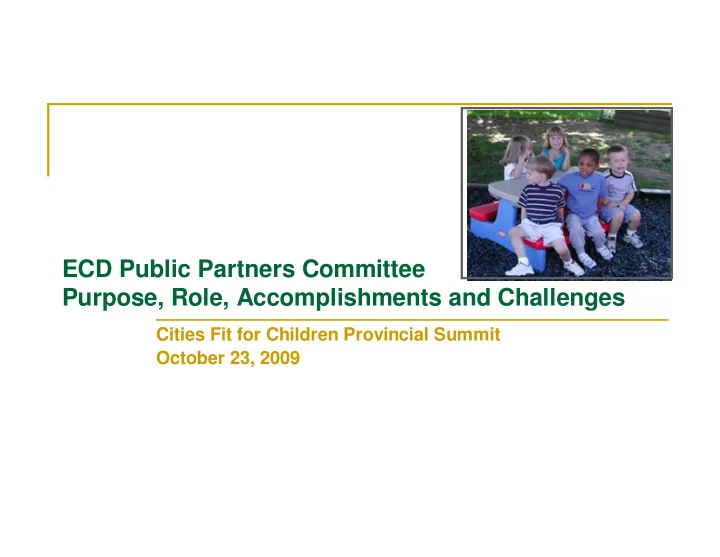
ECD Public Partners Committee Purpose, Role, Accomplishments and Challenges

slide-2
SLIDE 2

Outline of Presentation

This presentation will address the following areas:

  • New Westminster – Context
  • ECD Committee
  • Public Partners Committee

Purpose Membership and Structure Accomplishments Challenges

  • Questions
slide-3
SLIDE 3

New Westminster – Context

  • The City is centrally located within Metro Vancouver.
  • The City has a population of about 64,000 people.
  • The City is comprised of five sub-areas;

however, for the purposes of hub development; the Uptown and Downtown have been combined.

  • There were 3,455 children aged 0 to 5

years in 2006, which represented about 5.9% of the total population.

slide-4
SLIDE 4

ECD Committee – Beginnings

  • March 2003:

The Children’s First initiative was introduced to service providers, which acted as the impetus for an integrated service delivery system.

  • September 2003:

A consultant was hired to develop a five-year ECD Strategic Action Plan. An ECD Children’s First Committee was formed to improve outcomes for children/families based on the plan.

  • Spring 2004:

Start of plan implementation.

slide-5
SLIDE 5

ECD Committee – Purpose

  • The ECD Committee emerged from the ECD

Children’s First Committee.

  • The committee is comprised of service

providers serving the 0-6 population, civic and government representatives, parents and interested community members.

  • The committee meets monthly to exchange

information, endorse recommendations of its eight action teams, and to make decisions regarding funding allocations.

slide-6
SLIDE 6

Public Partners – Beginnings

  • February 2007:

Public Partners meet for the first time facilitating management level decision- making among the stakeholder

  • rganizations.
  • December 2007:

Public Partners signed off on a Memorandum of Understanding.

slide-7
SLIDE 7

Public Partners – Purpose

  • Coordinate the planning of member
  • rganizations to meet the identified needs

and opportunities of the community as related to ECD hub development.

  • Identify and access funding and other

resources.

  • Support and advocate on behalf of the

development of ECD hubs.

  • Play a facilitative role with the ECD

Committee, its Action Teams and others, as required.

  • Provide support, advice,

recommendations, feedback, and expertise to the MCFD ECD Community Development Worker.

  • Consider any other purposes as identified

by the community.

slide-8
SLIDE 8

Public Partners – Hub Development

The primary purpose of the Public Partners is to facilitate ECD Hub Development:

  • ECD hubs support the healthy development of young children and their families;

and include at least two early childhood development or family strengthening services, one of which is licensed child care.

  • ECD hubs act as focal points for their neighbourhoods and enable families to
  • btain information and seamlessly access a continuum of services related to their

needs.

  • ECD hubs have been proven to enhance child outcomes, including school

readiness and success. They also facilitate inter-sectoral collaboration and partnership building.

slide-9
SLIDE 9

Public Partners – Membership

The Public Partners include:

  • City of New Westminster (Parks, Culture and

Recreation and Social Planning)

  • Fraser Health (Health Promotion and Prevention)
  • MCFD
  • School District #40
  • United Way of the Lower Mainland

Staff from each of the partnering

  • rganizations are at a senior level and

have the authority to influence or make positive change within their organizations.

slide-10
SLIDE 10

Public Partners – Organizational Structure

slide-11
SLIDE 11

ECD Accomplishments

Planning for two of the four hubs is well underway.

  • Needs assessments have been completed for Queensborough and the

Uptown/Downtown.

  • Action teams have been established to conduct more detailed planning and to

advocate on behalf of hub development.

  • Public Partners are working to identify opportunities, realize funding and solidify

support within their respective organizations.

slide-12
SLIDE 12

The Queensborough Experience

  • Action team recommended that a

preliminary concept plan be developed at the Queensborough Community Centre.

  • Given that the centre was slated for a $6.2

million expansion, there was an

  • pportunity to accommodate a hub at this

location.

  • A compelling case was made for the

incorporation of a hub. It highlighted the benefits to the community, both social and economic, and the fact that a hub would address the high childhood vulnerability levels.

  • In October 2008, City Council endorsed

the preliminary concept plan for the hub.

slide-13
SLIDE 13

The Queensborough Experience

Vulnerability by Neighbourhood as Measured by the EDI – Waves 1 and 2:

  • Increase from 45.2% (Wave 1) to 48.5% (Wave 2) for the Queensborough

neighbourhood.

  • Next highest neighbourhood in terms of vulnerability is 36.5%; lowest is 18.4%.
slide-14
SLIDE 14

The Queensborough Experience

As outlined in the preliminary concept plan, the hub would:

  • comprise over 10,000 square feet on two levels;
  • incorporate close to 60 licensed child care spaces;
  • accommodate a range of early childhood development and family strengthening

services;

  • provide both dedicated and multipurpose spaces.
slide-15
SLIDE 15

The Queensborough Experience

slide-16
SLIDE 16

The Queensborough Experience

To date, the Public Partners have made the following contributions:

  • The two studies and the preliminary concept plan was funded by MCFD.

Depending on the timing of a hub, there may also be capital dollars available through MCFD.

  • The ongoing work of the ECD Committee and Public Partners which is being

funded by the United Way of the Lower Mainland.

  • The recent opening of a StrongStart Centre and 20 school age care spaces at

the local elementary school by the School District. These initiatives contribute to and build a strong foundation for a hub.

  • The willingness of Fraser Health to consider providing services targeting the

needs of parents and young children in Queensborough.

The City is also playing an important role by considering the incorporation of a hub as

part of the expansion to the community centre.

slide-17
SLIDE 17

The Uptown/Downtown Experience

  • Action team has completed needs assessment and is having to deal with

the challenge of no obvious location for a hub.

  • The area in question has two distinct population and commercial nodes and

is separated by a steep hill. Additionally, the Uptown is far more populated than the Downtown but the latter is designated as a future growth concentration area.

  • A possible opportunity involves the development of three new schools. The

City and School District, through the Province’s ‘Neighbourhoods of Learning Project,’ have submitted a proposal which calls for an ECD hub as part of the new middle school on the John Robson site.

  • Again, this demonstrates the importance of documenting needs and

identifying possible opportunities, as well as collectively working to capitalize on opportunities.

slide-18
SLIDE 18

Other Benefits of Collaboration

Other benefits derived through partnership and enhanced collaboration include:

  • City of New Westminster / School District #40

Child Care Protocol

  • New Westminster Community Schools Partners

Committee

  • New Youth Centre – inclusion of a range of

health, leisure and social services

slide-19
SLIDE 19

Challenges

  • Building Relationships and Trust
  • Defining Roles
  • Communicating Clearly
slide-20
SLIDE 20

Questions