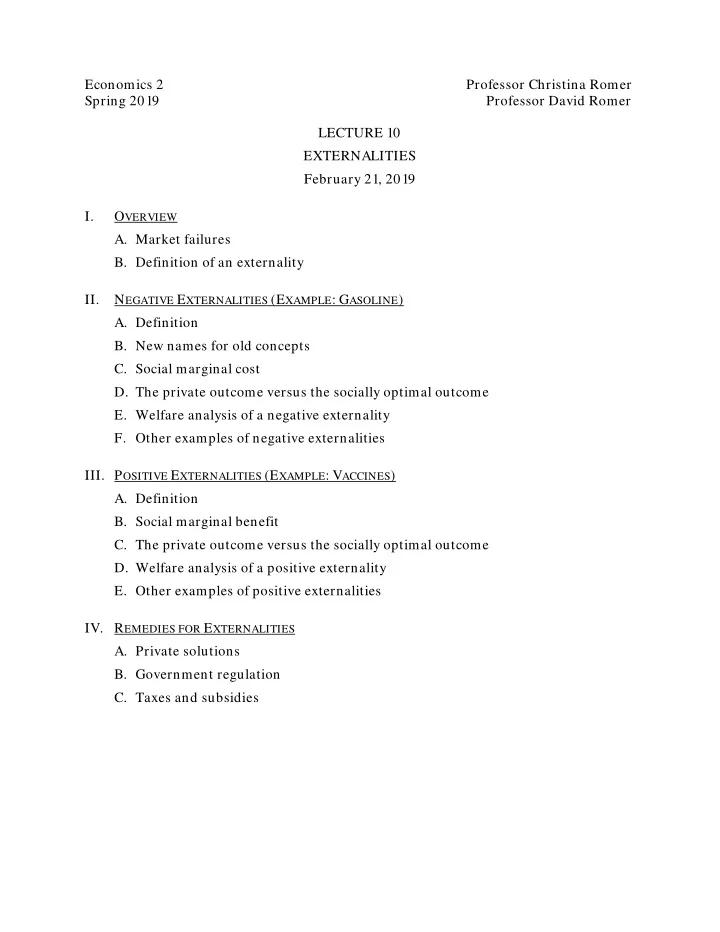
SLIDE 1 Economics 2 Professor Christina Romer Spring 2019 Professor David Romer LECTURE 10 EXTERNALITIES February 21, 2019 I. OVERVIEW
- A. Market failures
- B. Definition of an externality
- II. NEGATIVE EXTERNALITIES (EXAMPLE: GASOLINE)
- A. Definition
- B. New names for old concepts
- C. Social marginal cost
- D. The private outcome versus the socially optimal outcome
- E. Welfare analysis of a negative externality
- F. Other examples of negative externalities
- III. POSITIVE EXTERNALITIES (EXAMPLE: VACCINES)
- A. Definition
- B. Social marginal benefit
- C. The private outcome versus the socially optimal outcome
- D. Welfare analysis of a positive externality
- E. Other examples of positive externalities
- IV. REMEDIES FOR EXTERNALITIES
- A. Private solutions
- B. Government regulation
- C. Taxes and subsidies
SLIDE 2 LECTURE 10
Externalities
February 21, 2019
Economics 2 Christina Romer Spring 2019 David Romer
SLIDE 3 Announcements
- Midterm 1 Logistics:
- If your GSI is Todd Messer (Sections 101 and
102) go to 60 Barrows.
- If your GSI is Priscila de Oliveira (sections 103
and 104) go to 3108 Etcheverry.
- If your GSI is Vitaliia Yaremko (Sections 111
and 114) go to 170 Barrows.
- Everyone else come to usual room (2050
VLSB).
SLIDE 4 Announcements
- DSP Students:
- You should have received an email from the
head GSI (Todd Messer) about
- arrangements. If you haven’t, please
contact him (messertodd@berkeley.edu).
- Review Session:
- Friday, February 22, 6 – 8 p.m. in 2050 VLSB.
SLIDE 6 Market Failure
- When markets do not work well; there is some
defect.
- First example was monopoly—a profound lack of
competition.
SLIDE 7 Externality
- An effect related to the production or
consumption of a good that falls on people who are not the producers or consumers.
SLIDE 8
- II. NEGATIVE EXTERNALITIES
SLIDE 9 Atmospheric CO2 Concentration
Source: National Oceanic and Atmospheric Administration.
SLIDE 10 U.S. Carbon Dioxide Emissions, By Source
Source: Environmental Protection Agency.
SLIDE 11 Negative Externality
- The effects on those outside the market are bad.
- There is an external cost.
- Negative externalities can result from either the
consumption or the production of a good (or both).
SLIDE 12
D1,MB1 Q P S1,MC1 P1 Q1
Market for Gasoline
SLIDE 13 Some Terminology
- “Private” refers to people participating in the
market (the buyers and sellers).
- “Social” includes effects on people both in the
market and outside the market.
SLIDE 14
D1,PMB1 Q P S1,PMC1 P1 Q1
Review of Welfare Analysis
PMC is the private marginal cost; PMB is the private marginal benefit.
Total Private Surplus
SLIDE 15 Total Private Surplus
- Sum of consumer surplus and producer surplus.
- It is the area between the PMB and PMC, up to
the level produced and consumed.
SLIDE 16 More Terminology
- External Marginal Cost: The additional cost to
people outside the market when one more unit is produced and consumed.
- Social Marginal Cost: Private marginal cost plus
external marginal cost.
SLIDE 17
Negative Externality (Market for Gasoline)
D1,PMB1,SMB1 Q P S1,PMC1 Q1 SMC1 Q* External MC
SLIDE 18 Total Social Surplus
- Total private surplus plus external benefits minus
external costs.
- It includes the welfare of both people in the
market and outside the market.
SLIDE 19 Welfare Analysis of a Negative Externality
Q1 Q* Total Private Surplus a+b+c a+b External Costs −(b+c+d) −b Total Social Surplus a−d a Deadweight Loss d
a c b d
D1,PMB1,SMB1 Q P
Q*
SMC1
Q1
External MC S1,PMC1
SLIDE 20 When is the total social surplus as large as possible?
- The total social surplus is largest at the quantity
where SMB=SMC.
- Why is this the case?
- Any shortfall from the largest total social surplus is
the deadweight loss.
SLIDE 21 Some Points about the Welfare Analysis of a Negative Externality
- The total social surplus includes the people in the
market.
- The total social surplus typically isn’t maximized at
very low levels of production and consumption.
- When there is no externality, SMB and PMB are
the same, and SMC and PMC are the same.
- The market produces where PMB=PMC,
which is the same as where SMB=SMC.
SLIDE 22 Other Examples of Negative Externalities?
- Second-hand smoke from cigarettes.
- Texting or drinking and driving.
- Pesticide runoff from farms.
- Noise related to a construction project.
SLIDE 23 Whenever There Is a Negative Externality:
- The SMC curve lies above the PMC curve.
- The people in the market will choose to produce
where PMC=PMB (or supply is equal to demand).
- But society would be better off if the market
produced and consumed less (where SMC=SMB).
SLIDE 24
- III. POSITIVE EXTERNALITIES
SLIDE 25 Positive Externality
- The effects on those outside the market are good.
- There is an external benefit.
- Positive externalities can result from either the
consumption or the production of a good (or both).
SLIDE 26 More Terminology
- External Marginal Benefit: The additional benefit
to people outside the market when one more unit is produced and consumed.
- Social Marginal Benefit: Private marginal benefit
plus external marginal benefit.
SLIDE 27
Positive Externality (Market for Vaccines)
Q* D1,PMB1 Q P S1,PMC1,SMC1 Q1 SMB1 External MB
SLIDE 28 Welfare Analysis of a Positive Externality
a c b d
D1,PMB1 Q P S1,PMC1,SMC1
Q* Q1
External MB SMB1
Q1 Q* Total Private Surplus a a-d External Benefits b b+c+d Total Social Surplus a+b a+b+c Deadweight Loss c
SLIDE 29 Other Examples of Positive Externalities?
- Technology spillovers.
- Education.
- Planting flowers in your yard.
SLIDE 30 Whenever There Is a Positive Externality:
- The SMB curve lies above the PMB curve.
- The people in the market will choose to produce
where PMC=PMB (or supply is equal to demand).
- But society would be better off if the market
produced and consumed more (where SMC=SMB).
SLIDE 31
- IV. REMEDIES FOR EXTERNALITIES
SLIDE 32 Remedies for Externalities
- Private Solutions:
- Negotiation and compensation.
- Social sanctions.
- Government Regulation
- Taxes and Subsidies
SLIDE 33
Remedy for a Negative Externality (Tax)
D1,PMB1,SMB1 Q P S1,PMC1 Q1 SMC1,S2 Q* External MC, Tax Q2
SLIDE 34
Remedy for a Positive Externality (Subsidy)
Q* D1,PMB1 Q P S1,PMC1,SMC1 Q1 SMB1,D2 External MB, Subsidy Q2