Edgbaston Metro Extension City Centre Neighbourhood Forum 9 th - - PowerPoint PPT Presentation

edgbaston metro extension
SMART_READER_LITE
LIVE PREVIEW

Edgbaston Metro Extension City Centre Neighbourhood Forum 9 th - - PowerPoint PPT Presentation

Edgbaston Metro Extension City Centre Neighbourhood Forum 9 th February 2019 Introduction Presentation topics: The End Goal Update on progress Utility diversions Canal bridge Proposed construction strategy Gas and


slide-1
SLIDE 1

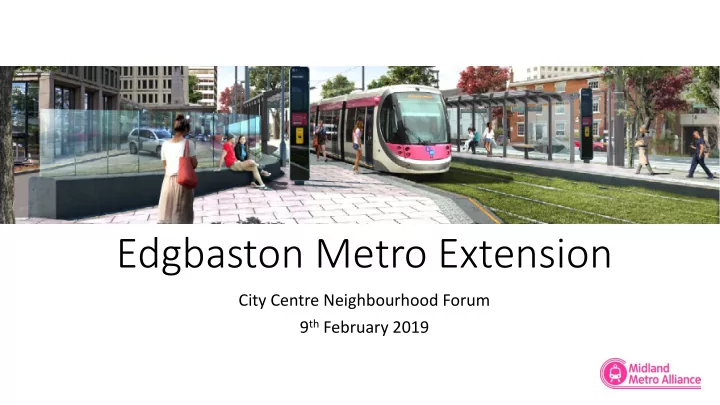
Edgbaston Metro Extension

City Centre Neighbourhood Forum 9th February 2019
slide-2
SLIDE 2

Introduction

  • Presentation topics:
  • The End Goal
  • Update on progress
  • Utility diversions
  • Canal bridge
  • Proposed construction strategy
  • Gas and Berkley Street reversal
slide-3
SLIDE 3

The End Goal

The Project in Numbers:

1.35km track along Broad Street 3 new stops at Brindley place, Five Ways and the terminus 3 significant road junctions 5 interfacing construction projects 60 buses an hour 20 pubs/ bars/clubs 5 restaurants 1 national arena 1 international convention centre/ symphony hall 7 hotels Edgbaston to New Street station in approx. 8 mins Edgbaston to HS2 or Snow Hill in approx. 12 mins

slide-4
SLIDE 4

The End Goal

Why? To improve the quality of life of the public by making their lives easier and more enjoyable. Encouraging development and regeneration. How? By providing a reliable, intuitive and efficient tram route to/from the west of Birmingham city centre, that seamlessly and sustainably connects with other modes and improves the urban environment. Strategic Benefits

  • Supporting economic and population growth by linking

‘jobs and people’ and ‘products and markets’

  • Reduce the environmental impacts from transport
  • Improve people’s health through the encouragement
  • f more active lifestyles
  • Raise the standard of living by improving access to

leisure and essential services

  • Improving national and regional links to boost the

West Midlands’ economy

  • Maximising the benefits of HS2
  • Improving the accessibility and connectivity of the re-

developed New Street station Local Benefits

  • Improving local air quality by reducing emissions
  • Reducing noise levels by reducing number of vehicles
  • Connect direct with existing Birmingham train stations and future

HS2 stop as well as local bus services and Digbeth Coach Station

  • Enhance attractiveness of environment by renewing the urban

realm from wall to wall and significantly increasing the width of footways

  • Improving safety of the public
  • Encouraging development e.g. New Garden Square, Broadway,

Left Bank etc

  • Deepen labour pools by providing better access
  • Reducing congestion and challenging the car culture in the City

Key Features

  • Edgbaston to New St Station in approx. 8 mins
  • Edgbaston to HS2 or Snow Hill in approx. 12 mins
  • Trams every 6 minutes with a capacity of 210 people
  • 1.35km of new twin track
  • 3 Metro stops (Brindleyplace, Five Ways and the terminus)

plus 2 already in construction (Centenary Square and Town Hall)

slide-5
SLIDE 5

Current High Level Dates

  • Now – Summer 2019

Advanced works

  • Spring 2019 - Autumn 2020

Main works

  • Autumn 2020 – Autumn 2021

Urban realm/Systems installation

  • Autumn 2021 – December 2021

Testing and commissioning

  • December 2021

Operational

slide-6
SLIDE 6

Update on Progress – Utility Diversions

slide-7
SLIDE 7

Broad Street Canal Bridge

slide-8
SLIDE 8

Broad Street Canal Bridge

Structure 1 Form - Masonry arch Ownership – CRT Current loading – Full highway Future loading – Full highway (inc. tram and accidental tram) Structure 2 Form – Concrete reinforced masonry arch Ownership – CRT Current loading – Full highway Future loading – Full highway (inc. tram and accidental tram Structure 3 Form – Metallic girder and concrete jack arch Ownership – BCC Current loading – Above structures Future loading - Above structures Reason for strengthening: Structure 1 needs to meet requirements for highway loading including future tram loading

slide-9
SLIDE 9

Photos

Structure 2 Structure 1 Structure 3

slide-10
SLIDE 10

The Challenge

  • Constrained site
  • Multiple affected parties i.e. BCC, TfWM, CRT, property owners
  • Budget
  • Constructability
  • Buried services
  • Stakeholder impact
  • Minimal depth to extrados
  • Listed buildings
  • No reduction in headroom
slide-11
SLIDE 11

MARS System

slide-12
SLIDE 12

MARS Schedule

slide-13
SLIDE 13

Photos

slide-14
SLIDE 14

Proposed Strategy - Lessons Learned

Junction with Broad, Sheepcote and Granville Street suffered delays due to volume of traffic, multiple/conflicting traffic movements and unclear authorised vehicles. Marshall control and traffic signals struggled to maintain flow. Junction with Berkley and Broad Street caused long queues on Berkley Street due to give way arrangement and parked

  • cars. This led to detracting visitors.

Lack of clear and suitable drop off, loading/unloading points deterred visitors. Complex give way junction at Holliday/Gas/Berkley Street prevented ease of access/egress from Broad Street Introduction of temporary signals at Bishopsgate Street junction as well as measures along Broad Street clogged Broad Street and restricted flow. Exiting Brindleyplace traffic causes congestion at Sheepcote/Broad Street junction

slide-15
SLIDE 15

Construction Strategy Principles

(based on lessons learned)

Strategy Principles:

  • Full width site setups whilst maintaining pedestrian access

and sufficient footway widths

  • Plan timings of site setups to reduce impact on peak

business periods

  • Localised advanced works targeted ahead of main work

e.g. utilities, deep drainage, site clearance, highway alterations Traffic Management Principles:

  • Improve wider vehicular network ahead of main works i.e.

Bath Row and Sheepcote Street measures

  • Improve local network ahead of main works i.e. reversal of

Gas and Berkley Street and junction with Holliday Street

  • Simplify traffic movements and where possible avoid

multiple temporary traffic signals Reasons:

  • 5 traffic management phases vs 10-12 using half width

setups meaning less change for pedestrians and vehicles

  • Reduction of overall schedule by minimum 6 months, more

likely to be 12 months

  • Less risk of schedule slipping
  • Prevents multiple conflicting traffic movements and reliance
  • n give way
  • Improved rotational traffic flow
  • Provides ability to provide dedicated drop off areas
  • Improved safety of public and workforce
  • Insufficient width to accommodate single lane carriageway

and construction works

  • To occupy areas only once and for shorter durations
  • Easier to market and provide way-finding information
slide-16
SLIDE 16

The Phases…….

  • Current main works phasing, TBC 20th February
  • Phase 1 – April 2019 to Mid-September 2019 (Fresher’s Week)
  • Phase 2 – Mid-September 2019 to End 2019
  • Phase 3 – January 2020 to August 2020
  • Phase 4 – August 2020 to December 2021. Predominantly off highway

including paving works, testing and commissioning, tram testing, driver training

slide-17
SLIDE 17

Gas and Berkley Street Reversal

Wider proposed traffic management……

slide-18
SLIDE 18

Thanks for listening……..