SLIDE 1
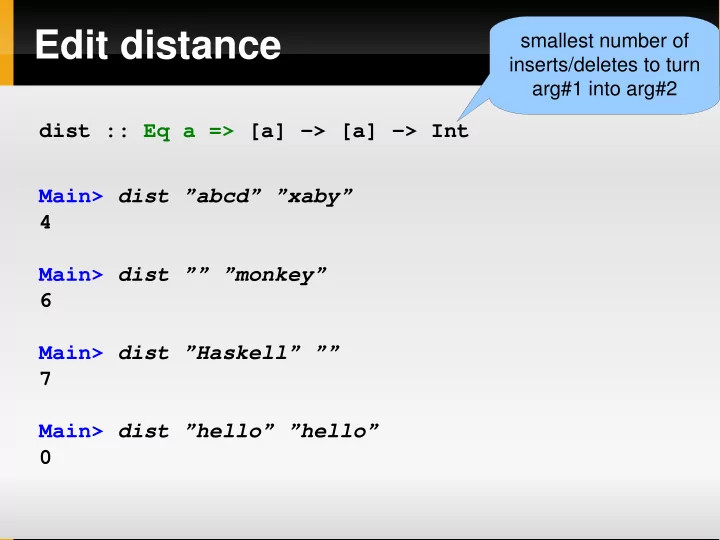
7 Main> dist ”abcd” ”xaby” Main> dist ”” ”monkey” Main> dist ”Haskell” ”” Main> dist ”hello” ”hello”
Edit distance
dist :: Eq a => [a] -> [a] -> Int 4 6
smallest number of inserts/deletes to turn arg#1 into arg#2
SLIDE 2
Edit distance implementation
dist :: Eq a => [a] -> [a] -> Int dist [] ys = length ys dist xs [] = length xs dist (x:xs) (y:ys) | x == y = dist xs ys | otherwise = (1 + dist (x:xs) ys) `min` (1 + dist xs (y:ys))
either insert y or delete x two recursive calls: exponential time challenge #0: implement a polynomial time version
SLIDE 3 How to test? -- ”Test Oracle”
Formal specification Executable Efficient (polynomial time)
think QuickCheck challenge #1: find an practical way to test your implementation! comparing against naive dist is no good...
SLIDE 5
An efficient dist
dist :: Eq a => [a] -> [a] -> Int dist xs ys = head (dists xs ys) dists :: Eq a => [a] -> [a] -> [Int] dists [] ys = [n,n-1..0] where n = length ys dists (x:xs) ys = line x ys (dists xs ys) line :: Eq a => a -> [a] -> [Int] -> [Int] line x [] [d] = [d+1] line x (y:ys) (d:ds) | x == y = head ds : ds' | otherwise = (1+(d`min`head ds')) : ds' where ds' = line x ys ds
dynamic programming testing upper-bound: easy, lower-bound: hard
SLIDE 6
Naive dist
dist :: Eq a => [a] -> [a] -> Int dist [] ys = length ys dist xs [] = length xs dist (x:xs) (y:ys) | x == y = dist xs ys dist (x:xs) (y:ys) | otherwise = (1 + dist (x:xs) ys) `min` (1 + dist xs (y:ys))
base case #1 step case #2 base case #2 step case #1
SLIDE 7
”Inductive Testing”
prop_BaseXs (ys :: String) = dist [] ys == length ys prop_BaseYs (xs :: String) = dist xs [] == length xs prop_StepSame x xs (ys :: String) = dist (x:xs) (x:ys) == dist xs ys prop_StepDiff x y xs (ys :: String) = x /= y ==> dist (x:xs) (y:ys) == (1 + dist (x:xs) ys) `min` (1 + dist xs (y:ys))
specialization
SLIDE 8 (Alternative)
distFix :: Eq a => ([a] -> [a] -> Int)
distFix f [] ys = length ys distFix f xs [] = length xs distFix f (x:xs) (y:ys) | x == y = f xs ys | otherwise = (1 + f (x:xs) ys) `min` (1 + f xs (y:ys)) prop_Dist xs (ys :: String) = dist xs ys == distFix dist xs ys
no recursion
SLIDE 9 What is happening?
bugs
SLIDE 10 Applications
Search algorithms
SAT-solvers other kinds of solvers
Optimization algorithms
LP-solvers (edit distance)
Symbolic algorithms?
substitution, unification, anti-unification, ...