Education and the Just Society: What Does Platos Republic Tell - - PDF document

education and the just society
SMART_READER_LITE
LIVE PREVIEW

Education and the Just Society: What Does Platos Republic Tell - - PDF document

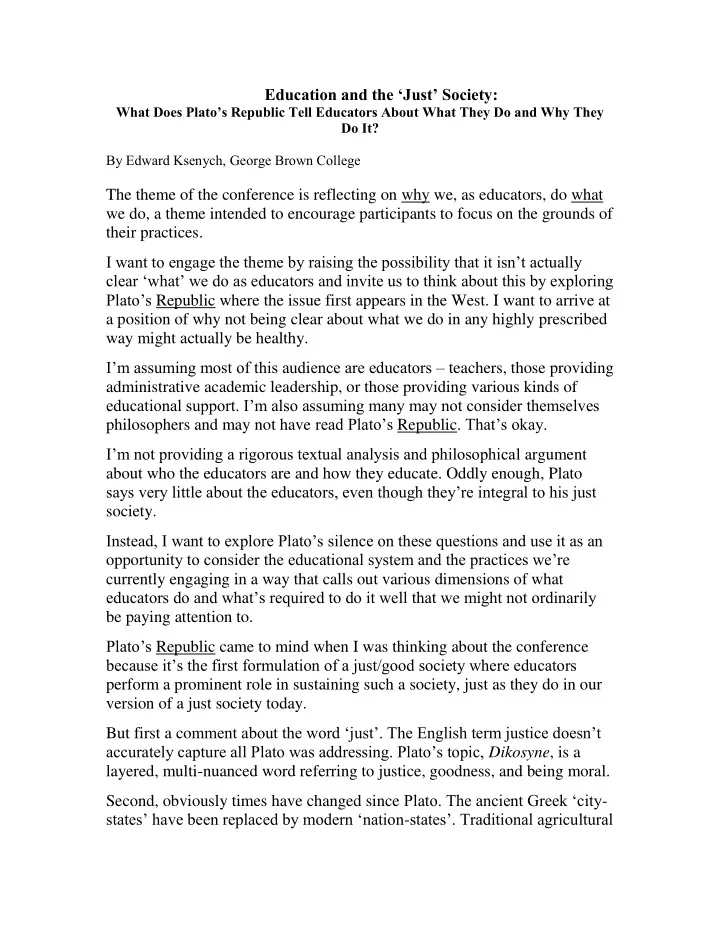
Education and the Just Society: What Does Platos Republic Tell Educators About What They Do and Why They Do It? By Edward Ksenych, George Brown College The theme of the conference is reflecting on why we, as educators, do what we do, a


slide-1
SLIDE 1

Education and the ‘Just’ Society:

What Does Plato’s Republic Tell Educators About What They Do and Why They Do It? By Edward Ksenych, George Brown College

The theme of the conference is reflecting on why we, as educators, do what we do, a theme intended to encourage participants to focus on the grounds of their practices. I want to engage the theme by raising the possibility that it isn’t actually clear ‘what’ we do as educators and invite us to think about this by exploring Plato’s Republic where the issue first appears in the West. I want to arrive at a position of why not being clear about what we do in any highly prescribed way might actually be healthy. I’m assuming most of this audience are educators – teachers, those providing administrative academic leadership, or those providing various kinds of educational support. I’m also assuming many may not consider themselves philosophers and may not have read Plato’s Republic. That’s okay. I’m not providing a rigorous textual analysis and philosophical argument about who the educators are and how they educate. Oddly enough, Plato says very little about the educators, even though they’re integral to his just society. Instead, I want to explore Plato’s silence on these questions and use it as an

  • pportunity to consider the educational system and the practices we’re

currently engaging in a way that calls out various dimensions of what educators do and what’s required to do it well that we might not ordinarily be paying attention to. Plato’s Republic came to mind when I was thinking about the conference because it’s the first formulation of a just/good society where educators perform a prominent role in sustaining such a society, just as they do in our version of a just society today. But first a comment about the word ‘just’. The English term justice doesn’t accurately capture all Plato was addressing. Plato’s topic, Dikosyne, is a layered, multi-nuanced word referring to justice, goodness, and being moral. Second, obviously times have changed since Plato. The ancient Greek ‘city- states’ have been replaced by modern ‘nation-states’. Traditional agricultural

slide-2
SLIDE 2

and trading economies based on some form of slave labour have been superseded by an expanding capitalist market system based on different forms of exploitation. Ideas about what or who humans are as well as principles for living together have also altered. The traditional idea of living an honourable, virtuous life in terms of one’s social roles and functions has been superseded with a person living a successful life. Our current world has also been shaped by ideas of natural inalienable human rights and more expansive ideas of citizenship than Plato knew. But I’m going to propose that a nation-state still affirms some position on what a good society is, and some position on living a good life which brings about happiness, as Plato did. And many of the social, economic and political issues Plato was contending with are also pertinent. Issues like relativism and its tendency to slide into nihilism, the rise of commercialism, democracy as a possible form of political organization, and an increasing faith in new techniques and technologies as an indispensable means to living the good life. One site where all of this appeared in ancient Athens was in education itself. Higher education was indispensable for participating as a citizen and performing one’s social function. And it was mainly in the hands of sophists,

  • r wisdom experts, who would teach the skills and knowledge to be

successful to anyone who could afford it. While there was variation among sophists like Protagoras (who was one of Socrates’ teachers) or Thrasymachus, all were skilled in rhetoric, interested in power, status and wealth as measures of success, and interested in applying new ideas and techniques for becoming successful – like relativism, the calculated effects

  • f persuasive speech, and the separation between human law and natural

law, as well as fact and value. One other historical comment. In the Greek cosmos in which Socrates and Plato were embedded, everything had a role, function or activity to perform which it did alone, or did best. And the ability to do that work/activity excellently required developing and properly exercising a particular innate capacity, quality or virtue. This also applied to people in human society. So

  • ne might ask what the function or role of, say, the farmer or activity of

farming is, and what inherent virtues need to be developed and exercised to farm excellently. Given the educator’s role in the Republic we might expect Plato would have a lot to say about them. But we find the opposite. Plato is silent about who

slide-3
SLIDE 3

they are and what they do… except for having Socrates provide a very detailed description and discussion of the curriculum for training those who guard the state, and those who govern it. So what does he tell us in the Republic? Here’s a very brief, selective

  • verview of the dialogue for those unfamiliar with it.

a) At the start Plato has his principal character Socrates discussing conventional ideas about ‘justice’ with a couple of young men, including ideas advanced by an aggressive sophist, and finds them flawed. So they set

  • ut to investigate the nature of justice. They eventually find that justice is

part of something greater - the Good. But Socrates refrains from trying to know the Good because it raises a prior issue – the nature of knowing and its entwinement with the nature of reality. b) Regarding the just society, Socrates proposes it should be organized around a cooperative division of labour where people are guided into doing what they’re ‘naturally’ able and inclined to do, and given further training and education. c) The society itself is comprised of three main functional, somewhat hierarchical, ‘sectors’ – not ‘classes’ in our sense of working, middle, or upper class because Plato abolishes the idea of private property on which classes become based. The three sectors are: 1) farmers, artisans/craftspeople whose purpose was to be productive, and Guardians, which are further divided into 2) auxillaries whose purpose was to guard and defend the society; and 3) ‘rulers’ along with a philosopher king, whose purpose was to govern. Since women were to be afforded the same education as men and could participate in ruling, I’m not sure how we end up with a society headed by a singular ‘philosopher king’ by the end of the story. d) Organizing society this way would lead to a ‘luxurious’ society. But such luxury would present problems associated with wealth: temptations to internal corruption, a tendency for citizens to overindulge, and the external problem of dealing with those who’d envy and want to invade the society. e) All guardians would have to undergo a primary education consisting of literature and theology, dramatic recitation, music, poetry, and physical

  • training. Developing rulers and an appropriate ‘philosopher-king’ would

require educating selected guardians in arithmetic, geometry, solid geometry, astronomy, harmonics, and the study of dialectic.

slide-4
SLIDE 4

f) Plato presents some occupational groups as posing problems, namely poets and artists. While poetry, literature, and other arts were important parts

  • f the curriculum, there was a conflict between artists and philosophers that

would require banishing poets from society. And he doesn’t mention some groups that existed in the city-states of his time at all – notably, slaves. Finally, there are groups he doesn’t say much about – educators, even though they seem to be practically in charge of having the entire system be able to run. Given all this, there seems to be an obvious answer to what educators do: they prepare people for a just/good society by ensuring they develop and exercise their inherent abilities and interests so that they can do what they’re supposed to do in an excellent way. This is sort of what our senior administrators tell us we’re doing at our colleges today. But I want to point out some puzzling things Plato either says, or mostly doesn’t say, about educators. a) Who ‘educates’ the productive classes? Cornford, translator of a popular version of the Republic, says the productive sector would also need some kind of primary education beyond training in the art and science of their craft or profession. Otherwise, how would we know who should be trained and educated as a Guardian? But Plato doesn’t actually say this. b) Then there are the educators. Who are they? Where are they located? Are they producers, auxillaries, rulers? Some combination? Why are they without a clear place, like poets/artists and slaves? And why, by contrast, does he spend so much time on curriculum? c) And what exactly are educators doing when they educate? Are they practicing an art and applied science of their own (a techne)? Are they practicing some body of disinterested knowledge aimed at explanation and understanding (an episteme) as they educate? Or are they exemplifying a highly theoretical grasp of their activity and other subjects in terms of essential definitions (a dianoia) and a revelatory apprehension of education (a noesis)? I mention these because they’re all different levels of knowing and doing that Plato presents in his discussion of the just society. d) And how do educators do any of these best? What virtues need to be cultivated in order to perform their role or function in an excellent way?

slide-5
SLIDE 5

It seems our modern society has improved on the Republic. Education also plays a prominent role in our version of the just society. Only we provide educators with lots of research, theories, and practical advice, often institutionalized into policies at governmental or institutional levels, like teaching by objectives, learning outcomes, or rationalized curriculum

  • planning. And these are supplemented with resources like educational

journals, conferences, PD activities, instructional strategies and techniques that prescribe how to do what we do. But not Plato, at least not in the Republic. We can, and many do, speculate that Plato is providing answers ‘indirectly’ to these questions through what his characters say and do in their

  • discussions. Many consider Socrates, Plato’s key character, to be the

exemplary educator. One step removed, we can also consider what Plato himself is saying and doing about educating and educators in how he sets up and executes the overall dialogue. Like figuring out what Shakespeare thought about some topic through reading a play in which that topic is present. But this is tricky. Plato’s dialogue is steeped in irony. Irony, the play of differences or opposites in constituting the multi-layered meaning and significance of things. Now a prevalent view that I, in part, agree with, is that Plato has Socrates showing us one form of what educators should be doing: teaching the art and science of asking good questions and providing good answers in a process of inquiry that moves from thesis to anti-thesis to synthesis up a ladder of knowing until we arrive at an understanding of the topic we’re investigating. Isn’t this what Plato has Socrates doing in the dialogue? Socrates certainly asks a lot of questions. But Plato also has him doing conversational battle with a sophist, comforting his main young interlocutors when they get anxious, spinning myths and stories, and spending a lot of time just presenting ideas that don’t come from his ‘students’ at all, ideas the students basically go along with in a rather passive way. Moreover, if Socrates is Plato’s exemplary educator practicing the Socratic method, then Socrates uses this process to arrive at the peculiar position of ridding the just society of artists, poets and dramatists after having provided all sorts of beautiful myths, memorable parables, and dramatic stories

  • himself. Ironically, if Plato, or his character Socrates, are exemplifying

anything as educators it’s that educators are very skilled story-tellers when

slide-6
SLIDE 6

they do their work excellently. Or is Plato telling us that educators need to know when and how to practice irony? Are there other characteristics we can identify that Plato might be implicitly

  • r demonstrably recommending given what he wrote and how? I think so.

First, Socrates presents educating as a public, collaborative activity rather than a competitive one occurring in private settings (like that practiced by the sophists). Collaborative on many levels. He moves between being quite caring with those who he’s educating to being firm and resistant, as he guides and shapes – like a potter. But shapes what? The interactions are dialogical, even when Socrates is outlining something in detail. The student

  • ften just listens, but is still called to demonstrate agreement. Or raise

concerns, object, seek clarification, or send the dialogue off in its next direction. Second, given Plato’s lengthy inquiry into ontology and epistemology it would seem the educator’s practice needs to be based on some kind of understanding of what is ‘more real’ and ‘less real’. Educators, like the guardians, need to be exposed to some kind of theory of reality and knowledge that will enable them to understand the nature of what is (i.e.,

  • ntology) and what humans can know about what is (i.e., epistemology).

Otherwise, how could they, as educators, recognize what’s merely an image

  • f learning, and what may appear as parroting or be a crude offering that

nevertheless provides material for a student’s further development. Third, the content and interactions in the dialogue indicate the educator is contending with and engaging, not only the external behaviours and talk of the student, but something internal – the student’s ‘soul’, based on some theory of what this might mean. Perhaps not the conventional religious ideas

  • f a soul we’ve been accustomed to, but a humanistic one where the conduct
  • f students isn’t simply regarded as ‘behaviour’, but ‘action’ that express the

embodied condition of humans, their moral agency, and way of thinking –

  • r what is essential to being human.

Fourth, to be an educator is to be orienting to truth. Educators are not here to teach or maintain ‘bullshit’ – skills and knowledge orienting to standards

  • ther than truth. This includes building a good life and a just society on the

apparent ‘truth’ of relativism. Plato’s teacher, Socrates, had been a student of the sophist Protagoras. One

  • f Protagoras’ contributions was to demonstrate the significance of

relativism regarding customs, laws, religion, knowledge, and truth. Yet

slide-7
SLIDE 7

Plato’s approach to reality and knowledge is organized around orienting to an essential nature to something that we can know in some way. Relativism does call attention to a significant aspect of the human condition. But what to do with truth given relativism? Consider Stanley Rosen’s response to the view that ultimately everything is culturally and historically relative: “Everyday life is articulated by customs and beliefs that are in continuous historical transformation. But these transformations are exhibitions of the flexibility of human nature, not of its nonexistence. It’s with respect to what

  • rdinarily endures that we identify changes in custom and belief, for

example, as different ways of pursuing glory or enjoying the beautiful. If this weren’t so we couldn’t perceive changes as changes of a particular kind; in fact, we wouldn’t perceive that we were changing but only that we were responding spontaneously to the stimuli of existence.” (Rosen, 1999: 224) Fifth, the initial question remains. Why do educators have no clear location in Plato’s just society? Perhaps because educators should be indifferent to their location, or status, in society. Because what they do involves performing and caring for all three functions regardless of what part of the curriculum they’re teaching or whether they’re teaching producers, auxillaries, or rulers. But I think there’s more to this matter of social location. In the Republic, educators don’t so much ‘exist’ as ‘are’. Educators, in their ambiguous status, are constantly ‘un-predicated’ in Plato’s story. Of course, in actual life they exist and do actual things. Yet, Plato declines to provide explicit, concrete predicates as to what these are. They’re left hanging. They simply ‘are’. I propose this is because the educators are the keepers of the question of ‘being’ – as it concerns being human, being in the world, and the being of the world that we are a part of, and from which we are apart. In addition, the duty of exercising this should be prescribed and pre-scripted as little as

  • possible. Such pre-scripting primarily meets formal organizational needs or

requirements at an institutional level. But how does it meet what is needed and required in the concrete activity of educating? Moreover, any attempt at pre-scripting what educators do will, at some point, entail educators ignoring, challenging, or resisting such organizational projects as Plato’s

  • wn detailed curriculum.
slide-8
SLIDE 8

I don’t want to be occult about the question of ‘being’. It concerns wondering about what is, a moment when we are simultaneously filled with a recognition of the presence of something and an absence of knowing how it’s possible. We may experience ‘wonder’ over many things: how is it possible that humans landed on the moon and returned? Or that a computerized instrument the size of a toonie can connect me to everyone I want to be connected with. How is it possible that this earth is here with all the living and non-living things on it; or that we humans exist? In the first two questions the question of being is qualitatively different than in the last two. Such achievements and things are wondrous and we may marvel at them. But at some level we know the origin of their existence is the result of human work, know-how, raw materials, concepts, and theories about things. And we know, or believe we know, if we really want answers, they can be found – try Google. But I don’t think the answers to the last two questions can be responded to in quite the same way, though they could be rendered that way. How is it possible that a tree, a spider, the earth, humans, or the very materials out of which humans invent and fabricate things, are? A feature of living in this marvelous, and equally troubling or sometimes horrifying, modern age is that human fabrication has asserted and veneered itself over most of what is. The mystery of what we are embedded in, and

  • urselves, is often hidden from our everyday, practical, and even reflective,

view. This isn’t only a feature the modern educator must contend with. Ancient Athens was immersed in a similar situation. It was a large, thriving, constructed metropolis where diverse peoples lived. Their way of life was increasingly centred around the human origin and construction of the ‘world’ they lived in, and even of nature itself. Whatever we could be talking about – whether it was cold or warm outside, what’s beautiful, what counts as knowledge or truth, what’s of value, the matter of gods or god – humans were the measure of all that is, was and would be. And this ‘law’ of sorts was increasingly being used for the purpose of self-advancement, whether individually or collectively. The educator challenges this at the same time as she provides a way of humanly relating to it. But how to do it can’t be prescribed too much without being up against or dominating a virtue of the educator’s character – an ‘anarchistic’ impulse. An impulse that collaboratively exists within an

slide-9
SLIDE 9
  • therwise law-like environment required by our need to live together and

develop in the best possible way according to reasonable principles and rules – whether it’s the rules of the social world or perhaps even Plato’s

  • curriculum. By “anarchistic impulse” I don’t mean some unregulated desire

to destroy, like Freud’s death instinct, but an impulse to resist structures and systems that organize us because one feels he/she has lost touch with what she/he is supposedly there to affirm and enable. Sort of like what Socrates did.

SELECTED RESOURCES Plato, (Translated and introduced with notes by Francis MacDonald Cornford), The Republic of Plato, London: Oxford University Press, 1941. Rosen, Stanley, Metaphysics in Ordinary Language, New Haven: Yale University Press, 1999.

May 27, 2015